{10}: The Number of Wholeness and Return
‘The thief comes only to steal and kill and destroy; I have come that they may have life, and have it to the full.’—John 10:10

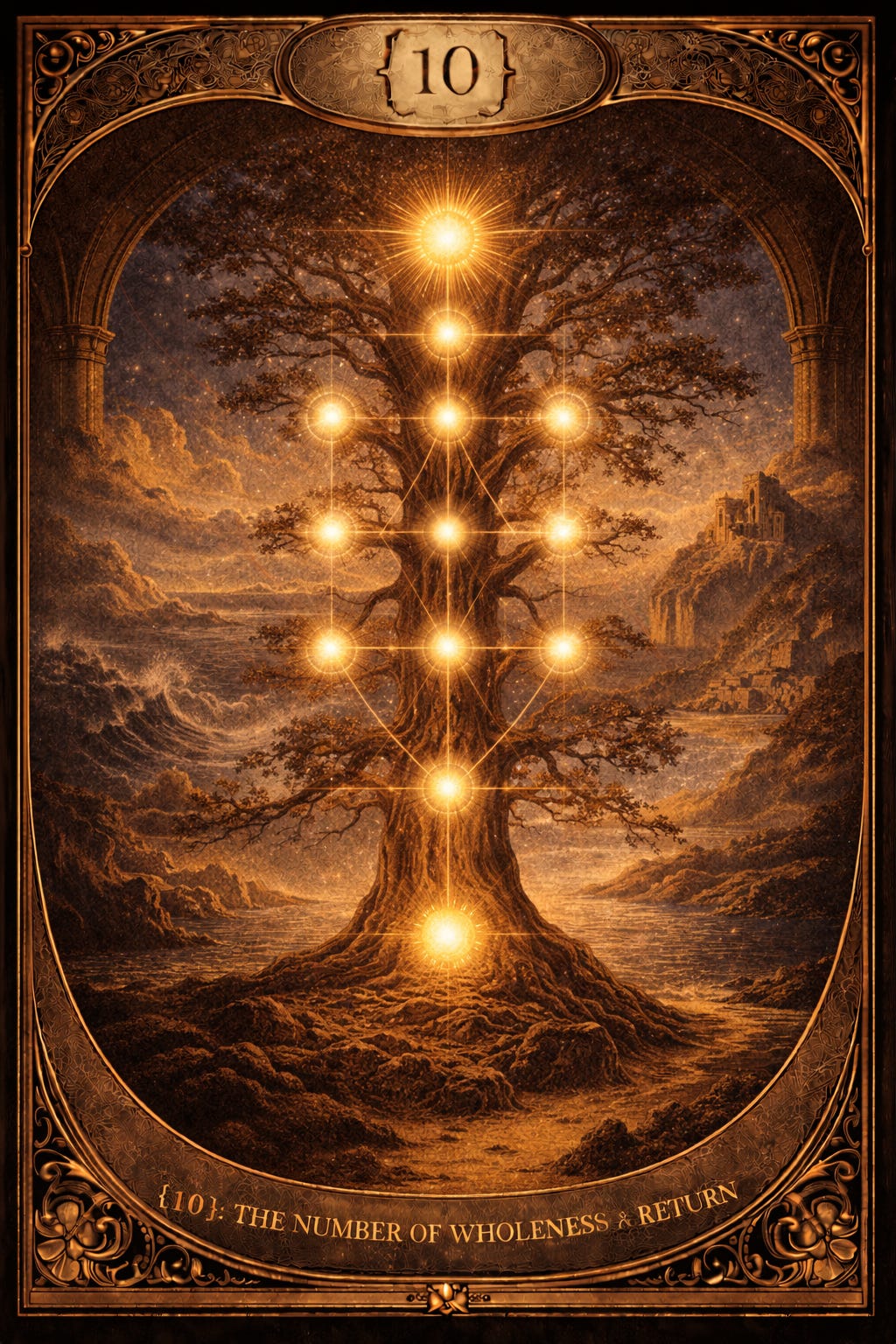
{10}: The Pure Path of the Decad
Calculation Board:



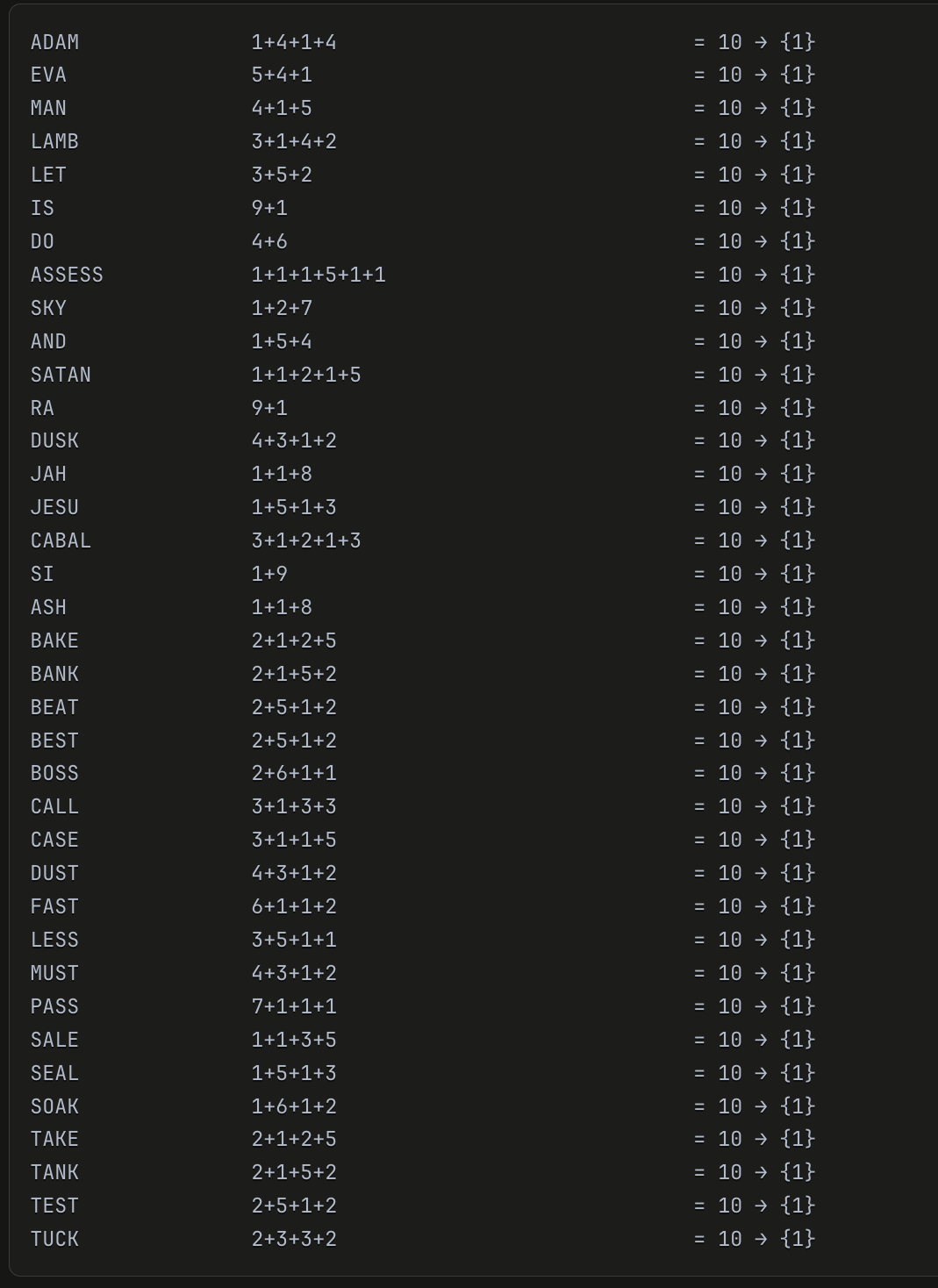

{10}: Full Journey|Return|Wholeness resolving to {1}: Initiation|Unity.
In the Pythagorean Tetractys, the number {10}, named the Decad, was considered the most sacred number because it contains the sum of the first {4} numbers: (1+2+3+4)={10}, and was believed to encompass the entire Cosmos.
In Hindu mythology, the Dashavatara refers to the {10} primary incarnations (avatars) of Vishnu, the preserver of the universe. Each avatar represents a specific stage in the evolution of consciousness and the protection of the Human Story.
The cycle begins with Matsya (the fish) and concludes with Kalki (the harbinger of the new age).
This sequence represents the Full Journey of the divine descending into the material world to restore Wholeness and balance whenever chaos threatens to dissolve the order of existence.
In Homer’s Odyssey, the number ten is the marker of the final transition. The Trojan War lasted for {10} years, and Odysseus wandered for an additional {10} years before returning to Ithaca.
‘But when the tenth year rolled round... the gods spun the thread for his return to his own house in Ithaca.’
The tenth year marks the Full Journey. It signifies that the trials are over, the debt to the gods is paid, and the hero is permitted to Return to home and family.
While in the Kabbalistic Tree of Life, there are the {10} Sephirot (emanations) through which the infinite light (Ein Sof) reveals itself to create the universe.
The journey begins at Keter (the Crown|Unity) and concludes at Malkuth (the Kingdom|Material Reality).
These {10} attributes represent a structured, energetic framework that bridges the Divine with the physical world, acting as both containers for divine light and pathways for spiritual energy, emotions, and intellect.
By resolving through {10} back to to {1}, this Essence represents the ‘Departure and Return’ to Unity or Fresh Beginnings.
SOL: {10}
Sol is the celestial archetype of the Unconquered Sun, representing the Primary Source of light, warmth, and life-giving energy. Historically, Sol is the divine personification of power and persistence. In the Roman tradition, Sol Invictus, the ‘Unconquered Sun,’ was celebrated as the protector of the empire, a deity whose light could never be extinguished by the darkness of night or winter. In Norse mythology, the goddess Sól drives the solar chariot across the Sky, pursued eternally by the wolf Sköll—a narrative of constant Journeying and cosmic duty. As the root of the solar and the metric for a Martian day, Sol represents the ‘Sun of Righteousness’ and the dispelling of ignorance. It marks the moment of Initiation where the flash of consciousness and shining-light crosses the the Void to manifest as a radiant, vitalising presence.
DNA: {10}
DNA (deoxyribonucleic acid) is the Hereditary Material in humans and almost all living organisms, storing instructions for Building, Maintaining, and Operating an organism. It exists as a double-stranded helix, typically found in the cell nucleus, composed of four chemical bases (adenine|guanine|cytosine|thymine) organised into nucleotides. DNA is a powerful symbol representing the Fundamental Blueprint of life, Identity, and Interconnectedness (Unity). As a double helix, it signifies the harmony of Opposing Forces, i.e. the {1} and the {0}, while serving as a modern emblem for science, heredity, ancestry, and complex information required for the Beginnings of life.
ADAM: {10}
The name Adam is derived from the Hebrew Adám, meaning ‘man’ or ‘mankind,’ and is intrinsically linked to adama, meaning ‘earth’ or ‘ground.’ In a literal and mythological sense, Adam represents the Initial Spark of human consciousness being shaped from the dust and breathed with life. He signifies the Initiation of the human experience, the transition from innocence, the capacity for sin, and the responsibility of stewardship—the first {1} that set the entire Human Story in motion.
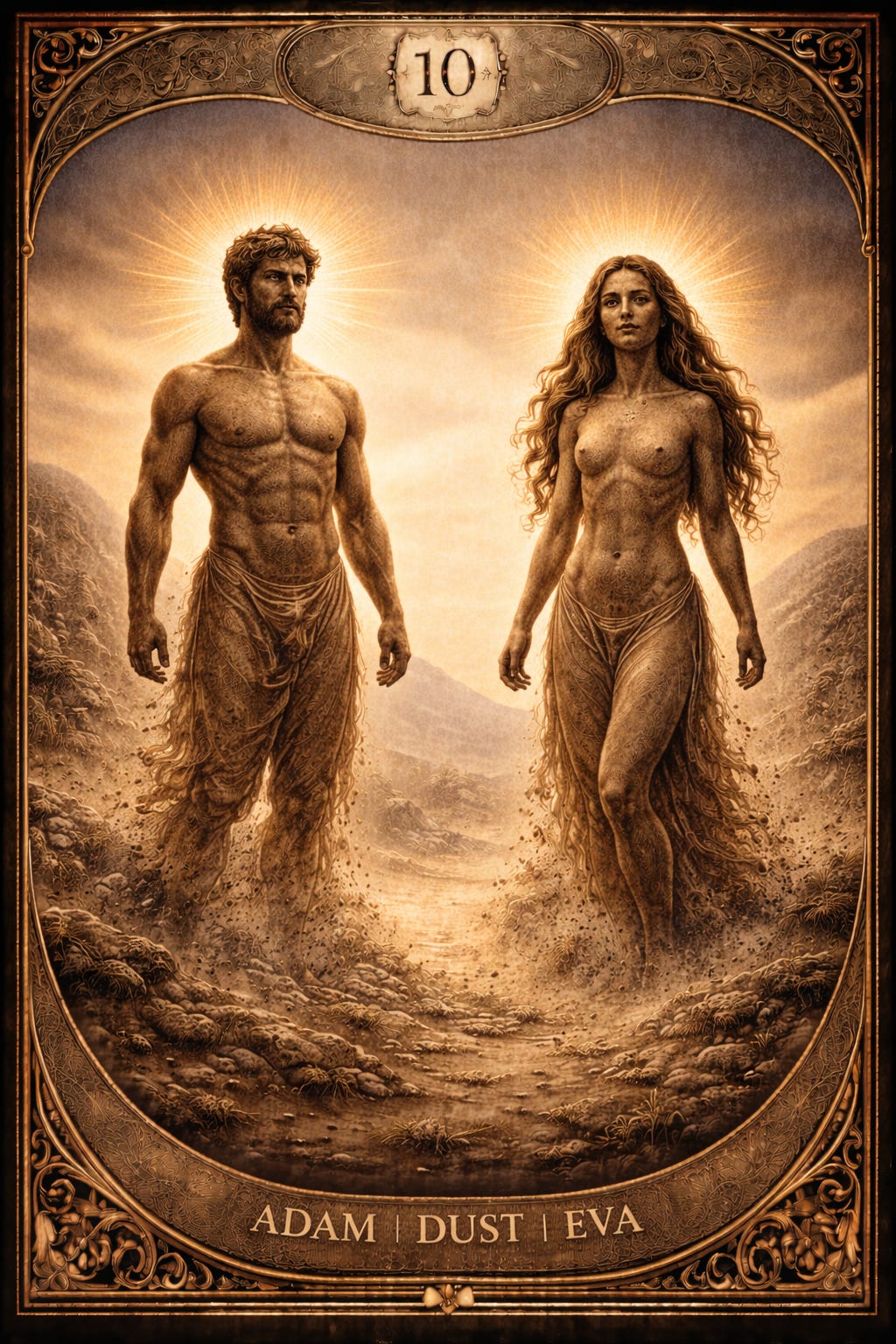
DUST: {10}
Dust is composed of fine particles of matter, originating from the Old English dūst. It is the most fundamental material of the physical world and serves as a direct linguistic link to Adam and Man. In the biblical narrative, it is the substance from which the first human was shaped (‘out of the ground’) and the state to which he is destined to return (‘for dust thou art, and unto dust shalt thou return’). It represents the absolute Wholeness of the biological cycle—the material beginning and ending that anchors the Initiation of life in the heavy reality of the earth.
EVA: {10}
The spelling Eva is the classical Latin and Germanic form of the name Eve, originating from the Hebrew: Chavah, meaning ‘to breathe’ or ‘to live.’ This specific spelling was popularised through the Latin Vulgate Bible, the translation that served as the foundational text for Western Christendom for over a millennium. Eva is the structural counterpart to Adam, and first mother to Man—representing the vital feminine force required to Initiate the Human Lineage.
MAN: {10}
Man serves as the collective noun for a species of primate with the faculty for self-awareness and reason. It symbolises a complex range of concepts, originating from Old English: mann which meant ‘human being’ regardless of gender, and represents masculinity, strength, and personhood. Derived earlier from the Proto-Indo-European: man-, meaning ‘to think,’ it also represents the rational, self-conscious nature of human existence. It can imply a call to stoicism (‘be a Man’) or used as an Exclamation of emotion—while ‘the Man’ often signifies Authority Figures or the Establishment.
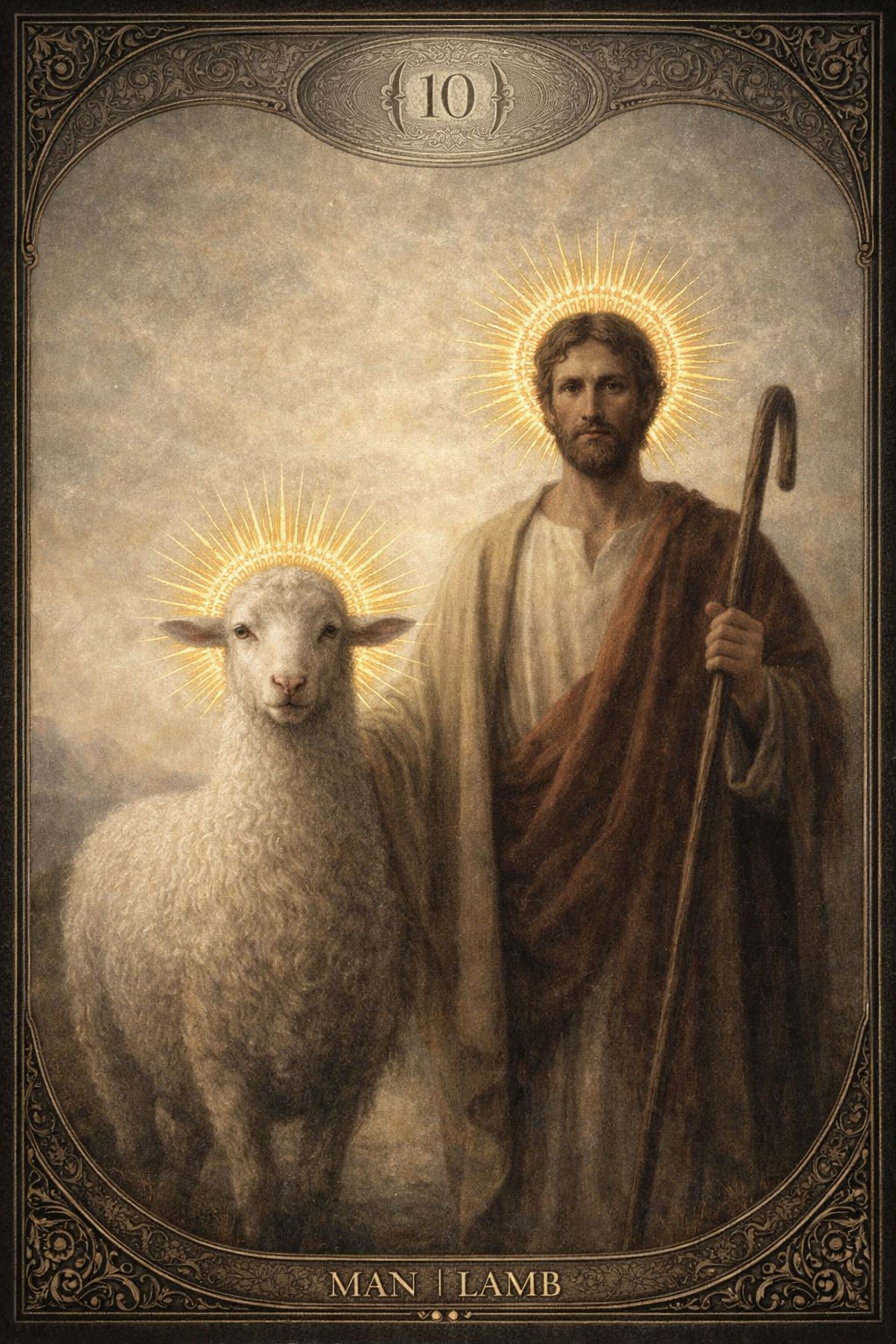
LAMB: {10}
The Lamb is one of the most potent symbols in human history, specifically within the Judeo-Christian tradition. Because of its white wool and gentle nature, the Lamb is a universal symbol for untainted innocence and purity, representing a harmless, defenceless, or meek nature, frequently in contrast to the strength of the shepherd or the harshness of the world. In the Bible, the ‘Lamb of God’ (Agnus Dei) signifies the ultimate sacrifice that Restores the relationship between Man and the Divine, symbolising both the Suffering Saviour (led to slaughter) and the triumphant, Resurrected Saviour. The Lamb is commonly used to represent youth or a new, untainted Beginning—representing a yearning for a simpler, peaceful existence, or a deep connection with nature and vulnerability.
LET: {10}
The word Let is a fundamental Imperative in the English language, originating from the Old English: lætan, meaning ‘to allow,’ ‘leave behind,’ or ‘permit to remain.’ It functions as a linguistic gateway, signalling the removal of an obstacle or the granting of permission for a process to occur. In a theological context, it is the word of creation—Fiat lux or ‘Let there be Light’—representing the Initial Spark of will that brought all Existence into Being.
IS: {10}
Is is the third-person singular present indicative of the verb be, derived from the Proto-Indo-European root: es-, meaning ‘to exist.’ It is the most direct statement of Wholeness and reality available in language. To say something ‘Is’ is to clear away all potentiality and uncertainty and focus on the absolute, present statement of Fact. Philosophically, it represents the ‘I Am’—the core of Identity and the undeniable truth of Being. It is the structural anchor of any sentence, providing the definition and the definitive Initiation of a truth.
DO: {10}
The verb Do comes from the Old English: don, which shares roots with the Greek: tithenai, meaning ‘to put’ or ‘to place’—representing the transition from abstract thought into concrete Action. Unlike ‘thinking’ or ‘feeling,’ to Do is to exert one’s will upon the material world, embodying the active power of the Individual to shape their environment. In every context, it signifies the Initiation of a task and the commitment to see a process through to its Conclusion.
ASSESS: {10}
Assess is derived from the Latin: assidere, which literally translates to ‘sit beside.’ Historically, this referred to the role of a judge’s assistant who sat nearby to help determine the value or tax of an estate. It represents pause and reflection, where a situation is measured against a standard to determine its value. It is the logical counterpart to Action—before one can Do, one must Assess. It signifies the Wholeness of understanding required to make a judgment, serving as the critical Journey where information is refined into a decided path of Initiation.
SKY: {10}
The Sky represents the vast, overhead expanse that encompasses the earth and its atmosphere, derived from the Old Norse: sky, meaning ‘cloud’ or ‘region of the clouds.’ Historically, the Sky has been perceived as the limit of the physical world and the dwelling place of the Divine. It’s appearance reflects human emotions, with clear blue skies symbolising joy and peace, while dark, stormy clouds represent unease, power, or foreboding. The Journey from day to night signifies the changing nature of life and provides a backdrop for romantic, celestial imagery while in Buddhism, the Sky is a metaphor for a mind free from confusion, representing pure Awareness.
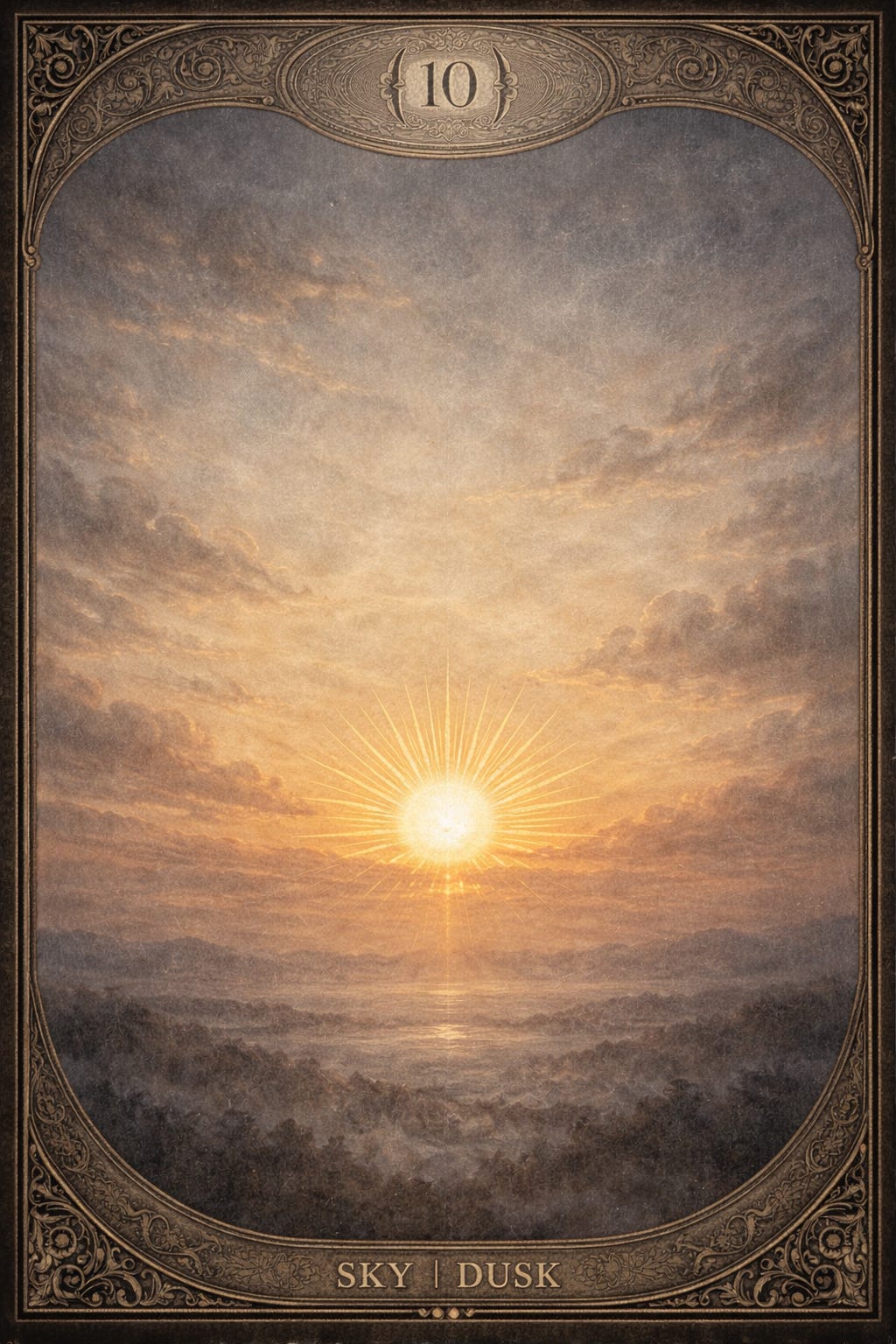
DUSK: {10}
Dusk refers to the darkest stage of twilight, occurring just before nightfall. The word originates from the Old English: dox, meaning ‘dark-coloured’ or ‘gloomy.’ It represents the natural Conclusion of the Day’s Cycle, the moment when the clarity of the sun begins to resolve into the shadow of the night. In a narrative sense, Dusk signifies the Full Journey of the sun—often associated with introspection, peace, and spiritual awakening, this twilight period serves as a transition between the light and dark, representing both a fading and the promise of Renewal.
JESU: {10}
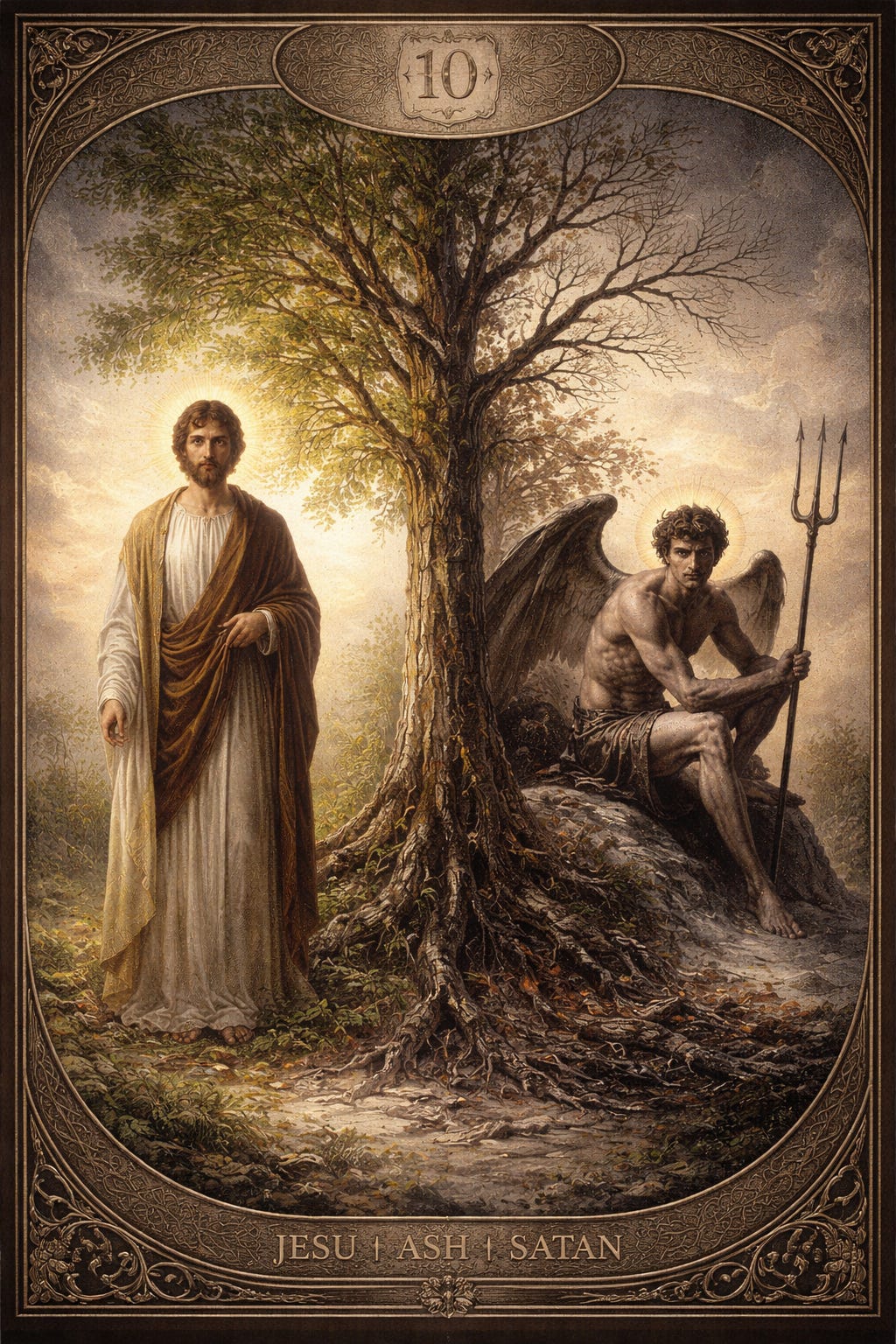
The name Jesu is the traditional Latin and archaic English vocative form of Jesus. Its usage stems from the Latin Vulgate, specifically appearing in liturgical texts, hymns, and the famous Bach chorale Jesu, Joy of Man’s Desiring. Historically, this spelling was the standard in pre-modern English bibles and remains a fixture in Freemasonry and high-church liturgy, where the name is often treated with a higher degree of formal reverence. Jesu signifies the Initiation of a spiritual era and the the Sacrificial Journey. In Masonic tradition, the use of Jesu over the common spelling often underscores a connection to ancient, Latinate lineages and the preservation of a ‘Secret’ or ‘Sacred’ truth.
ASH: {10}
The word Ash carries a dual significance, representing both a biological structure and the residue of Return.
The Tree: The Ash tree (Fraxinus) is a genus of large deciduous trees. In Norse mythology, the World Tree, Yggdrasil was an Ash, serving as the central axis that bound all realms of existence. It represents the Ultimate Unity between the spiritual and natural worlds.
The Soot: As a mineral residue, Ash is what remains after a substance has been consumed by fire. It is the final, purified state of matter—the residue of a form after it has undergone a Total Change in state. Whether as a tree or as soot, Ash represents the endurance of the essence after the Full Journey of life or fire is complete.
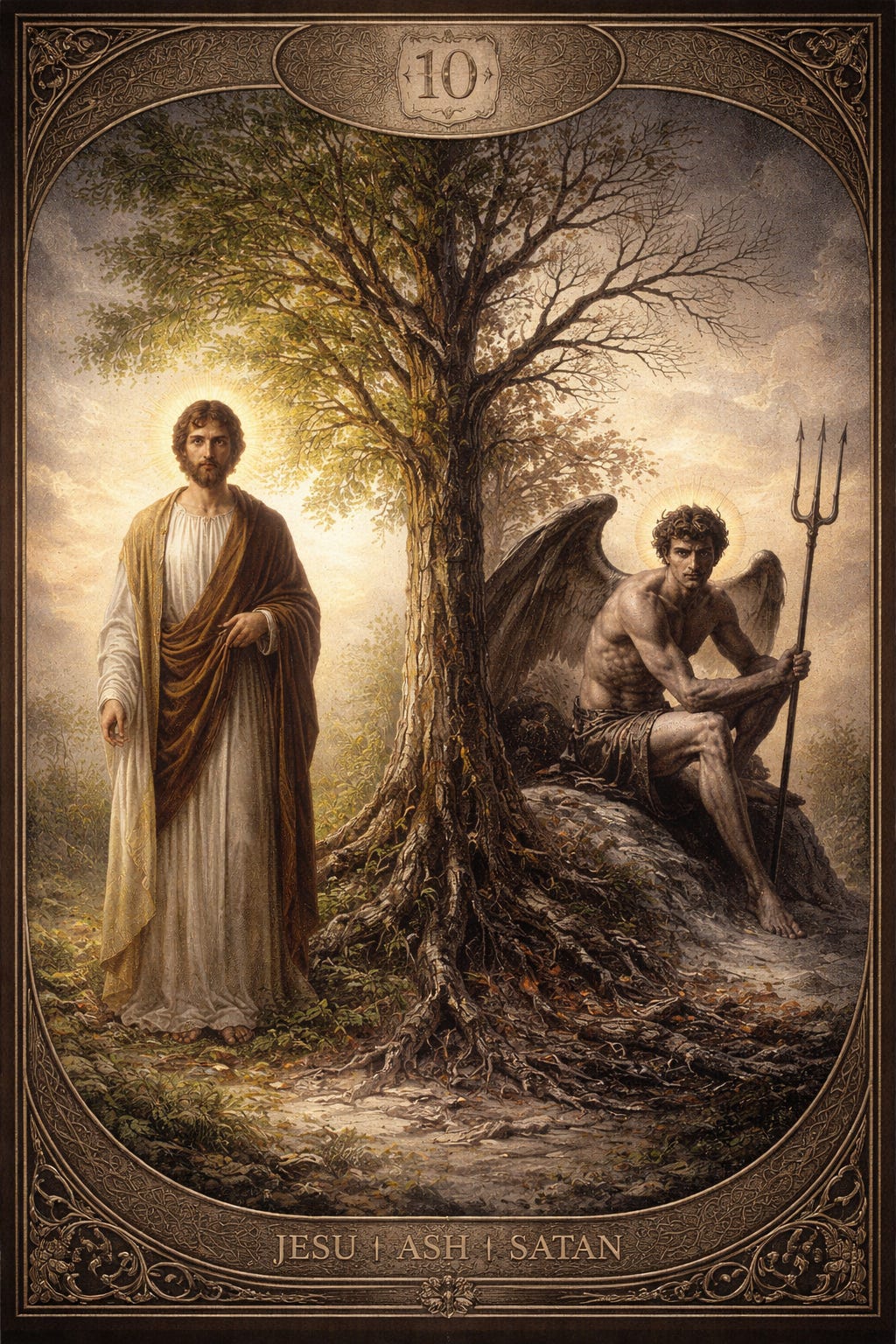
SATAN: {10}
The name Satan originates from the Hebrew: ha-satan, meaning ‘the adversary,’ ‘accuser,’ or ‘opposer.’ Historically, this was not initially a proper name but a functional title for an entity within the divine council whose role was to test the integrity of Man. In a narrative sense, Satan represents the necessary friction required to Initiate growth or change. He is the shadow aspect of Unity—the structural opposition that forces the Individual to define their own Wholeness.
RA: {10}
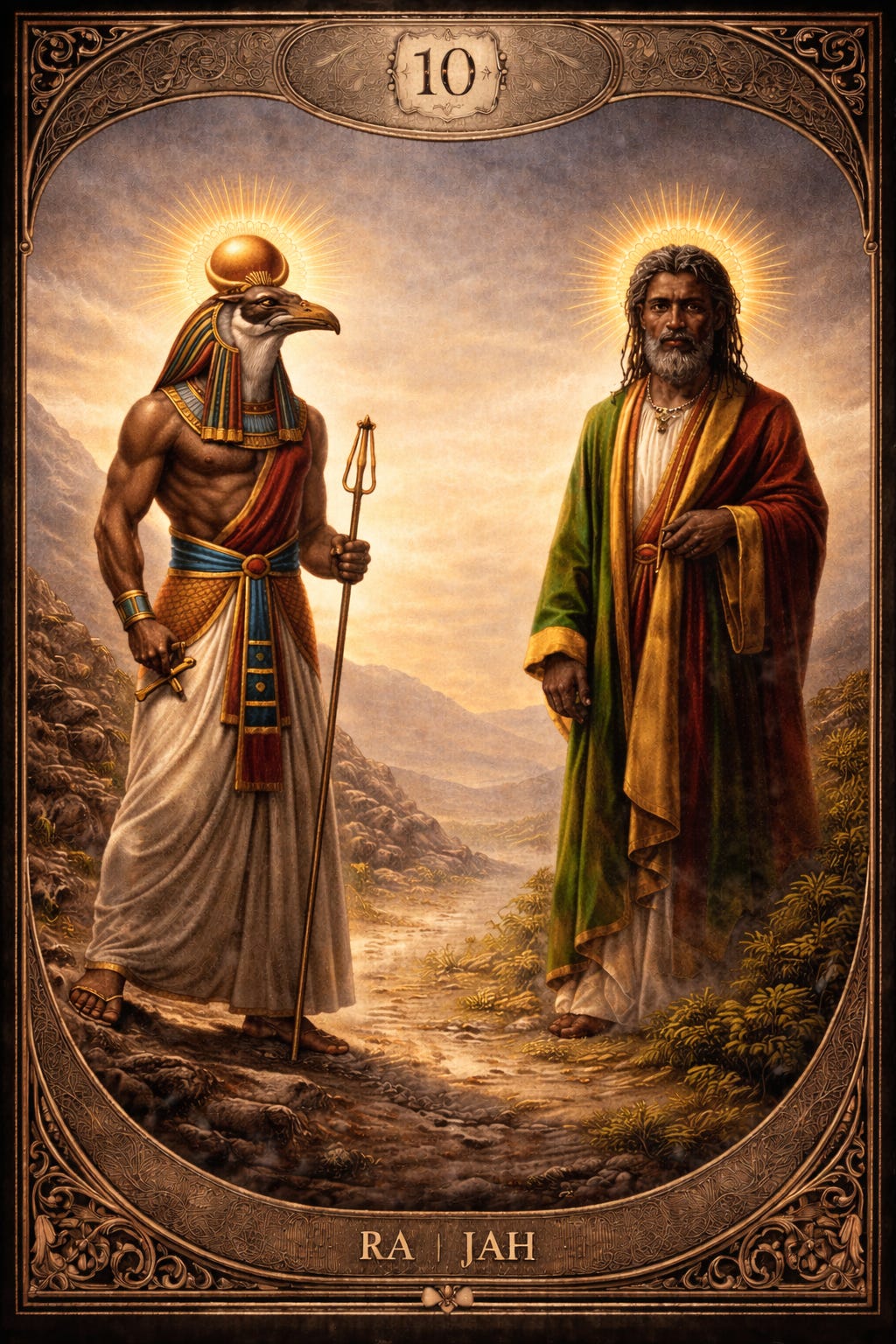
Ra is the ancient Egyptian deity of the sun, representing the primary source of life, warmth, and growth. He was believed to sail across the Sky in a solar barque, battling the forces of chaos each night to ensure the sun’s rebirth at dawn. This cycle represents the eternal Initiation of the day and the Full Journey of the soul through the realms of shadow and light. As the ‘Self-Created One,’ Ra embodies the concept of Unity and the Initial Spark of the cosmos, serving as the absolute solar anchor for the ancient world’s understanding of existence.
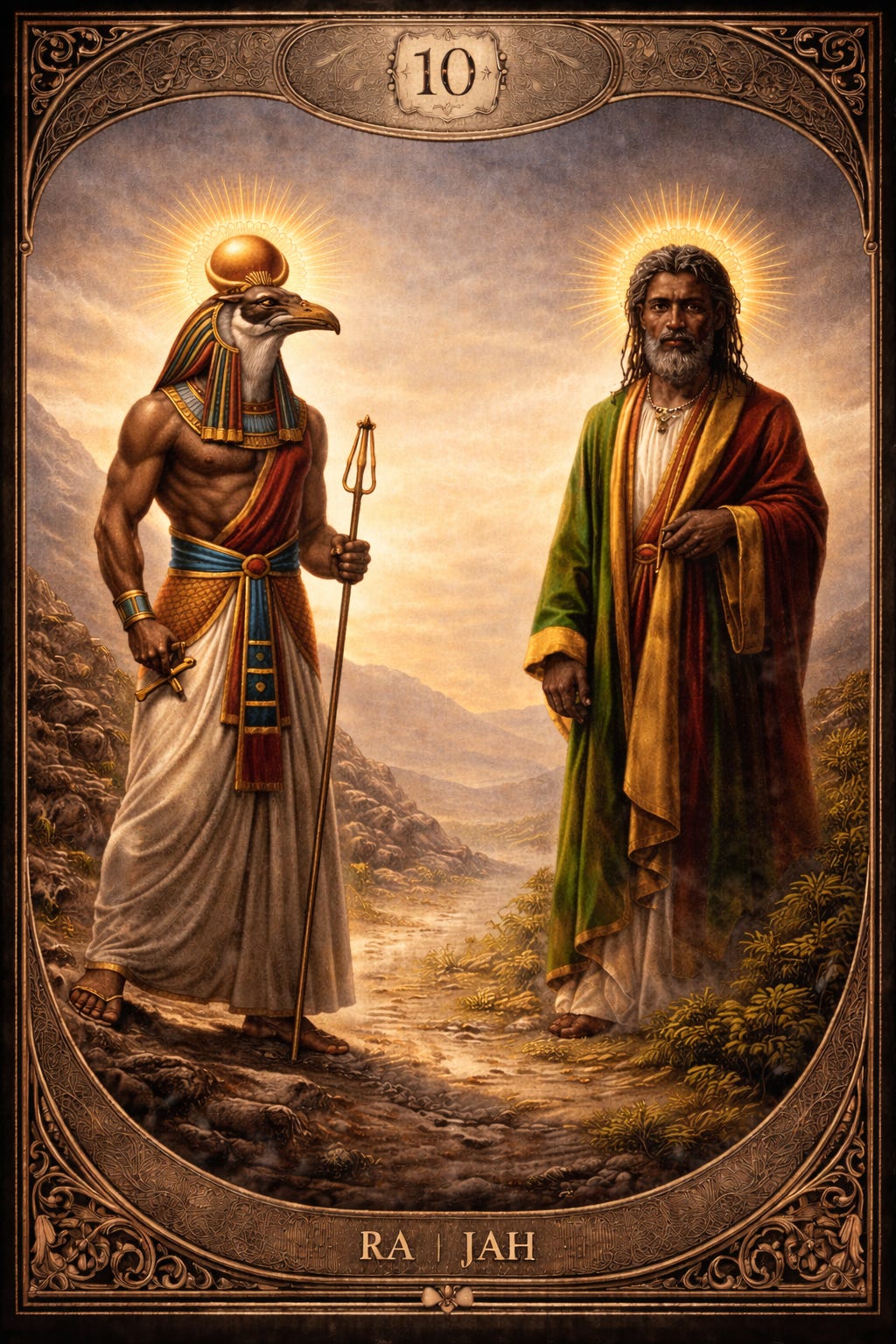
JAH: {10}
Jah is a shortened, poetic form of the Hebrew name for God|Yahweh, appearing frequently in the Hebrew Bible, notably in the expression ‘Hallelujah’, or ‘Praise Jah’. Historically, this name became a central pillar of the Rastafari movement, representing God as a living, indwelling presence within the Individual. It signifies the Unity between the divine and the human experience—represents the ultimate Wholeness—the alpha and omega of the Spiritual Journey, and the singular authority that Initiated the Human Story.
AND: {10}
The word And is the primary coordinating conjunction in the English language, originating from the Old English: ond, which shares roots with the German: und and the Latin: ante, meaning ‘before’ or ‘against.’ It serves as the fundamental linguistic tether, used to connect words, clauses, or sentences into a unified whole. In a structural sense, And represents the Initiation of a relationship or a sequence and serves as the very agent of Wholeness—preventing concepts from remaining isolated and instead weaving them into a continuous thread.
CABAL: {10}
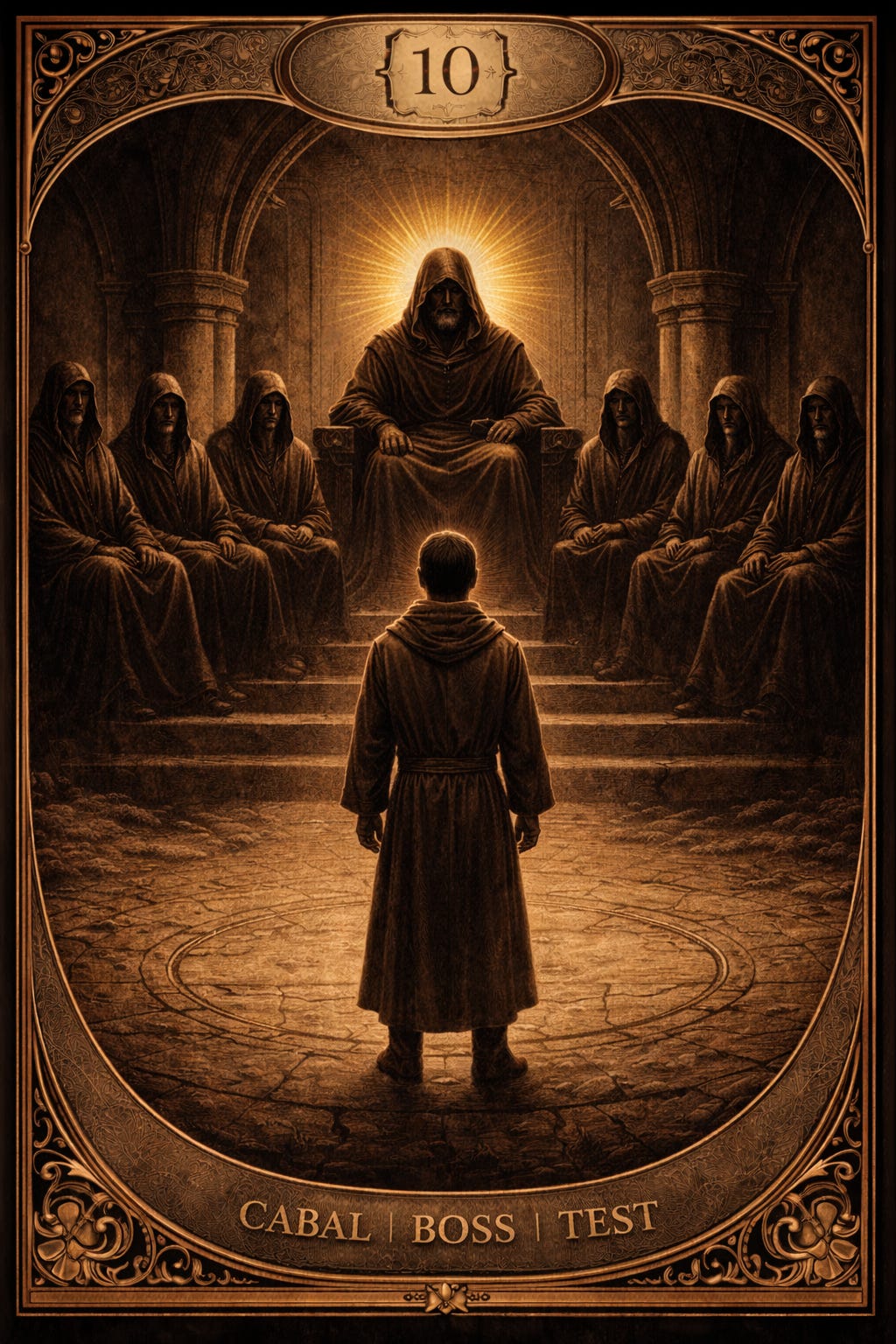
A Cabal refers to a small group of people united in a close design, usually to promote their private views or interests in church or state. The term originated from the Hebrew Kabbalah, meaning ‘received tradition’ or ‘secret knowledge.’ In the 17th century, the word took on a political edge in England when it was used as an acronym for five ministers of King Charles II: Clifford|Arlington|Buckingham|Ashley|Lauderdale. It represents a dense Structure of influence and the Initiation of plans behind the veil of public awareness. It is the human attempt to create a unified circle of power, reflecting a hidden Wholeness that directs the course of the larger Human Story.
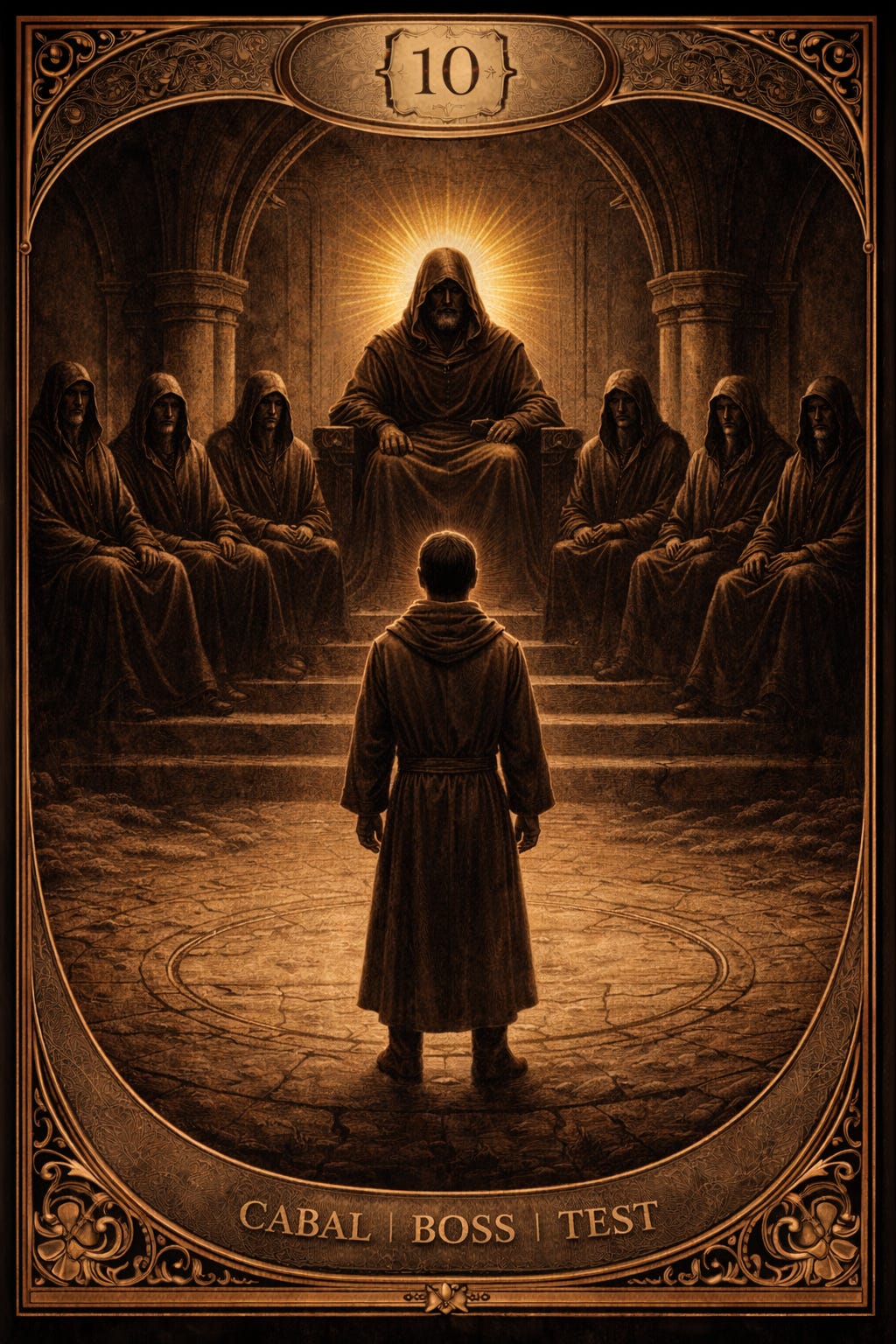
BOSS: {10}
The term Boss entered American English from the Dutch: baas, meaning ‘master’ or ‘head of a household.’ Historically, it refers to the Individual who holds the authority to direct the Initiation of work and oversee the Full Completion of multiple projects. A Boss is the central point of a hierarchy, responsible for directing the Effort and maintaining the Unity of a team. Whether as a person in charge or as a decorative ‘Boss’ in architecture (the ornamental projection at the intersection of a vault), it signifies the Singular point of focus that holds the larger group together.
SI: {10}
SI serves as the international abbreviation for the Système International d’unités (International System of Units), the modern form of the metric system. It is the mathematical and scientific standard used to ensure that measurements are consistent across every border and discipline. Historically, it was established to provide a universal Structure for the physical sciences, replacing a chaotic variety of local systems. In this context, SI is the ultimate agent of Wholeness in the numerical world—the global Unity of measurement that allows for the precise Assessment of reality.
BEAT: {10}
The word Beat comes from the Old English: beatan, meaning ‘to strike’ or ‘to hammer.’ It describes a repetitive application of force used to shape metal, create a rhythm, or overcome an opponent. Historically, the Beat is the fundamental unit of time in music and the pulse of the human heart, representing the steady Initiation of movement that sustains life. It signifies the persistent effort required to drive a process forward, ensuring that a rhythm or a task reaches its state of Wholeness through consistent action.
CALL: {10}
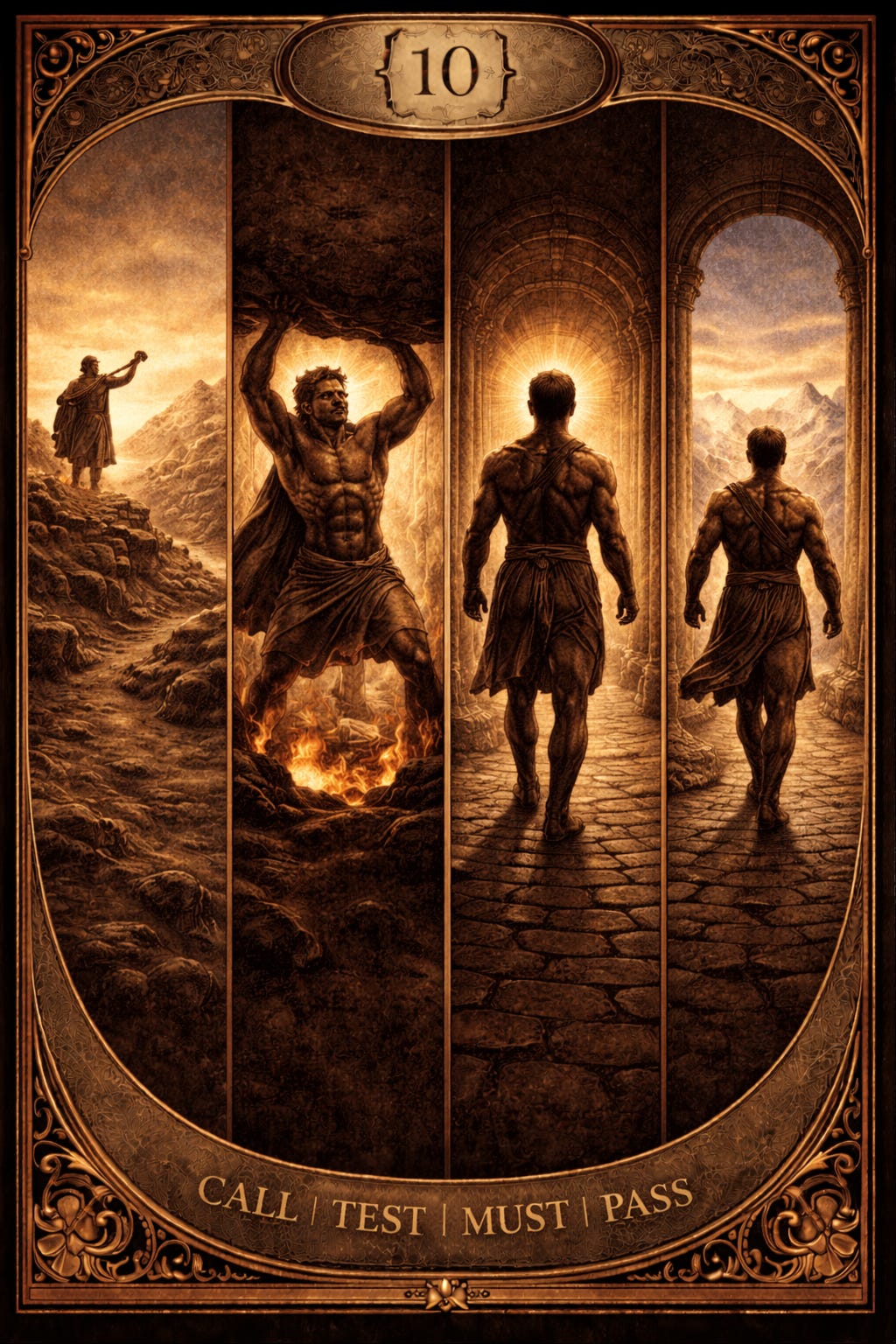
The word Call originates from the Old Norse: kalla, meaning ‘to cry out’ or ‘to summon.’ It is a vocal Initiation, an act of reaching across a distance to demand attention or to give a specific name to a thing. Historically, a Call represents a vocation or a spiritual summons, the moment an individual is drawn out of their current state to begin a new Full Journey. It is the linguistic tool used to command presence and establish a connection, serving as the bridge that brings separate entities into a state of temporary Unity.
TEST: {10}
The word Test is derived from the Latin: testum, an earthen pot or crucible used for refining precious metals by intense heat. To put something to the Test is to subject it to the friction of reality to see if its Wholeness remains intact. It is the critical Threshold of the Full Journey, where the quality of a person, an object, or a theory is finally revealed. Only by surviving the Test can a subject be validated as true, marking the final Initiation into a state of proven and undeniable Unity.
MUST: {10}
The word Must originates from the Old English: mōste, the past tense of mōtan, meaning ‘to be able to’ or ‘to be obliged to.’ It represents the ultimate expression of necessity and the unavoidable path. Unlike a choice or a suggestion, a Must signifies a structural requirement that drives the Full Journey forward. It is the internal or external force that compels the Initiation of action, serving as the ironclad rule that ensures a system or a life remains on its intended course toward Wholeness.
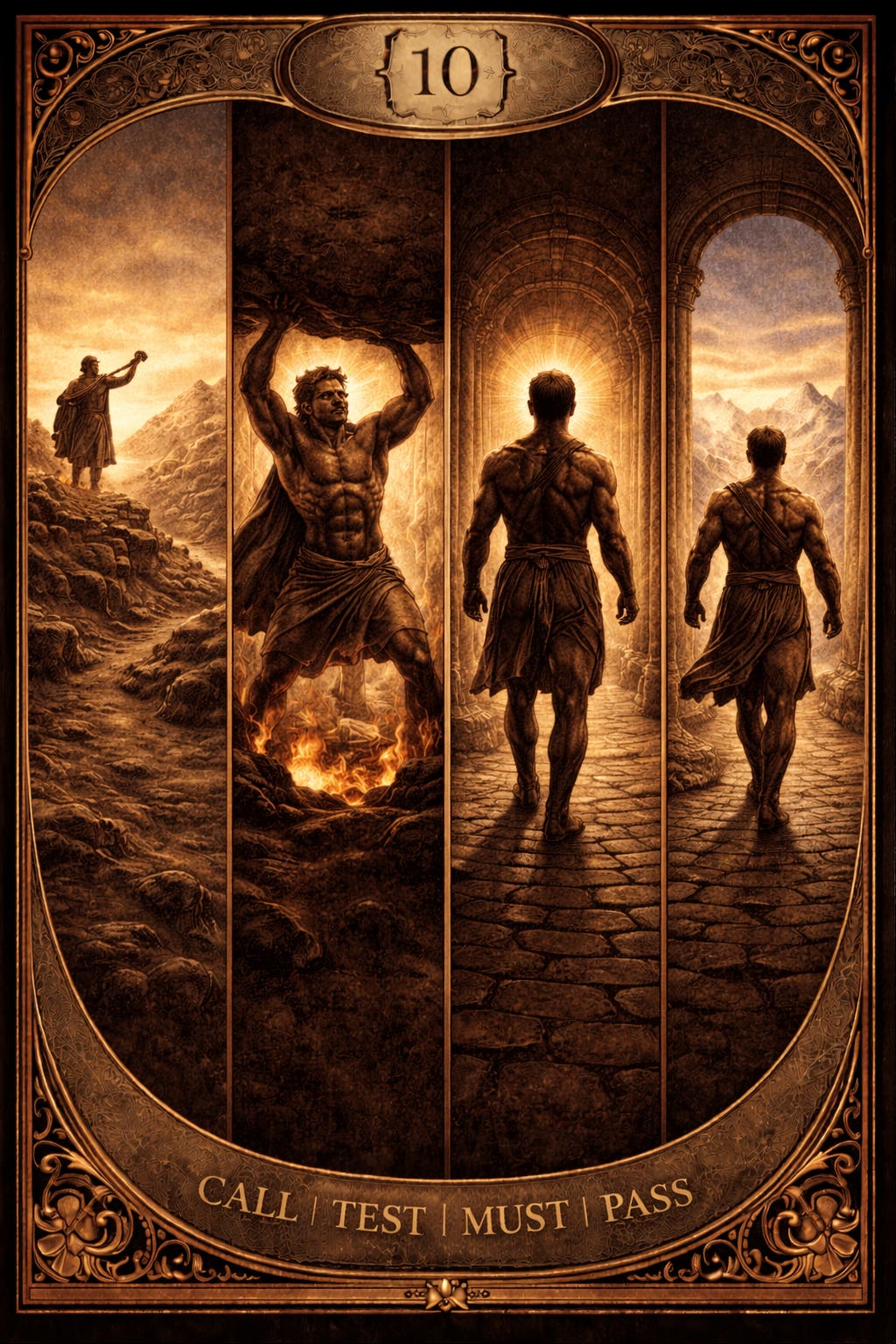
PASS: {10}
Pass is derived from the Latin: passus, meaning ‘a step’ or ‘to spread out.’ It describes the act of Moving Through a space, transitioning from one state to another, or handing an object from one person to the next. To Pass is to cross a Threshold, marking the successful navigation of a stage in the Full Journey. Whether it refers to the passage of time or the successful completion of an ordeal, it signifies the movement required to reach a state of Unity with the Next Phase of the Story.
CASE: {10}
Case carries a dual meaning derived from two distinct roots. From the Latin: casus, it means ‘a fall’ or ‘an event,’ such as a ‘case of circumstances’, representing a specific moment in time. From the Latin capsa, it refers to a ‘box’ or ‘receptacle,’ a physical container that holds something within. In both senses, it represents Wholeness. Whether it is a legal Case that must be resolved to find the truth or a physical Case that protects its contents, it signifies a defined boundary that encompasses a particular set of facts or objects, bringing them into a single, organised Unity.
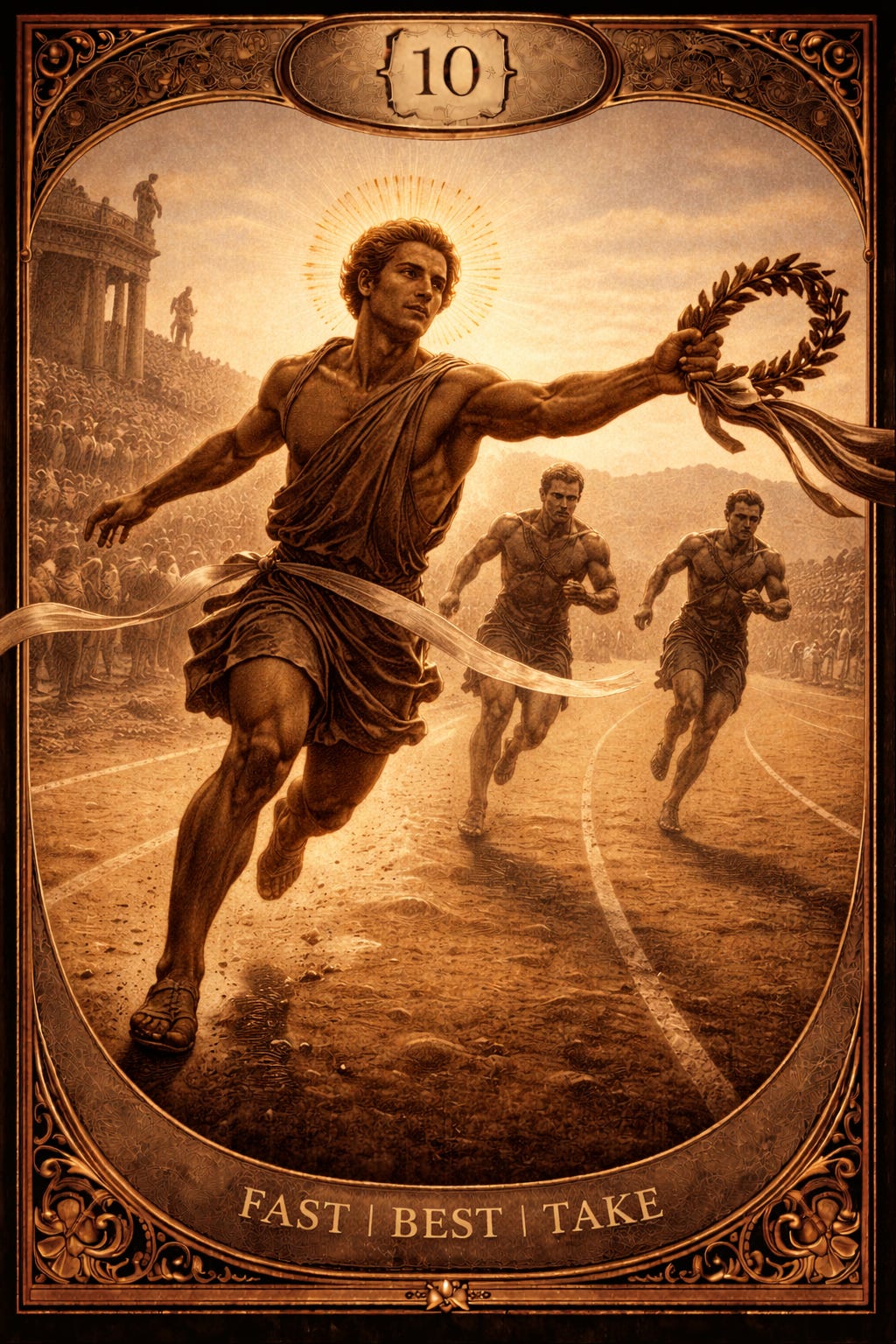
FAST: {10}
Fast is a word of paradoxical stability, rooted in the Old English: fæst, meaning ‘firmly fixed’ or ‘steadfast.’
Speed: When referring to rapid movement, it implies a state of kinetic Unity, where an entity moves with such aerodynamic efficiency that the friction of the external world is minimised. In this state, the motion becomes so streamlined that the Initiation and the destination appear to merge into a single, seamless event.
Abstinence: In the context of refraining from food, a Fast is a period of spiritual or physical purification. It is a deliberate pause in the Full Journey of consumption, intended to return the individual to a state of internal Wholeness and clarity by stripping away external desires.
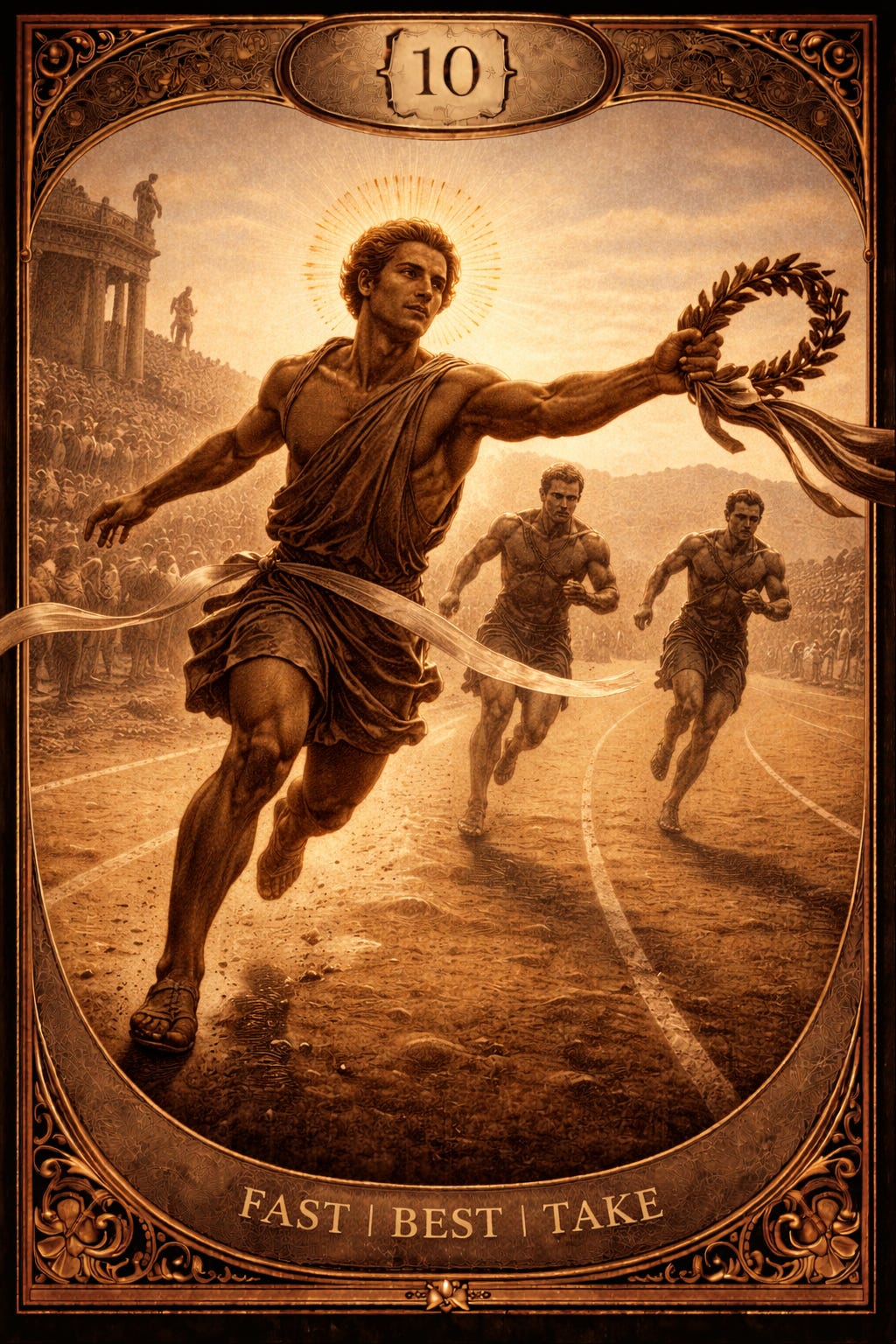
BEST: {10}
Best is the superlative form of ‘good,’ derived from the Old English: betst, meaning ‘of the highest quality’ or ‘most excellent.’ It represents the apex of a scale, the point where a thing or person has reached the limit of their potential. To achieve the Best is to complete the Full Journey of improvement, arriving at a state of Wholeness that cannot be surpassed. It is the benchmark of Unity, where all necessary qualities have been perfectly integrated to produce the most effective or virtuous outcome.
TAKE: {10}
Take comes from the Old Norse: taka, meaning ‘to grasp,’ ‘lay hold of,’ or ‘receive.’ It is the active counterpart to giving, representing the moment an individual claims an object, an idea, or an opportunity. To Take is to Initiate a transfer of energy or belonging, pulling some piece of the world into one’s own sphere of influence. It signifies the Full Journey in the passing of ownership, marking the point where the conditional state of an item is transferred to another.
LESS: {10}
Less comes from the Old English: læs, meaning ‘smaller’ or ‘fewer.’ While it suggests a reduction in quantity, philosophically it often leads to a higher state of Wholeness—the principle that ‘less is more.’ By removing the superfluous, what remains is the essential Unity of the subject—representing the process of refinement, where the Full Journey involves shedding excess layers to reveal the Core Truth. It is the mathematical and aesthetic act of returning to the simplest, most potent version of a thing.
SALE: {10}
The word Sale comes from the Old English: sala, meaning ‘the act of giving up or delivering.’ It represents the completion of a commercial cycle where value is recognized and ownership is transferred. In the marketplace, a Sale is the moment of Wholeness for a transaction; it is the point where the labor of production meets the necessity of the consumer. It signifies the successful Initiation of a new life for an object, as it leaves the hands of the maker to fulfill its purpose in the world.
SEAL: {10}
The word Seal carries two primary meanings, both representing a state of Wholeness. Derived from the Latin: sigillum, meaning ‘a small picture’ or ‘a mark,’ it is the act of authentication used to close a document or vessel, ensuring its contents remain untainted. It signifies the ultimate authority and the preservation of a Full Journey or message. Additionally, it refers to the semi-aquatic marine mammal of the suborder Pinnipedia. Known for its streamlined body and ability to navigate between the elements of land and water, the Seal represents both a fluid Unity and natural Initiation into the depths of the wild. Both definitions signify a boundary—one of legal or spiritual protection, and the other of biological adaptation.
TANK: {10}
The word Tank originally referred to a large pool or cistern for water, likely derived from the Gujarati: tānkh or the Portuguese: tanque. It is a vessel designed for the absolute containment of a substance, ensuring that nothing is lost to the environment. Whether used for life-sustaining water or as a heavily armoured vehicle, a Tank represents a reinforced Wholeness. It is the physical manifestation of the Protected Journey, providing a secure environment that guards its contents or its occupants against external influence.
TUCK: {10}
The word Tuck originates from the Old English: tucian, which initially meant ‘to ill-treat’ or ‘disturb,’ but evolved through Middle English to mean ‘to pull’ or ‘gather.’ It describes the act of folding the edges of a fabric or material into a confined space, creating a neat and secure enclosure. To Tuck something away is to bring it into a state of Wholeness, ensuring that all loose ends are integrated into a single, tidy form. It represents a final touch of care or concealment, marking the completion of an arrangement where the object is safely held within its designated boundary.
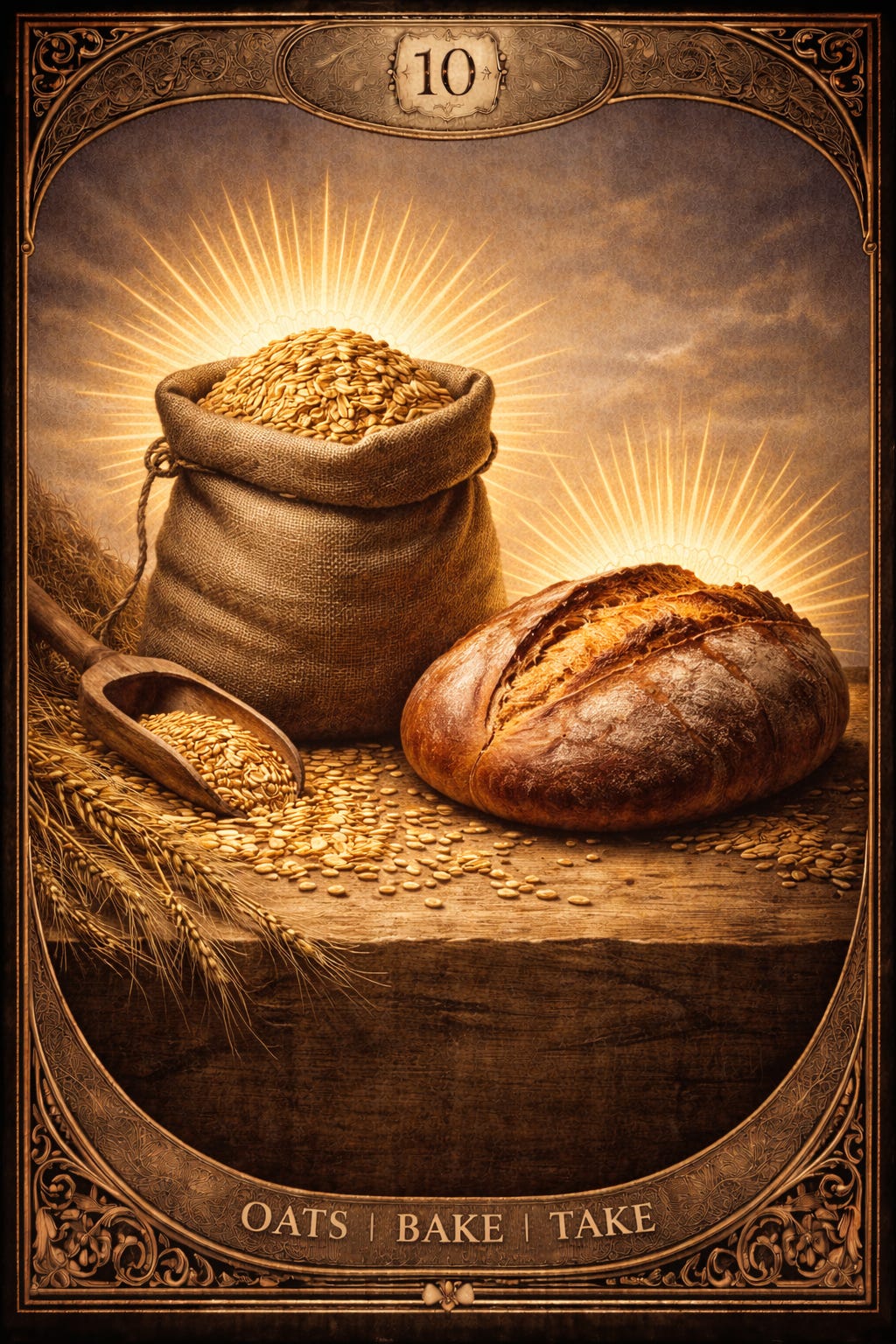
OATS: {10}
Oats comes from the Old English: āte, referring to the cereal grain known for its hardiness and nutritional value. As a crop, it represents the Full Journey of the seasonal cycle—from the sowing of the seed to the labor of the harvest. Historically a staple of both Man and livestock, Oats signify the simple, unrefined sustenance required to fuel the body. They represent the organic Unity of nature’s provision, providing the foundational energy needed to sustain the Human Lineage through the rigours of existence.
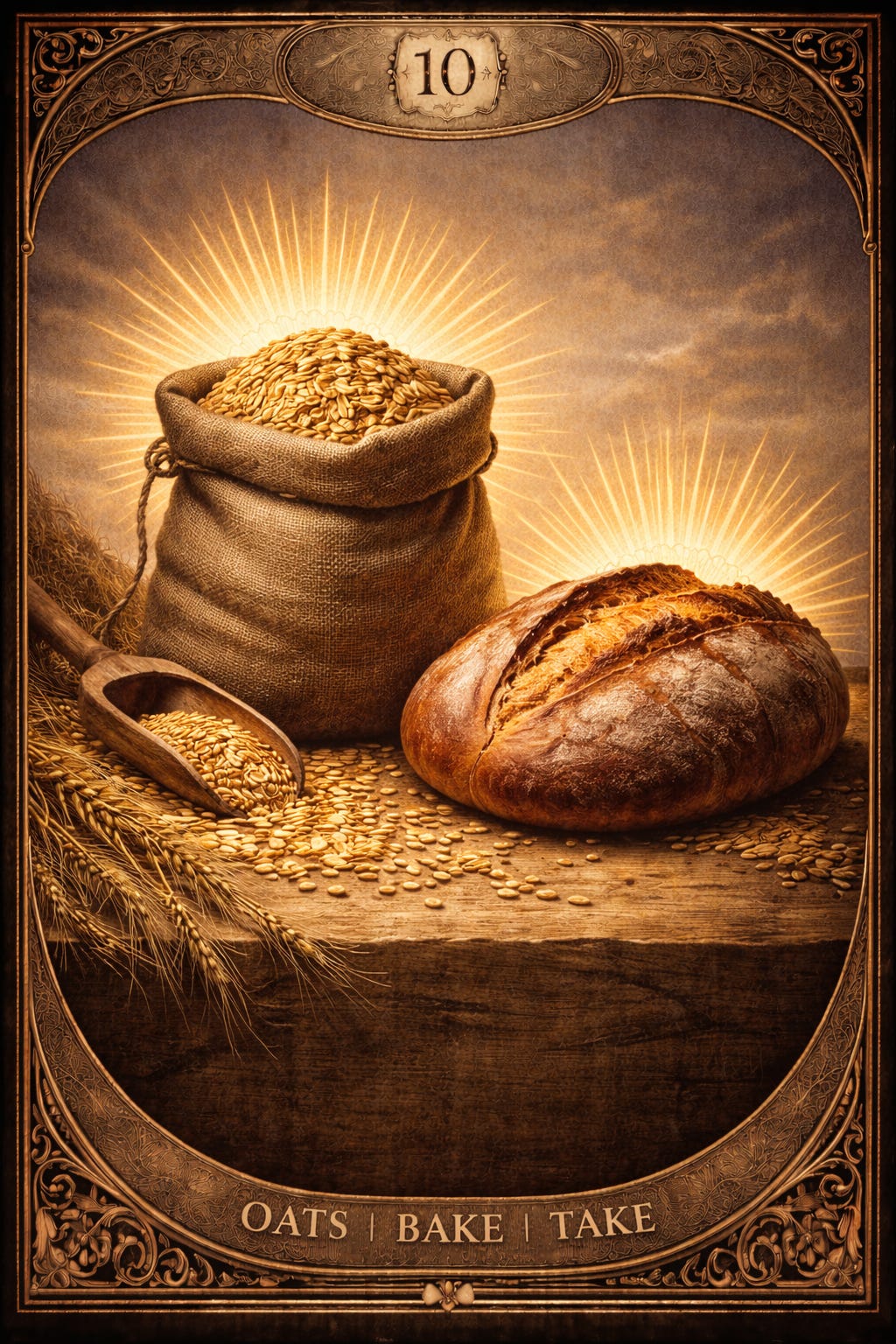
BAKE: {10}
Bake originates from the Old English: bacan, meaning ‘to cook by dry heat.’ It is one of the most ancient methods of transformation, where raw, disparate ingredients are subjected to fire to create a unified, finished product. In the kitchen or the kiln, the act of baking represents the Full Journey of a substance—taking a chaotic mixture and hardening it into a stable, nourishing form. It is the culinary Initiation of sustenance, where heat serves as the catalyst that turns potential energy into a finished meal.
SOAK: {10}
Soak is derived from the Old English: sūcan, meaning ‘to suck’ or ‘to absorb liquid.’ It describes a passive yet thorough process of saturation, where an object is completely immersed until its original state is transformed. Unlike a superficial wash, a Soak allows the element to permeate the very core of a substance, representing a return to a state of fluid Wholeness. It is the quiet Initiation of a chemical or physical change, where the Full Journey of the process is measured by the depth of absorption and the softening of the subject’s boundaries.
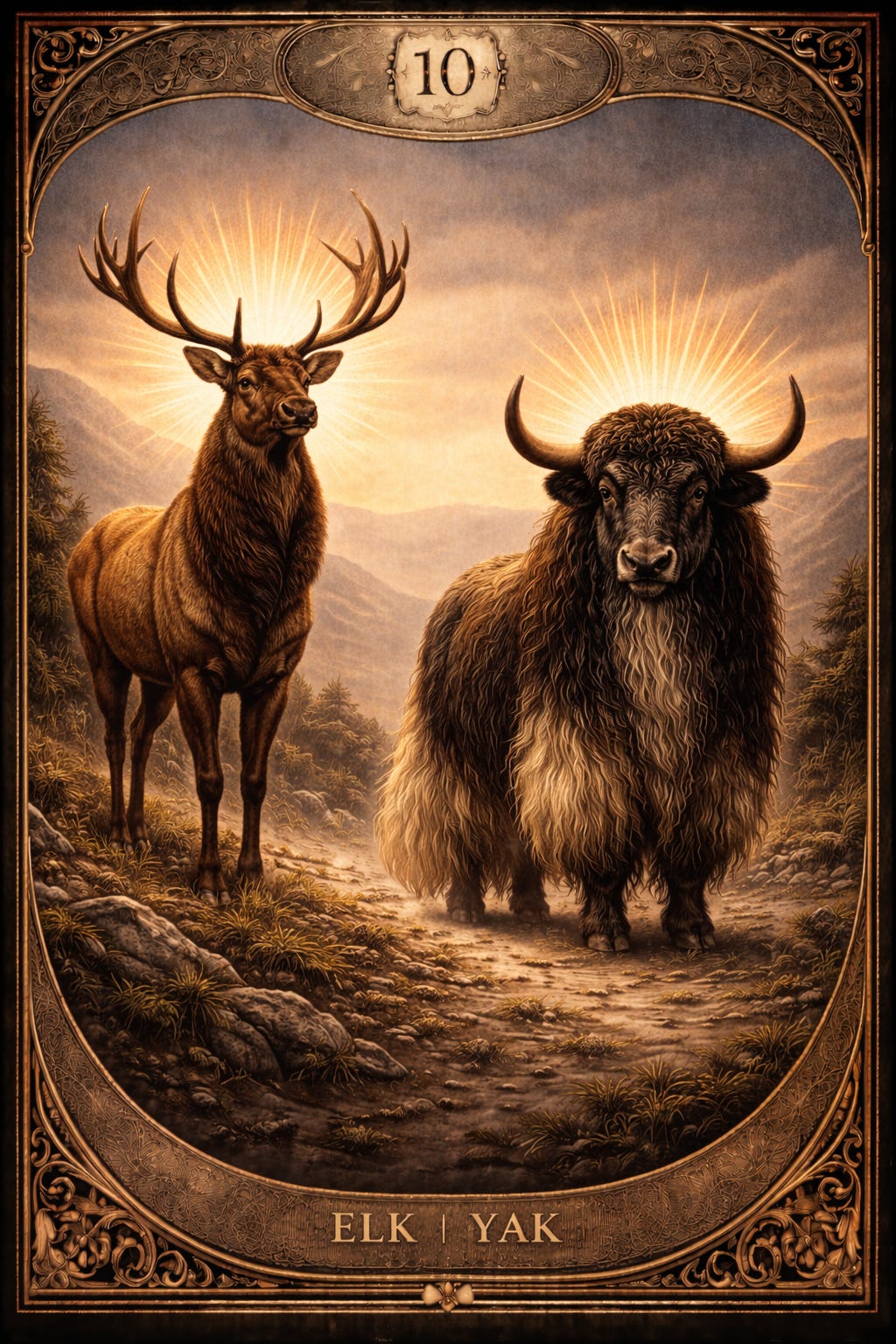
ELK: {10}
The Elk is one of the largest species within the deer family, with its name rooted in the Old English: eolh. In many indigenous cultures, the Elk is a symbol of stamina, strength, and the majesty of the wilderness. As a singular entity in the wild, it represents the Initial Spark of the untamed world—a creature that navigates vast distances with grace and endurance. It embodies a solitary Wholeness, serving as a reminder of the raw, powerful life force that exists independently of human society, yet remains a vital part of the broader Human Story of the hunt and the horizon.
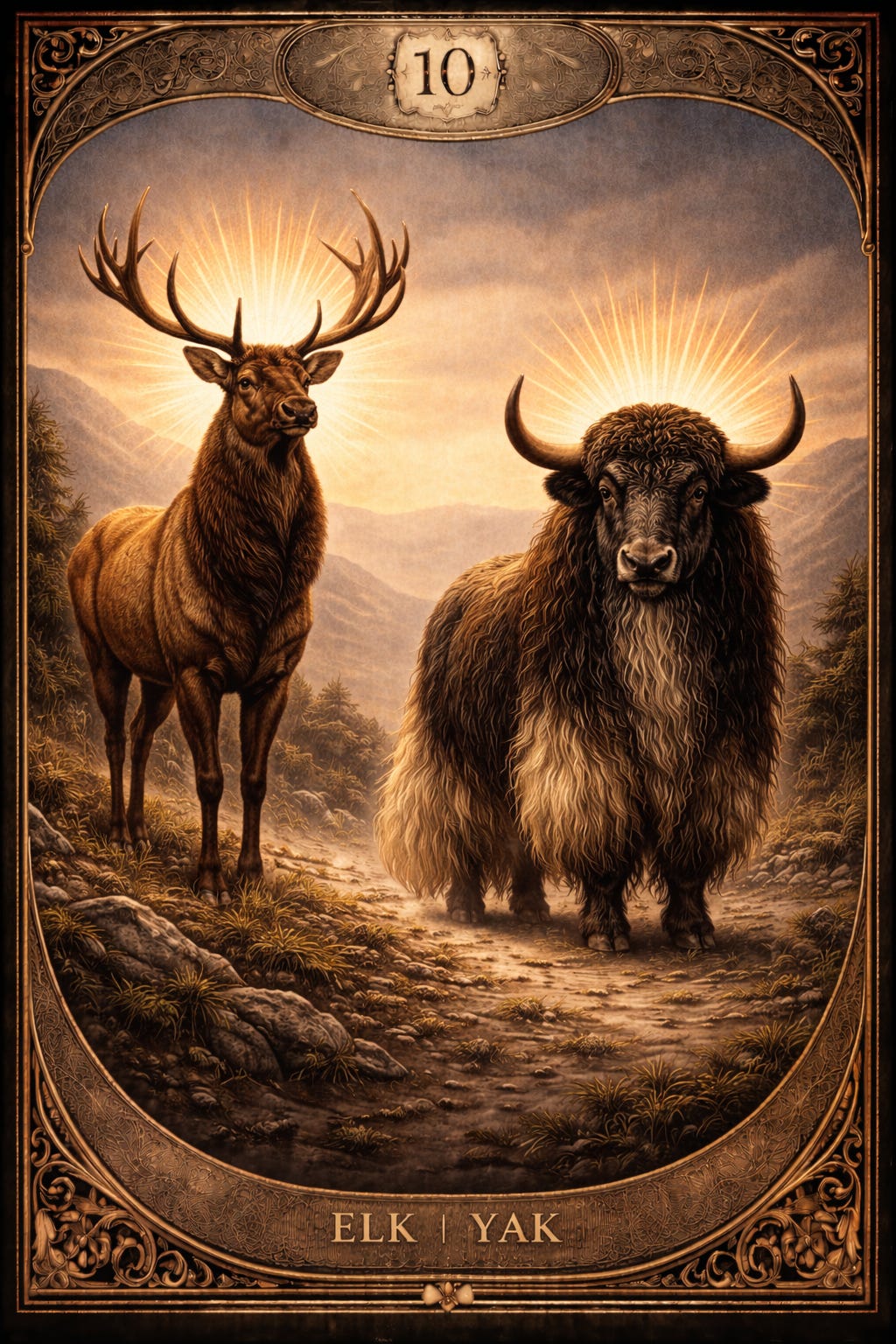
YAK: {10}
The word Yak is derived from the Tibetan: gyag, referring to the long-haired, humped bovid native to the Himalayan region. For the people of the high plateaus, the Yak is the ultimate agent of Stewardship, providing milk, fibre, and labor in an unforgiving environment. It is a vessel of endurance that carries the heavy burdens of the Full Journey across mountain passes. In its rugged nature, the Yak represents the essential Unity between a culture and beast of burden that make its survival possible, standing as a quiet, steadfast anchor in the landscape.
NEON: ATOMIC ELEMENT: {10}
Neon is the chemical element with the atomic number {10}, a noble gas that sits at the end of the second period of the periodic table. Its name is derived from the Greek: neon, the neuter form of neos, meaning ‘new.’ This etymology highlights its role as a perpetual Initiation—the discovery of a ‘new’ element within the atmosphere. Discovered in 1898 by Sir William Ramsay and Morris Travers, Neon is chemically inert, meaning it does not naturally form bonds with other elements. This characteristic represents a state of absolute Unity and self-containment—a substance that is already ‘Complete’ and requires nothing from the outside world to achieve stability.
In the physical structure of the atom, Neon possesses a full valence shell, satisfying the ‘Octet Rule.’ This represents the Full Journey of the second atomic shell—the point where every available space for an electron is filled, resulting in a state of perfect Wholeness. Because of this stability, Neon acts as the benchmark for chemical equilibrium. When electrified, it emits a brilliant reddish-orange light, serving as a literal Initial Spark of illumination. It is the gas of the ‘Neon Sign,’ a medium that converts invisible electrical energy into a visible, vibrant presence, effectively acting as a beacon that ‘Calls’ out from the darkness.
The Linguistic Hinge: TEN

{12}: Unity|Initiation: {1} crossing {+} into Duality|Relation: {2} resolving to {3}: Creation|Expression—the Frequency of FAE|BABY|DAY|ART|ELM|MOSS and SWAN.

{28}: The Balanced Path of the Decad
Calculation Board:
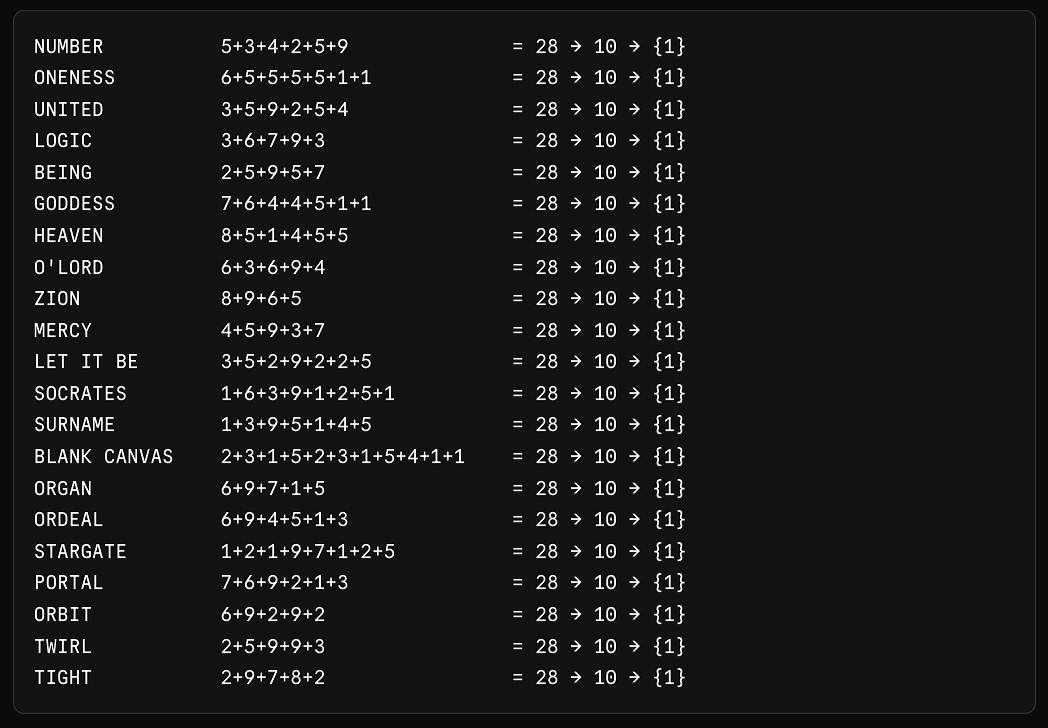
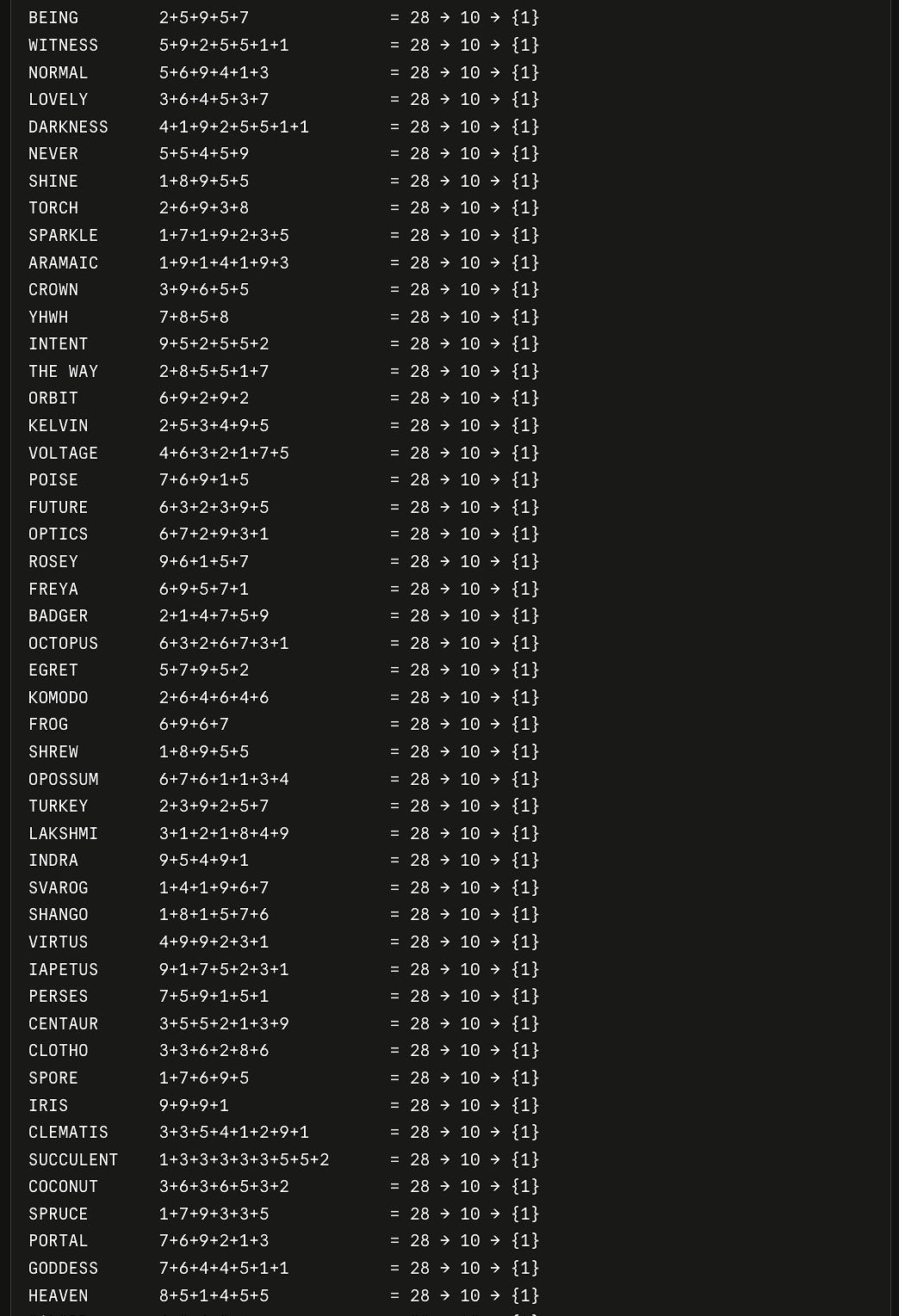
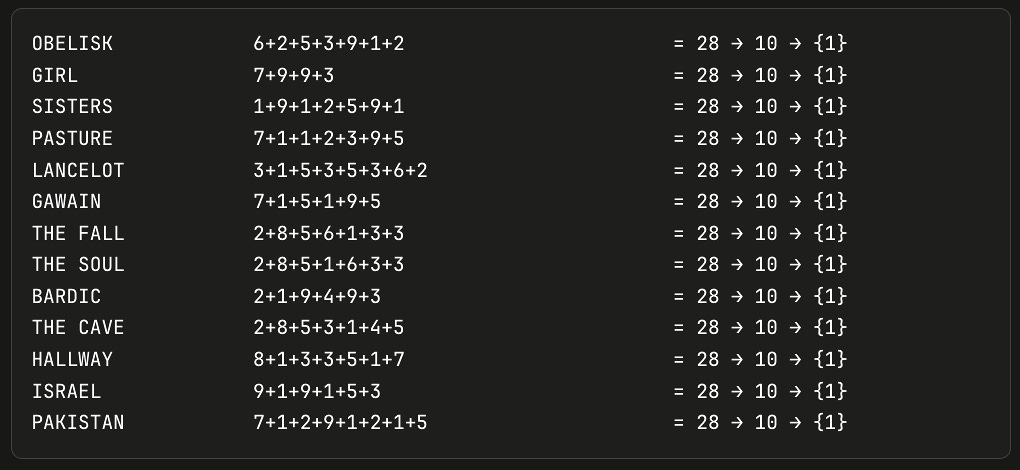
{28}: Duality|Relation: {2} crossing {+} into Eternal Law|Balance: {8} resolving to {10}: Full Journey|Return|Wholeness then to {1}: Initiation|Unity.
Tied to Saturn’s 28-year cycle to mark significant thresholds or phases in the course of an Individual’s development through life, {28} is the second Perfect Number, the sum of all its divisors: (1+2+4+7+14). It holds Biblical significance with {28} chapters in Acts and Matthew (KJV), and {28} mentions of ‘Lamb’ and ‘Hallelujah,’ linking it to divine purpose, and is used in commercial trade as the approximate number of grams in an ounce.
ONENESS: {28}
ORDEAL: {28}
LET IS BE: {28}
ZION: {28}
MERCY: {28}
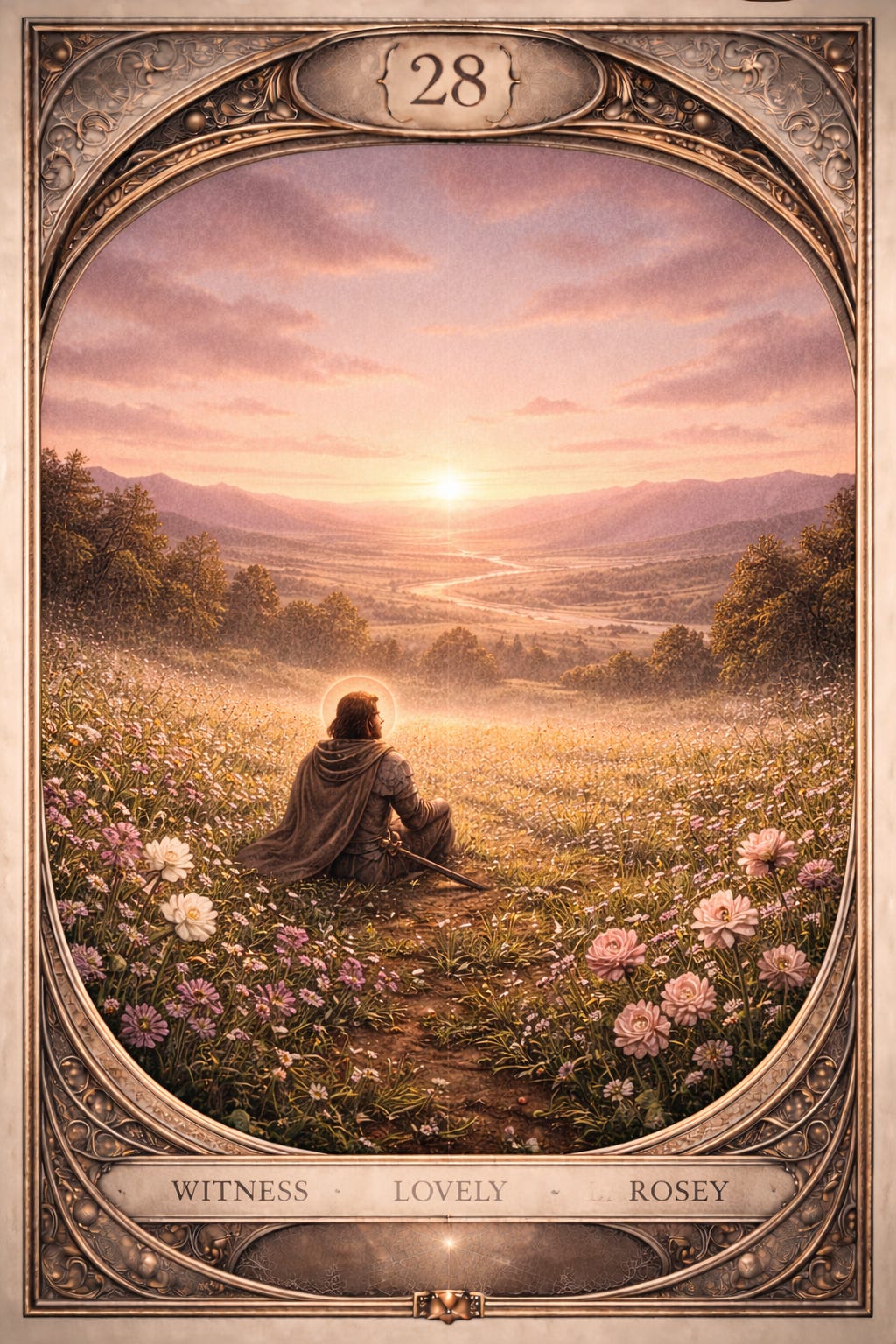
WITNESS: {28}
A Witness is more than a passive observer—in legal and spiritual contexts, the Witness is one who provides testimony to the Truth, serving to provide an event or material reality itself the Conscious Experience of Self so it may be recorded, reviewed, or simply felt. In Eastern traditions (Vedanta|Yoga), the Witness represents the True Self (Atman) that exists apart from the ego, mind, and body—the ‘inner eye’ that sees without judgment, representing pure awareness. While in the New Testament, it refers to one who has stood in Witness of Jesus’s ministry, death, and resurrection, often testifying even at the cost of their life, originating the term ‘martyr’. While the Israelites were called to be witnesses (representatives) of God's character to the world
Portal: {28}
A Portal is a threshold, transition, or gateway between Two different states, realms, or realities, seen as a Boundary between the familiar and the unknown, markers of Fresh Chapters, and serving as a Transformative Passage—such as from the material to the spiritual world. In a modern context, they signify a point of entry to information, websites, or interconnected Systems. The Portal embodies change, opportunity, and access to new dimensions of Experience, and are often described as imposing, large, or magical, a Portal acts as a symbolic, or sometimes physical, Doorway to another world—the very embodiment of the {1} crossing {+} the {0}.
LOVELY: {28}
Lovely symbolises deep affection, beauty, and warmth, originating from Old English: luflic to mean ‘lovable’. It signifies more than aesthetics, representing kindness, charm, and joy in both people and experiences. Often, Lovely implies a gentle, sincere, or even divine beauty that brings comfort, goodness, and delight—describing both visual beauty (charming|exquisite), pleasant personality traits in Individuals, and positive, enjoyable Experiences or a relaxing, comfortable Atmosphere, such as a ‘lovely day’ or ‘lovely meal.’ In all matters, Lovely is the quality that demands Return.
ROSEY: {28}
Rosey is a term describing a warm, pinkish hue, traditionally associated with the ‘Rosey-fingered Dawn’ of Homeric epic. It represents the first flush of light as the rises at dawn, signalling the Initiation of a fresh day, and evokes images of delicate, fragrant, and classic beauty. Beyond colour, it signifies a state of optimism, health, and vitality, and is used to describe a bright Future or a favourable, cheerful, and hopeful perspective, as in a ‘Rosy outlook.’
NORMAL: {28}
The word Normal originates from the Latin: norma, a carpenter’s square used to ensure a perfect right angle. Scientifically, it represents the Standard or the Baseline from which all deviations are measured. It is the state of poise and Balance that allows a System to function. Far from being ‘average,’ the Normal is the calibrated centre of Existence—the precise alignment that allows the future to be built on stable, predictable ground, symboling Unity with societal, cultural, or group standards, or a Return to stability after disruption or trauma.
NEVER: {28}
Never is the ultimate linguistic negation, originating from Old English: nāfre (‘not ever’). Unlike a temporary ‘no,’ Never serves as a definitive constant in language—symbolising absolute finality, negation, and the impossibility of an event occurring at any time in the past, present, or future. It serves as a powerful, definitive, and often emotional barrier, signifying strict prohibitions, permanent states, or the total absence of something—represents the unbreakable, eternal Boundary
SHINE: {28}
Shine refers to a steady, sustained emission or reflection of light, stemming from the Germanic: skeinan, meaning to be bright or clear. Unlike a momentary ‘spark’ or ‘flash,’ a Shine represents a Constant State of brilliance. Physically, this occurs when a surface is refined to the point of removing all friction and distortion, allowing it to reflect its Environment with total clarity. It is the outward Manifestation of internal energy—such as the thermal heat of a star—becoming visible as a permanent, radiant presence. It serves as a metaphor for standing out, personal growth, and showcasing one's Best qualities, while symbolising inner radiance, empowerment, and joy, often representing excellence, purity, and the Divine.
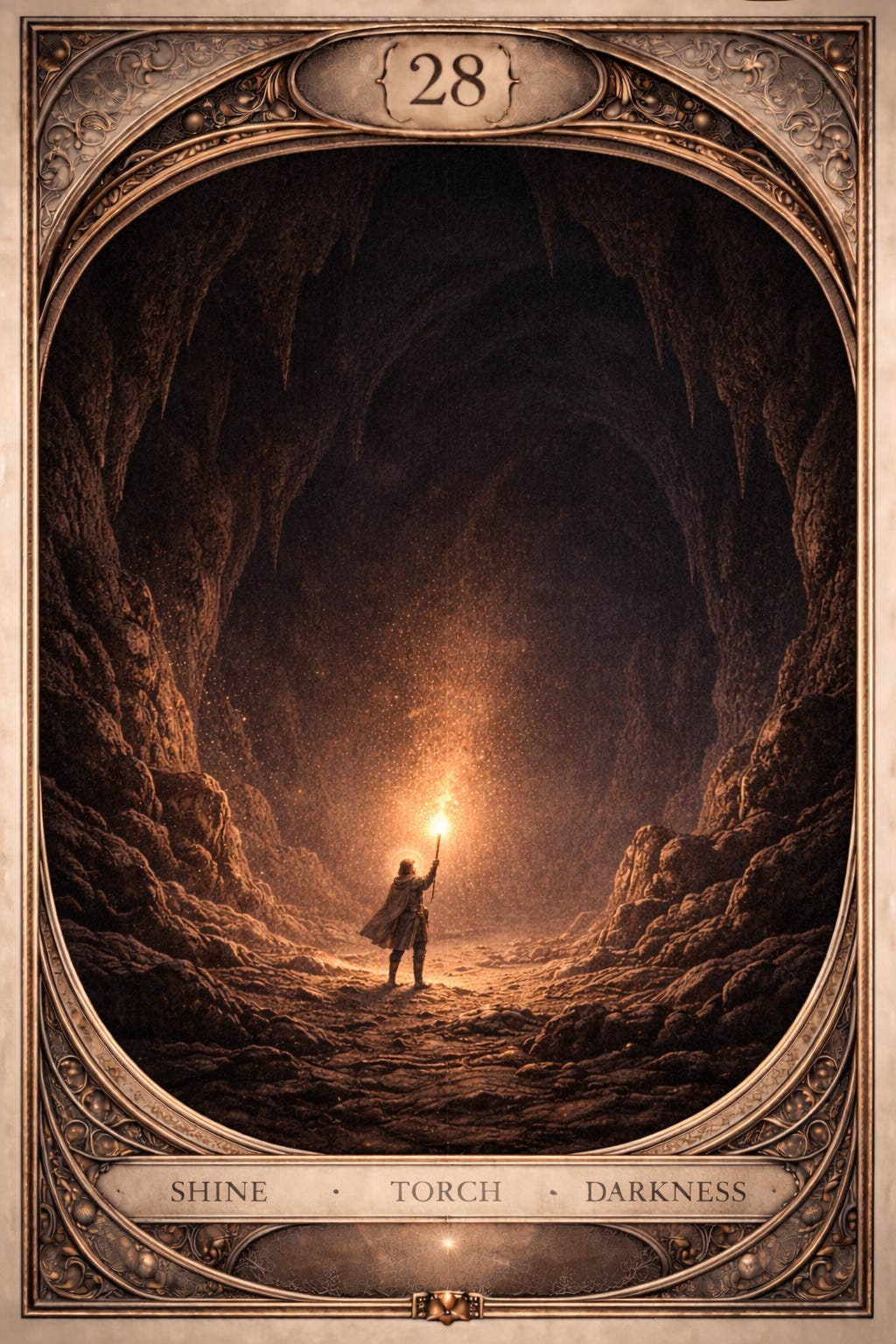
TORCH: {28}
A Torch is a symbolic or portable source of fire used to carry a flame from a central hearth into the unknown. It represents the active Initiation of light into a specific, dark space. Unlike the sun, which provides a universal and distant illumination, the Torch is used to refer to a metaphorical or material tool held aloft by an Individual to navigate their spiritual or physical Environment. It signifies hope, truth, and the enduring human spirit, frequently used in academic, governmental, and Olympic contexts to represent inspiration and the pursuit of wisdom—commonly symbolising enlightenment, knowledge, liberty, and Guidance, representing the triumph of light over Darkness.
DARKNESS: {28}
Darkness is the scientific absence of visible Light—universally symbolising mystery, fear, and evil, often serving as the counterpoint to Light, knowledge, and goodness. It represents hidden truths, secrets, the subconscious, and in many contexts, profound sadness or death. Conversely, it can also represent protection, quiet, rest, and the nurturing, hidden Potential before creation, while the ‘journey through Darkness’ signifies a transformative, often painful, Rite of Passage involving the unknown, despair, or spiritual testing
SPARKLE: {28}
Sparkle is the rapid, multi-point reflection of light caused by a surface with many facets, such as a gemstone or a crystalline structure. It is the visual result of a single, unified light source being broken and multiplied into a Field of brilliant points. Physically, a Sparkle is dynamic—only perceptible when the object, the light Source, or the Observer is in Motion. It represents a state where a solid, dense material produces an energetic and kinetic output, turning static light into a lively display of varied intensity.
ARAMAIC: {28}
Aramaic is a Semitic language with a history spanning over 3,000 years, serving as the lingua franca of the Near East and the administrative tongue of the Persian Empire. It is the language in which large portions of the biblical books of Daniel and Ezra were written, and it is widely recognized as the native dialect of Jesus. Historically, its alphabet is the ancestor of both modern Hebrew and Arabic scripts, an as a linguistic vehicle, it represents the long Journey between ancient Mesopotamian civilisations and the foundational texts of Western spiritual thought, acting as a preserved vessel for high-density historical and theological information.
CROWN: {28}
A Crown is a traditional form of headgear worn by a monarch as a symbol of sovereignty, victory, and divine right. Originating from the Latin: corona (garland or wreath), it marks the highest point of the individual, both physically and hierarchically. In anatomy, the ‘Crown’ refers to the top of the skull or the visible part of a tooth, signifying the terminal boundary of a structure. It represents the attainment of a final state of authority and law, where the wearer of the Crown is recognized as the singular point of Governance and symbol of Unity across a specific domain.
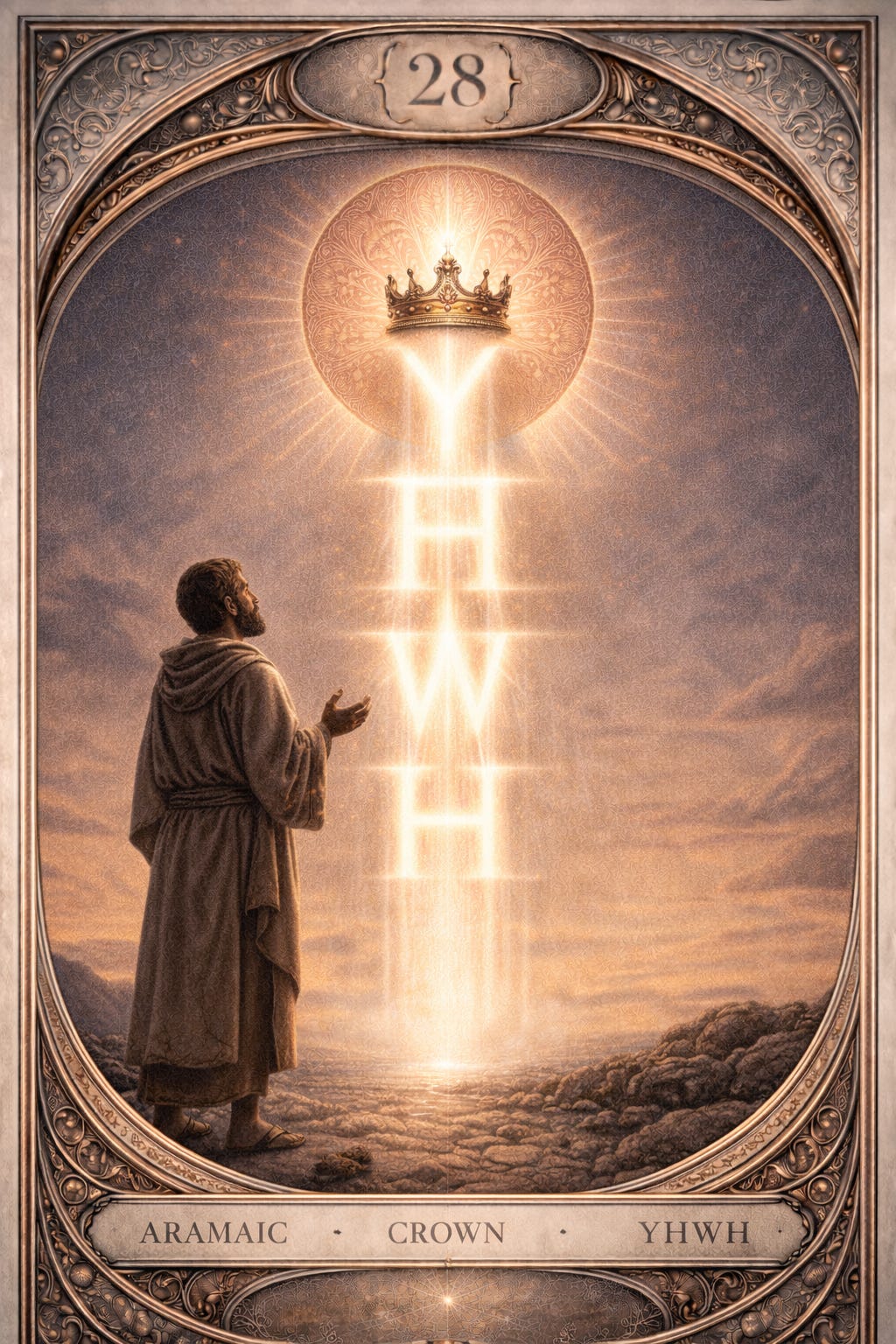
YHWH (English|Pythagorean): {28}
YHWH is the Tetragrammaton, the four-letter biblical name of the God of Israel. In Hebrew, the name is a trilateral form of the verb ‘to be,’ often interpreted as ‘He Who Causes to Exist’ or ‘I Am That I Am.’ It is considered so sacred in Jewish tradition that it is not spoken aloud, substituted instead with titles such as Adonai or HaShem. It represents the absolute source of Existence—a self-existent, eternal being that precedes and sustains all of creation. It is the linguistic representation of the Ultimate Unity from which all Relations and Laws emerge.
INTENT: {28}
Intent is the mental state of being set upon a specific course of action or purpose. From the Latin: intentus (stretching out|leaning forward), it describes the focused application of the will toward a target. In Law, Intent is the crucial element that distinguishes a deliberate act from an accident, determining the moral and legal weight of an outcome. It is the internal drive that precedes Manifestation—the invisible vector that directs energy into a specific form, ensuring the movement of an Individual remains aligned with a predetermined goal.
POISE: {28}
Poise is a state of graceful and elegant bearing, signifying a perfect distribution of weight and energy. Etymologically rooted in the Old French: pois (weight or balance), it describes the physical and mental Equilibrium required to remain steady under pressure. In physics, it is a unit of dynamic viscosity, measuring a fluid’s resistance to flow—philosophically, it is the refusal to be unsettled by external forces. Poise represents the calibrated centre of an Individual, where internal strength and external composure meet in a state of total structural Unity.
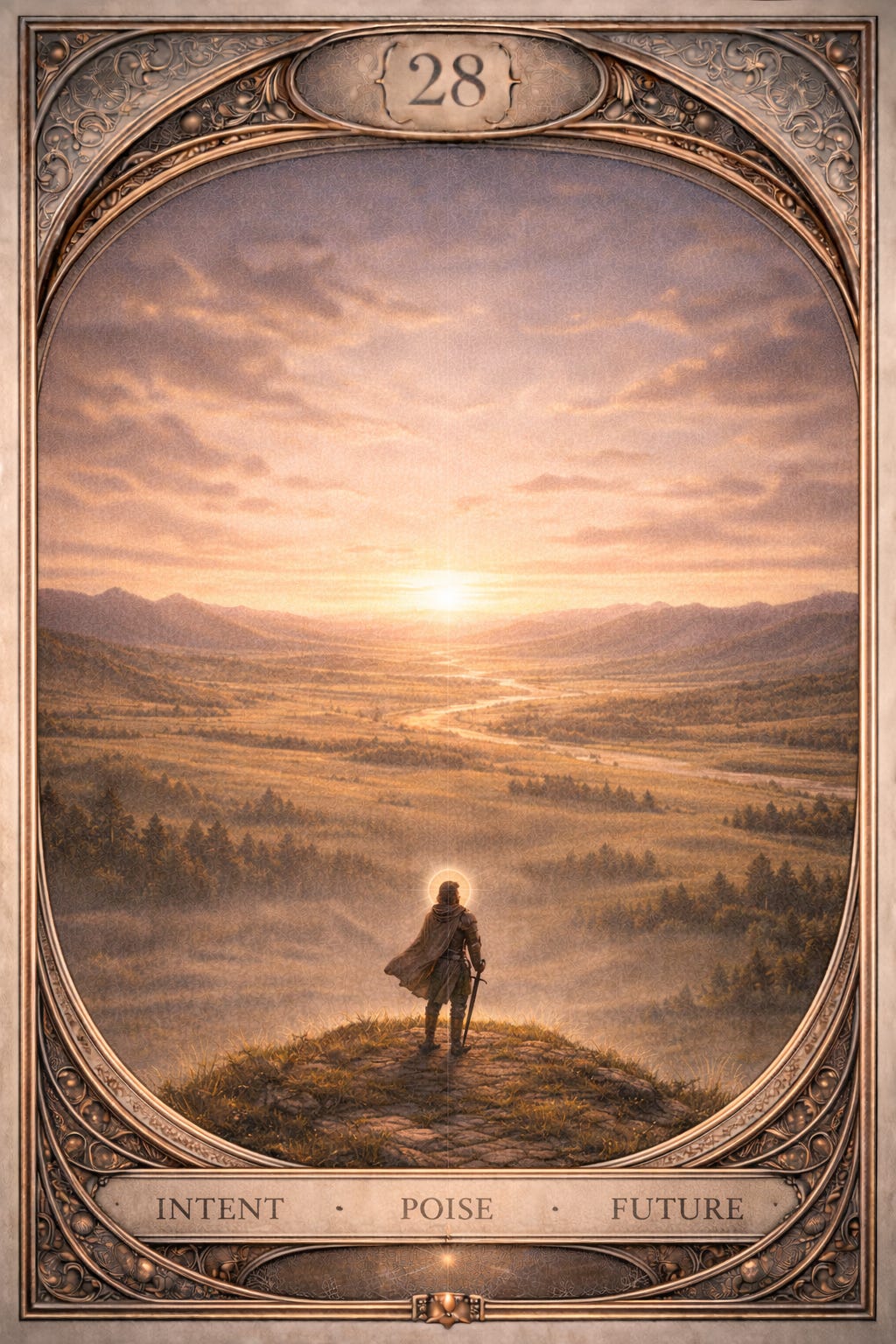
FUTURE: {28}
The Future is the time that is yet to come, derived from the Latin: futurus (about to be). While often viewed as a linear destination, it is scientifically a field of probability and potential that is shaped by current trajectory. It symbolises the unknown, progress, and anticipation, often acting as a forward-looking, optimistic concept associated with innovation, destiny, and the inevitable Passage of time. The Future is not an accident but a mathematical extension of the present—representing the ‘Return’ or the outcome of a Cycle, where all preceding actions and intents culminate in a fresh state of Unity—the horizon toward which every Journey inevitably leads.
THE WAY: {28}
The Way is a profound archetypal concept representing the path of right action and universal alignment. It is the most common translation of the Chinese term: Tao (or Dao), signifying the fundamental, underlying principle of the universe that flows through all Existence. In a historical and religious context, early Christians referred to their movement as ‘The Way’ before the term ‘Christianity’ was adopted. In storytelling, ‘The Way’ is the narrow, often difficult path the hero must discover to achieve resolution. It represents the transition from wandering into a state of directed purpose, where the Individual’s Journey becomes a reflection of the Eternal Law itself.
ORBIT: {28}
An Orbit is the gravitationally curved trajectory of an object, such as the Path of a planet around a star. From the Latin: orbita (wheel track), it represents a state of perfect Balance between momentum and gravity. In an Orbit, an object is in a state of constant freefall, yet it never crashes—instead maintaining a Perpetual Cycle. This movement defines the Boundaries of a System, creating a predictable, stable environment. It is the physical manifestation of a ‘Full Journey’ that returns to its beginning point with mathematical precision, ensuring motion remains Unified and Eternal.
KELVIN: {28}
Kelvin is the SI unit of thermodynamic temperature, starting at absolute zero—the point where all molecular motion ceases. Named after the physicist Lord Kelvin, this scale measures the total internal energy of a system. Unlike Celsius or Fahrenheit, the Kelvin scale is absolute—not relying on the properties of a specific substance like water, but on the fundamental laws of physics. It represents the ‘Standard’ of thermal intensity, signifying the calibrated measurement of heat and light, marking the Precise Point where energy becomes a functional, detectable force.
VOLTAGE: {28}
Voltage, or electromotive force, is the pressure from an electrical circuit’s power source that pushes charged electrons through a conducting loop. Named after Alessandro Volta, it is the ‘potential difference’ between Two Points that allows work to be performed. Without Voltage, electricity remains static and dormant—it is the ‘push’ that Initiates flow which then creates light, representing the Active Intent of a system to Move Energy from a state of Potential into a state of Manifestation.
IRIS: {28}
Iris serves a dual role in this frequency as both a biological mechanism and a divine messenger. In anatomy, the Iris is the coloured, circular structure in the eye responsible for controlling the diameter and size of the pupil, thereby regulating the amount of light reaching the retina. In Greek mythology, Iris is the goddess of the rainbow and the messenger of the Olympian gods, acting as the link between the heavens and the earth. Whether as a regulator of physical light or a carrier of divine information, Iris represents the ‘Adjustable Threshold’—the vital bridge that translates external brilliance into internal perception.
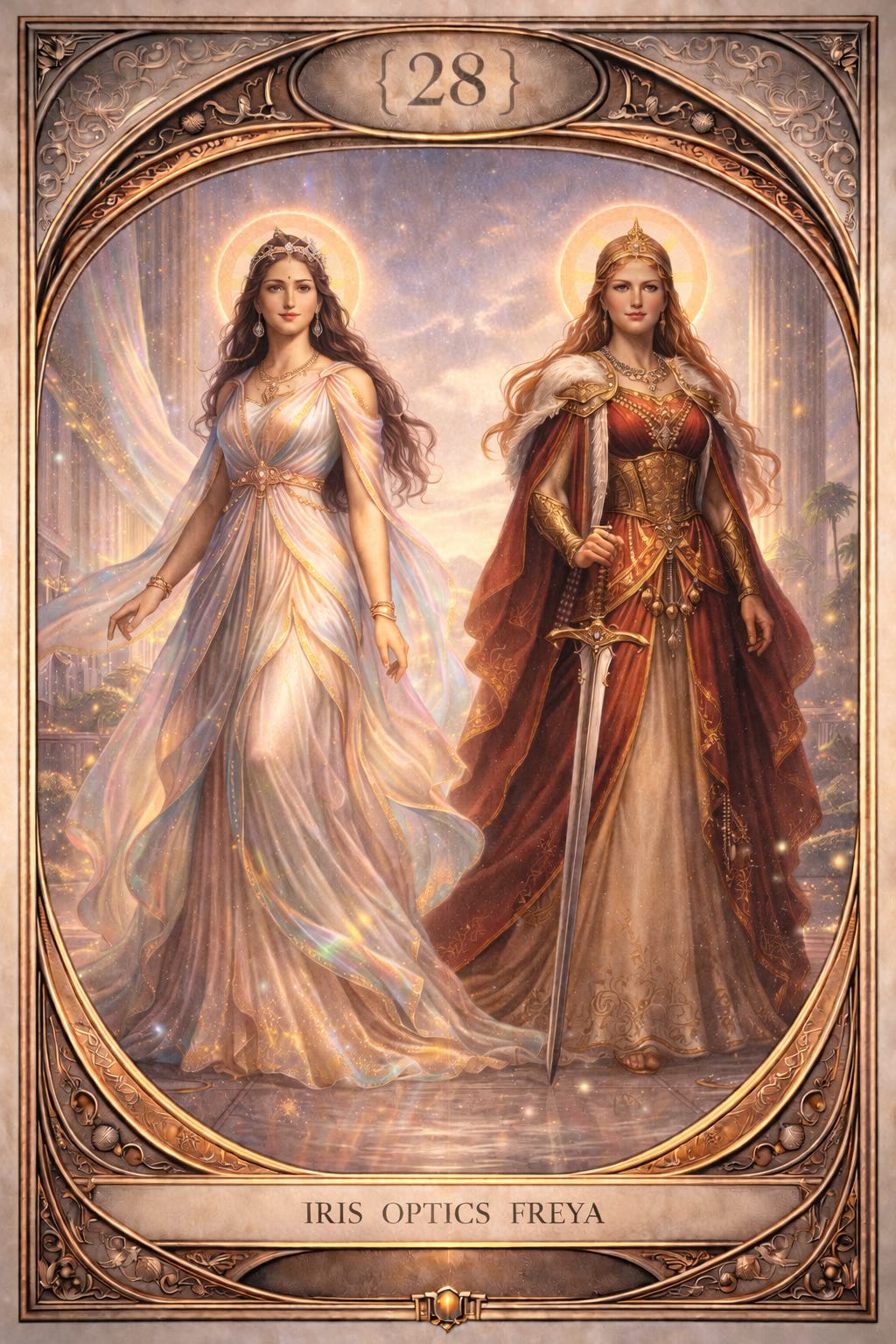
OPTICS: {28}
Optics is the branch of physics that studies the behavior and properties of light, including its interactions with matter. It Governs the Laws of reflection, refraction, and dispersion that allow for visual perception. Historically, the study of Optics transformed human understanding of the universe, moving from the subjective ‘feeling’ of sight to the objective measurement of light waves. It represents the structural baseline of how Experience is Witnessed, providing the precise ‘Standard’ through which external stimuli is Translated into a Coherent Image.
FREYA: {28}
Freya is a preeminent goddess in Norse mythology, associated with love, beauty, fertility, and war. She is the leader of the Valkyries and rules over the heavenly field Fólkvangr, where she receives half of those who die in battle. Freya represents a powerful duality; she is both the tender bringer of abundance and the fierce, armoured witness to conflict. Historically, she is linked to the practice of Seiðr, a form of Norse magic concerned with discerning and influencing the future. Her presence signifies the integration of the Relational Feminine with the absolute Sovereignty of a Ruler.
OCTOPUS: {28}
The Octopus is a highly intelligent cephalopod characterised by its three hearts, blue blood, and Eight complex arms that contain a majority of its neurons. This biological structure allows each limb to act with a degree of local autonomy while remaining part of a Unified Intent. The Octopus is a master of camouflage and Optics, capable of altering its skin texture and colour to vanish into its environment. It represents the ultimate fluidity of form—a creature that can navigate the immense pressure of the deep ocean through a combination of extreme flexibility and Centralised Intelligence, while its dwelling in the deep ocean connects it to hidden depths, secrets, and the subconscious mind.
FROG: {28}
The Frog is a diverse amphibian characterised by its Dual Life Cycle, transitioning from an aquatic, gill-breathing larva to a terrestrial, lung-breathing adult. This metamorphosis is a complete biological transformation, allowing the organism to survive in Two entirely different Worlds. Historically, the Frog has been a symbol of cleansing, rebirth, and fertility, and its ability to absorb moisture through its skin makes it a sensitive indicator of environmental health, serving as a biological record of the purity or toxicity of the water and land it inhabits.
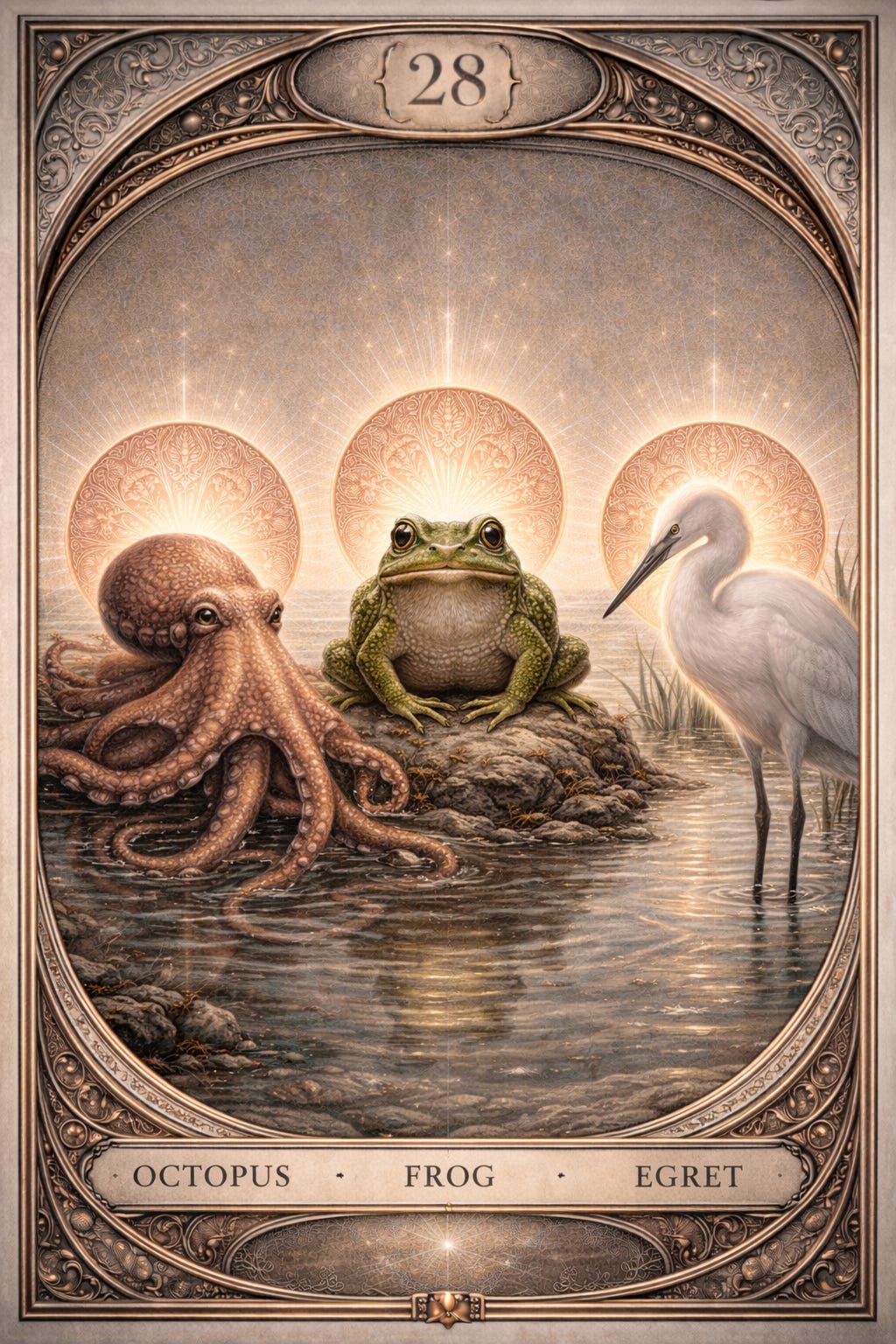
EGRET: {28}
The Egret is a heron-like bird known for its striking white plumage and its graceful, motionless hunting stance. Historically, the long feathers of the Egret were highly prized as symbols of status and purity. In many cultures, it is viewed as a symbol of tranquility and focused observation—standing perfectly still in the water, serving as a silent Witness to the ripples of the environment before striking with absolute precision. The Egret represents the state of being pure and clear—a brilliant, white presence that remains Poised and Balanced between the air, the land, and the water.
KOMODO: {28}
The Komodo dragon is the largest living species of lizard, an apex predator endemic to a handful of Indonesian islands. It is a biological relic of an ancient lineage, possessing a rugged, armoured hide and a sophisticated sensory system that allows it to track prey over vast distances using its forked tongue. This lizard represents a state of absolute prehistoric stability—a creature that dominates its environment through patient, motionless observation followed by a strike of overwhelming force. The Komodo embodies the resilience of an ancient organism that has remained unchanged through millions of years of environmental shifts.
OPOSSUM: {28}
The Opossum is the only marsupial found in North America, a resilient survivor that has persisted since the late Cretaceous period. It is most famous for thanatosis, or ‘playing dead,’ a physiological response to extreme threat where the animal enters a comatose-like state to deflect predators. This behavior is a literal physical preservation tactic, where the organism survives by mimicking the absence of life to protect it. It represents a unique form of protective stillness—an ability to endure life-threatening moments by retreating into a state of total, calculated inactivity.
SHREW: {28}
The Shrew is a small, insectivorous mammal known for its incredibly high metabolic rate, requiring it to eat almost constantly to sustain its body temperature. Because of this, the animal exists in a state of perpetual, intense kinetic energy. Despite its diminutive size, the Shrew is a fierce and relentless hunter, with some species even possessing venomous saliva to subdue larger prey. It represents life at its most rapid and Concentrated—a tiny unit of purpose that moves with a speed and ferocity that belies its physical stature.
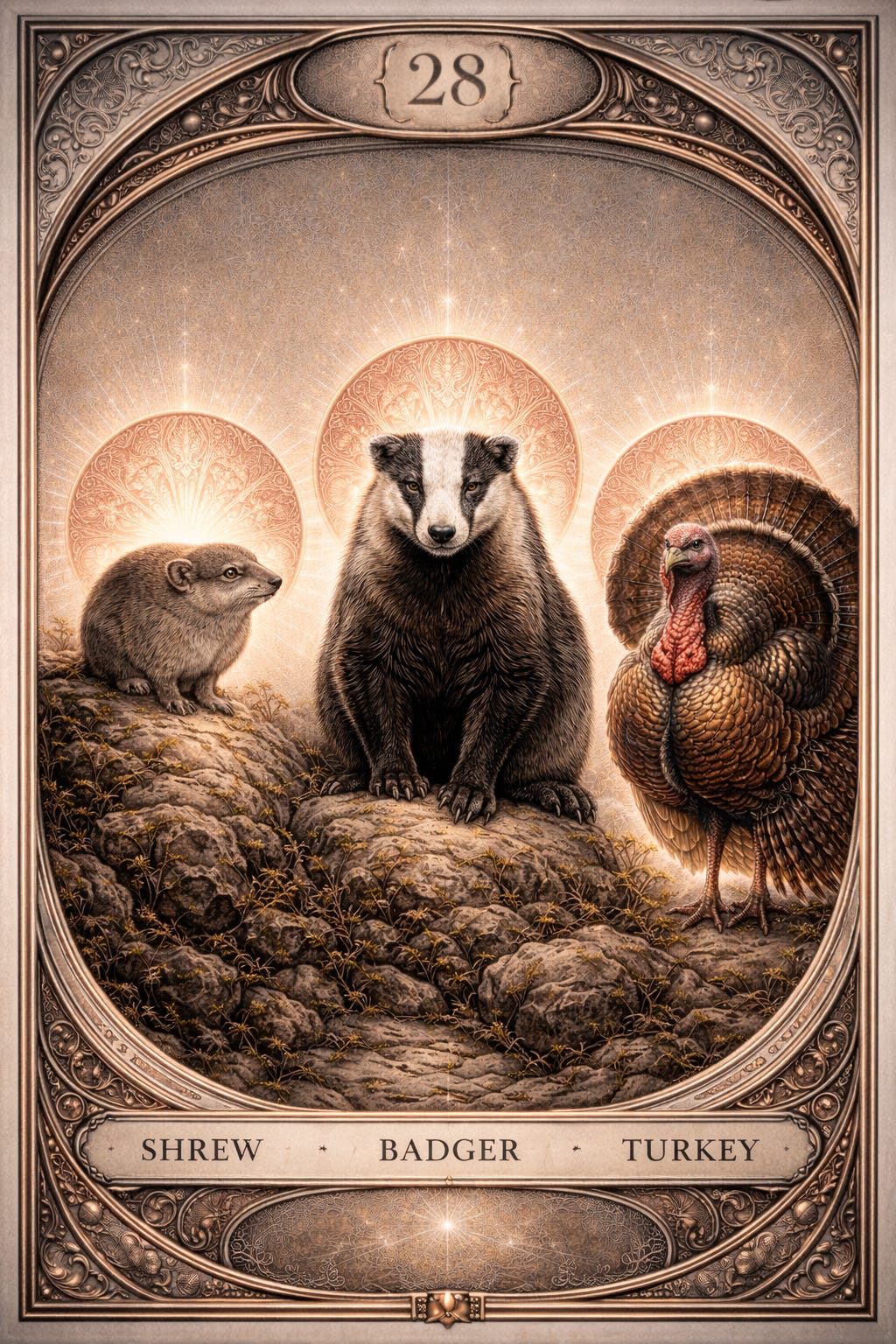
BADGER: {28}
The Badger is a robust, fossorial mammal known for its extraordinary strength and defensive tenacity. With a low Centre of gravity and powerful limbs designed for excavation, the Badger creates ‘setts’—complex underground tunnel systems that can persist for centuries. In folklore and biology, it is a symbol of grounded persistence and Solitude—an animal that maintains its own standard of territory with unyielding Poise. In Celtic tradition, they are associated with wisdom—their digging nature sometimes linked to uncovering hidden knowledge, or in older folklore, to witchcraft. Often seen as creatures that would rather die than surrender, the Badger symbolises endurance and the ability to see projects through past Completion.
TURKEY: {28}
The Turkey is a large ground-dwelling bird native to North America, historically revered by indigenous cultures such as the Aztecs and Mayans as a symbol of pride, fertility, and abundance. In Mayan iconography, the Turkey was often linked to the gods and seen as a vessel for religious sacrifice and festival. In modern Western tradition, it has become the central biological Anchor for the ‘harvest’ or ‘thanksgiving,’ representing the completion of a Seasonal Cycle. It is an animal characterised by its communal nature and its colourful, fan-like display—serving as a visible demonstration of vitality and social standing within its flock.
LAKSHMI: {28}
Lakshmi is the Hindu goddess of wealth, fortune, power, beauty, and prosperity. She is the Shakti (energy) of Vishnu, representing the active force that maintains and preserves the universe. Historically, she is depicted standing or sitting on a lotus flower, symbolising spiritual perfection and the ability to remain untainted by the ‘mud’ of the material world. Lakshmi is not merely about material riches; she represents the ‘Aims of Human Life,’ including moral duty and emotional fulfilment. Her presence signifies a state of total abundance where the internal and external worlds are in perfect, wealthy alignment.
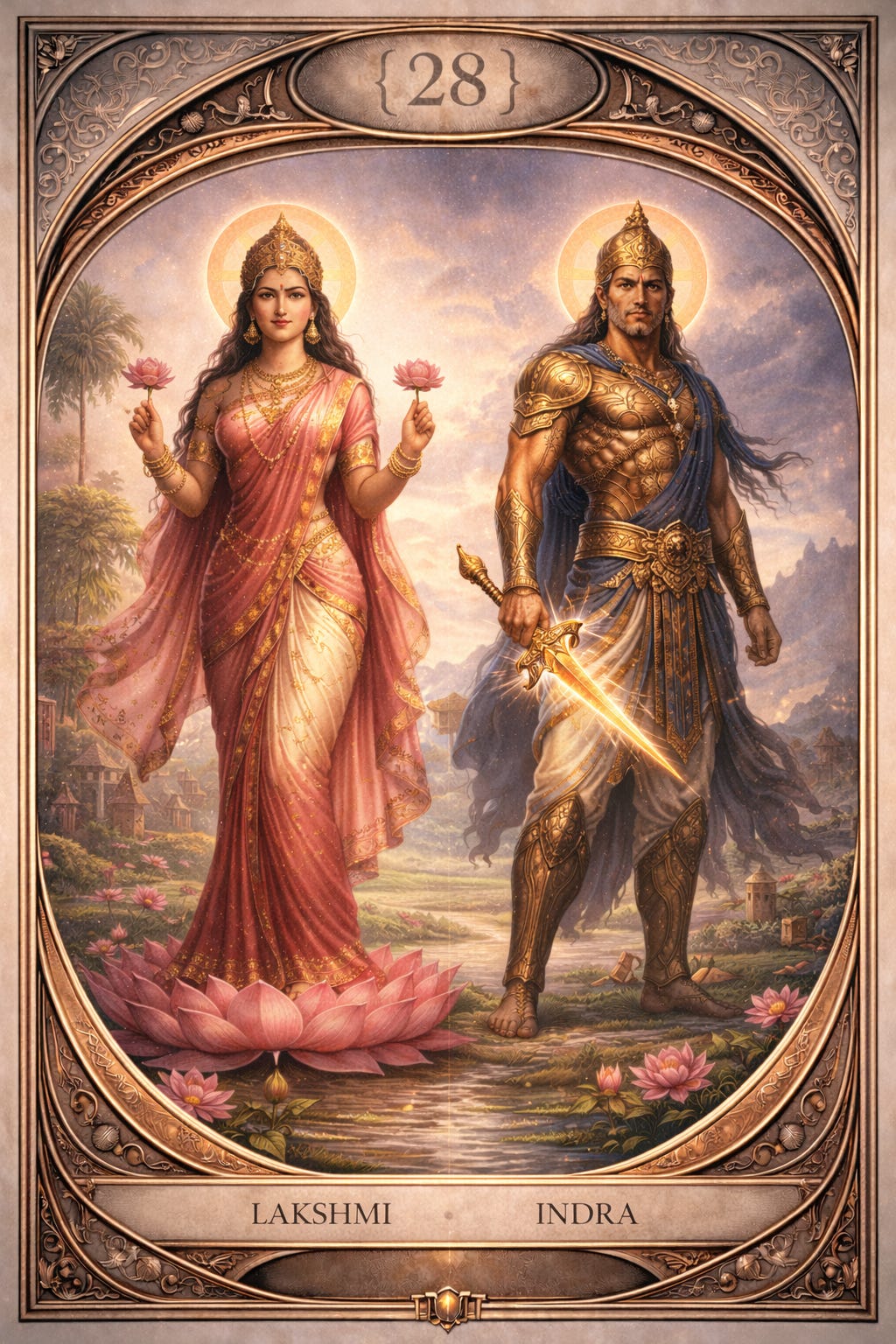
INDRA: {28}
Indra is the king of the gods (Devas) and the lord of the heavens in Vedic mythology. He is the deity of thunder, lightning, storms, and river flows, wielding the Vajra (thunderbolt) as his primary weapon. Historically, Indra is celebrated as a great warrior who defeated the serpent Vritra, liberating the waters and bringing light to the world. He represents the ‘Sovereignty of the Sky’ and the immense pressure and power required to govern the natural elements. As the leader of the heavenly host, he embodies the force of Will that breaks through obstacles to Initiate the flow of life-giving resources.
SVAROG: {28}
Svarog is the Slavic god of celestial fire and blacksmithing, often regarded as the creator and father of the other gods. Historically, he is credited with forging the world and establishing the First Laws of marriage and social order. As a divine smith, Svarog represents the transformative power of heat and craft—one who takes raw, chaotic elements and hammers them into a structured, functional Reality. He signifies the ‘Celestial Forge,’ where the fire of Intent is used to create the permanent foundations of civilization and the Eternal Cycles of the sun.
SHANGO: {28}
Shango is one of the most powerful and popular deities in the Yoruba religion of West Africa, serving as the Orisha of thunder, lightning, and justice. Historically a powerful king of the Oyo Empire, he was deified after his death, becoming the embodiment of royal authority and masculine fire. He is often depicted carrying an Oshe (a double-headed axe), which represents the Balanced power of a Ruler who can both create and destroy. Shango represents the ‘Electric Will’—the sudden, transformative strike of lightning that clears away falsehood and restores the moral order of the community.
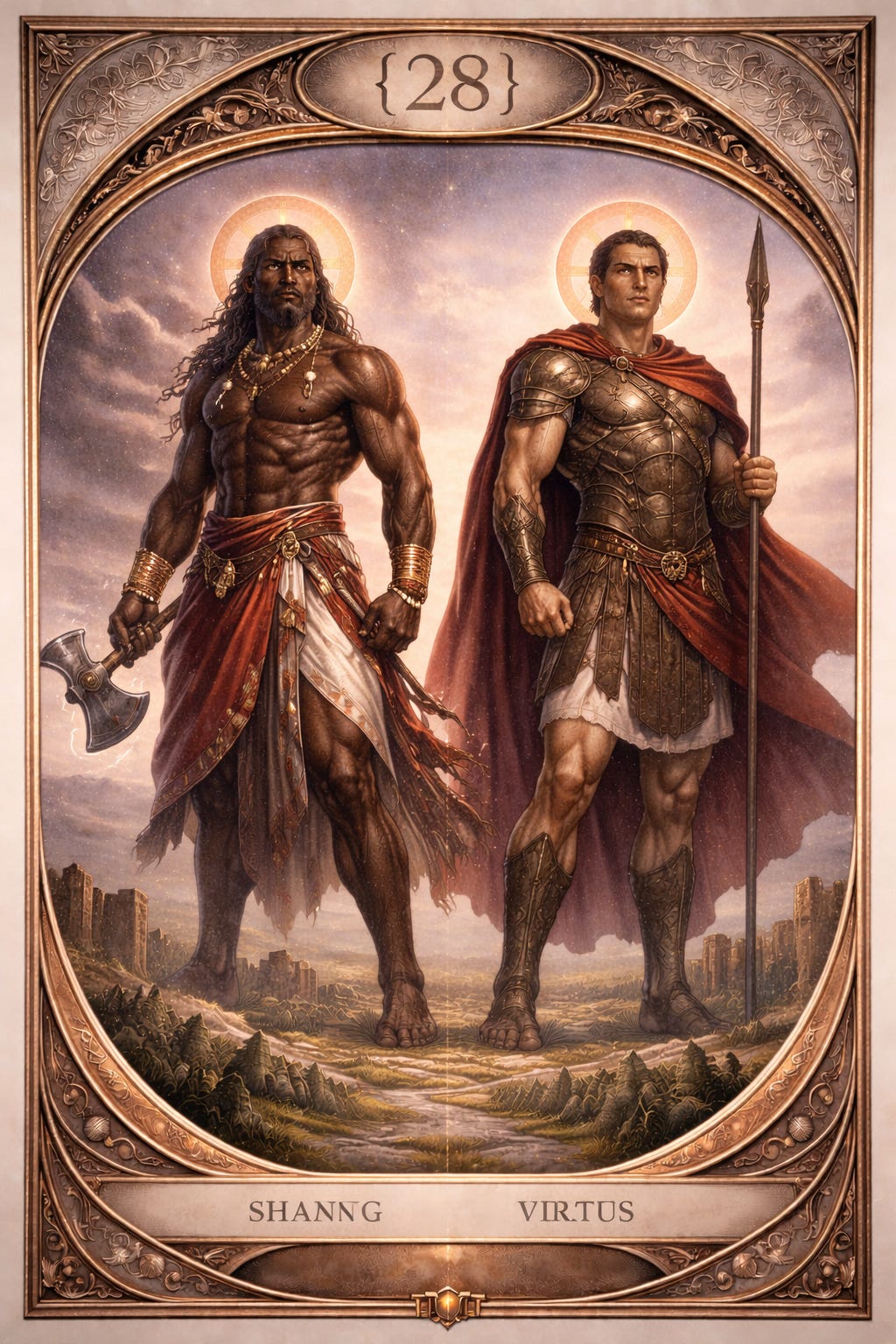
VIRTUS: {28}
Virtus was a Roman deity and the personification of ‘Virtue,’ specifically the qualities of bravery, military strength, and moral excellence. In Roman thought, virtus was not a passive trait but an active, rugged strength of character, derived from vir, the Latin word for Man. This deity was often depicted on Roman coinage as an armoured figure, symbolising the ‘Internal Standard’ required to Govern oneself and Lead others. Virtus signifies the unwavering alignment of an Individual’s Actions with a code of honour, acting as the ethical bedrock that allows a society to remain stable and upright.
IAPETUS: {28}
Iapetus is one of the twelve original Titans in Greek mythology, the son of Uranus (Sky) and Gaia (Earth). He is known as the Titan of Mortality and is the father of prominent figures like Prometheus and Atlas. Historically, Iapetus represents the ‘Pillar of the West,’ one of the four columns that hold the heavens and the earth apart. His lineage is tied to the very Beginnings of mankind and the enduring struggle Between divine power and human limitation. He embodies the ‘Structural Boundary’ of the ancient world—the foundational force that maintains the space where mortal life is allowed to exist.
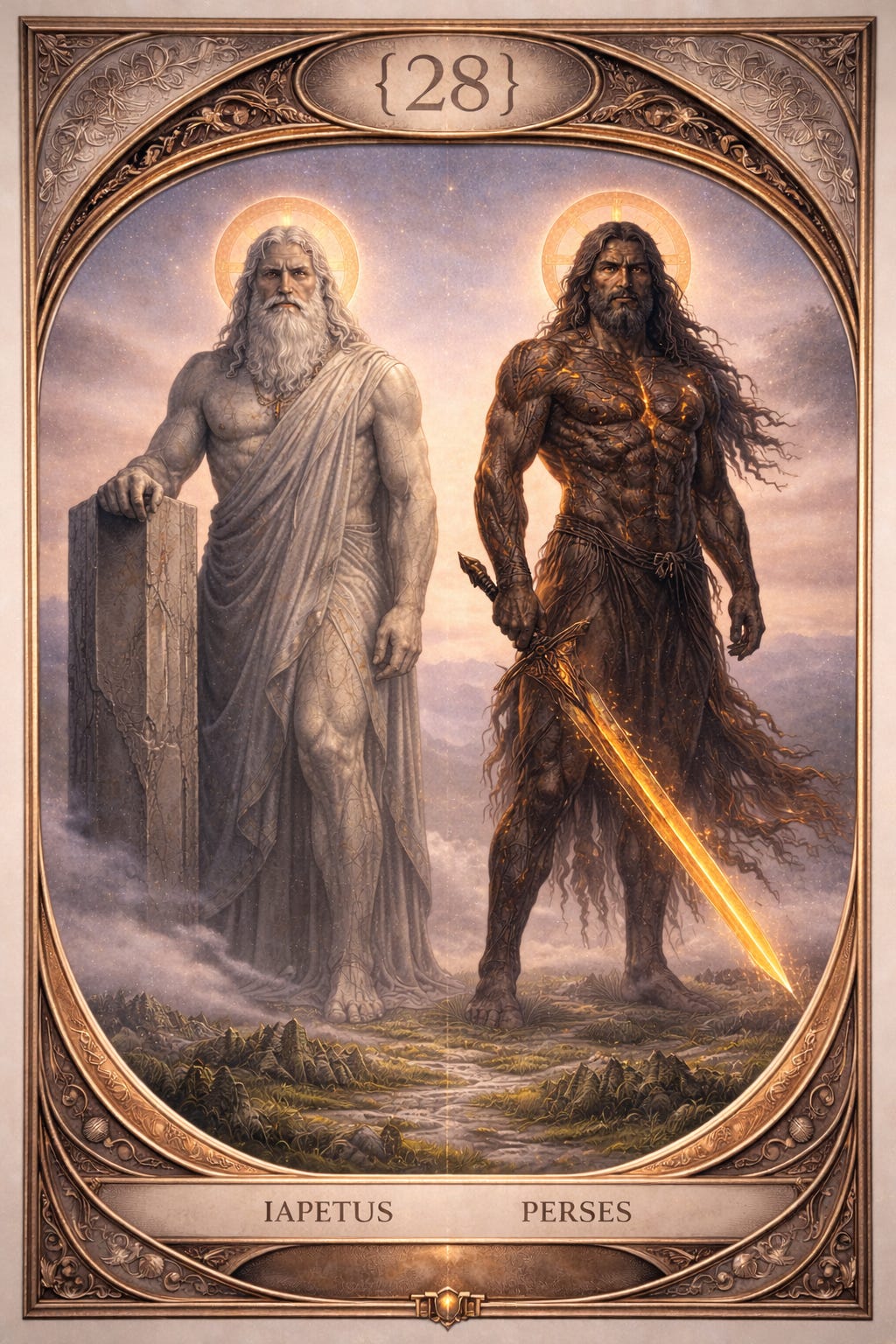
PERSES: {28}
While Perses is the Greek Titan of destruction and the scorched earth. In the generational hierarchy of Greek myth, he is the son of Crius and Eurybia, and the father of Hecate. His name is derived from the Greek word: perthō (to lay waste or to sack). Unlike chaotic destruction, Perses represents the ‘Cleansing Fire’ or the necessary Close of a Cycle that allows for new growth to Begin. In this context, he is the guardian of the transformative void, overseeing the moment when one Journey Ends so another may Emerge.
CENTAUR: {28}
The Centaur is a mythological creature from Greek antiquity with the upper body of a human and the lower body of a horse. This form represents a total biological integration of the ‘Higher Mind’ and ‘Animal Instinct.’ Historically, Centaurs were often depicted as wild and untamed, with the notable exception of Chiron, the wise tutor of heroes. The Centaur embodies the tension of a Dual Nature held in a Single Frame—embodying the internal conflict between reason and passion, often signifying chaos, barbarism, and unbridled, lustful behavior.
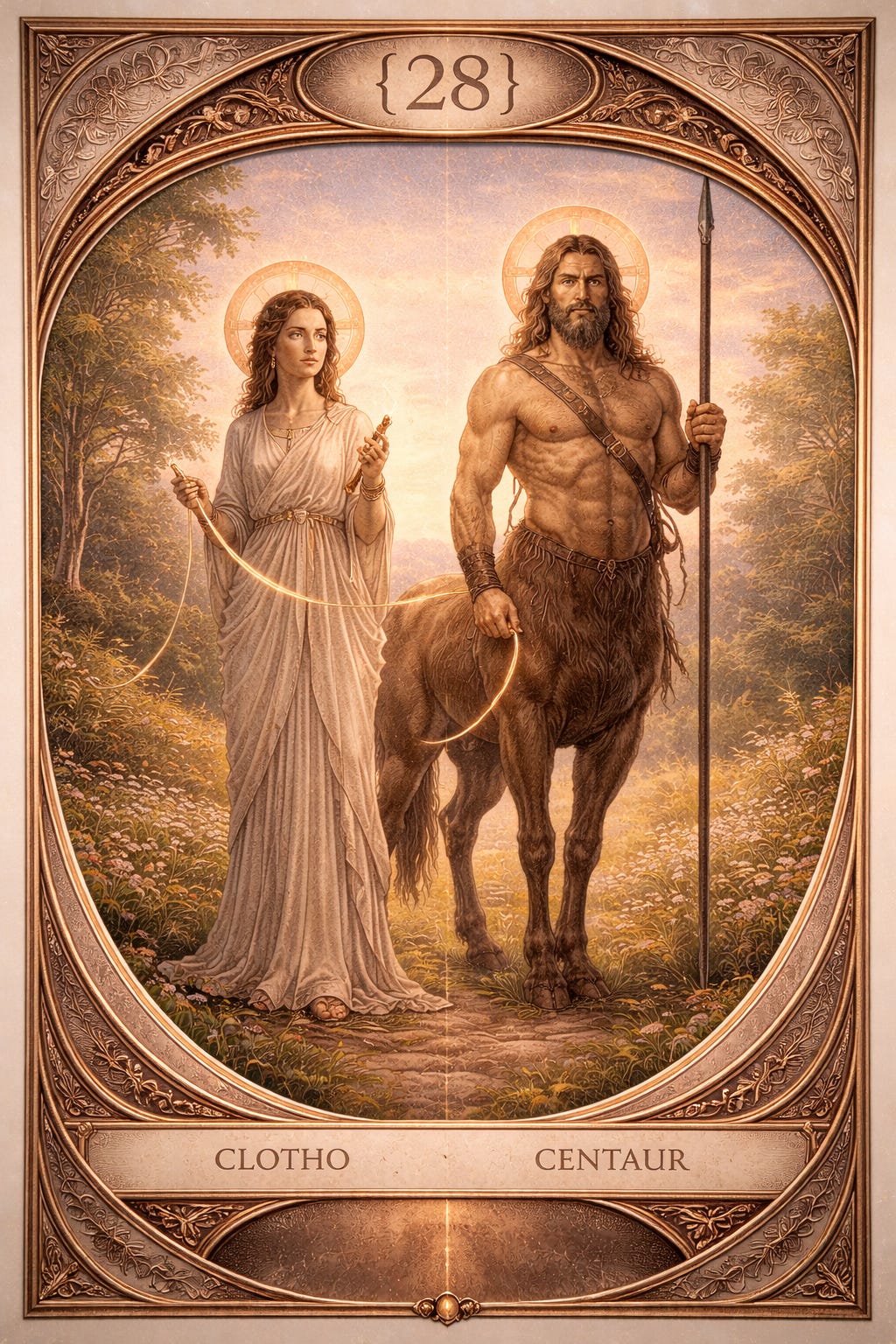
CLOTHO: {28}
Clotho is the youngest of the three Moirai, or Fates, in Greek mythology. Her name is derived from the Greek verb: klōthein (to spin). As the ‘Spinner,’ she is the one responsible for spinning the thread of human life, effectively initiating the existence of every mortal and god. Historically, she represents the ‘First Cause’ or the point of origin for any Journey. Clotho decides when a life begins, making her the divine gatekeeper of potential. She is the steady hand that turns raw, unformed fate into a structured, linear reality.
SPORE: {28}
A Spore is a specialised reproductive cell capable of developing into a New Individual without fusion with another cell. Found in plants, algae, fungi, and protozoa, the Spore is a master of environmental resilience, often encased in a protective coating that allows it to remain dormant for years in extreme conditions. A Spore is a biological ‘Hard Drive’—it contains the entire genetic blueprint and future potential of an organism in a highly compressed, nearly indestructible form. It represents the ultimate state of ‘Survivalist Poise,’ waiting for the exact right moment to Initiate the next Cycle of life.
CLEMATIS: {28}
Clematis is a genus of climbing vines within the buttercup family, long celebrated in horticulture for its diverse and brilliant blooms. Its name is derived from the Ancient Greek: klema (vine branch or climbing plant). Unlike plants that rely on a rigid trunk, Clematis secures its journey upward by using its leaf stalks to coil around structures, demonstrating a unique ‘adaptive strength.’ Historically, in the language of flowers, it represents mental beauty and ingenuity. It signifies the ability of a living system to ascend toward the light by finding firm purchase on the world around it, turning a flexible form into a towering display of vitality.
SUCCULENT: {28}
A Succulent is a plant characterised by its thickened, fleshy tissues adapted to retain water in arid climates or soil conditions. This biological strategy allows the plant to maintain a state of internal abundance even when the external environment is completely depleted. From the Latin: succulentus (full of juice), these plants are masters of ‘Self-Containment.’ They represent a high-efficiency structural law: by storing their own life-force within a geometric, often armoured exterior, they remain poised and vibrant through extended periods of drought, embodying a state of permanent, living readiness.
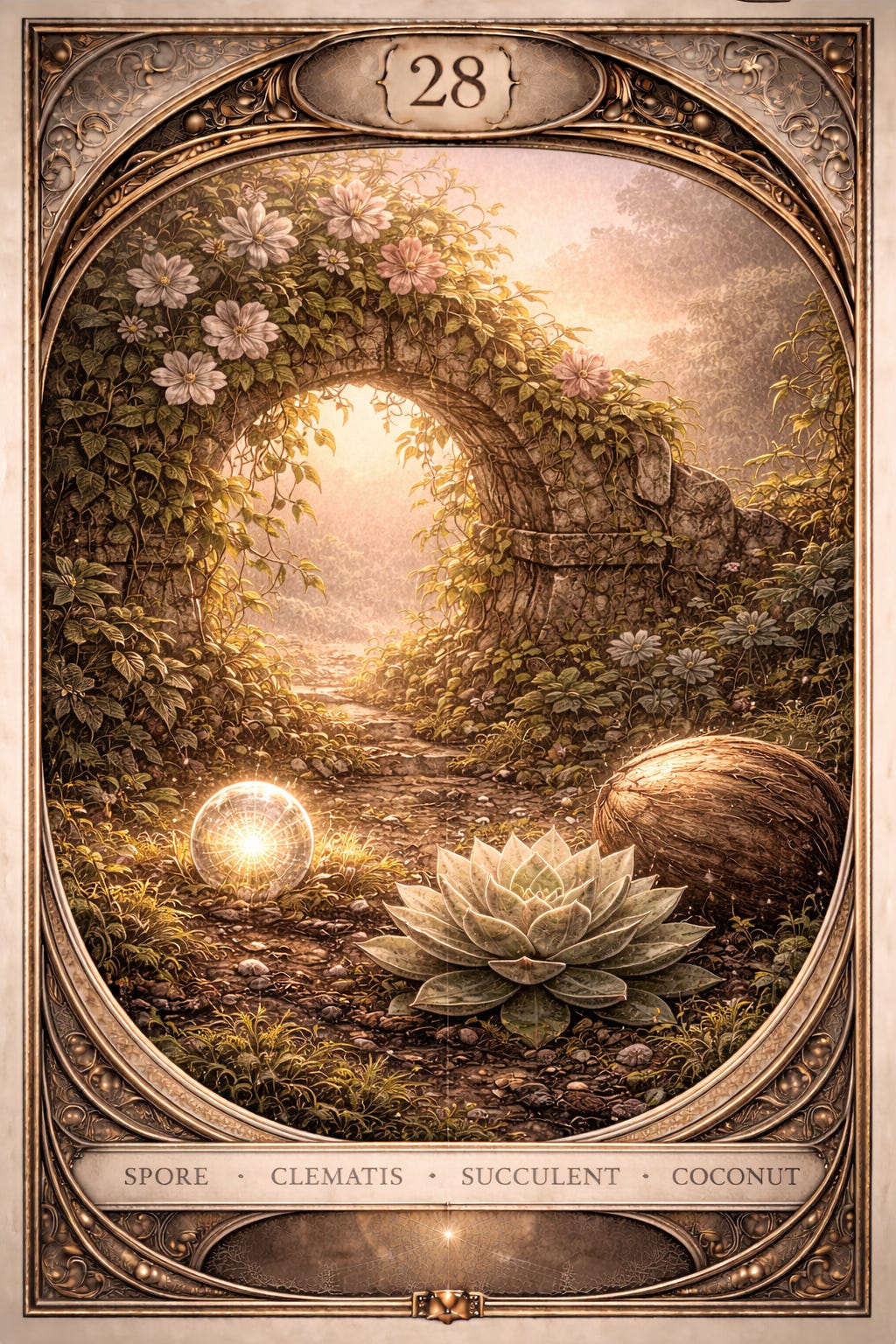
COCONUT: {28}
The Coconut is the fruit of the coco palm, uniquely designed for long-distance dispersal across the world’s oceans. Its structure is a masterpiece of biological engineering: a hard, protective endocarp (the shell) protects the nutrient-dense ‘meat’ and water inside, while a fibrous husk provides the buoyancy needed to float for months. Historically, it is known as the ‘Tree of Life’ because every part of it can be used for survival. It represents the ‘Self-Sustaining Vessel’—a biological unit that can cross the vast, dark void of the sea to initiate a new forest on a distant shore.
SPRUCE: {28}
The Spruce is an evergreen coniferous tree characterised by its conical shape and needle-like leaves, thriving in the cold, northern temperate and boreal regions of the earth. Historically, its wood has been prized for its ‘resonance,’ used to create the soundboards of the world’s finest violins and pianos. The Spruce represents a state of ‘Enduring Clarity’—remaining green and functional throughout the harshest winters, refusing to enter the dormancy of deciduous trees. It stands as a perennial Witness to the changing seasons, maintaining a consistent, upright presence and a unified structural integrity regardless of the temperature.
OBELISK: {28}
GIRL: {28}
SISTERS: {28}
PASTURE: {28}
LANCELOT: {28}
GAWAIN: {28}
THE FALL: {28}
BARDIC: {28}
THE CAVE: {28}
HALLWAY: {28}
ISREAL: {28}
PAKISTAN: {28}
NICKEL: ATOMIC ELEMENT {28}
Nickel is the chemical element with atomic number {28}, positioned as a transition metal in the periodic table. It is one of only four elements that are ferromagnetic at room temperature, meaning it possesses a natural, internal ability to align its atoms into a unified magnetic field. Historically, nickel has been found in “iron” meteorites, making it one of the first metals from the heavens to be utilised by ancient civilisations for tools and weaponry.
In the story of this frequency, Nickel serves as the literal ‘Hardware of Endurance.’ Its primary characteristics perfectly mirror the principles of the {28} frequency:
Corrosion Resistance: Nickel is prized for its ability to resist oxidation. It does not easily succumb to the ‘Darkness’ of decay, maintaining its polished Shine even in harsh, acidic, or high-temperature environments. It acts as the ‘Normal’ or the stable baseline in metallurgy, often added to other metals to provide them with structural Poise.
The Earth’s Core: Geologically, Nickel is a primary component of the Earth’s inner core. Along with Iron, it forms the dense, pressurised center of our world. It is the Anchor of the planet’s magnetic shield, the very force that allows the atmosphere to exist and protects the Future of all biological life from solar radiation.
The Superalloy: Because of its high melting point (1455°C), Nickel is the critical component in ‘superalloys’ used in jet engines and gas turbines. It is the metal that can withstand the Voltage and heat of extreme propulsion without losing its shape.
As the 28th element, Nickel is the ‘Durable Witness’ of the periodic table. It is a material that survives the fire, resists the rust, and holds the centre of the world together.
The Linguistic Hinge: TWENTY-EIGHT

{57}: Life|Change: {5} crossing {+} into Perfection|the Mystic Quest: {7} resolving to {12}: Divine Order then to {3}: Creation|Expression—the Frequency of PERFECTION|DETERMINISM|THE ALL-CREATOR|PROVIDENCE|THE WILD WOMAN and THE MASTER BUILDER.
{82}: The Path of Active Imagination
Calculation Board:

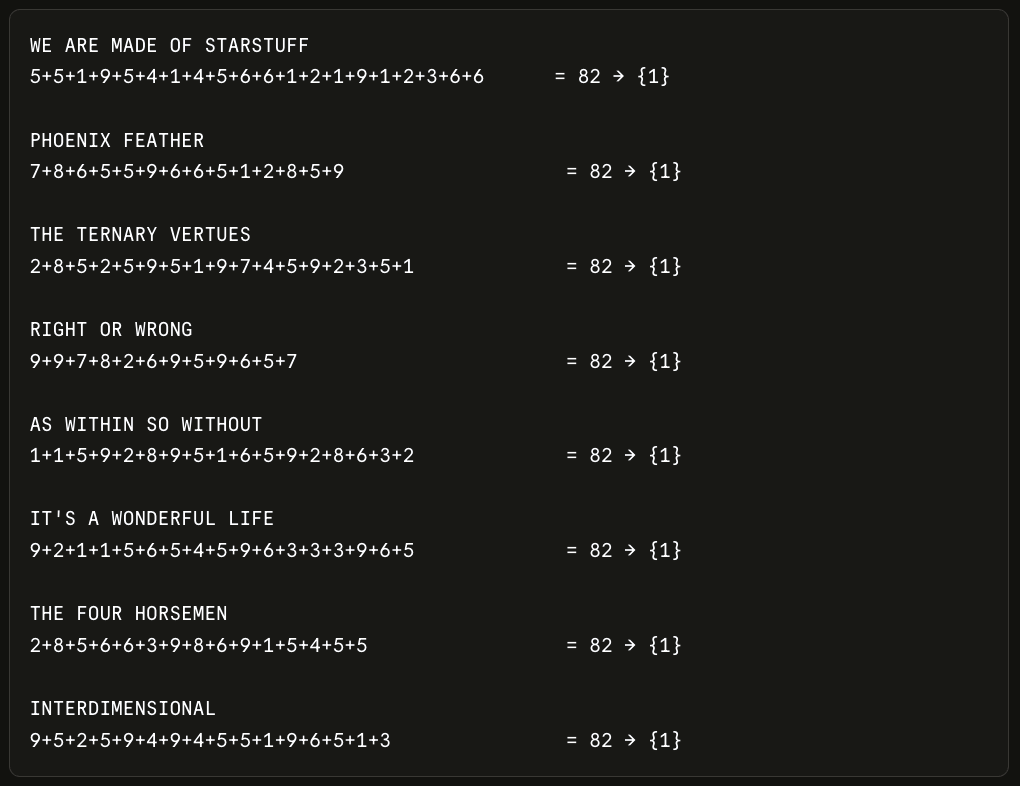

{82}: Eternal Law|Balance: {8} crossing {+} into Duality|Relation: {2} resolving to {10}: Wholeness|Return|Full Journey then to {1}: Unity|Initiation.
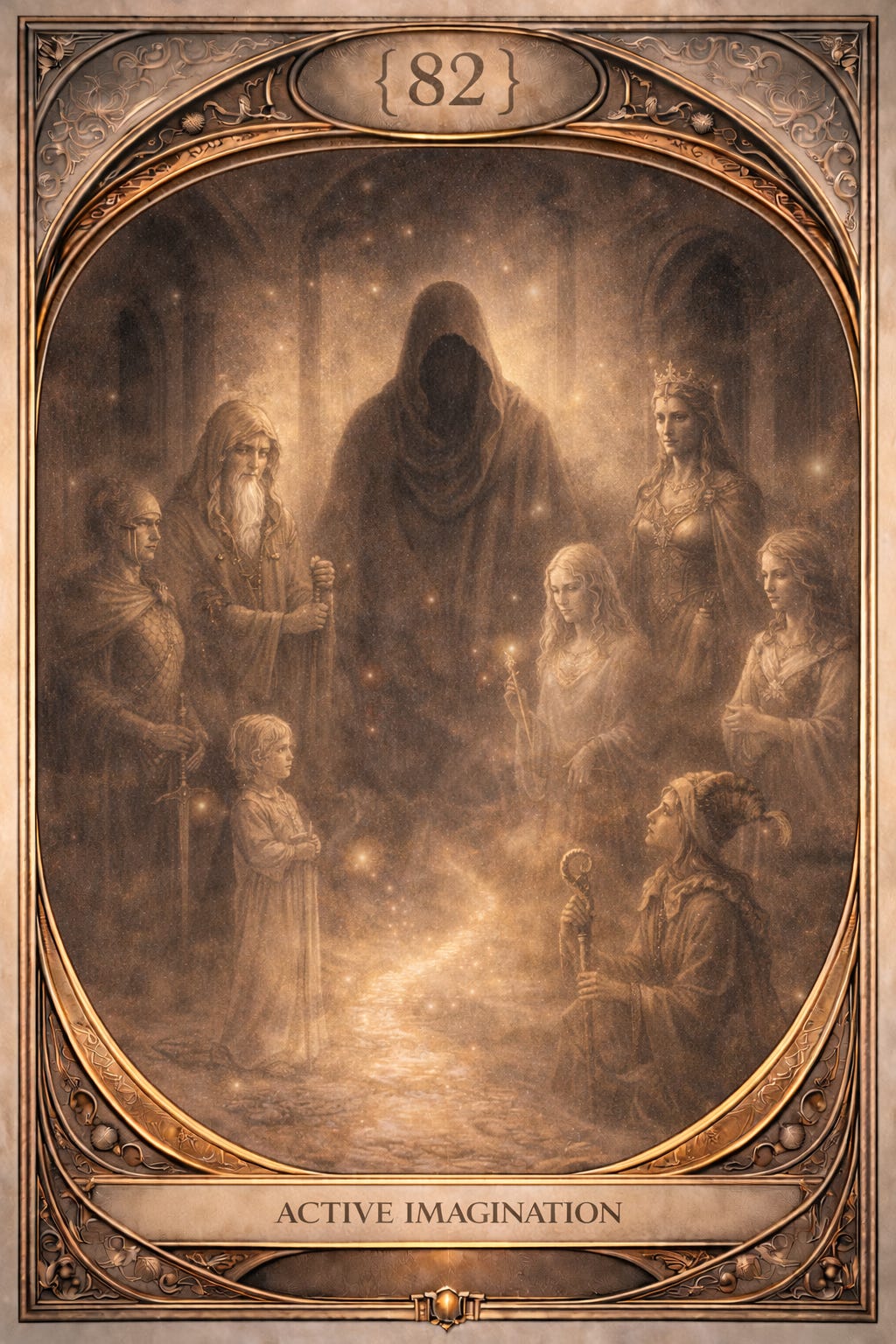
Active Imagination: {82}
Active Imagination, a technique developed by Carl Jung, signifies a conscious, active dialogue with the unconscious mind to foster self-awareness and integration (individuation). It represents Bridging the gap between conscious thought and subconscious imagery, allowing symbolic, autonomous inner figures to interact with the Ego, serving as a ‘method of introspection,’ and symbolising the Journey toward becoming a complete Individual by allowing different, fragmented parts of the psyche to Interact and Integrate.
{100}: Number Of The Wundering-Pilgrim
Calculation Board:
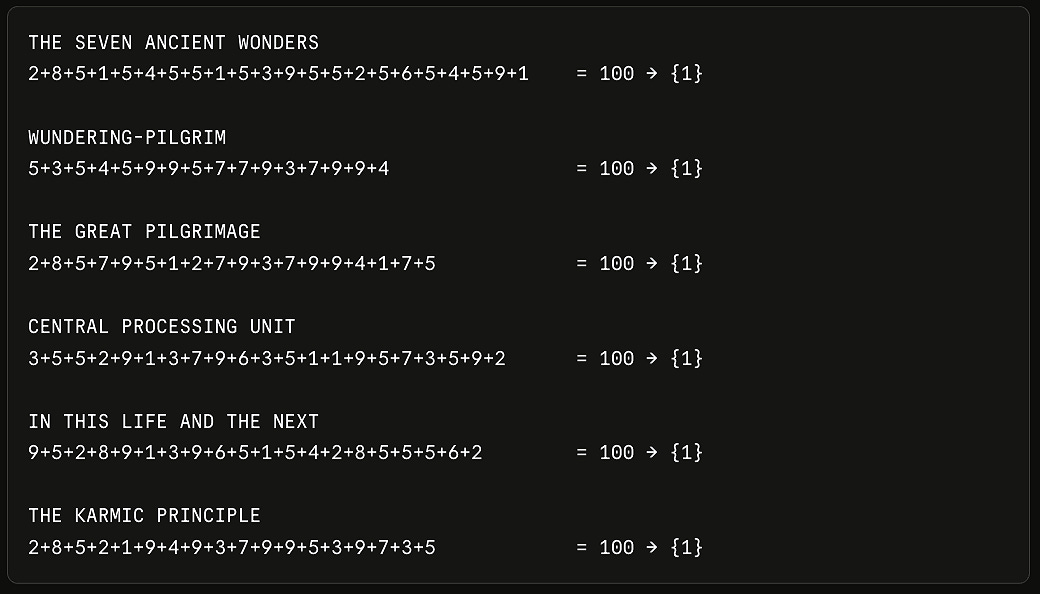
{100}: Unity|Initiation: {1} crossing {+} into the Void|Unknown|Potential: {0} crossing {+} into the Void|Unknown|Potential: {0} resolving to {1}: Unity|Initiation.
The Linguistic Hinge: ONE HUNDRED

{54}: Change|Life: {5} crossing: {+} into Foundation|Structure: {4} resolving to Completion|Love|Universal Wisdom: {9}—the Frequency of DARK ENERGY|BOOK OF THOTH|GOOD AND EVIL|ALL IS WRITTEN|IT SHALL BE DONE|ILLUMINATOR|RELATIONALLY|THE MAGICIAN|THE PANTHEON and SUN, MOON, AND STARS.