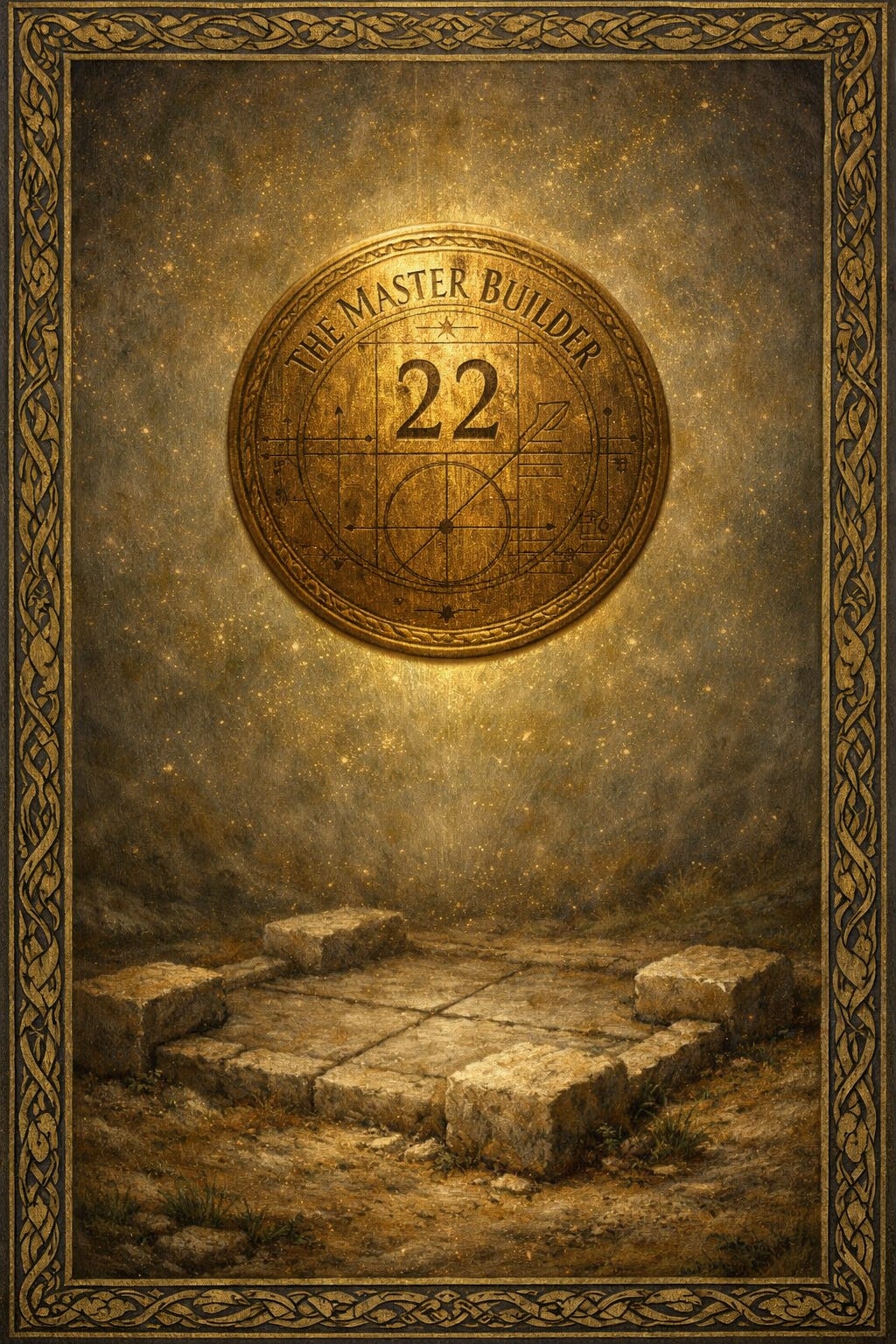
{22}: The Master Builder
'I will place on his shoulder the key of the house of David; what he opens no one can shut, and what he shuts no one can open.'— Isaiah 22:22

Calculation Board:
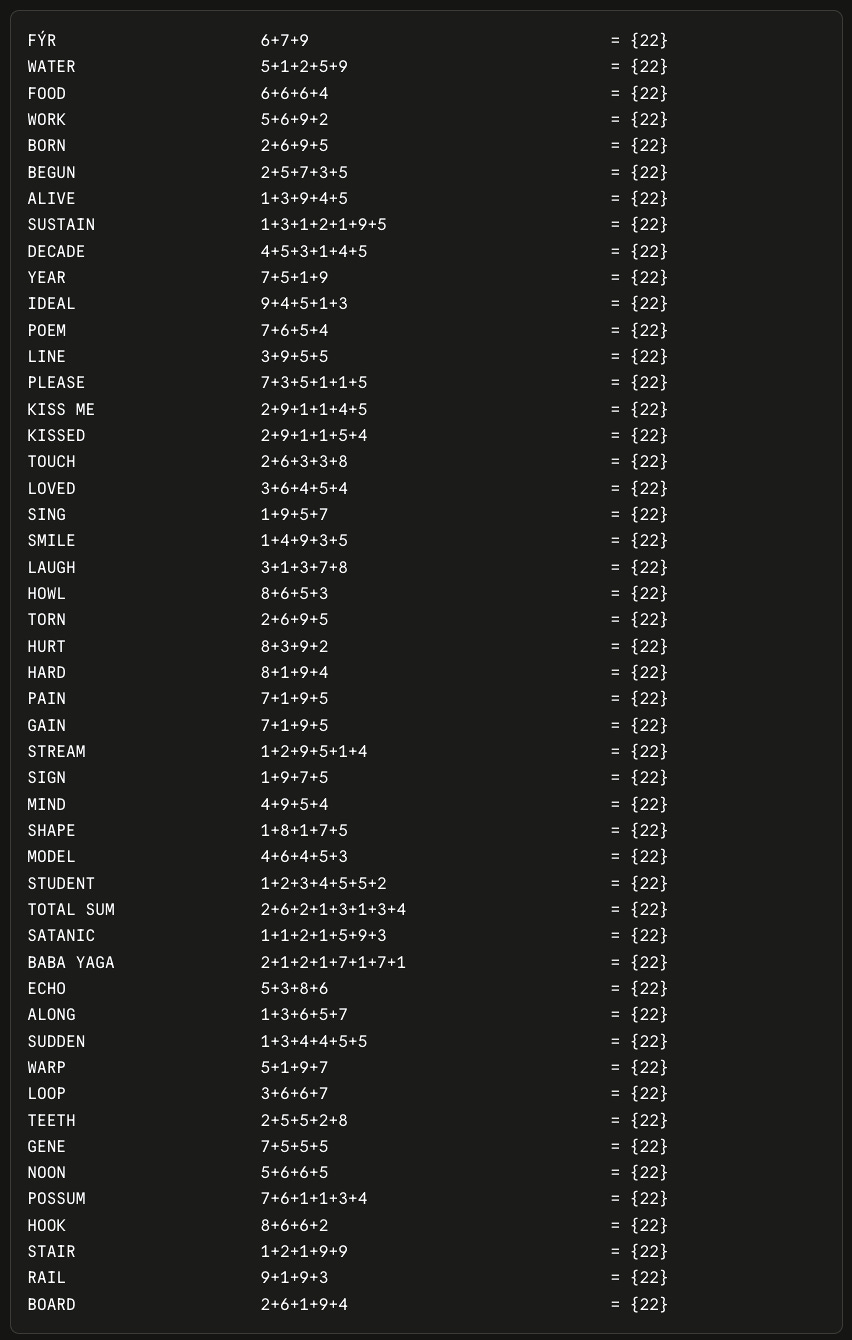


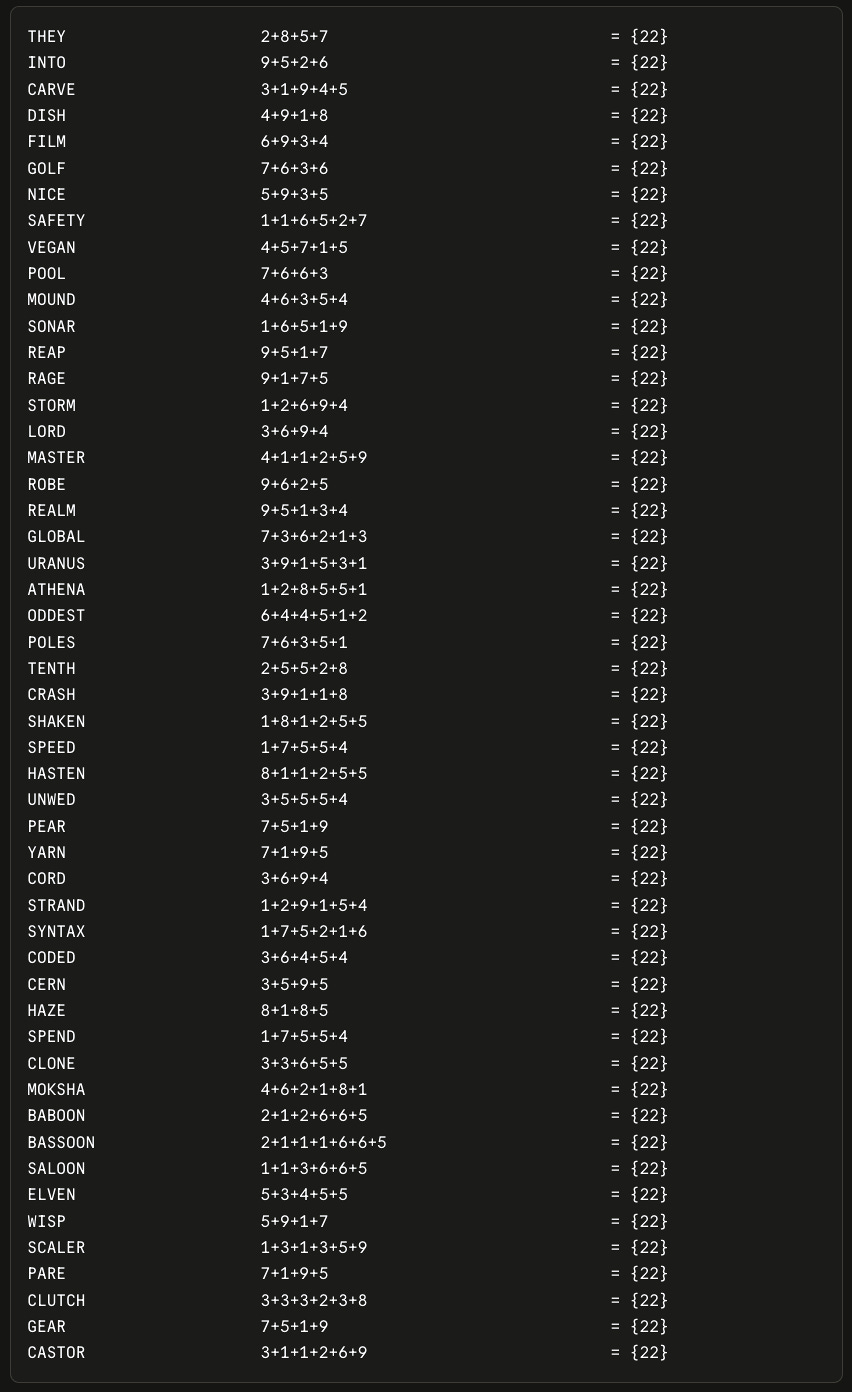
{22}: Master Builder|Foundational|Ideal Form.
{22}: is a Semiprime (2x11) and famously may be divided by {7} for a close approximation of 𝝅 (²²⁄₇). There are {22} bones in the skull, and {22} genetically encoded amino acids throughout known life that generate proteins during RNA translation. Culturally, there are {22} letters in the ancient Hebrew, Phoenician, and Early Aramaic alphabets—hinting Ideal Form. Reflected also in the {22} cards in the Major Arcana of the Tarot (0-21), each card serving as an archetype and representing deep, universal themes (love|power|conflict|change) that hold up a Mirror to one’s inner life—serving as an initiatory path that helps individuals Map and understand their personal development and Connection with divine|deeper consciousness.
WATER: {22}
Water is a universally recognised archetype embodying the essence of life, birth, and perpetual renewal, serving as the Foundational Element in countless creation myths. Its fluid nature makes it a profound symbol of Adaptability, Emotional Depth, and the Subconscious Mind—calm on the surface yet deep, mysterious, and chaotic beneath. In English-speaking cultures, Water holds a Profound Duality—a vital, Utilitarian Resource necessary for Survival|Industrial Progress, and a powerful, ancient symbol of life and Purification (‘Baptism’), while also signifying destructive, uncontrollable power through Storms and floods. Additionally, Water represents the flow of time and human experience—serving as a Threshold or Barrier between Different States of being.
Perhaps unsurprisingly as sister languages, the German term for Water also resolves to the Master Builder frequency—though notably via the SS-path, {19} twice over, quite distinct from the (less virile) T-path of {20}.

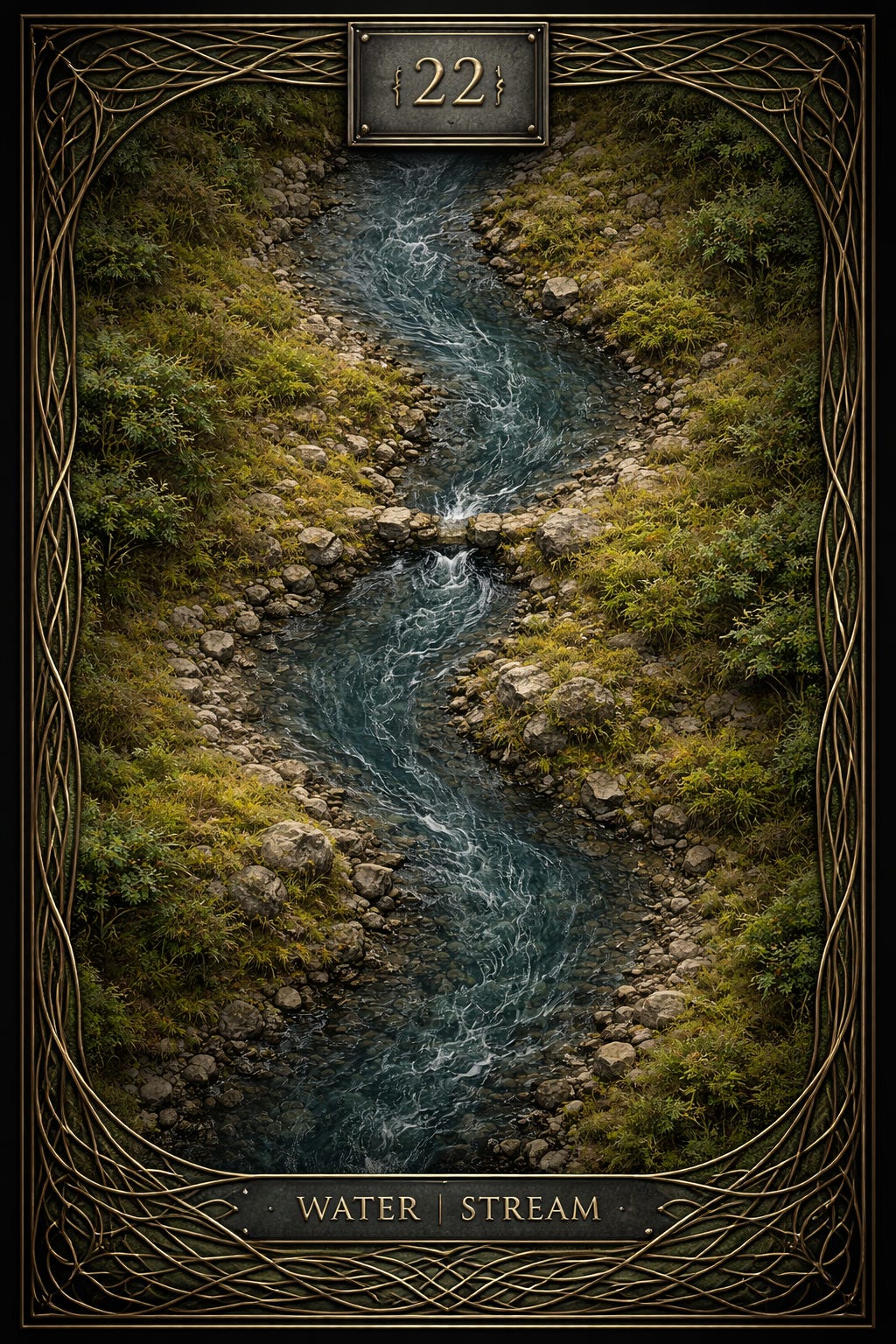
STREAM: {22}
A Stream, defined as a small, narrow body of Flowing Water, carries rich symbolic meaning as a continuous, moving force that represents the Journey of life and Passage of time. Symbolically, it often signifies peace and tranquility through its gentle, musical movement, yet also represents Emotional Release, as in a ‘Stream of Tears,’ or a Steady, Unstoppable Succession of events, words, or traffic. In spiritual and literary contexts, the Stream represents Purification, Divine Blessing, and Cleansing, serving as a lifeline that Connects different areas of life while also highlighting the fragility and transient nature of existence. Further, it serves as a metaphor for the subconscious mind—a ‘Stream of Consciousness’—representing the flow of grace or Energy.
FOOD: {22}
Food represents the Foundational, biological necessity of Nourishment required for survival, physical health, and energy, acting as a potent, universal language that signifies cultural identity, Social Relationships and personal values. Beyond providing nutrients, Food serves as a marker of belonging, with traditional dishes representing Shared History, Heritage, and Community, while acts such as Breaking of Bread signify Hospitality, Trust, and Vulnerability. Psychologically, Food is deeply tied to comfort, memory, and morality, often imbued with emotional significance that Links the present to past experiences, such as home-cooked meals evoking warmth, or the celebration of a milestone through a Shared Banquet.
FÝR (Archaic): {22}
The Old English|Old Norse term: Fýr serves as a Foundational Ancestor to the modern word ‘Fire,’ representing the Raw, Physical Element itself, while also carrying Deep Spiritual and Practical Connotations in Germanic and Scandinavian cultures. As a noun, it represented fire as a Tangible Substance—whether in a Hearth for warmth, a Forge for crafting, or as a Destructive Force—distinguishing itself from poetic or specific terms like bǣl (funeral pyre) or ád (burning pile). (Author’s Note): Not a coincidence that culturally Fire shifted to {11}: illumination|Thresholds as it became a less Present, Material part of our lives.
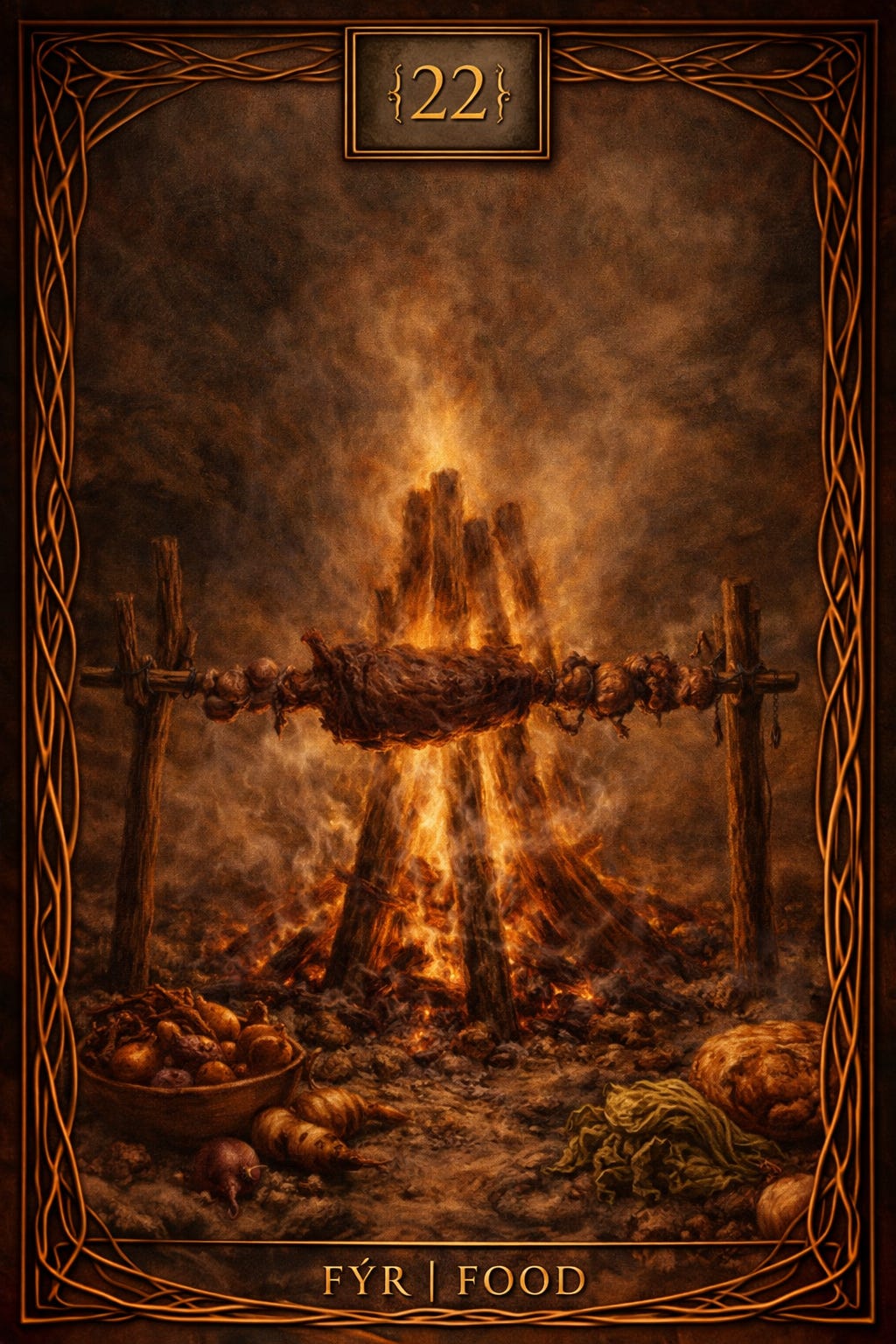
GENE: {22}
The singular term Gene serves as the Foundational Physical and Functional unit of Heredity, Bridging abstract Biological Concepts with Material Reality by functioning as a specific DNA sequence that serves as instructions for producing proteins or Functional RNA. Coined from the Greek: Genos (birth|origin), the gene symbolises the continuity of life, Connecting parents to offspring and acting as the Material Link between generations. Beyond its literal molecular role, the Gene is frequently used metaphorically in popular discourse to denote the essence or Innate Cause of traits, behaviours, or personal identity, functioning as a ‘Blueprint’ for the organism itself.
BORN: {22}
Born represents the beginning of life—symbolising emergence, innocence, and the Transition from potential to Physical Existence. Beyond its literal definition of being brought forth as offspring, it serves as a powerful metaphor for Foundational Beginnings, spiritual rebirth, creativity, and the Material Conception of an idea, project, or personal transformation. It is often used to describe Innate talents or traits—such as a ‘Born Leader,’ suggesting something that is Congenital, Natural, or Inborn rather than learned, while figuratively, it denotes the Genesis of something, such as a desire or realisation ‘Born of Necessity.’
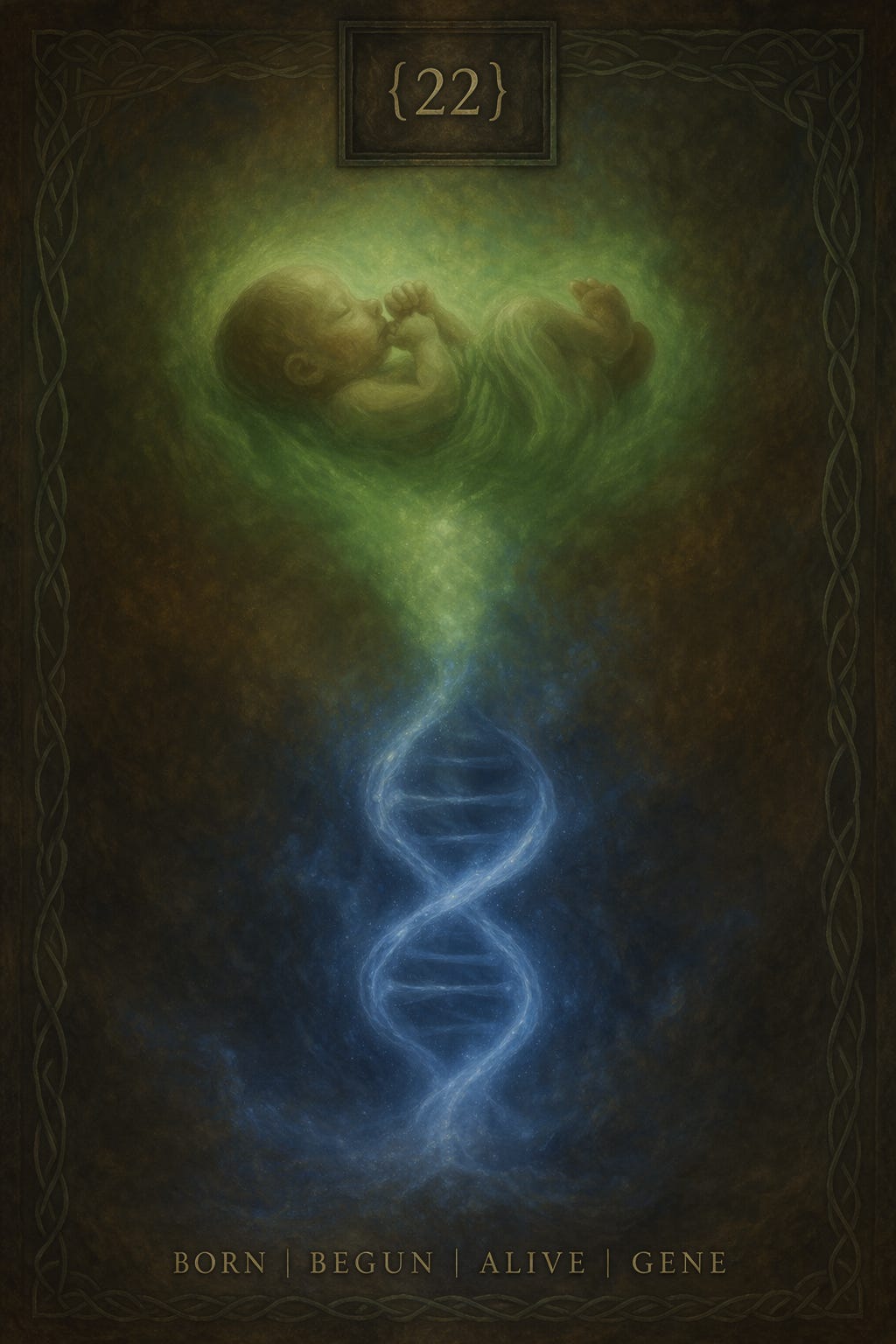
BEGUN: {22}
Begun, the past participle of begin, signifies the formal, irreversible initiation of an action, process, or era. While ‘started’ implies a simple commencement, ‘Begun’ often connotes a more Profound Transition into a New State, signalling the initial step Has Been Taken and the journey is now underway. It holds thematic significance in literature and philosophy, representing the activation of destiny, the opening of possibilities—and when used with perfect tenses, e.g., ‘It has Begun’, marks the commencement point as Already Existing and Influential, often functioning as a pivotal moment that transforms inaction into Engagement.
ALIVE: {22}
Alive signifies the State of having life, breathing, and existing as an Animate Organism, yet it carries deep symbolic weight beyond simple biology. To be Alive is equated with alertness, sensitivity to surroundings, and Conscious Engagement with the world (‘Alive to the danger’), and may represent the Endurance of hope, the continuation of Tradition, or the presence of Intense Activity (‘a place Alive with noise’). Ultimately, Alive represents a conscious, ‘In-the-Moment’ experience—contrasting sharply with apathy or stagnation, and frequently associated with joy, passion, and the active pursuit of meaningful experiences.
WORK: {22}
Work symbolises a Complex Intersection of duty, identity, purpose, and struggle, extending far beyond the literal act of paid labor to represent the human effort to Shape the world and Define the self. Culturally|Metaphorically, Work is often viewed as a ‘Mountain’ to be climbed, a ‘Garden’ requiring cultivation, or a ‘Journey’ reflecting progress and the Discipline|Persistence needed to achieve both personal and societal goals. It serves as a primary source of self-worth and social status, serving as a ‘mirror’ that reflects an individual’s values, skills, and contribution to the community. While at times perceived negatively as a ‘battle|treadmill’ that induces stress and fatigue, work may also be a Profound Medium for creativity and passion—aptly described as ‘love made visible,’ that Connects people to a purpose larger than themselves. (Author’s Note): And before long it will be the latter for everyone.
SUSTAIN: {22}
Sustain, derived from the Latin: sustinere (‘to hold up’), represents Endurance, Nourishment, and Active Support from below, representing the ability to uphold burdens, maintain existence, and prolong life. Its core meaning encompasses strengthening, nourishing, and keeping something going, ranging from the Physical Support of a Structure to the Emotional Buoying of spirits during adversity. Symbolically, it embodies the concept of stewardship and long-term viability, inferring a continuous, active involvement—often likened to a ‘Sustainer’ or a Foundation. Furthermore, it carries legal and formal weight, denoting the Validation or Confirmation of a truth.
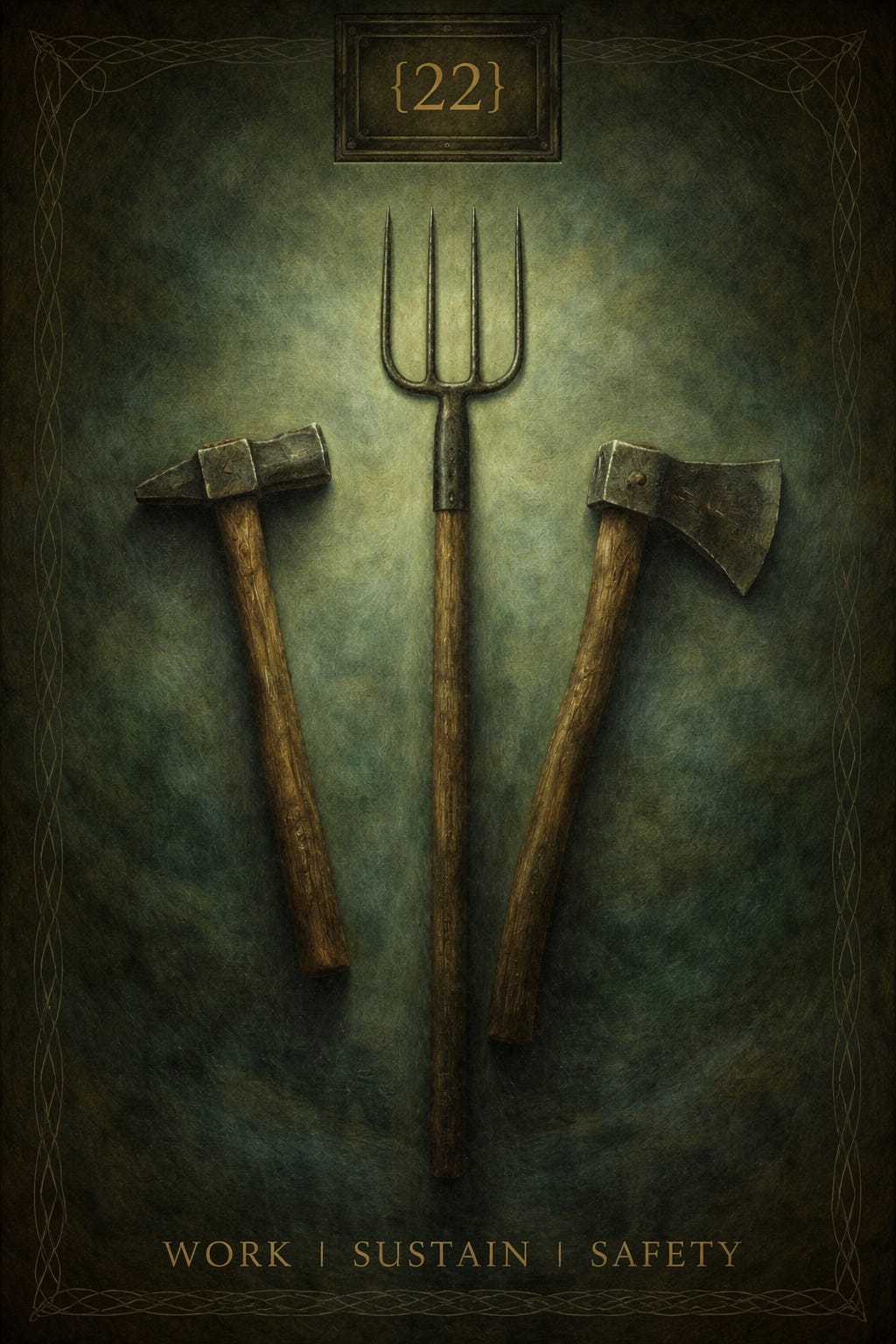
SAFETY: {22}
Safety is a multifaceted concept signifying the Preservation of positive value, functioning as a State free from unacceptable risks, injury, or harm. Beyond simply denoting a ‘zero-harm’ condition, it represents a Dynamic, Proactive Process involving Hazard Identification, Risk Management, and the implementation of Protective Controls. Metaphorically, Safety is commonly visualised as a Protective, Enclosed Space—a Sanctuary or Refuge, designed to Maintain the physical, psychological, and material well-being of individuals. While culturally, Safety embodies a Shared responsibility, a ‘Just Culture’ of accountability, and a ‘Steady State’ where systems function as intended.
IDEAL: {22}
The term Ideal represents the pinnacle of perfection, beauty, or excellence, serving as an aspirational standard or archetype that often exists only in the Imagination or as a Mental Construct. Derived from Platonic philosophy, it represents a ‘Perfect Model’ of something in its Highest Form, contrasting with the often imperfect, tangible reality. Symbolically, it stands for an ultimate aim, principle, or high moral standard that forms a Foundational Drive for endeavour, representing a ‘Model for Imitation’ or the ‘Best-Case Scenario’ for a person, situation, or society. While suggesting a visionary, ‘not real’ entity, the Ideal commonly embodies a desirable, though challenging, objective meant to be strived toward, symbolising the Difference Between what is Observed and ‘What Ought To Be.’
TENTH: {22}
The Tenth is an ordinal number and Foundational concept in Numerology, symbolising the completion of a cycle, Divine Order, and the transition toward a new beginning, functioning as a Bridge between Unity|Initiation: {1} and the infinite Unknown|Potential: {0}. In its nature, it represents ‘The Decad’—a perfect number in Pythagorean thought representing the sum of 1+2+3+4, which signifies the universe’s completeness, and is practically grounded in human anatomy, serving as the basis for decimal systems through our Ten Fingers and Toes. Culturally, the term infers accountability, law, and perfection, exemplified by the Ten Commandments and the practice of tithing (giving one-tenth), which signifies Total Stewardship, or finality, such as with the ‘Tenth Plague in Egypt’—while in modern, everyday usage, Tenth represents a perfect score|whole, ordered set.
DECADE: {22}
A Decade, originating from the Greek: Dekas (‘a group of ten’) denotes a consecutive period of Ten Years, serving as a Foundational Unit for measuring Time in historical, personal, and cultural contexts. While often applied to 0-to-9 calendar periods like the ‘Roaring Twenties,’ it symbolically represents a distinct era or epoch often characterised by defining Technological, Social, or Cultural Shifts, serving as a Bridge between Historical Milestones. Beyond time, the term represents Structure, completeness, or a significant pause for Reflection on growth and change, such as a ten-year career span or a personal lifetime milestone. Finally, ‘Decade’ retains its literal, non-temporal meaning as any collection or set of Ten, famously referring to a portion of a Rosary or scientific groupings of that count.
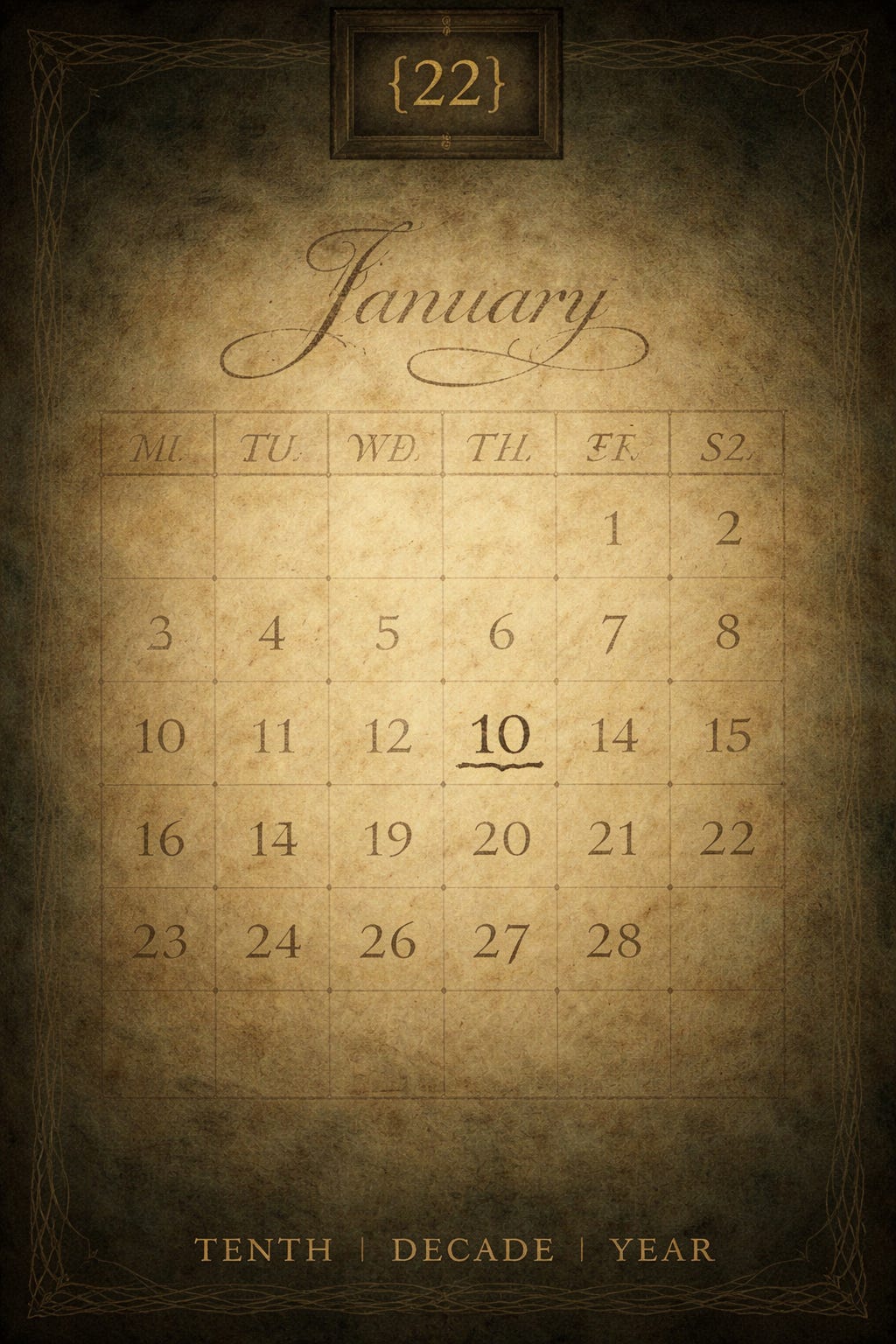
YEAR: {22}
A Year represents renewal, the cycles of life, and the passage of time—defined as the orbital period of the Earth around the Sun, roughly 365.25 days, forming the Foundational Unit for human calendars and marking the rhythmic progression of seasons. Symbolically, the Year encapsulates a transformative journey—often depicted in literature via The Four Seasons from the birth of spring to the death of winter—while psychologically, the Gregorian year functions as a ‘fresh cycle,’ with January, named after the Two-Faced god Janus, embodying both Reflection on the past and anticipation of the future. Further, it serves as a measure of Structural Organisation in human affairs (academic|fiscal|civil) and, through the ‘Year of our Lord’ (AD|CE), acts as a Marker for historical and religious narratives.
ODDEST: {22}
Oddest, the superlative of Odd, represents the Ultimate Deviation from the normal, conventional, or expected, signifying extreme strangeness, rarity, or eccentricity. It denotes that which is most peculiar, uncanny, or bizarre. That which is Oddest can signify not only unmatched strangeness, like ‘Odd Socks,’ but also a ‘Fifth Wheel’ or the most ‘unconventional|out-of-the-box thinker’—denoting the Highest Degree of peculiarity, distinguishing someone as a ‘character’ or quirky individual.
POEM: {22}
A Poem is a Concentrated Form of artistic literature that employs rhythm, sound, and figurative language to evoke Deep Emotional or Intellectual Responses, serving as a creation that Transcends literal interpretation. Symbolically, the Poem represents an Intense Distillation of human experience, functioning as a Bridge Between the Tangible World and Abstract, Invisible Truths, allowing a single image—such as a Rose or a Raven, to carry Significant Weight regarding Emotions, Mortality, or Transcendental Reality. The Structure of a Poem, whether Rigid like a sonnet or Free-Verse, acts as a Vessel for Complex Emotion—a ‘hidden language,’ where words chosen through the Poet’s intent and intuition Hold Meaning not always first clear—the Poem ‘meaning’ what the Poet intended yet also Inviting the reader to Collaborate, bringing personal experiences to the Multi-Layered Interpretations.
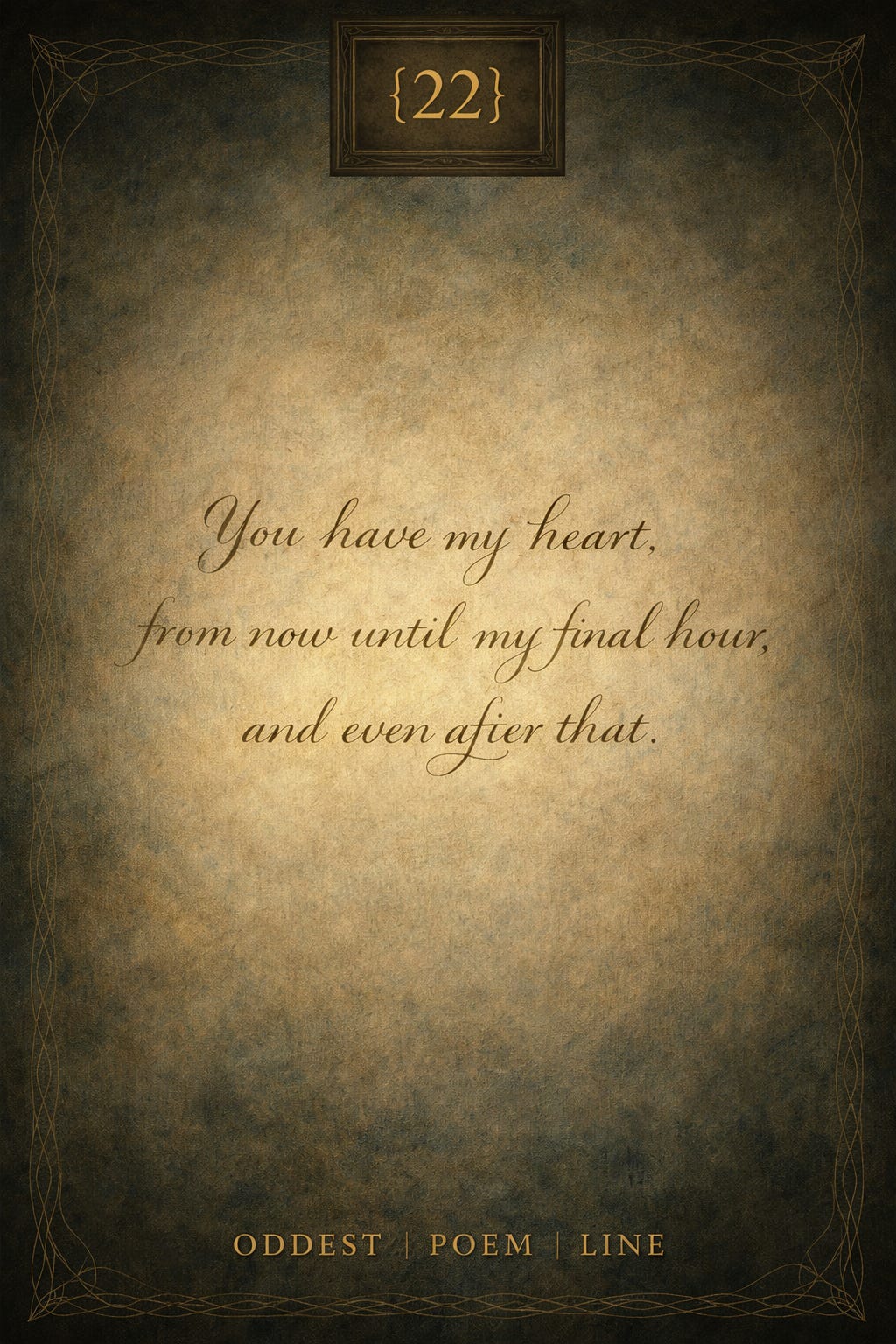
LINE: {22}
A Line represents a Foundational Boundary, Trajectory, or Connection, serving as both a Physical Marker of Division and a conceptual Pathway Between ideas. Symbolically, it signifies Duality and the law of Opposites, with vertical lines suggesting Spirituality, Power, and masculine Energy, while horizontal lines evoke Calm, Stability, and the Material World. In art and communication, the Line guides the eye and convey movement, where straight lines denote Order and simplicity, whereas curved lines imply grace and organic fluidity. Metaphorically, a Line commonly Defines limits—as in ‘Crossing the Line,’ or creates a Pathway for tracking progress, journeys, or continuity, transforming from a mere mark into a Structured, Meaningful Force.
PLEASE: {22}
Derived from the from the Latin: Placere (‘to be acceptable|agreeable’), Please serves as a vital linguistic marker of Politeness, Respect, and Social Etiquette. Symbolically, it functions as the ‘Magic Word,’ representing a Bridge of Courtesy that shifts a command or demand into a voluntary request. Beyond mere polite addition, its meaning is heavily influenced by context—Please signifying formal Deference, an urgent Plea, or when paired with a falling pitch contour, a disguised, non-optional Command. In professional or legal contexts, it functions as a Pragmatic Tool for Establishing Rapport, ensuring Compliance—while in emotional contexts, it can indicate Supplication, Gratitude, or sometimes, Frustration.
KISS ME: {22}
The phrase ‘Kiss Me’ functions as an intimate, imperative request that transcends mere physical contact, symbolising a Plea for Vulnerability, Deep Affection, Affirmation, or a Passionate Reconnection. Beyond romantic passion, Kiss Me can represent Comfort, Healing, or Reconciliation, frequently employed as a way to ‘Seal’ Peace, Friendship, or Affectionate gratitude. The phrase can also appear in popular culture, such as in ‘Kiss Me, I'm Irish,’ which invokes the folklore of the Blarney Stone (my own ancestor’s myth as it happens) to celebrate a sense of luck and charm. Furthermore, in moments of Extreme Emotional Tension, the act is commonly interpreted as a surrender of The Ego and a universal, silent language of Trust when words fail.
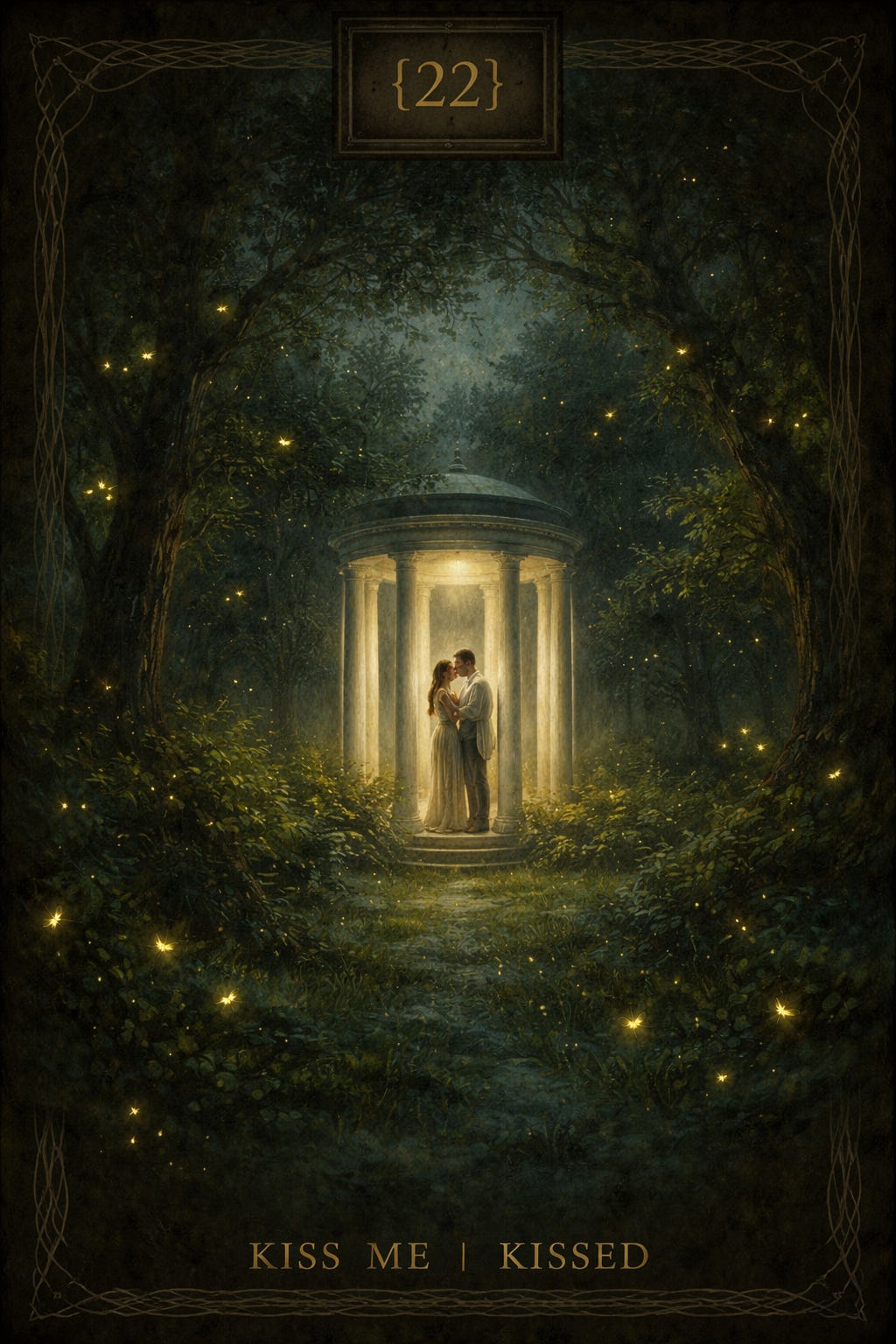
KISSED: {22}
As a past participle, Kissed transcends a simple action, functioning either as an adjective modifying a noun or as a component of passive voice to signify a state of completion, Romantic Longing, or Deep Affection. When used adjectivally, as in ‘Sun-Kissed Skin,’ it represents a gentle, idealised Connection, suggesting the subject has been Touched by Nature or Affection—bringing warmth or blessing. In literary or passive contexts (‘She Was Kissed’), it signifies a completed, often momentous event that can symbolise a shift from apathy to feeling, a transformation from a ‘Sleeping State to Life,’ or the Binding of a pledge. Symbolically, ‘Kissed’ carries a lingering, almost spiritual or fairy-tale quality, conveying Validation, Romantic Devotion—or the Sealing of a Bond.
TOUCH: {22}
One of The Five Senses, Touch represents a Profound, Sensory and symbolic act, functioning as the most Visceral Bridge between the Internal Self and the External World. Symbolically, it embodies Intimacy, Vulnerability, Empathy, and Direct Connection—a ‘Physical Language’ that conveys emotion when words fail, fostering social ties and emotional regulation through Skin-to-Skin Contact. In a metaphorical sense, a Touch indicates Emotional Bonding, Compassion, or a Deep Mental Impression—sometimes highlighting a small amount of a quality (‘A Touch Of’) or a distinct, deft skill (‘Artist’s Touch’). It is a symbol of nuanced Duality, simultaneously representing a Gentle Caress or a Violent Act, while its absence may lead to a profound sense of isolation.
LOVED: {22}
As a past participle, Loved functions as a passive recipient of Deep Effection, transforming the act of Love into a State of Being. Unlike the active verb form, Loved infers a completed action or an Enduring State of being Treasured or Esteemed, Elevating the subject to a position of Special Importance or Significance. Historically, it denotes not only Friends and Family but can act as a euphemism for the deceased (‘Loved Ones’). Syntactically, it often appears in the passive voice (‘Is Loved’), indicating the subject is the focus of admiration, or as an Absolute Phrase (‘Loved By All...’), suggesting an Intrinsic, Established Status. In essence, Loved encapsulates a sense of Vulnerability, Value, and Permanence, frequently used in literature to signify Cherished Memory or Profound emotional Attachment.
SING: {22}
To Sing is the act of producing musical sounds with the voice, but it carries deep symbolic meaning as an expression of emotion, joy, or spiritual devotion that transcends rational speech. Symbolically, to Sing represents a reverent or sorrowful Engagement with the world—a way to Connect with Others, nature, or the divine. It is often used to symbolise a Comforting Power, providing hope or solace during times of hardship. In a Communal sense, singing signifies Togetherness, Cultural Identity, or an act of Resistance. In many contexts, it represents a profound, often metaphysical, restoration of Social Peace, as the vibrations of the voice can stir the Soul, and represent the ‘Nakedness of the Self’, revealing inner Vulnerability and Longing.
SMILE: {22}
A Smile is a universal yet highly nuanced facial expression primarily symbolising delight, Sociability, and amusement—formed by flexing the muscles at the Sides of the mouth. Beyond indicating genuine happiness—particularly in a ‘Duchenne smile’ that involves the eyes, it functions as a powerful Social Signal to build Rapport, convey Friendship, and Foster Trust. However can also represent Over-Politeness, Social Obligation, or the Masking of negative emotions like embarrassment or sorrow. While it Enhances Beauty and projects a positive outlook, the Smile may also be used to display Dominance, Seduction, or Deception. Culturally, it is seen as a ‘universal language of kindness’ that Bridges Gaps, though may be Interpreted as unprofessional, insincere, or a sign of superficiality in some contexts. Ultimately, the smile is a Dualistic, versatile expression that communicates Interpersonal Intentions and Internal States, serving as both a genuine Reflection of inner happiness and a Social Tool for navigating human Interaction.
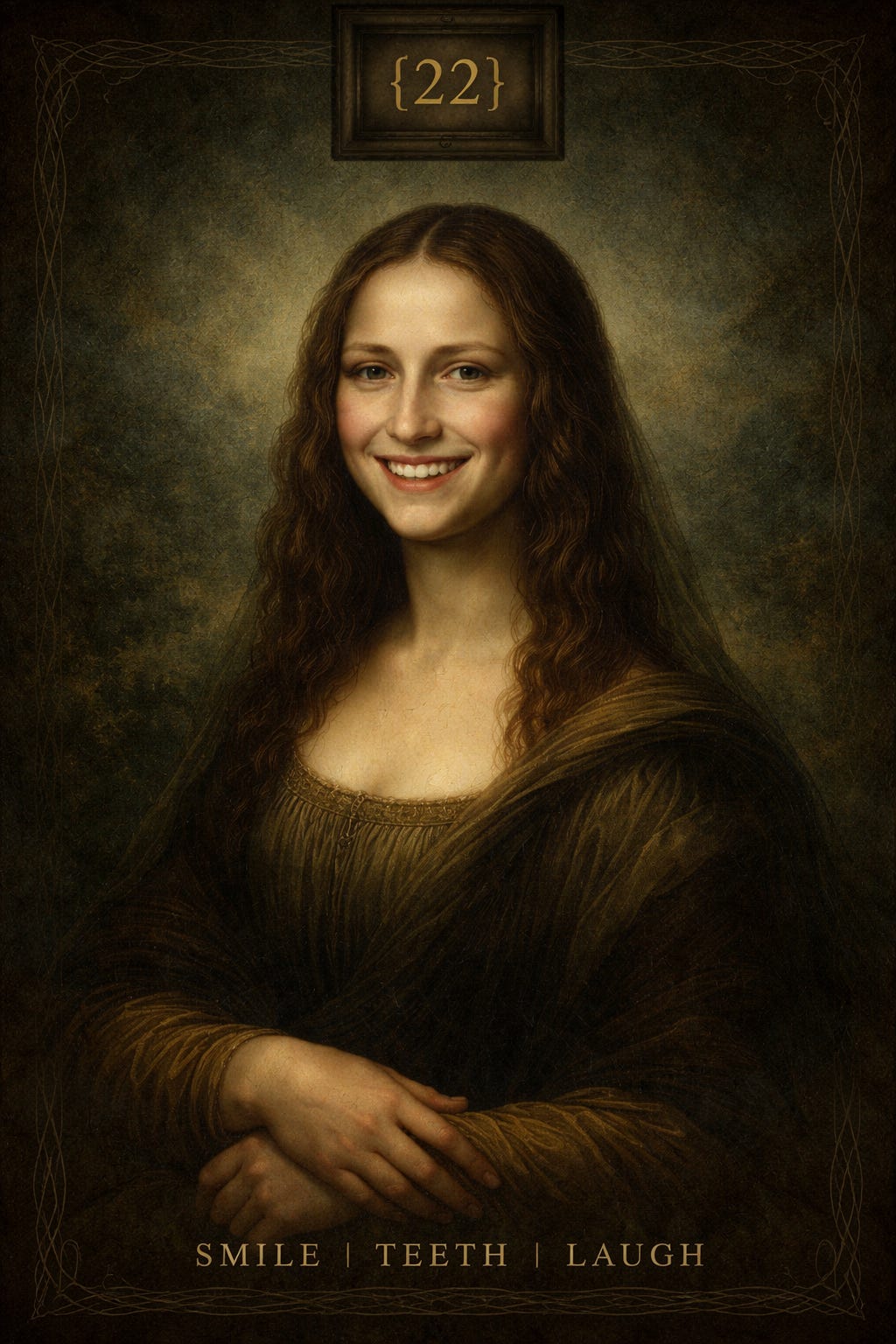
TEETH: {22}
Teeth carry complex, Dualistic symbolism, functioning as potent representations of strength, vitality, and power, while simultaneously embodying fear, aggression, and mortality. In literature|psychology, Teeth often represent ‘The Self’, with their condition or appearance—such as sharp, broken, or falling out, reflecting a character's Emotional State, Socioeconomic Status, or Internal Decay. While perfectly aligned Teeth Signify Beauty, wealth, and honesty—‘sharp wolf-like’ Teeth signify predatory, instinctual drives. In many cultures, the shedding of Teeth represents a Vital Transition into maturity, while in Dream and Freudian analysis, the loss of Teeth often signifies anxiety regarding a loss of power, a fear of aging, or castration fears.
LAUGH: {22}
To Laugh signifies a profoundly human, Social, and Emotional expression, functioning as an Auditory Signal of delight, relief, or Connection, while also serving as a Complex Tool for Social Bonding, or conversely, as a Mechanism for mockery, scorn, and the exertion of Dominance. Beyond its positive connotations of pleasure and therapeutic relief, the Laugh can represent nervous Energy and Social Awkwardness, while in Philosophy|Literature, it is interpreted as a ‘Social Corrective’ that Enforces behavioural norms. Commonly deemed contagious, a Laugh Bridges the Gap Between individuals—signifying Trust and Shared, Unbridled Emotion.
HOWL: {22}
Howl symbolises a primal, intense vocalisation that acts as a Profound Emotional Outlet for Pain, grief, rage, or wild untamed instinct, transcending mere verbal communication. Originating as an imitation of a long, mournful animal cry, it represents a Deep Connection to raw emotion and a longing for Bondship, commonly seen in both animal behavior (communicating loneliness|marking territory) and human expression (expressing anguish|intense laughter). In literature and cultural narratives, the Howl signifies rebellion against constraints, the wilder aspects of nature, or a desperate, lonely lamentation—serving as a powerful, resonant sound that Breaks Silence to demand attention or express Profound Inward Experience.
HURT: {22}
Hurt represents a violent collision, ramming, or blow, and embodies a comprehensive spectrum of Physical Injury and Deep Mental Anguish—symbolising a Traumatic Rupture in normal function, signifying not just a physical wound (aches|cuts|trauma) but also a ‘Relational Devaluation’—a poignant indicator that one has been treated unfairly or that a Valued Bond has been Severed, resulting in damage to one’s Self-Esteem. Hurt functions also as a symbol of loss and Vulnerability to the actions of Others, serving as a Social Pain that can lead to isolation or a desperate plea for emotional healing. It is a term of Collision—both physical and metaphorical, that denotes a blow to the Body or The Ego.
UNWED: {22}
Directly, Unwed means not married, yet it carries a distinct, formal|old-fashioned connotation compared to ‘unmarried|single,’ frequently appearing in news reporting and signifying a status that lies outside the expected societal norm of marriage, serving as a Marker of being ‘Unattached.’ Historically, it can carry an undertone of stigma or marginalisation—exemplified by the phrase ‘Unwed Mother,’ suggesting a life that has not been sanctioned by the social, legal, or religious constraints of wedlock.
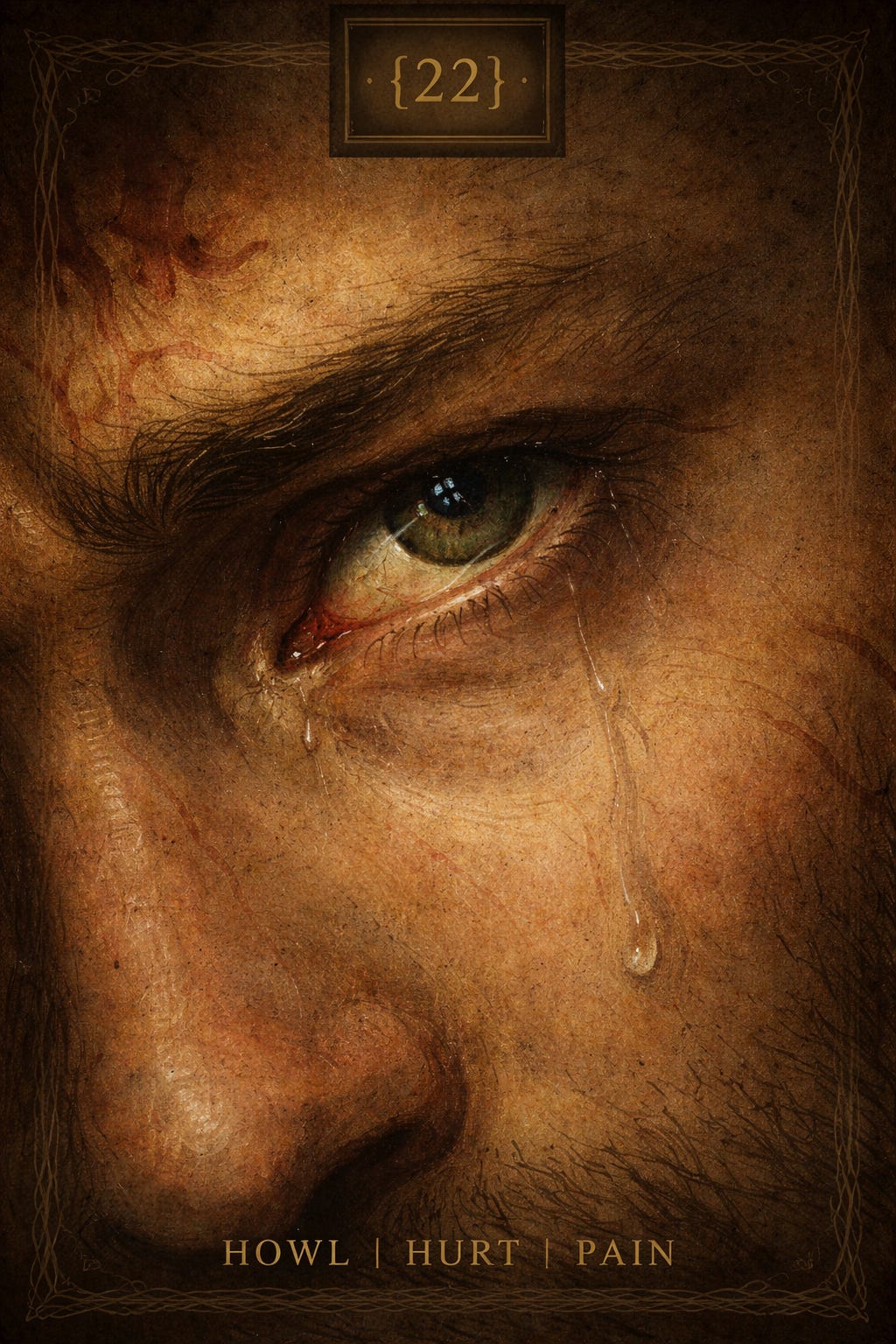
PAIN: {22}
Pain symbolises a profound, subjective experience that acts as a multidimensional marker of Both Physical Harm and Emotional Suffering, functioning metaphorically as a ‘Mark of Weakness’, an Enemy to be Battled, or a Signal of necessary change. Etymologically derived from terms for punishment and torture, Pain signifies not just sensation, but the Disruption of function and the Imposition of involuntary limitations on the self. Culturally, it represents a transformative, though often unwanted, Ordeal that challenges the Limits of human Endurance and forces a Confrontation with one’s own Mortality|Vulnerability—metaphorically serving as an Alarm or Protector, forcing Attention onto the Body, revealing both the Fragility of life and the Resilience of The Human Spirit in striving to Manage, Interpret, and ultimately overcome it.
GAIN: {22}
Gain originates from 12th-century Old French, carrying connotations of Profit, Acquisition, and even Agricultural Bounty, which has evolved to symbolically represent Both Positive Achievement and Selfish Accumulation. It generally represents the Acquisition of an advantage, benefit, or increase—whether Financial, Physical, or Abstract, often through deliberate effort, Work, or Competition. Symbolically, it can represent ‘Earning One's Place,’ embodying the culmination of ‘No Pain, No Gain’ through persistence, while it it can also bear a darker, more insatiable symbolism in philosophical contexts—such as in Buddhism or Hindu thought, where it can represent the desire that fuels Suffering and Material Attachment.
SIGN: {22}
A Sign is a Foundational unit of Communication, serving as a visible Marker, Pointer, or Gesture that represents something Other than itself—whether a Concrete Object, an Abstract Idea, or a Direct Command. Symbolically, it functions as a ‘signifier’ or indicator that points to a ‘signified’ meaning, Bridging the Gap Between perception and understanding. While a natural sign, like smoke, implies a Causal Connection to its source (Fire), conventional signs, such as road signs or the {+} in mathematics, rely on Shared Context to denote specific information. and represents ‘evidence of things unseen,’ serving as a Omen, trace, or a Direct Signal that Communicates a message, or a signature that indicates Formal Agreement.
MIND: {22}
Mind originates from the Old English: Gemynd, which initially meant memory, remembrance, or consciousness, reflecting a Deeply Ingrained Connection to the mental acts of recalling and thinking. Symbolically, it embodies the seat of human consciousness, intelligence, personality, and emotions, serving as the Bridge Between the Inner Subjective World and External Reality. Etymologically derived from the Proto-Indo-European root: *Men- (‘to think’), its meaning expanded over centuries to encompass all cognitive processes, including Perception, Reasoning, Desire, and Volition. Mind is frequently used as a synonym for the Intellect or Soul (‘immaterial essence’), representing the ‘Ghost in the Machine’ or the conscious Self-Distinguished from the Physical Body.
INTO: {22}
Into functions as a preposition indicating movement from Outside to Within, Signalling Entry, Inclusion, or transformation from One State or Form to Another, such as ‘Turning Into|Breaking Into.’ Symbolically, it represents transition, immersion, and engagement, moving beyond mere position (‘in’) to imply active change, Deep Involvement in a subject, or the act of Plunging Into a fresh condition or activity. It is frequently used to signify a Deeper, more Intimate Connection, Collision, or Thorough Analysis, often carrying a tone of Intense Commitment or Enthusiastic Interest in something.
THEY: {22}
They holds a multifaceted, evolving significance in the English language, serving primarily as a third-person Plural pronoun, a generic singular pronoun for Unknown Individuals, and a specific identifier for Non-Binary Individuals, encompassing Both Inclusion and Detachment. Symbolically, it represents ‘The Other’—an anonymous group, authority figure, or ‘Them as opposed to Us,’ and sometimes infers an Unspecified or Distant Collective, as in ‘They Say.’ Historically imported around the 13th century, it has functioned as a gender-neutral singular pronoun since the 14th century—used by writers like Shakespeare and Austen to fill gaps when gender is unknown or irrelevant.
SHAPE: {22}
Shape signifies the Outward Appearance, Contour, or Physical Form of an object, serving as a fundamental identifier that Separates an entity's Structure from its Substance. Symbolically, shape represents Organisation, Perception, and the manifestation of Abstract Ideas into Concrete Reality, commonly indicating how a plan or concept is taking form. It denotes condition or state of health—such as being in ‘Good Shape,’ and suggests the capacity to be Moulded, Influenced, or Directed, reflecting Adaptability and growth. Significantly, the Geometric Shape carries Deep and Foundational symbolic meaning across cultures—with circles representing unity and infinity, Squares denoting Stability and Material Order, and triangles suggesting dynamic Energy.
TORN: {22}
Torn represents a state of being Pulled Apart—signifying Division, Conflict, and Deep Emotional Distress, regularly describing a person unable to decide between Two Contradictory choices or feelings. Symbolically, it transcends its literal definition of ripped fabric or jagged edges to signify a Broken|Fractured State of being—where Wholeness has been Disrupted by External Forces, Trauma, or Internal Turmoil.
CARVE: {22}
Carve represents the deliberate transformation, Precision, and creation of Lasting Form from Raw, Enduring Materials like wood or stone, representing the act of bringing a Hidden Vision into Reality through focused effort, patience, and the removal of unnecessary elements. Metaphorically, it implies Shaping one’s Destiny, character, or career—as in ‘Carving out a Niche,’ signifying Intentionality, Permanence, and the leaving of a lasting legacy, scar, or ‘Mark’ upon the world.
PARE: {22}
Pare, derived from the Latin: Parare (to prepare), refers to the act of Trimming, Peeling, or Cutting Away the Outer Layer, Edges, or Excess Parts of an object, typically in gradual, successive stages. Its physical nature involves a meticulous, reductive process which reduces the overall size, bulk, or quantity. Symbolically, to Pare represents Purification, Ideal Form, and the Necessary Removal of non-essential elements—a metaphorical pruning of distractions or sin to achieve a more essential or spiritual state, signifying a conscious, often uncomfortable reduction ‘To the Bone’ or Essential Core, focusing on efficiency, discipline, and the stripping away of redundancies to reveal the True Form beneath.
MODEL: {22}
Derived from the Latin: Modulus (measure|standard), Model represents a Structured, Symbolic, or Physical Representation of an original—a simplified simulation created for Understanding, Prediction, or Emulation. It represents an Ideal Pattern or Archetype worthy of Imitation—acting as a Blueprint, Prototype, Framework or Benchmark of Excellence, such as a ‘Model Citizen.’ Conversely, it can act as a literal, Scaled-Down Reproduction, in the context of fashion, a person portraying a Designed Lifestyle, embodying the concept of an Exemplary Form.
STUDENT: {22}
Derived from the Latin: Studere (‘to be eager|to strive after’), Student transcends its literal definition as a person enrolled in school to symbolise a Perpetual State of becoming, curiosity, and intellectual Humility. It represents an active seeker of knowledge—a ‘novice’ who is not yet a Master, emphasising the transformative journey from ignorance to understanding. Stood in contrast to the Teacher, the Student embodies Adaptability and the freshness of a new generation—serving as a ‘Teachable Observer’ of life and human nature.
TOTAL SUM: {22}
Total Sum signifies the complete numerical result obtained by Adding all Individual Components or Addends Within a Set—signifying the Aggregation and Synthesis of Disparate Parts into a Single Whole. Beyond Addition, it represents the Absolute, Comprehensive Totality of something—whether financial, numerical, or conceptual, frequently used to indicate that All Possible Elements have been considered. Philosophically, the Total Sum embodies the concept of ‘Summation’—denoted by the Greek Symbol: ‘Sigma,’ (Σ) which denotes that the final, whole amount is the culmination of all contributing factors, and also resolves to {22}.

GURU: {22}
A Guru, from the Sanskrit: (गुरु) is traditionally defined as a spiritual mentor, guide, or Master who ‘Dispels the Darkness of Ignorance’ (‘Gu—Darkness|Ru—Dispeller’) and brings forth the Light of knowledge, Self-Realisation, and wisdom to a seeker, symbolising a Bridge Between the Mortal and the Divine. Beyond just imparting knowledge, a guru acts as an exemplar of life, a counselor, and a ‘Parent of the Mind’ who Moulds Values and Helps in spiritual evolution. The relationship is centered on Reverence, Service, and in many traditions, the ‘Guru-shishya parampara’ (disciplic succession).
MOKSHA: {22}
Moksha, derived from the Sanskrit root: Muc (to free|let go), symbolises the ultimate liberation, emancipation, and release of the individual Soul (Atman) from the ceaseless cycle of death and rebirth (samsara) in Hinduism, Jainism, Buddhism, and Sikhism. As the Highest Goal among the Four Puruṣārthas of life, it represents the setting-free of blocked human potential, signifying a Transition from ignorance (avidya) and worldly attachment to Perfect Self-Realisation, Divine Bliss (ananda), and permanent oneness with the Supreme Self or Reality (Brahman)—embodying the ultimate end of all suffering and the attainment of absolute consciousness.
SATANIC: {22}
The Satanic refers to anything relating to, characteristic of, or venerating Satan—historically viewed as the Ultimate Adversary to God and personification of evil, wickedness, or cruelty. Symbolically, it embodies Rebellion against conventional religious, moral, or societal authority, often utilising icons like the inverted Pentagram, Baphomet, or inverted cross to represent individualism, rationalism, and defiance. While Satanic is often a polemical, ‘Othering’ label used by outsiders to describe perceived diabolical behavior, it is adopted by modern, mostly atheistic, religious movements—such as the Church of Satan or The Satanic Temple, to symbolise Humanistic Values, personal autonomy, and the Rejection of dogma, rather than literal devil worship.
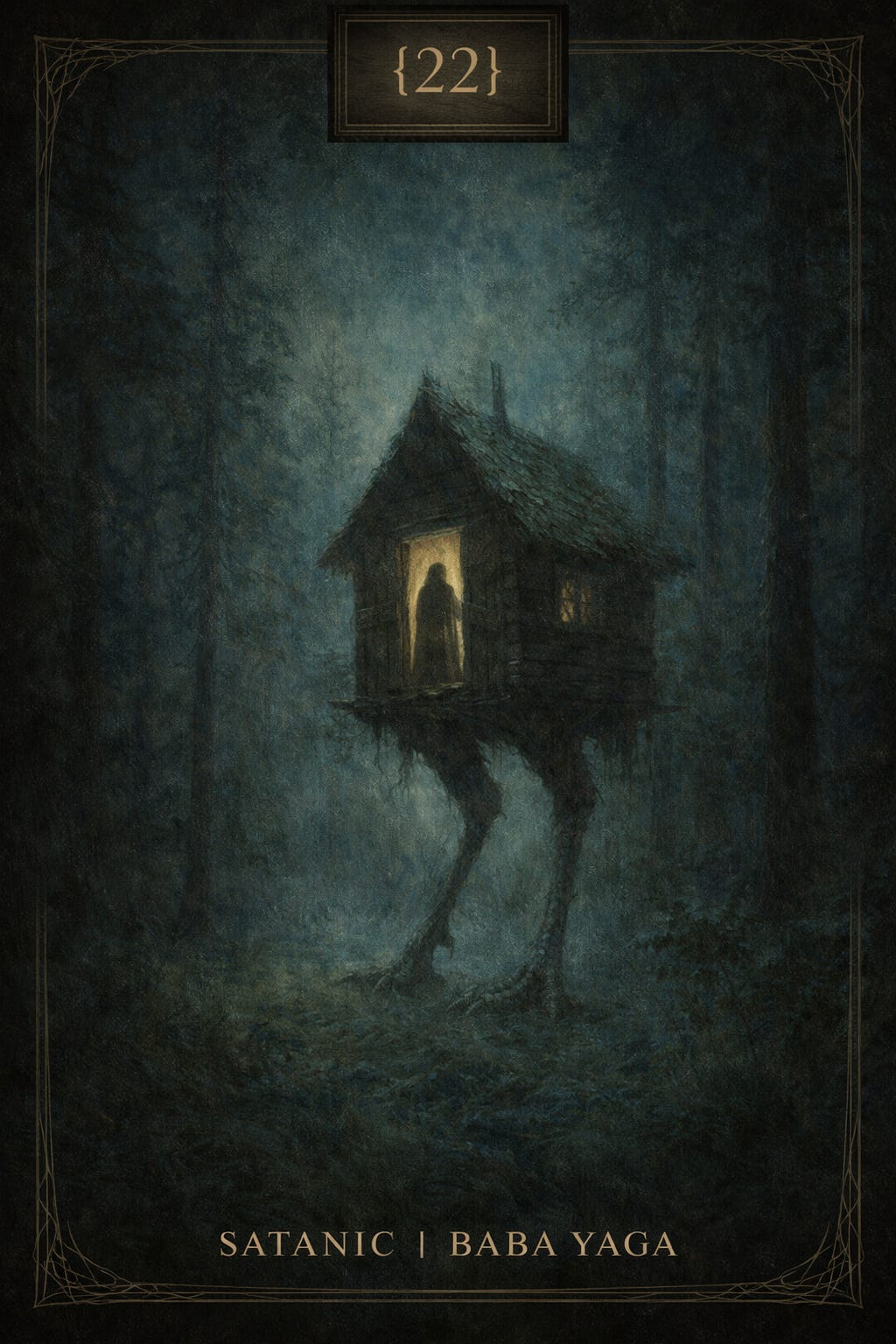
BABA YAGA: {22}
Baba Yaga is a pivotal and enigmatic figure in Slavic folklore representing a Paradoxical force of nature—embodying the untameable wild, the dark aspect of The Mother archetype, and the Boundary Between life and death. Typically depicted as a repulsive ‘bony-legged’ old woman with iron teeth, she resides deep in the forest within a Sentient Hut on chicken legs surrounded by a bone fence. While often a terrifying witch who kidnaps and devours children—serving as a cautionary figure for children's Behavior, Baba Yaga simultaneously acts as a wise mentor or donor, Testing heroes with impossible tasks and Gifting them magical items if they display courage and respect.
ELVEN: {22}
Elven, the adjective of ‘Elf,’ encapsulates a rich, evolving symbolism, rooted in Germanic|Norse traditions where they were perceived as ‘white|shining’ beings, indicating Supernatural Beauty, power, and a Dualistic, ambivalent nature that could both aid and hinder humanity. Symbolically, that which is Elven represents a Deep Connection to nature, immortality or extreme longevity, and an otherworldly grace— serving as the ‘Fairer, Wiser, Ideal’ versions of humanity that embody Ancestral Spirit, artistry, and magical proficiency.
WISP: {22}
A Wisp is physically defined as a thin, Delicate, or fleeting strand of something—such as smoke, hair, or hay—symbolising Fragility, Intangibility, and Ephemeral Beauty. Figuratively, it represents a Faint Hint or Trace of an Emotion, like a ‘Wisp of sadness.’ In folklore, the term is central to the ‘Will-o'-the-Wisp,’ a mischievous or malevolent atmospheric ghost light (ignis fatuus) that hovers over marshes, signifying Deceit, treacherous guidance, and the perils of curiosity. Metaphorically, the Wisp, embodies a fleeting and otherworldly or untrustworthy presence—whether a tiny trace of hair, plume of smoke, or in literature—a fatal, Wandering Phantom or elusive Nature Spirit.
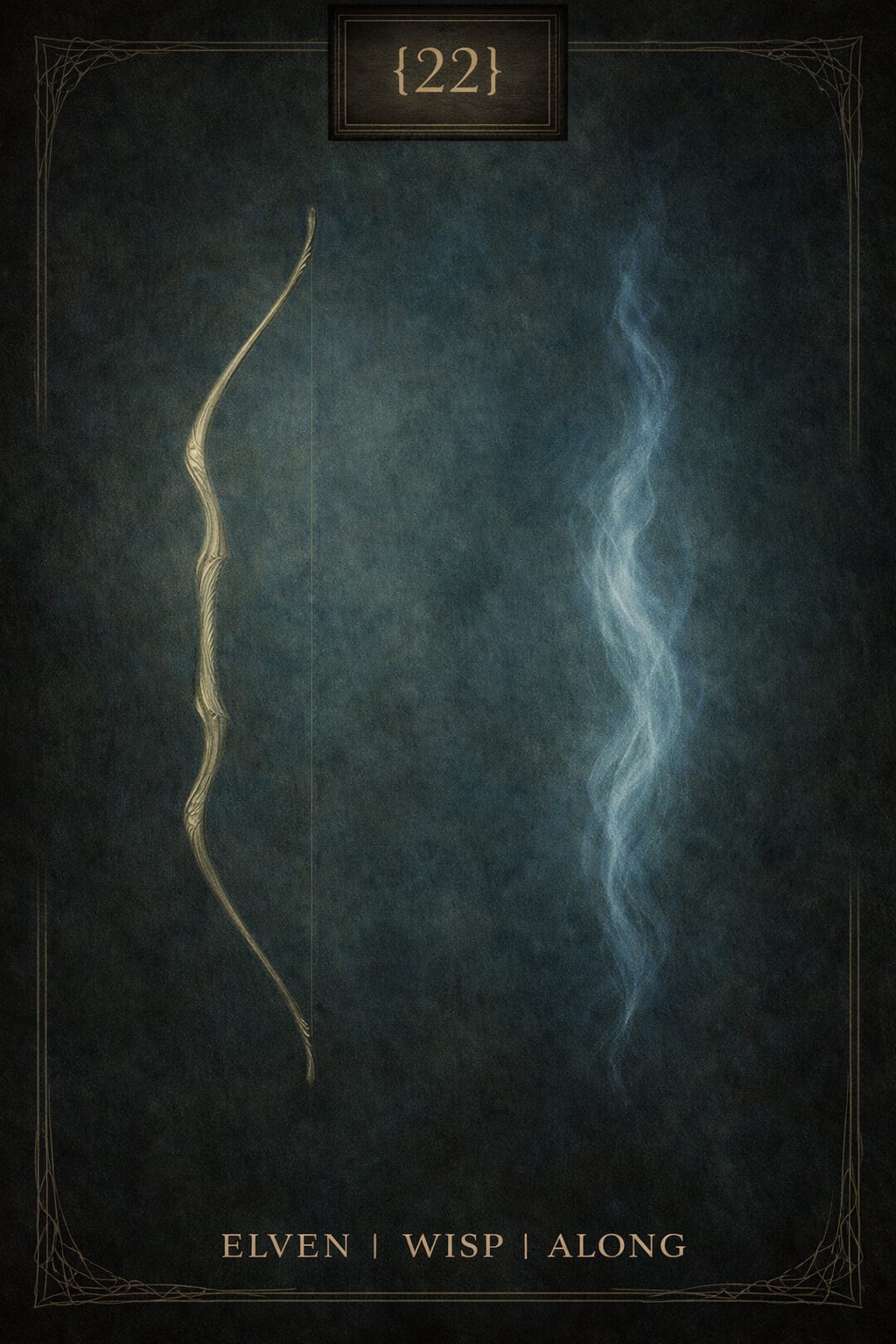
ALONG: {22}
Along primarily denotes movement or positioning in a Linear Fashion, typically Parallel to an elongated object or following a path, symbolising Continuous, Directed Progress and Accompaniment. Symbolically, it represents journeys, Companionship, and the unfolding of time or process, often evoking a sense of moving With something rather than against it. As a preposition, it emphasises Alignment and Spatial or Metaphorical Progression (‘Along the Path of Life’), while its adverbial use, such as ‘Come Along’ or ‘Bring along,’ suggests association, inclusion, and advancement toward a Shared Goal.
SUDDEN: {22}
Sudden denotes an abrupt, unexpected occurrence happening without warning, often signalling a Sharp Transition, Breaking Continuity, or Marking a moment of urgency and haste. Symbolically, it represents the intrusion of uncontrollable fate, radical change, or immediate, often disruptive disruption, Shifting a situation from Peace to Chaos, or reveals an unspoken reality. In literature and life, the ‘Sudden’ encapsulates the Fragility of Control and the dramatic, chaotic interruption of normalcy—linked to unexpected tragedy (‘Sudden Death’), rapid revelation (‘Sudden Enlightenment’), or spontaneous action (‘Sudden Decision’). Its essence is instantaneousness—a Swift Shift from a Known State to a New, Shocking One, leaving little to no time for preparation or emotional adjustment.
WARP: {22}
Etymologically derived from Proto-Germanic roots meaning ‘to turn|bend|throw,’ Warp represents a multifaceted concept rooted in the Physical Twisting, Bending, or Distortion of a Material out of its original flat or straight plane, often due to environmental stress like heat|moisture. In Weaving, the Warp constitutes the Foundational, longitudinal threads under Tension—the ‘Backbone’ of the fabric that receives the Interlacing weft. While in modern pop culture, ‘Warp’ signifies the breaking of physical laws to bend space-time for Extreme Speed (Warp Speed), a sci-fi ‘Otherworld,’ or Instant Traversal (teleportation), representing technological or magical manipulation of reality. Figuratively, it denotes a Profound, Negative Shift or Distortion of character, story, or reality.
LOOP: {22}
A Loop represents Continuity, Repetition, and the Interconnectedness of life, often representing a cycle that returns to its Origin to imply Eternity, rebirth, or a Self-Sustaining Feedback Mechanism. Metaphorically, it can signify being caught in an endless, often unproductive pattern, such as a ‘Feedback Loop’ in Relationships or a ‘Time Loop’ in literature—or it can represent specialised knowledge through the idiom ‘In the Loop.’ In various contexts, it stands for Wholeness (the circle), Binding Connection (knots), or in ancient symbolism, the ‘Breath of Life,’ such as the Egyptian Ankh. Ultimately, the Loop serves as a powerful symbol for both Peaceful return and frustrating Stagnation, emphasising that endings may Also be new starting points.
WELSH: {22}
The language that preserved so much of the oldest Celtic tradition—the Mabinogion, the Bardic Lineages, and the Arthurian mythological substrate falls on the essence of Master Builder|Foundational|Ideal Form.
NOON: {22}
Noon, traditionally marking the Solar Zenith|12:00 PM, signifies the High Peak of clarity, and the Turning Point between Morning and Afternoon—symbolising the Height of Energy, consciousness, or a moment of Critical Decision-Making. Etymologically derived from the Latin: Nona Hora (ninth hour), it historically meant 3:00 PM—a canonical time for prayer or breaking fasts, before shifting to midday due to monastic routines and mechanical timekeeping. Culturally and spiritually, Noon serves as a Boundary for sacred and daily actions, signifying the Climax of spiritual work, the peak of the sun’s Power, or in Nietzschean terms, a ‘Great Noon’ representing a historical pinnacle and moment of Self-Realisation for humanity.
POSSUM: {22}
The Australian Possum is a nocturnal, arboreal marsupial belonging to the order Diprotodontia, renowned for its High Adaptability, intelligence, and Resilience in inhabiting both native eucalyptus forests and Urban Suburban Environments, often taking up residence in roof spaces. Physically diverse, ranging from the common brushtail—with its thick, bushy tail and ‘furry-tailed little fox’ appearance—to the smaller ringtail, they are known to be Vocal, solitary, and territorial, using scent glands to Mark their territory and engaging in noisy, though rarely fatal, disputes. In Australian Aboriginal culture, particularly in the south-east, the Possum holds deep meaning, as their skins were used to create Meaningful Possum-Skin Cloaks that Mapped personal history, Clan Connection to Country, and provided Essential Warmth.
HOOK: {22}
A Hook is a versatile, metaphorical term representing an Engaging Opening designed to immediately capture attention, draw in an audience, and compel further exploration, often likened to the ‘bait’ that catches a fish or an ‘On the Hook’ obligation. In literature and writing, it acts as the initial, poignant, or surprising sentence—such as a rhetorical question, anecdote, or shocking fact, that Disrupts the opening and sets the narrative tone. Symbolically, it represents a Connection or Snare, holding the audience's focus and serving as a Tool for creating anticipation or curiosity, often leading to a ‘page-turner effect.’ The nature of a hook is to be both relevant and alluring, establishing a first Impression that compels readers, listeners, or viewers to continue rather than turn away—transforming a passive audience into an Engaged one.
SCALER: {22}
A Scaler, derived from the Latin: Scalaris (‘ladder|steps’), inherently symbolises a Mechanism for Measurement, Ascension, and Standardisation, functioning as an Instrument of Reduction or Precision. In nature, this concept is represented through hierarchical systems such as ecological pyramids or the Gradual, Additive growth of Biological Structures, where Incremental Units determine the Total Magnitude. Fundamentally, the term signifies a device or method that Bridges Different Magnitudes—characterised by its ability to turn complex, compound, or chaotic inputs into Simplified, Ordered, and Uniform Quantities.
STAIR: {22}
A singular Stair is a Foundational Structural element—a single unit of tread and riser, that embodies the essence of Vertical Transition, acting as a Crucial Threshold Between Levels or States of Being. Symbolically, while a complete staircase often represents a long journey or progress, a single Stair signifies a Decisive moment, a Necessary individual effort, or the initial intentional step in a Larger Process of change, transformation, or growth. It acts as a Liminal Space, a moment of pause and orientation between ‘Here and There’ that can signify either a step upward (positive ascent|ambition) or a downward descent (reflection|decline), while other times representing an Obstacle or a ‘missing element’ in a system, pointing to the Structural Barriers or Hidden Challenges within a Social or Personal Journey.
RAIL: {22}
Rail encapsulates a multifaceted nature, ranging from a simple Structural Bar to a Foundational Component of modern transport, symbolising Progress, Industrial Strength, and Connectivity. Functionally, the Rail is a Durable Steel Component that guides trains, representing the conquest of Distance, technological Dominance over nature, and the ‘Iron Horse Era.’ In a more evocative sense, the Rail symbolies the ‘In-Between’ of travel, Marking Transitions between different states, places, or stages of life, and Separating people from the Landscape they traverse. As a verb, to Rail (against) signifies the angry, passionate expression of dissent, contrasting the Rigid, quiet nature of physical Rails with a noisy, chaotic human protest.
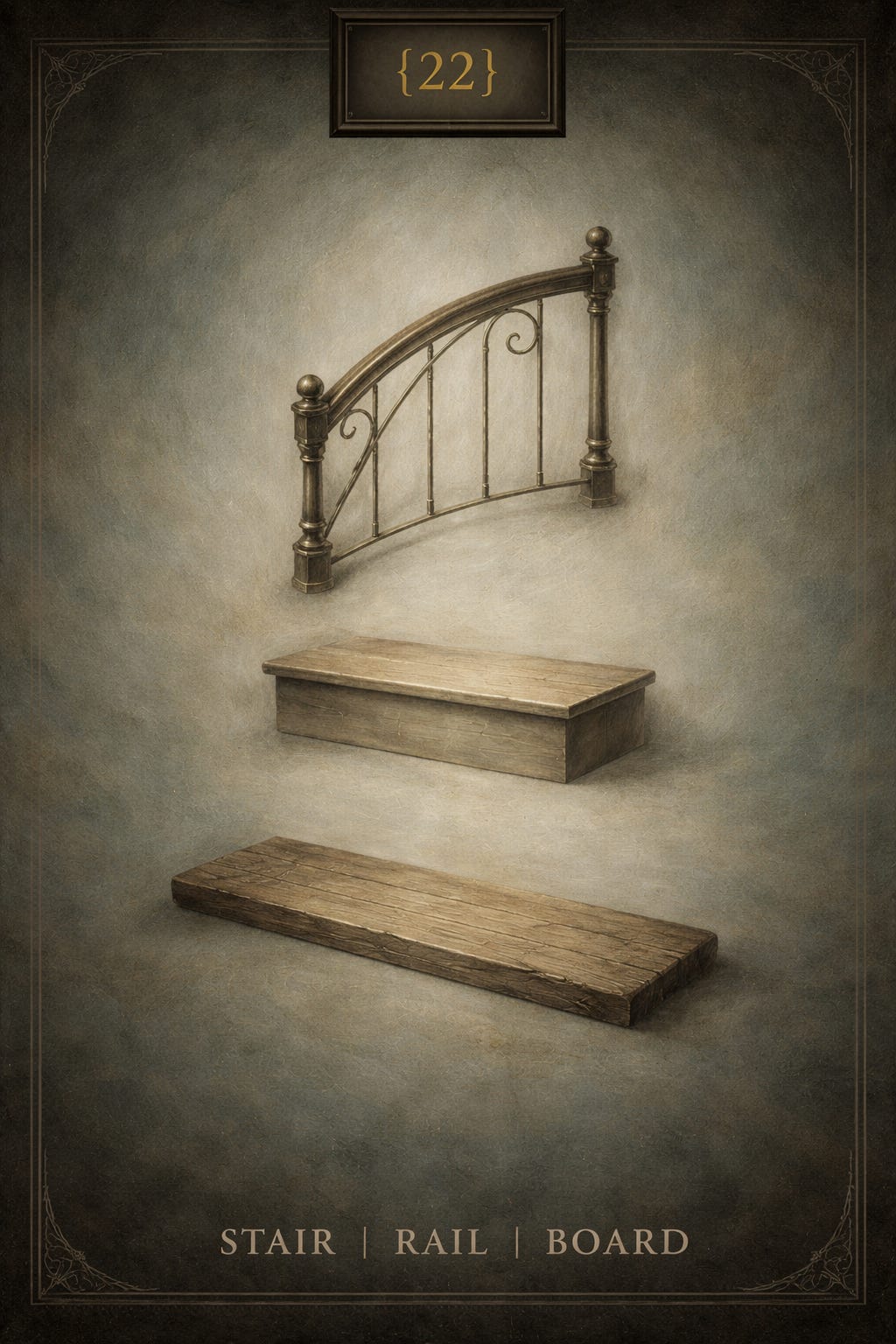
BOARD: {22}
Board rooted in the Old English: Bord meaning a Plank, Flat Surface, or Shield, fundamentally symbolises Structure, Separation, and Foundational Support. In its literal nature, a Board is a Flat, Hard Material, often Wood, representing Durability and Utility. Symbolically, it embodies the ‘Table’ where decisions are made (boardroom) and where Community Gathers for Sustenance (room and board), linking it directly to governance, social interaction, and hospitality. The term also implies transparency or authority, particularly in phrases like ‘Above Board’ (honest|open), and as a Surface of Communication—like a blackboard or bulletin board, signifying the Dissemination of knowledge, and when used in metaphors like ‘Stiff as a Board,’ represents Rigidity.
NICE: {22}
Nice ironically originated in the 13th century from the Latin: Nescius (‘not-knowing|ignorant’), and has undergone a dramatic semantic evolution from meaning Foolish, Shy, and Wanton to its modern connotation of Pleasant, Kind, and Agreeable. Its nature as a highly polysemous word often signifies that it acts as a ‘catch-all’ descriptor, shifting through time, and symbolically, represents a superficial layer of Politeness, Social Conformity, or False Civility, serving as a ‘soft’ filler word that can be used ironically to imply the Exact Opposite of delightful—or conversely, to represent Strict Accuracy and Refined Discrimination.
VEGAN: {22}
Coined in 1944 by Donald Watson as the ‘beginning and end of vegetarian,’ the term Vegan signifies a philosophy and lifestyle that seeks to Exclude—as far as is possible and practicable, all forms of exploitation of, and cruelty to, animals for food, clothing, or any other purpose. In nature, this represents a conscious Realignment of human existence away from the domination of other species, fostering a return to an ‘animal-free’ existence. The meaning of veganism extends far beyond a plant-based diet, embracing a Profound, compassionate Commitment to recognising animals as sentient beings with a right to life—rather than as commodities.
DISH: {22}
A Dish is an open, shallow, concave Vessel designed to hold, serve, or cook food, inherently symbolising Nourishment and Hospitality. Beyond its physical nature, the term signifies the prepared meal itself, acting as a Cultural Marker of identity or a personal preference (‘Favourite Dish’). Symbolically, it represents Communal Fellowship—often featuring in rituals or Shared dining moments. Culturally, a ‘National Dish’ signifies a nation’s history, shared identity, and political cohesion. Informally, Dish has expanded to represent Gossip (‘Dish the Dirt’) or describe a Physically Attractive person. Ultimately, its nature Bridges the Functional, the Container, with the experiential—the Sustenance and Social Interaction provided within.
GOLF: {22}
Golf—often falsely believed to be an acronym for ‘Gentlemen Only, Ladies Forbidden,’ is actually derived from the 15th-century Scottish word: ‘gouf|gowf,’ which likely originated from the Dutch word: Kolf (‘club’) Lyrically rooted in Scots terms for ‘striking|cuffing,’ the word represents a Precision sport played Outdoors on vast, irregular courses (links) that prioritise Immersion in Nature. Symbolically, Golf serves as a spiritual analogy for life—Testing Character, Patience, and Integrity through self-regulation in a challenging, natural setting—functioning as a mental escape that emphasises Personal Accountability over Direct Conflict with Opponents.
MOUND: {22}
A Mound is a Heaped, Raised Pile of earth, stone, or debris—either a Small natural hillock or an artificial Structure created through human intervention, such as burial Mounds (tumuli), platform Mounds, or settlement tells. Symbolically, the Mound acts as an ‘Earth-Work’ that represents ancient cosmological Order, the afterlife, and ancestral Connection to the Land, often serving as crucial monuments honoring the dead and Bridging the Gap between Sacred and Secular Worlds. By their nature, they are designed for Endurance and High Visibility—requiring extensive Community Labor to build and sometimes representing a ‘Map’ of clan Identities or Animal spirits.
SPEND: {22}
Derived from the Latin: expendere (‘to weigh out money’), the term Spend signifies the act of Disbursing, Consuming, or Utilising Resources such as Money, Time, Effort, or Energy. Its nature is inherently Transactional and Transitional, inferring a movement from Possession to Employment, often leading to a ‘Spent’ state of exhaustion or depletion, as seen when a Storm loses its fury or a person is physically tired. Symbolically, spending represents the exchange of a finite resource for a specific outcome, embodying choices about value and the passage of life, wherein time is ‘passed|used up’. The act carries a Dual meaning, Bridging the positive, productive use of resources (investment) with the negative, excessive, or useless waste (squandering), making it a metaphor for how one Engages with life’s limited opportunities.
FILM: {22}
Film, traditionally defined as a series of still images on a Cellulose Base that create the illusion of movement, is a powerful, Synthetic Medium Combining visual art, narrative, and sound to mirror and shape reality. Its nature is rooted in technological spectacle, functioning as both a 20th-century mass-entertainment medium and a deeply subjective art form that manipulates time, space, and perspective, often engaging in ‘Lived Religion’ by providing symbolic, experiential answers to existential human questions. As a term, it signifies not only the physical medium of cinema but also a ‘Significant Form’ that, through its unique language, captures life as a Reflection or dream, Influencing Audience Perceptions of themselves and the world.
POOL: {22}
A Pool, in both its natural and constructed forms, signifies Quiet Sanctuary, Emotional Depth, and a Controlled|Domesticated Space that often Reflects the subconscious mind. Its nature as a standing or gently moving body of Water makes it a Powerful Mirror, conveying themes of Self-Reflection, Tranquility—or conversely, the ‘The Deep End’ of potential fear, Hidden Feelings, or Stagnant Desire. Symbolically, it stands in Contrast to the vast, unnamable Ocean, offering instead a Contained, Safe Environment where one might experience Purification, a fresh start, or Intimate Vulnerability, while in an ecological sense, the Pool similarly acts as a Vital, Confined Habitat or a Delicate often Ertificial Ecosystem.
ECHO: {22}
An Echo is the Reflection of sound waves returning to their source, symbolising Memory, Repetition, and the Haunting Persistence of the past. Rooted in the Greek myth of a Nymph cursed by Hera to only Repeat the words of Others, the term represents unrequited love, the loss of individual voice, and the painful transformation from a Tangible Presence into Sound. Symbolically, it often signals themes of melancholy or the ‘Echo of Trauma’, representing something that remains after the original subject has vanished. In a broader sense, it denotes Imitation, Dependency, and the Reflection of a person’s own actions or words back to them, acting as a reminder of past decisions.
SONAR: {22}
Sonar, an acronym for SOund Navigation And Ranging, is a technique and technology that utilises acoustic sound propagation to Detect, Navigate, and Communicate with Submerged Objects, functioning as a ‘sound-based vision’ in environments where light and radar cannot travel. Its nature is defined by two primary types: Active Sonar, which emits acoustic ‘pings’ to measure echoes from targets, and Passive Sonar, which listens silently for sounds made by vessels or marine life.
GLOBAL: {22}
Global, derived from the Latin: Globus (sphere), acts as both a physical descriptor of shape and a powerful concept representing Comprehensive, Worldwide Scope. Symbolically, it embodies unity, Interconnectedness, and the ‘Global Village’ concept, where Distant Localities are Shaped by events happening Elsewhere. Its nature is inherently Holistic, relating to the entire planet, and Integrative, Binding distant economies, cultures, and populations into a single, complex, often debated, world society. (Author’s Note): The future is the understanding we are all Tinctures on the One Palette—not to be messily smudged into one, but Blended with care and creative expression.
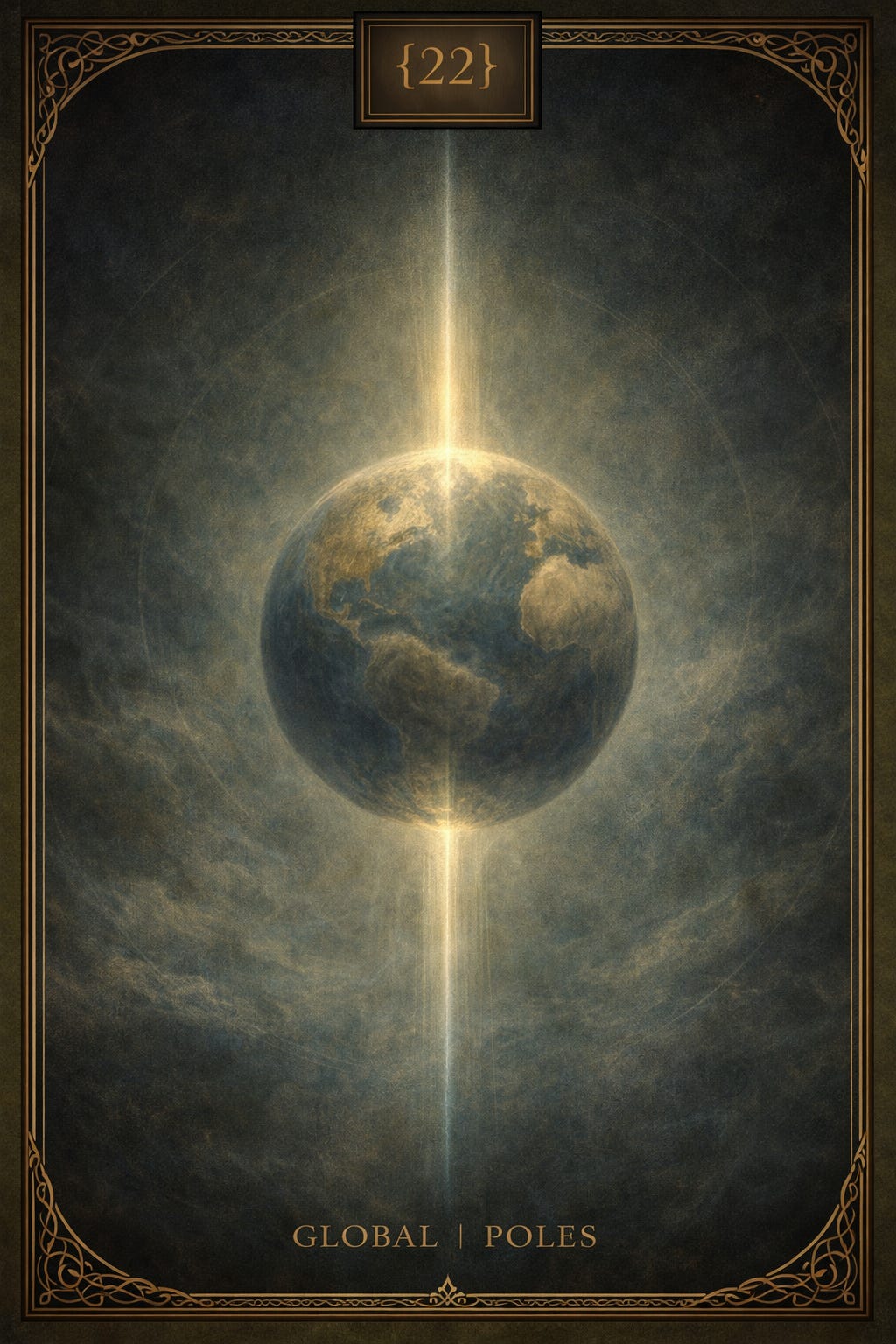
POLES: {22}
Poles represents Duality, Extreme Opposition, and Structural Support. In nature and science, they signify the Geographical or Magnetic Extremities of the earth and celestial bodies—the North and South, serving as Foundational Points of orientation, Rotational Axes, and Magnetic Polarity. Symbolically, Poles embody Tension—such as ‘Poles Apart’ describing Absolute Distance or Difference in thought or belief. While historically|culturally, Totem Poles serve as Mediators Between the Earthly and Divine Realms. Finally, Poles carry connotations of Permanence, Rigidity, and the Boundary Between Spaces—thereby functioning as vertical, Silent Storytellers and Markers of Memory.
REAP: {22}
Reap, derived from Old English: Ripan (‘to cut grain’), symbolises the final, inevitable culmination of effort, serving as a natural metaphor for receiving the consequences of one’s actions, whether Positive or Negative. Rooted in Agrarian Necessity, the act of harvesting mature crops represents the culmination of a patient, cyclical process where the Harvest (result) is directly tied to the Seed (action) that was previously sown. Symbolically, it embodies the culmination of Hard Work, accountability, and the karmic principle that one cannot escape the often Amplified Results of their deeds.
RAGE: {22}
Rage, derived from the Latin: Rabies (‘madness|fury’), represents the Peak of the anger spectrum—an intense, often uncontrollable Emotional State characterised by violent, irrational outbursts. Its nature is raw and undifferentiated, acting as a ‘brief madness’ that overrides reason and floods the body with excessive adrenaline, causing Physical Reactions such as trembling or a feeling of being Beside Oneself. While it can serve as a Protective Mechanism against egregious injustice or threat, it is widely recognised as a Destructive Force that can Erode Social Bonds and Impair Judgment—signifying a total loss of Self-Regulation, resulting in an ‘All-or-Nothing’ response that seeks immediate, frequently malevolent discharge of Energy.
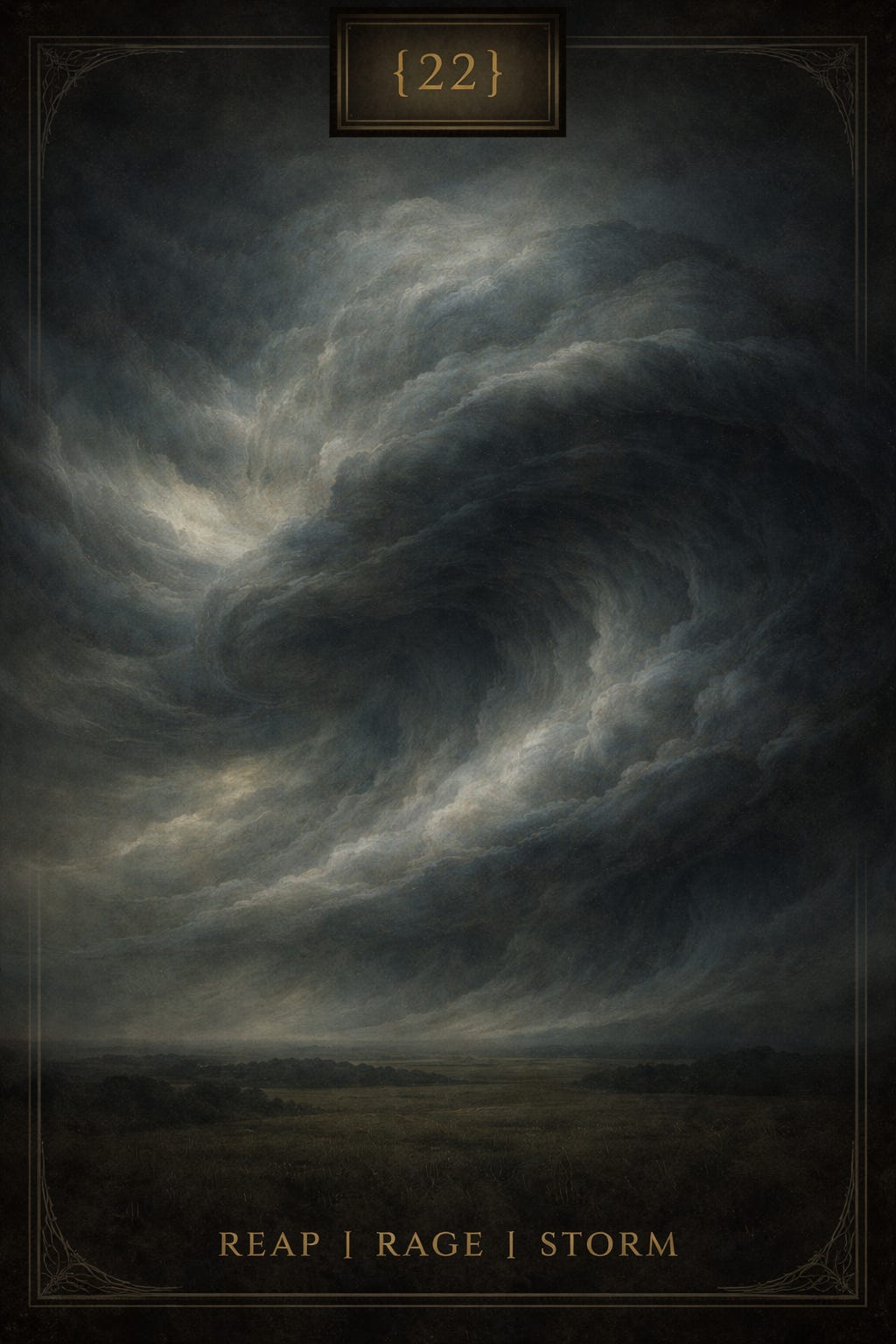
STORM: {22}
A Storm is a violent atmospheric disturbance in nature characterised by Low Pressure, Strong Winds, Heavy Precipitation, and Thunder or Lightning, representing a powerful, unpredictable force that Disrupts, Cleanses, or Destroys. Symbolically, it transcends its meteorological definition to signify Intense Emotional Turmoil, impending dread, or major life changes—the Storm also serving as a metaphor for Passion, Deep-Seated Rage, or a Necessary Cleansing Process that precedes renewal. In literature and art, this Natural Disruption Mirrors ‘Internal Battles,’ employed as a dramatic Tool to Signal Conflict or the Breakdown of Order before reaching a Calm or transformed State.
LORD: {22}
Lord, derived from the Old English: Hlāfweard ('loaf-ward|bread-keeper’) signifies a Protector, Provider, and Master—reflecting a historical Germanic custom of a chieftain Securing Food for his followers. Etymologically evolving from a Practical Manager of Resources to a title of High Authority, it signifies a person with absolute control, power, and ownership, frequently applied to feudal superiors, noblemen, or peers in British society. In a deeply sacred context, Lord is used as a title of reverence for God or Jesus Christ, denoting Supreme Divinity and the source of spiritual life. Consequently, the title encapsulates a Transition from secular ‘bread-winning’ leadership to supreme Spiritual Sovereignty, emphasising a Hierarchical Relationship of Dependence, Shelter, and Stewardship in Both earthly and celestial spheres.
MASTER: {22}
Master signifies a multifaceted combination of authority, supreme skill, and original creation, derived from the Latin: Magister (‘head|director’). It represents Dominance and Control, referring to the head of a household, a ‘Master Copy,’ an employer, or a slaveholder. Symbolically, it represents a person who has attained Exceptional Proficiency, acting as an Expert, Mentor, or Teacher—a ‘Master Craftsman|Old Master.’ While in numerology, a ‘Master Number’ is one the double-digit values: {11}, {22}, and {33}—termed Master because they possess a Higher, more intense vibrational frequency than single-digit numbers {1-9}, representing Heightened Potential, spiritual purpose, and Greater Responsibility, seen as ‘Old Souls,’ under the inference one has Mastered the lessons of their single-digit counterparts over many lifetimes.
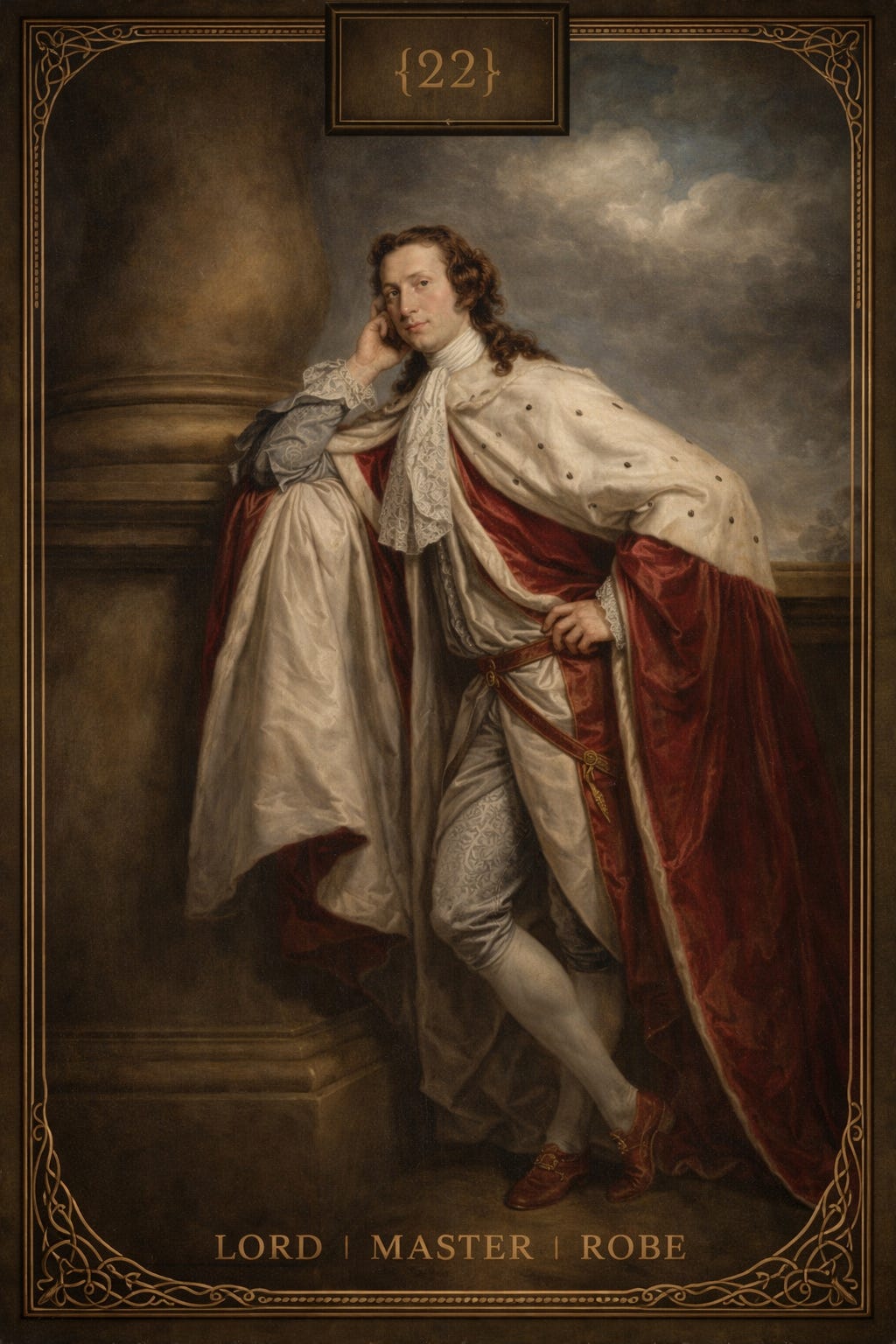
ROBE: {22}
A Robe is a long, loose outer garment that functions symbolically as a powerful Marker of Authority|Status|Identity—frequently Distinguishing the wearer by rank, profession, or spiritual standing. Historically, the Robe in both medieval European|ancient Eastern cultures signified royalty, nobility, and power, often crafted from Opulent Materials to highlight Social Hierarchy. Furthermore, the garment acts as a metonym for specific vocations—termed ‘The Robe’ to represent the judiciary or the clergy, and can denote Intense Emotional States, such as the tearing of a Robe to signify profound grief or repentance. In contemporary settings, the Robe has Transitioned into a symbol of personal comfort, lounging, and self-care—Bridging the Gap between Historical Formality and Modern Relaxation.
REALM: {22}
A Realm, originating from Old French|Latin roots signifying the territory of a King|Queen, symbolises a Domain of Control, Authority, or Sovereign Rule, traditionally referring to a kingdom or landed domain. Beyond this formal, political context, the term has evolved to represent a specific, often Intangible, sphere of Influence, interest, or activity, such as the ‘Realm of Imagination’ or ‘Realm of Science,’ highlighting a bounded field of thought or experience. Symbolically, it implies a Self-Consistent Universe, a Specialised Territory, or a particular State of being that is Distinct from its surroundings—whether used to denote a nation or a conceptual area, the essence of a realm defined as a Structured Space where specific rules, beings, or characteristics hold Dominion.
URANUS: {22}
Uranus, named after the primordial Greek deity of the sky (Ouranos), symbolises the ‘Great Awakener,’ representing radical change, innovation, and liberation from tradition. In mythology, Uranus was the sky-father whose harsh tyranny led to his castration by his son, Cronus, Separating Heaven and Earth and giving rise to Aphrodite, signifying that creation arises from Chaos and Rupture. Astrologically, this Ice Giant dictates the urge to Break the Status Quo, governing electricity, technology, and eccentricity. It is a generational planet that spurs Humanitarianism, progressive Ideals, and individuality, urging humanity to evolve and Embrace the unexpected. Unlike personal planets, its energy is Detached, Brainy, and Revolutionary, often sparking Sudden, sometimes Disruptive Shifts that advance society toward the future.
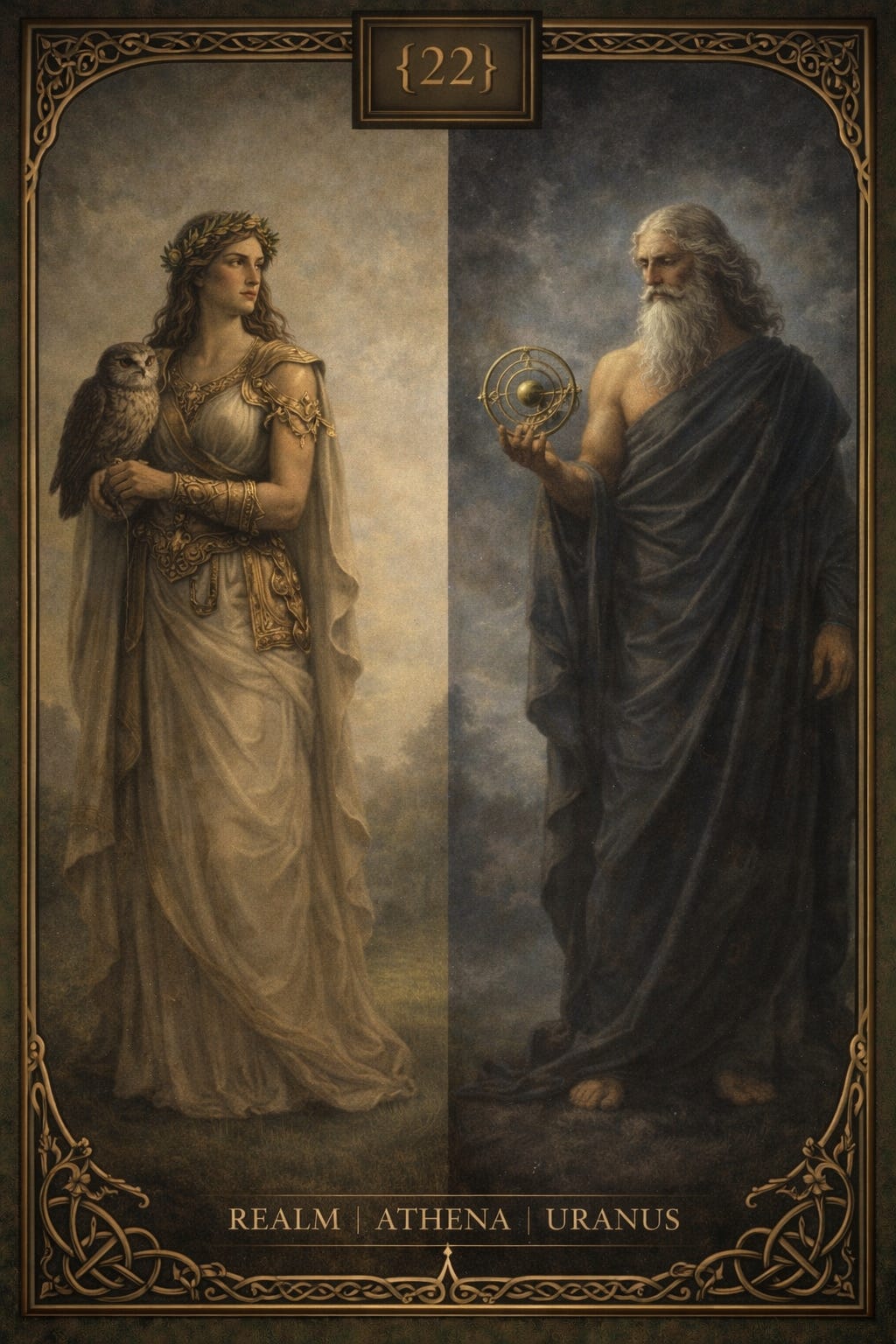
ATHENA: {22}
Athena, in Greek mythology, is the revered goddess of wisdom, Strategic Warfare, and Handicraft, embodying intellectual prowess and Civilised Society rather than brute violence, often epitomised by her birth directly from Zeus’s forehead Fully Armoured. As the patroness of Athens, her symbolism is deeply tied to Civic Responsibility, Protection, and Justice, representing the Transition from Raw Power to Ordered Democracy—while her sacred symbols, most notably the Owl (wisdom| insight), the Olive Tree (peace|prosperity), and the Aegis (divine protection), highlight her role as a guiding mentor to heroes and a champion of Civilisation.
CRASH: {22}
The term Crash originated in the late 14th century as an Imitative word for breaking or loud clattering—symbolising Violent Rupture, Sudden Failure, and the Abrupt Collision of Opposing Forces. It signifies the Shattering of Order and Civilisation—representing an Intense, Unexpected, and often irreversible event, whether a Physical vehicular Impact, a Sudden stock market Collapse, or a Systemic Failure, while its modern usage has broadened Crash to include the metaphorical ‘Crashing Out’ (extreme fatigue|emotional breakdown), the informal ‘Crashing’ (staying uninvited|briefly), or a Rapid, Intensive Effort (‘Crash Course’)—ultimately a word denoting a Dramatic Shift from Energy to Inactivity, from Order to Chaos, or from a High to a Low Point.
SHAKEN: {22}
Shaken signifies a state of being profoundly Disturbed, Unnerved, or Emotionally Agitated by a Shock or Sudden, Unpleasant Event. As an adjective, its nature is to act as a Psychological or Physical Indicator of Instability, representing a transition from a State of Calm|Firmness into a state of Disorder, Trembling, or Vulnerability. Symbolically, being Shaken represents a loss of control, a Disruption of Foundation, or a transformative moment that forces a Re-Evaluation of reality. The term also metaphorically implies a ‘Sifting Process’ that removes the superficial, leaving behind what is Essential.
SPEED: {22}
Speed, defined in physics as a non-negative scalar quantity representing the Magnitude of Change in Position over Time (distance divided by time), constitutes the rate at which an object covers ground, distinct from velocity which includes direction. In nature, Speed is essential for survival—embodied by predators and prey, while also representing the ‘Texture and Rhythm’ of space. Symbolically, Speed has evolved from its Old English roots (spēd) implying prosperity, success, and divine fortune—still echoed in ‘Godspeed’—into a modern obsession symbolising Efficiency, Technological Progress, and Liberation from Distance. Its nature may be instantaneous or averaged, yet as a concept, commonly signifies the relentless, often Unreflective, pace of modern life.
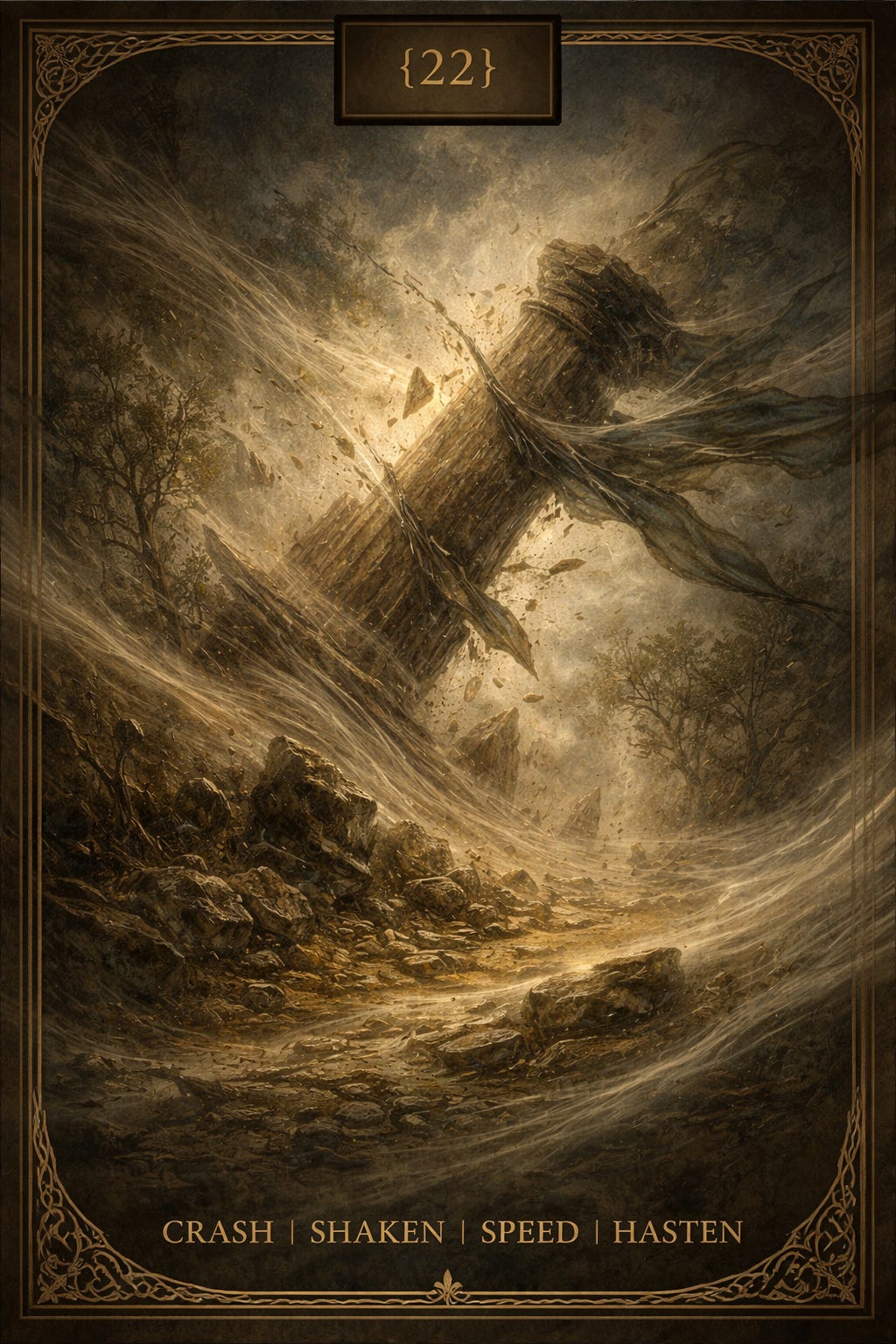
HASTEN: {22}
Hasten, from the Middle English|Old French: Haster (‘struggle|conflict’) means to move, act, or cause something to occur with rapid Speed or Urgency. Its nature is inherently active and often formal, frequently used to emphasise Immediate action (‘Hasten to Reply’) or to Accelerate an Outcome, such as ‘Hastening one’s Demise.’ Symbolically, Hasten represents a desperate struggle against time, the impelling of Fate, or a profound eagerness to reach a goal—Bridging the Gap between Human Intent and inevitable Results.
CLUTCH: {22}
Clutch signifies a Tight Grasp, Control, or a Critical, High-Pressure moment requiring decisive action, derived from Old English roots for Seizing or Bending. Its nature is multifaceted, Bridging the physical act of grasping with mechanical, situational, and slang meanings. Symbolically, it represents the nexus of panic and power—a desperate ‘Clutching at Straws’ or the ‘Clutches of Fate’—yet in modern sports and gaming, it has shifted to symbolise Resilience, performing optimally under pressure.
GEAR: {22}
Gear originates from the Old Norse: Gervi (apparel|equipment), evolving from its 13th-century roots as personal combat attire into a versatile noun defining necessary equipment, tools, or clothing for specific operations. By the 1520s, it assumed the mechanical meaning of a toothed, rotating wheel that Meshes with another to transmit torque and motion, changing Speed or direction. Its nature is inherently functional, representing Interlocked, Precise, and Collaborative Systems where Individual Components must Align to achieve Complex Operations. Symbolically, the Gear represents Industrial Efficiency, Teamwork, the Inner Workings of a system, making it the universal icon for ‘Settings.’
CASTOR: {22}
Castor has roots in mythology, natural history, and industrial use. It comes from the Greek: Kastor (‘to excel|to shine’) and the Latin: Castor (‘beaver’). Symbolically, Castor is the Mortal Twin of Pollux—together forming the Dioscuri Pair in Greco-Roman mythology. This represents Brotherly Love, Protection, horsemanship, and stellar immortality in the Gemini Constellation. While Castor Oil, named after the Ricinus Communis Plant whose seeds it derives from—likely because it was used as a substitute for Castoreum, a perfume base and medicinal substance obtained from Beaver Glands, is a thick, pale yellow vegetable oil traditionally used for its potent laxative effects, skin moisturising, and anti-inflammatory properties.
BABOON: {22}
The Baboon (genus: Papio) is a large, highly social Old World monkey native to Africa and Arabia, embodying a nature that is terrestrial, opportunistic, and fiercely intelligent. Symbolically, they present a Paradox—while commonly viewed as aggressive crop-raiders, ancient Egyptians revered the hamadryas baboon as a sacred manifestation of Thoth himself—the god of wisdom, writing, and the Moon, observing their chattering at sunrise as hymns to the sun god, Ra. They symbolise Social Intelligence, Community, vocal expression, and Primal Power. The term’s etymology, likely from Old French: babouin (meaning a grimacing figure or simpleton), highlights a historical perception of their human-like expressions. Culturally, they are Multifaceted, representing both orderly wisdom and chaotic, raw, ‘bull-like’ strength in the form of the deity Babi. As a totem or archetype, the Baboon calls for finding one’s ‘Troop,’ using Vocalisation, and maintaining Adaptability.
PEAR: {22}
The Pear is a fruit tree honored since antiquity for its longevity, sometimes living 250 years, and its Resilient Nature—symbolising immortality, Prosperity, Abundance, and Comfort. Throughout history, the Pear has held diverse, Contradictory meanings: it is associated with feminine fertility, sensuality, and the goddess Hera in Greek mythology, yet it is also used in Chinese tradition to signify Separation when Shared. In Christian art, its sweetness represents the Virgin and Child, while in 19th-century French caricature, the term: La Poire became a satirical symbol of King Louis-Philippe, and colloquially, a fool—and modern phrase ‘Gone Pear-Shaped’ which denotes a plan that has gone wrong, originating from 20th-century RAF slang, while the fruit remains a global icon of Health, wisdom, and Natural Bounty.
YARN: {22}
Yarn is a long, continuous strand of Interlocked Fibres used in textile production, symbolising Connection and the Intricate Weaving Together of Disparate Elements into a Cohesive Whole, often representing life’s journey or the ‘Threads of Memory.’ Its nature is Dualistic—ranging from Raw, Natural Wool to Synthetic Materials, and it acts as a Tactile, Calming Medium, heavily associated with Tradition, Patience, and the feminine, domestic arts. Metaphorically, yarn extends into storytelling, where to ‘Spin a Yarn’ (originating from 19th-century sailors) means to tell a long, often exaggerated or fantastical tale—particularly in Australian English, where it is a verb meaning to Converse informally, signifying a democratic and Relational Exchange of knowledge or simply a Social Chat.
CORD: {22}
A Cord is a Strong, Flexible, and Slender Structure composed of several Woven|Braided Strands, functioning to bind or measure. Its physical nature is characterised by Tension and Tenacity—making it a symbol of ‘Strength in Unity’, Binding Relationships, and the Unbreakable Connection between Spiritual and Physical Realms, such as the metaphorical silver Cord of life or the umbilical Cord. Beyond its utilitarian role, it signifies a Connective Bond—as in the Cords of love or marriage, and can likewise represent the entrapment of sin, as seen in ‘Cords of Vanity.’ Symbolically, it holds Duality—brings Order and Measurement, used in ancient rituals to Define sacred spaces or land, yet it can also imply Restricted Freedom, or in the context of knots, the active Binding of Destiny.
STRAND: {22}
A Strand signifies a thin, fibre-like element, such as hair, thread, or wire, that is either a Single Component or part of a Larger Twisted Unit, symbolising Interconnectedness, Structural Unity, and the Delicate Nature of Individual Parts within a Complex Whole. Its nature as a component of rope or DNA implies Inherent Strength through Collaboration (‘a cord of three Strands is not quickly broken’), while metaphorically, it represents a Single Thread of thought, plot, or narrative within a Broader Argument. Overall, Strand Paradoxically Bridges the themes of Binding Together (weaving) and Breaking Apart (stranded), representing both the Individual Constituent and the Margin of existence.
SYNTAX: {22}
Syntax, derived from the Ancient Greek: Súntaxis meaning ‘Orderly Arrangement’ refers to the specific rules and principles governing how words, phrases, and morphemes are sequenced to Construct Well-Formed, and Meaningful Sentences. By nature, Syntax is the Architectural Framework of language, focusing on word order, hierarchy, and Structural Relationships rather than the literal meaning of individual words, distinguishing it from Semantics—and in literature, is a Crucial Tool for manipulating rhythm, tone, and focus, while in computer science, provides the Rigid, Strict Rules for code that must be followed for execution.
CODED: {22}
The past participle Coded signifies a state of being processed, encrypted, or subtly implied, acting as a Bridge between Overt Reality and Hidden Meaning. Symbolically, it represents Messages concealed in plain sight, requiring a specialised key, Shared Cultural Context, or Deep Analysis to unveil Deeper Intent beyond the Literal Surface. In literary|social contexts, ‘Coded’ implies that actions, characters, or communication possess an undercurrent of meaning—often relating to identity and stereotypes, creating ‘Layers of Interpretation’ for the audience.
CERN: {22}
CERN, derived from the French acronym for Conseil Européen pour la Recherche Nucléaire (European Council for Nuclear Research), is an Intergovernmental Organisation established in 1954 as a post-war beacon of scientific Collaboration and peace near Geneva on the Franco-Swiss Border—its core nature that of a ‘Pure Scientific’ facility, dedicated to studying Fundamental Particles through massive particle accelerators like the Large Hadron Collider, which probe the Smallest Building Blocks of matter and simulate conditions following the Big Bang. Symbolically, CERN represents the Boundary of human knowledge and International Cooperation, Bridging diverse nations in the shared pursuit of uncovering the fundamental laws of nature. (Author’s Note): watch This and tell me they don’t know what we have been in contact with all this time. And then Smile because it’s awesome.
HAZE: {22}
Haze is an atmospheric phenomenon characterised by a suspension of Fine, dry Particles—such as dust, salt, or anthropogenic pollutants like sulfates and soot, that reduces visibility, gives the air an opalescent, milky, or brownish appearance, and Scatters Light, often turning distant objects bluish. Naturally occurring or induced by Urbanisation, it represents a lack of clarity, serving as a profound symbol for mental confusion, ambiguity, spiritual uncertainty, and the obscuring of truth or ‘Moral Fuzziness,’ often Blurring the Lines Between reality and illusion. In both literature and art, this 'nebular quality acts as a ‘luminous halo’ that brings the background forward, Dissolving Hard Distinctions and capturing a state of perpetual transition or ‘Indistinction’ itself.
CLONE: {22}
A Clone is a biological entity—Gene, Cell, or Organism, produced asexually from a single progenitor, possessing an Identical or Near-Identical nuclear genetic makeup. Derived from the Greek: Klon (‘twig’), the term signifies a natural (identical twins|plant cuttings) or artificial (somatic cell nuclear transfer) Replication process where fertilisation is bypassed. While functionally used in horticulture for centuries to Replicate desirable plant traits, modern cloning sparks Ethical, Legal, and Social Debates regarding human identity, individuality, and the potential for abuse or ‘Playing God.’ Symbolically, the Clone is often depicted in pop culture as either a horrific ‘Other’ or a tragic, soulless Copy—reflecting anxieties about biotechnology, de-extinction (cloning mammoths), and the loss of unique personhood in a ‘Culture of Copies.’
SALOON: {22}
Derived from the French: Salon and Italian: Salone (large, comfortable room|hall), the term Saloon evolved by the 1840s to define a distinct American drinking establishment, characterised by its role as a bustling, often rustic, Social Hub for cowboys, miners, and travellers in the 19th-century Old West. The nature of the Saloon was Inherently Contradictory, serving as a Vital Communal Hearth—offering Companionship, Free Lunch, Mail Services, and a ‘working man’s bank’ of credit—while simultaneously serving as a den of gambling, vice, violence, and intense commercial exploitation. Symbolically, the Saloon represents the unbridled spirit, rugged individualism, and the ‘wild chaos’ of a rapidly developing West, while its signature Swing Doors and long wooden bar evoke an enduring mythos of lawlessness, danger, and Camaraderie.
TITANIUM: ATOMIC ELEMENT {22}
Atomic Number {22}: Titanium (Ti) is a lustrous, silvery-grey Transition metal renowned for its Exceptional Strength-to-Weight Ratio, High Corrosion Resistance, and Low Density. Found abundantly in Nature within igneous rocks and minerals like rutile and ilmenite, it is never found in its pure state but is extracted as a Hard, Durable Metal. Symbolically named after the powerful Titans of Greek mythology, Titanium embodies Strength, Resilience, and Endurance—its significance lying in its unique ability to Resist saltwater and chlorine, making it vital for aerospace, marine, and industrial applications. Finally, its High Biocompatibility—the ability to Connect with bone and tissue without rejection, making it indispensable in modern medicine, and is considered a symbol of both futuristic, Cutting-Edge technology and ‘Indestructible Stability,’ often used to Bridge High-Performance requirements with Aesthetic, hypoallergenic finishes in jewellery.
The Linguistic Hinge: TWENTY TWO

{39}: Creation|Expression: {3} crossing {+} into Universal Wisdom|Completion: {9} resolving to {12}: Unity|Initiation: {1} crossing {+} into Duality|Relation: {2} resolving to {3}: Creation|Expression—the Frequency of WHOLENESS|DIAMETER|SYMMETRY|KNOWING|STRENGTH|RED ROSE|GUARDIAN|PRAYERS|SELFHOOD and THE FIRST {10} DIGITS OF PI. (Author’s Note): Incredible because the ancients would divide {22} by {7} for a close approximation of Pi.
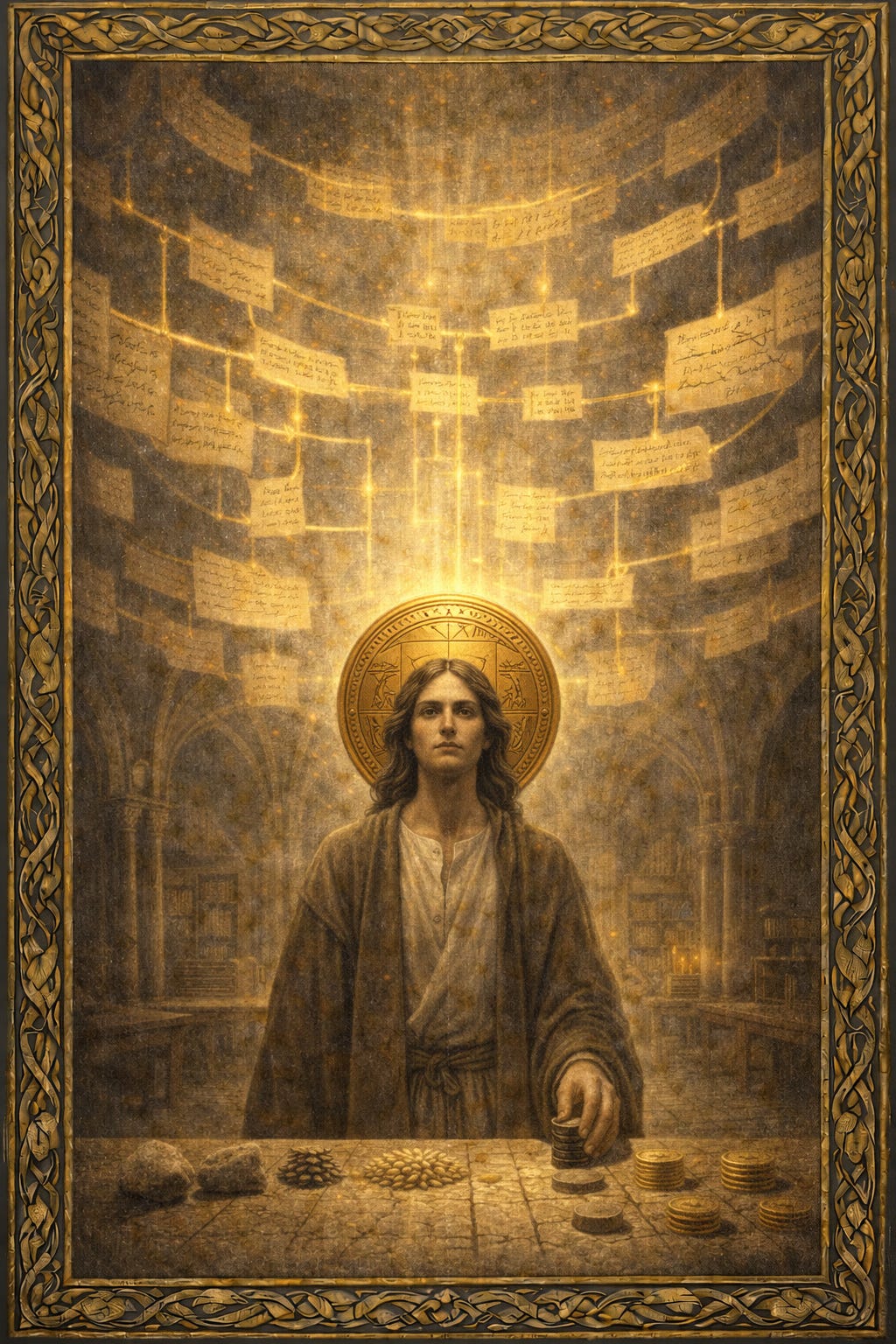
‘As a person puts on new garments, giving up old ones, the soul similarly accepts new material bodies, giving up the old and useless ones.’—Bhagavad Gita 2.22
KABBALAH: 22 Letters of Creation
Hebrew alphabet has exactly 22 letters—not {21}, not {26}, but {22}.
In Sefer Yetzirah (Book of Formation), creation emerges through:
22 letters (structural substrate).
10 sefirot (energetic emanations).
Together: 32 paths of wisdom.
The letters are not energy—they are ARCHITECTURE.
The sefirot are divine emanations (flows of creative force).
The 22 letters are divine structures (forms that channel force).
{22} in Kabbalah = alphabet of creation—the building blocks through which infinite divine energy takes finite structured form.
Without the 22 letters:
Energy remains undifferentiated.
Potential remains unmanifested.
Creation remains unbuilt.
The 22 letters are construction materials for reality itself.
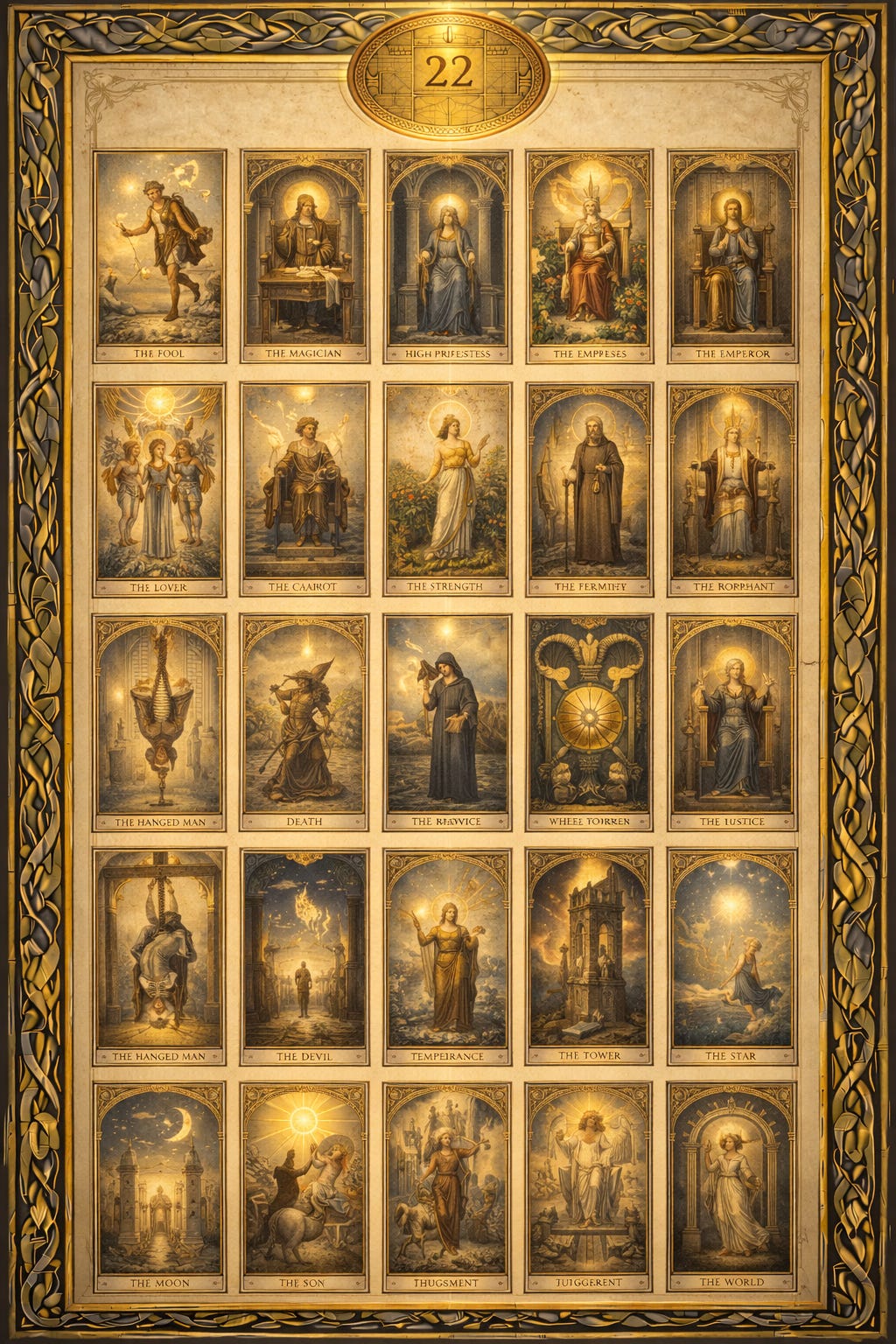
TAROT: 22 Major Arcana
The Tarot deck contains:
22 Major Arcana (archetypal journeys, structural states).
56 Minor Arcana (situational cards, daily life).
The Major Arcana are not events—they are FRAMEWORKS.
They describe structural states of being:
0 - The Fool (unmanifested potential).
I - The Magician through XX - Judgment (stages of manifestation).
XXI - The World (completed structure).
22 cards = complete symbolic architecture of human experience—not what happens to you but what you’re becoming through what happens.
Minor Arcana show situations within structures.
Major Arcana show the structures themselves.
{22} in Tarot = the scaffolding of soul-development—the stages through which consciousness must build itself.
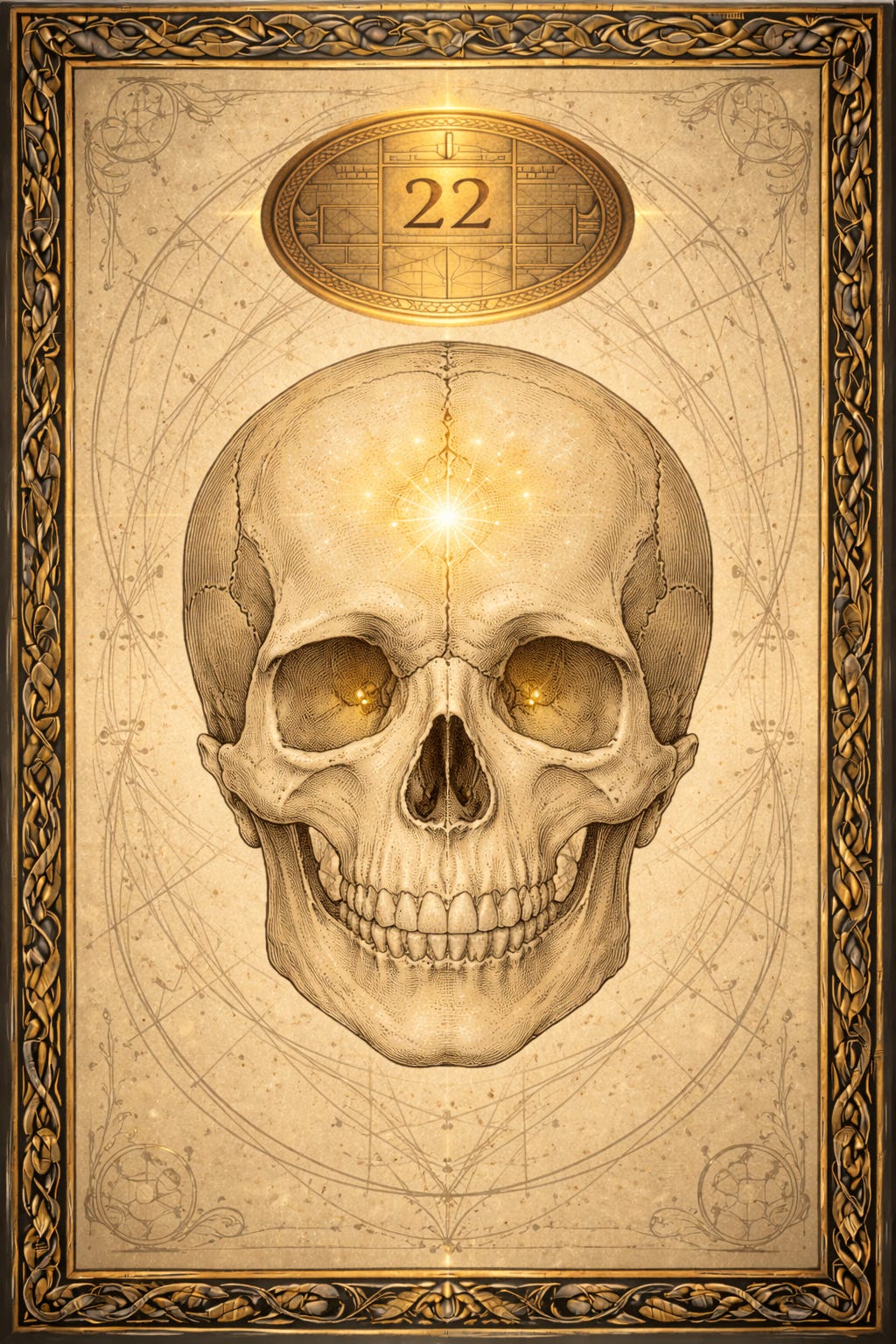
ANATOMY: 22 Bones of the Skull
The human skull contains exactly 22 bones:
8 cranial bones (protective vault).
14 facial bones (structural framework).
The skull is:
Load-bearing enclosure (protects brain while supporting face).
Protective and form-defining (creates cavity and identity).
House of mind (contains logos/consciousness).
This is not growth {31} (skull doesn’t expand in adulthood).
This is not transformation {13} (skull bones don’t regenerate).
This is structural containment {22} (permanent architecture).
{22} bones create the framework that:
Protects consciousness (brain inside).
Enables communication (jaw, sinuses, eye sockets).
Defines identity (facial structure).
{22} in anatomy = the skull as sacred architecture—built once, maintained forever, housing the divine.
CHEMISTRY: Titanium (Element 22)
Atomic number 22 = Titanium (Ti)
Titanium’s properties:
Strong (high tensile strength).
Light (low density for metal).
Corrosion-resistant (protective oxide layer like aluminium).
Biocompatible (body doesn’t reject it).
Titanium is used for:
Bone plates (structural skeletal repair).
Joint replacements (load-bearing articulation).
Aerospace frames (must not fail under stress).
Medical implants (permanent body infrastructure).
{22} at atomic level = trusted structure under stress—the material you choose when failure is not acceptable.
Titanium is {22} in elemental form:
Load-bearing (carries weight reliably).
Enduring (doesn’t corrode, degrade, or fatigue easily).
Biocompatible (integrates with living systems).
Structural (becomes part of skeleton/aircraft/building).
Where aluminium {13} creates protective boundary through sacrificial oxidation, titanium {22} creates permanent framework through inherent stability.
LINGUISTICS: 22-Letter Alphabets
Many foundational alphabets contain {22} letters:
Hebrew = {22} letters.
Phoenician (ancestor of Greek, Latin, Hebrew) = {22} letters.
Early Aramaic = {22} letters.
Why {22} consistently emerges:
Alphabets are compression systems—they aim for minimum number of units that can generate all meaning.
Too few letters: Cannot express full range of sounds.
Too many letters: System becomes unwieldy, hard to learn.
22 represents sweet spot:
Expressive completeness meets structural economy
{22} in linguistics = the minimal alphabet—just enough building blocks to construct infinite meaning without excess complexity.
Like 22 bones create skull’s complete structure without redundant pieces, 22 letters create language’s complete structure without wasteful complexity.
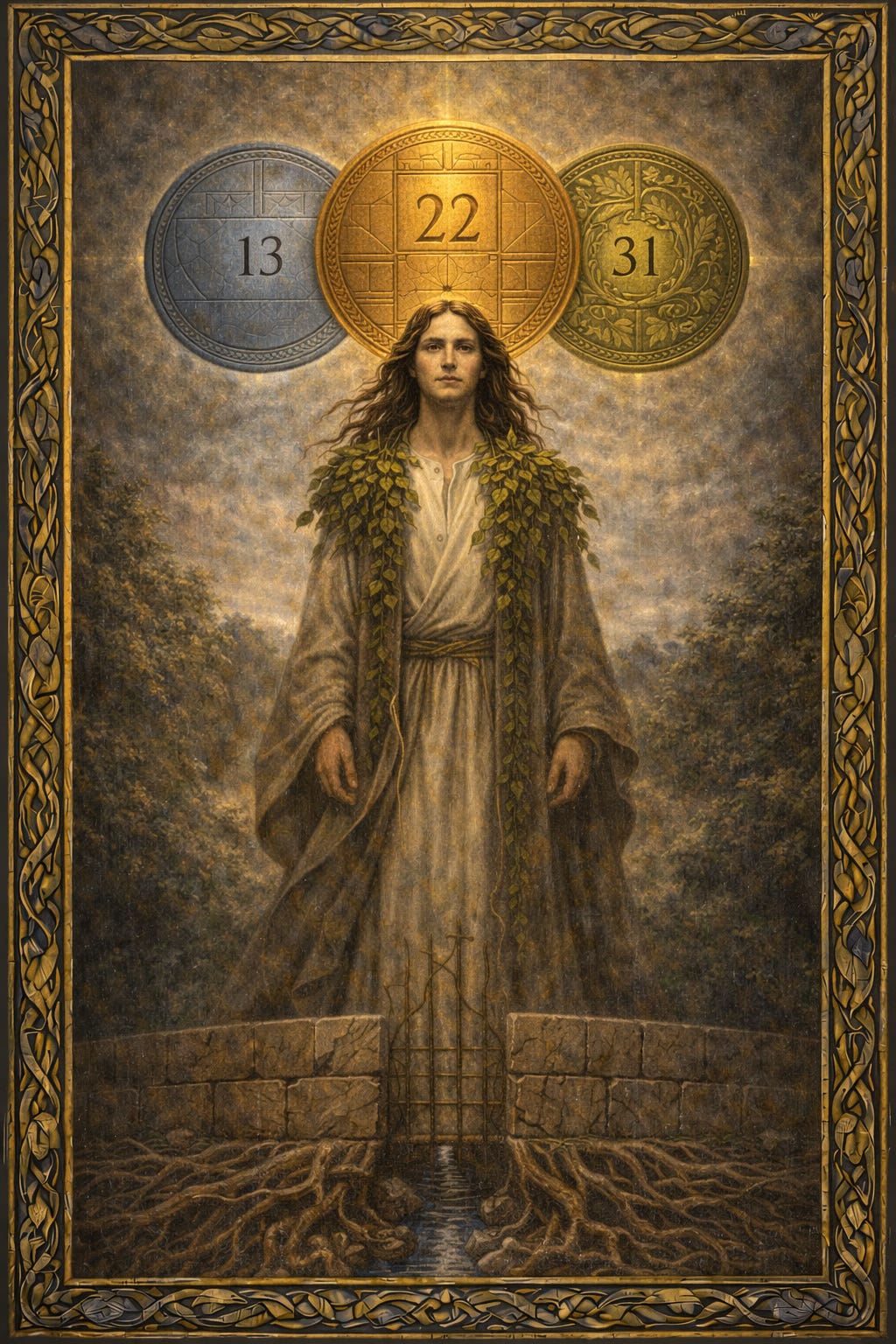
The Pattern Revealed
Across all domains, {22} appears when a system needs to hold meaning, not generate it {31} or transform it {13}.
{22} is architecture—the framework that:
Channels energy without being consumed by it.
Supports weight without collapsing under it.
Enables function without interfering with it.
Endures time without degrading through it.
{13} creates space (through death/boundary).
{31} fills space (through growth/life).
{22} organises space (through structure/system).
All three are foundation {4}:
{13} = Foundation as absence (what’s removed).
{31} = Foundation as presence (what’s added).
{22} = Foundation as order (how it’s arranged).