'See now that I, even I, am He, and there is no god with me: I kill, and I make alive; I wound, and I heal...'—Proclamation of Unity: Deuteronomy 32:39
{39}: Creation|Expression: {3} crossing {+} into Universal Wisdom|Love|Completion: {9} resolving to {12}: Unity|Initiation: {1} crossing {+} into Duality|Relation: {2} resolving to {3}: Creation|Expression.
This Substack is reader-supported. To receive new posts and support my work, consider becoming a free or paid subscriber.
{39}: is a composite, odd natural number, and Semiprime—meaning it is the product of TwoPrime Numbers. Its factors are: {1}, {3}, {13}, and {39}. Additionally, {39} is a Perfect Totient Number and the sum of Five (Life|Change) Consecutive Primes: (3+5+7+11+13).
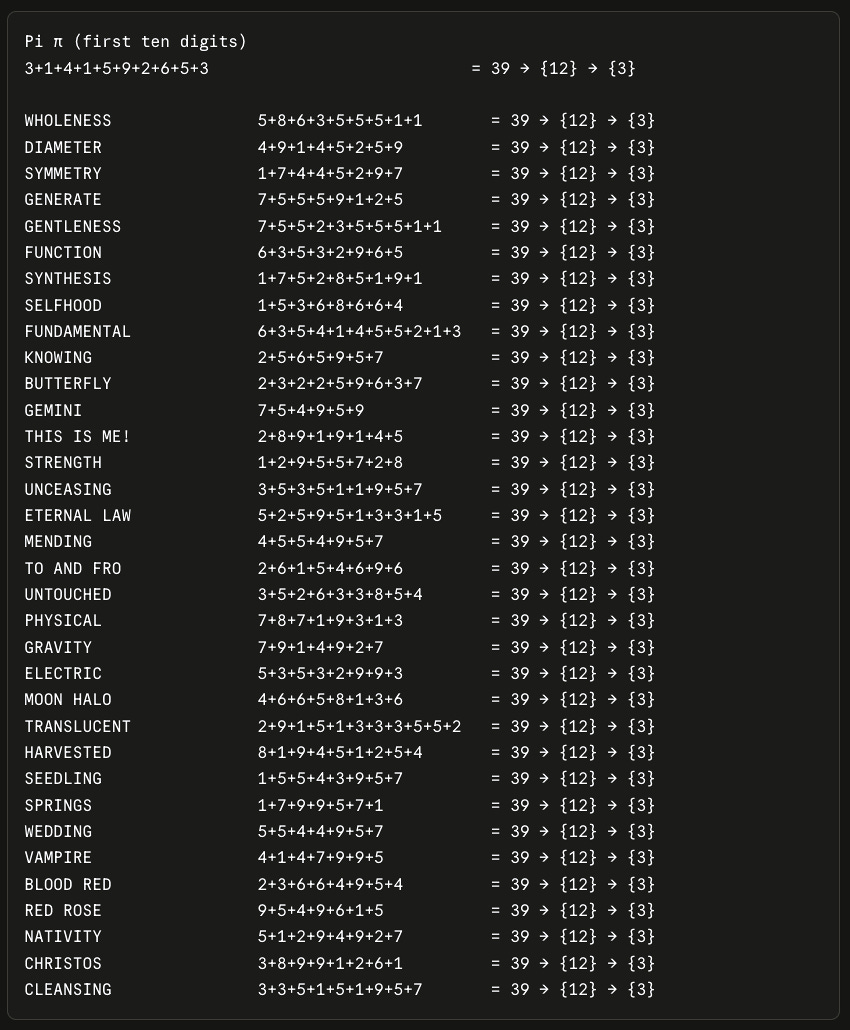
FIRST TEN DIGITS OF PI (π): {39}
Pi (π) represents the ratio of a circle's circumference (distance around) to its Diameter (distance across)—AND means no matter the size of a circle, the distance around it is always about 3.14 times its Diameter. Well, the sum of the First Ten Digits of Pi: π (3.141592653)—notably beginning and ending in {3}, resolves to: {39}, seeing the entire sequence Cycle through Creation|Expression from beginning to end. Fitting, when Pi(π) literally as the Constant that allows finite forms (circles|spheres|orbits), to ExpressContinuityWithout Endpoint.
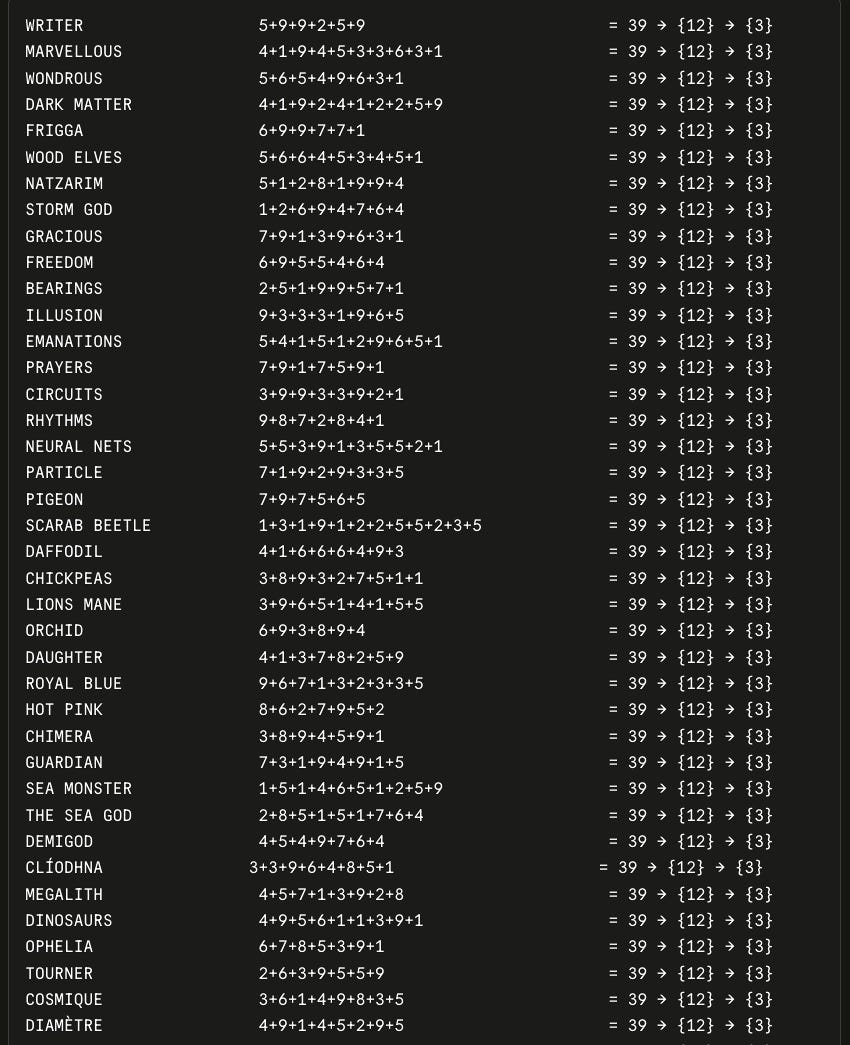
(Author’s Note): we use {10} digits for resolving infinite constants because {10} represents Wholeness|Full Journey in the same system. With this rule, we learn that both the Golden Ratio|Euler’s Number resolve to {47}: Foundation|Mystic Quest → {11} Illumination, and the {10} digit structure of Pi begins and ends in a {3}, has the intermediary sum of: {39}: (30+3x3), then to: {12}: (3x4), before resolving back to {3}—all fittingly ‘Circular.’
WHOLENESS: {39}
Wholeness is defined as the quality of being Complete, Unbroken, and Undamaged, representing a state of Totality where all parts of an entity or being are Integrated and Functioning Together without division—embodying the harmony of Mind, Body, and Spirit, and viewed in psychology and philosophy as a Balanced State that requires Integrating both the Light and Dark aspects of oneself, rather than achieving perfection. It signifies a deep sense of Peace and Internal Stability, functioning as the underlying, Interconnected Nature of reality, an ‘Indivisible Wholeness’ that brings meaning, purpose, and a sense of being ‘at home’ in oneself—ultimately representing the Healing of past wounds, the Acceptance of one’s complete story, and the Shift from Ego-Centric, Partial Living to a World-Centric Perspective of Interconnectedness.
DIAMETER: {39}
Derived from the Greek: Diametros (‘across|measure’) and commonly denoted by the symbol: (⌀), Diameter refers to the longest straight line segment that Passes through the Centre of a circle or sphere, Connecting Two Opposite Points on its Boundary, and acts as the definitive measure of its total width—signifying Balance, Completeness, and Directness. While the circle itself is a symbol of perfection and infinity, the Diameter acts as its Stabilising Internal Axis, creating Equality by dividing the whole into Two Equivalent Halves or semicircles—representing Maximum Span and structural Integrity.
GENERATE: {39}
Generate acts as a Dynamic verb meaning to Bring Into existence, Produce, or Cause something to Begin and Develop, originating from the Latin: Generare (‘to beget|produce’) and the root: Gen- (‘give birth’). Symbolically, it represents the active, often Continuous process of Bringing Forth new ideas, Energy, Offspring, or situations, rather than merely the finished Creation itself. It suggests a vital, natural, or mechanical force at work—such as generating Electricity, Generating Excitement, or Generating Wealth—emphasising productivity and the transformation of potential into tangible output. While similar to ‘create,’ Generate often implies a SystematicProcess or a ‘spark’ that causes something to arise or Multiply, carrying a connotation of Initiation, Growth, and Ongoing Vitality.
FUNCTION: {39}
Historically rooted in the Latin: Fungi (‘to perform’), Function signifies the natural purpose, intended use, or specific duty of a person, machine, or Part Within a LargerSystem, often emphasising Action and Operation rather than static existence. Symbolically, it embodies the concept of ‘Form Follows Function’—suggesting that the intrinsic purpose of an object Defines its Shape and Design, and represents the Crucial Link between Cause and Effect. In broader contexts, Function can symbolise the role an individual plays in a Social Structure, the contribution of a Part to a Whole, or even the Dependency of One Factor Upon Another, serving as a ‘mapping’ of input to output, and denoting Orderly Work and Meaningful Existence, contrasted with malfunction or being defunct.
SYNTHESIS: {39}
Synthesis originates from the Greek: Syntithenai (‘to put together|composition’), and represents the process of Combining Diverse Elements, Ideas, or Components to Form a Coherent New Whole. Symbolically, it stands in contrast to analysis—which breaks things apart to understand them, marking Synthesis a Creative and Holistic act that focuses on Connection, Integration, and the Generation of fresh meaning. It often suggests a Transformative Process, akin to chemistry where elements Unite to Create a Completely New Substance (water from hydrogen|oxygen), rather than merely a mixture of parts. Philosophically, Synthesis implies a Creative Tension that ReconcilesOpposites (thesis|antithesis) into a Higher Order, reflecting a Balance of Disparate energies or experiences.
UNTOUCHED: {39}
Untouched means not handled, used, or physically altered, but it carries profound symbolic connotations of purity, Innocence, and Pristine Preservation. Symbolically, it represents a state that is unspoiled by modern influence, Virgin in its NaturalBeauty, or completely Unmarred by damage, suggesting a Sacred or Inviolate Quality. Metaphorically, Untouched may denote Emotional Indifference or Immunity—leaving a person unmoved, unaffected, or indifferent by outside forces. Finally, it can indicate something remaining in its Original, Authentic, or Uncharted State, embodying a Quiet Tranquility, untapped potential, or a Secret, Preserved History that has Survived Unscathed.
SELFHOOD: {39}
Selfhood refers to the state of being a Distinct, Unique Individual, encompassing the Totality of one’s Personality, Consciousness, and Character. It is the Inner Essence of a Person—often viewed as a Persistent Entity, that sets them apart from others and defines their own unique experience of the world, serving as the ‘Owner|Observer’ of their personal Life Story. While psychology focuses on this as a self-contained, autonomous entity, philosophical, spiritual, and literary perspectives regularly view it as a Continuous, Relational Process of Maturation—serving as the Overarching Framework for Self-Understanding and Authenticity, helping individuals navigate life with purpose while Balancing Personal Desires with Social Interactions.
FUNDEMENTAL: {39}
Fundamental derives from the Latin: Fundamentum (‘Foundation’), and signifies anything that serves as an essential, Indispensable Base or Core Component upon which a Larger Structure, System, or Belief is built. It represents the primary Principles, Core Truths, or Underlying Causes that are not only important but necessary, such that their removal would cause the entire entity to collapse. Symbolically, it embodies the concepts of Deep-Rootedness, Permanence, and Radical, Systematic Importance, commonly referring to the Very Essence of an issue rather than its surface appearances. Whether applied to basic human rights, the axioms of mathematics, or the Fundamental frequency in music, the word emphasises a state of being Elemental, Primary, and Absolutely Crucial.
KNOWING: {39}
Knowing transcends the mere accumulation of facts, serving as a profound symbol of Conscious Awareness, Intimate Connection, and Transformative Insight. While ‘Knowledge’ represents a static collection of information, Knowing acts as an Active, Ongoing Process—a verb indicating Deep Familiarity, Intuition, or the Direct Experience of reality. Symbolically, a ‘Knowing’ glance or smile suggests perception of Hidden Truths|Wisdom, and an Inside Understanding that defies spoken explanation, while in philosophical and spiritual contexts, it signifies the journey from ignorance to enlightenment—an Intimate, Living Relationship Between the Knower and the Known, often highlighting a Sacred or Personal Bond.
BUTTERFLY: {39}
The Butterfly is a profound, universal symbol of Transformation, Metamorphosis, and Personal Growth, representing the soul’s journey from one Expression to another—an Earthly Existence to a Higher State of consciousness. Emerging from the ‘metaphoric death’ of the Chrysalis, it embodies Rebirth, Resurrection, and the capacity to Transcend physical or emotional limitations to achieve Freedom. Its delicate, yet enduring nature—exemplified by long-distance migrations, symbolises Hope and The Triumph of the Spirit over material constraints. Across various cultures, the Butterfly is seen as a messenger of Joy, a symbol of Love and Longevity in China, representatives of the Soul in Greek tradition (where ‘Psyche’ means both), and omens of Comfort from departed loved ones in Celtic and NativeAmerican cultures.
‘The Butterfly is proof that One can go through a great deal of Darkness and still become something Beautiful.’—Beau Taplin (a lifetime ago).
SYMMETRY: {39}
Symmetry, derived from the Ancient Greek: Symmetria meaning ‘Agreement in Dimensions|Arrangement,’ represents a primary principle of Balance and OrderedProportion where Parts of a Whole Correspond in Size, Shape, and Relative Position. In nature, Symmetry serves as a blueprint for growth and survival, such as in the bilateral wings of a Butterfly or the radial patterns of a flower, symbolising Efficiency and Natural Beauty. While throughout art and architecture, Symmetrical Design is employed to evoke feelings—guiding the viewer’s eye toward a Central Focal Point to create a sense of calm. Symbolically, Symmetry signifies Beauty and truth, cosmic Order as opposed to Chaos—making it a universal language that Bridges the Gap Between Scientific Precision (Universal Wisdom) and Artistic Expression.
GENTLENESS: {39}
Gentleness is the profound virtue of wielding Power with Restrained, Compassionate Tenderness. At times misunderstood as weakness or timidity, true Gentleness is actually ‘Strength under Control,’ symbolised by the image of a tamed wild stallion or a sheathed sword, indicating an Intentional Choice to act with Kindness even when one has the capability to be harsh. Symbolically, it represents the ‘Fruit of the Spirit,’ a Transformative, Inner Grace that Cultivates a Calm, Patient Temperament that can Defuse Conflict, Heal Broken Relationships, and Foster a safe, non-threatening environment. It is a humble, patient approach to life that prioritises Others‘ Well-Being—Gentleness ultimately a courageous form of Love that Reflects a serene, noble spirit, embodying a Conscious Decision to walk softly through a harsh world.
THIS IS ME!: {39}
The phrase ‘This Is Me!’ functions as a Powerful, Versatile Declaration of Identity, primarily symbolising unapologetic Self-Acceptance, Authenticity, and the Courageous Refusal to hide one’s True Self behind societal expectations or insecurities. Metaphorically, it serves as a Boundary-Setting Anthem, allowing individuals to Stand Tall in their own skin, Embracing their scars, differences, and deformities over seeking approval from Others. Associated with the anthem from ‘The Greatest Showman,’ the phrase embodies a Shift from being Hidden to being Seen, representing a Definitive, Public Moment of truth where one Takes Ownership of their Life’s Story, Flaws, and Strengths alike.
STRENGTH: {39}
Strength signifies far more than mere physical muscle; it represents the multifaceted capacity for Endurance, Fortitude, and Resilience in BothBody and Mind—understood as a vital, stabilising Energy that allows individuals to Withstand Hardship and Temptation, often acting as a cornerstone of character, and embodied by Enduring, Natural, and Powerful images (the unbreakable oak tree|the courageous lion|mighty, ancient mountain), serving as reminders of Inner Resilience. Strength is the quiet power to Adapt to challenges, depicted in the Tarot as a figure calmly taming a Beast, representing the triumph of Compassionate, Inner Resolve over raw, aggressive force—ultimately symbolising the capacity to hold space for oneself and others, the persistence to Continue Rising after failure, and the Inner Capacity to withstand life's storms.
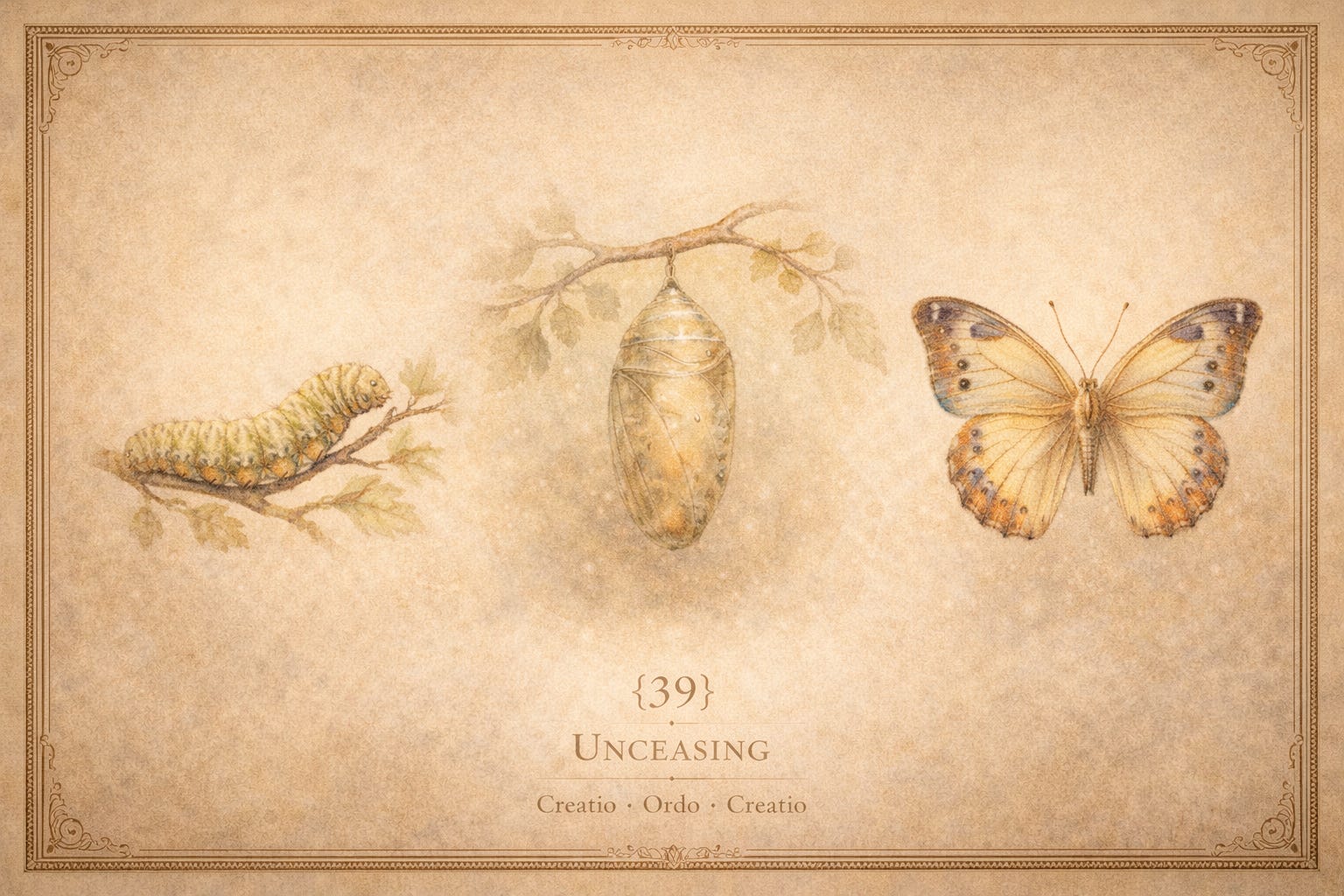
UNCEASING: {39}
Unceasing acts as an adjective describing actions, states, or phenomena that Continue Without Stopping, Pausing, or Becoming Less—signifying a Relentless, Perpetual, or Non-Stop Nature—such as ‘Unceasing Rain’ or the movement of waves, or to Persistent Efforts|Emotions like ‘Unceasing Support|Unceasing Labour.’ Symbolically, unceasing represents Endurance, Immortality, and the Eternal, frequently appearing in literature and theology to emphasise a Tireless, Unstoppable Force or Devotion—while in a spiritual or theological context, it symbolises the soul's Perpetual Activity and existence, or a Committed, Relentless Faith.
ETERNAL LAW: {39}
Eternal Law refers to the Unchanging and Universal Principles established by a Divine Creator or inherent in the Cosmos that govern the order, purpose, and Moral Conduct of all Creation. Symbolically, it represents the ultimate, objective truth and Rational Plan of the divine, guiding humanity toward Good and away from Evil. It is often understood as the source of both Natural Law and moral law, standing as the supreme authority against which human-made laws are measured. In various philosophical and religious traditions, including Hinduism’s: Sanatana Dharma, it symbolises cosmic Order (Rta), righteousness, duty, and Enduring, Immutable Ethical Principles that apply to all beings regardless of time or location.
EBB AND FLOW: {39}
TO AND FRO: {39}
The phrase ‘To And Fro’ refers to a Continuous, Alternating Movement in Opposite Directions—Back and Forth from a Central Point, inferring a Repetitive, Rhythmic, or Wandering Motion. Literally, it describes an Oscillatory Movement—such as waves on a shoreline, a tire swing, metronome, or branches swaying in the wind, while symbolically signifying Indecisiveness, Restlessness, or a state of Vacillation, where an individual|idea wavers Between Two Options without arriving at a firm conclusion. It can also symbolise the busy, often aimless, activity of life—inferring Energy spent without necessarily achieving progress.
PHYSICAL: {39}
Physical refers to that which is material, tangible, and perceptible to the senses—the concrete reality of the Universe, distinguished from the mental, emotional, or spiritual realms. It denotes the structural and bodily properties of existence, covering matters of Size, Shape, and Strength—applied to activities requiring Bodily Effort, Contact, or Force. Symbolically, Physical represents the Grounding of human life in the material world, representing Mortal Existence, Vulnerability, and the limitations of Time and Space—and serving as a Bridge to Interaction, signifying TangibleConnection, Affection, or Aggression through Touch, while also representing the ‘Vessel of the Self’—a Temporary Habitation for consciousness.
PARTICLE: {39}
A Particle, derived from the Latin: Particula (‘part’), refers to a minute, distinct portion of matter—such as an atom, molecule, or speck of dust, that Together with Others constitutes a Larger Mass. In physics, it signifies a localised building block of the Universe, often treated as a Point-Like Entity with negligible internal structure, ranging from subatomic electrons to macroscopic grains of sand. Symbolically, the Particle embodies the concepts of fundamentalism and the Infinite Creation within the Infinitesimal, representing how Massive Systems are assembled from Minuscule, Hidden Constituents—philosophically highlighting the Interconnectedness of all things, suggesting that even the smallest, ‘invisible’ piece of truth, evidence, or matter is an Indispensable Part of the Greater Whole.
GRAVITY: {39}
Derived from the Latin: Gravitas, (‘weight|heaviness’), Gravity encapsulates a Duality between fundamental physical law and profound human experience. Physically, it is the invisible, inescapable force of Attraction that Binds the Universe together, causing objects to possess weight, shaping the orbits of planets, and HoldingAtmosphere and Oceans to the Earth. Symbolically, Gravity represents the Anchoring Forces of life—consequence and reality, that which keeps us Grounded, both physically and emotionally. Metaphorically, the ‘Gravity of a Situation’ denotes Extreme Seriousness, Importance, or Solemnity, representing the Mental|Emotional Burden that accompanies significant, life-altering events.
ELECTRIC: {39}
Electric originates from the Greek: Elektron (‘amber’), historically denoting substances that, when rubbed, attract light objects via Static Electricity, as observed by William Gilbert in 1600. Literally, it refers to the Generation, Conduction, or Utilisation of electrical force, covering both the physical infrastructure and the Energy itself, which became a foundational force of modern industrial society in the late 19th century. Symbolically, Electric serves as a metaphor for modern life and technological progress, or vibrant, luminous colours like ‘Electric Blue,’ while its figurative use frequently implies a sudden, high-tension Energy, such as an ‘Electric Atmosphere|Electric Performance’—signifying Intense Excitement, Thrill, or a Charged Emotional State.
MENDING: {39}
Mending refers to the act of Repairing, Patching, or Restoring something Broken, Torn, or Damaged, particularly textiles and clothing, back to a Functional State. It symbolises the Beauty in Imperfection, particularly through practices like ‘Visible Mending’ or the Japanese: Kintsugi (repairing with gold), where the repair marks are Celebrated rather than hidden, Turning Flaws into Unique Artistic Expressions and narratives of personal history. Finally, Mending carries a metaphorical weight representing Healing, whether through Personal Emotional Recovery (‘Mending a Broken Heart’) or the Fixing of DamagedRelationships (‘Mending Fences’)—ultimately embodying the idea that things that are disunited may be made Whole and even Stronger than before.
MOON HALO: {39}
A Moon Halo, otherwise known as a ‘22-degree Halo,’ is a stunning atmospheric phenomenon appearing as a luminous, circular ring of pale, faint-rainbow light surrounding The Full Moon. Symbolically, it is regarded as an omen of Intense Transformation or a sign of Divine Protection meant to Guard the viewer from negative energy during times of Personal Transition or Emotional Turmoil. Culturally, this ‘Ring around the Moon’ is deeply embedded in folklore as a harbinger of imminent change, serving as a ‘storm ring’ that Signals the arrival of rain, snow, or unsettled weather within 24 hours, a theory often supported by the presence of high-altitude cirrus ice crystals that precede warm fronts. Spiritually, it serves as a powerful reminder of Life’s Cycles, intuition, and Feminine Energy, encouraging Introspection and Connection to the Universe.
TRANSLUCENT: {39}
Translucent, derived from the Latin: Trans- (‘through’) and Lucēre (‘to shine’), describes a material or substance that allows Light to pass through but diffuses it, preventing a clear, distinct view of what lies beyond. Unlike transparent materials that reveal all, or opaque ones that hide everything, the Translucent occupies a Delicate, EtherealMiddle Ground—associated with frosted glass, milky amber, or thin skin. Because it FiltersLight, it frequently evokes themes of Mystery, Contemplation, and Inner Spirituality, suggesting a Hidden, Inner Life or a Beauty that is felt rather than fully seen. While in a metaphorical context, a ‘Translucent’ person|idea infers a certain kind of Honesty that is not completely naked or harsh, but rather glows with a Soft, Authentic Quality that is ‘free from disguise.’
HARVESTED: {39}
Harvested means the act of gathering, reaping, or collecting mature crops, resources, or data at the peak of their readiness—representing the Culmination of Effort, Patience, and Time where one’s labor is rewarded with Tangible Results. It embodies the Cyclical Nature of Life, Death, and Renewal—Shifting from the Active, Nurturing Phase of Growth to the Final, Necessary Act of bringing something to Completion. Figuratively, to have something ‘Harvested’ implies a sense of abundance or the ‘Reaping Of What One Has Sown,’ reflecting accountability for past actions, whether they lead to a positive yield or consequences. In deeper contexts, the term can also carry a ‘bittersweet quality,’ suggesting the End of a Season|Phase—while Dualistically also associated with Deep Gratitude, Sustenance, and the Necessary Preservation for future scarcity.
SEEDLING: {39}
A Seedling, defined literally as a young plant recently emerged from a seed, represents the Critical, Vulnerable First Stage of Growth—symbolically serving as a metaphor for the Fragile yet Hopeful Beginnings of a Creative Project, Relationship, or Personal Journey, representing the ‘Unseen Strength|Hidden Potential’ contained within a small, humble start. The Seedling signifies the determination of the human heart to Overcome Obstacles—like pushing through dark, dense soil to reach the Light, highlighting the importance of Persistence, Effort, and Care in Nurturing Personal Evolution. Finally, it represents a Life Cycle of Renewal and the necessity of patience, serving as a reminder that great, strong, and enduring things begin with small, Carefully Tended Beginnings.
DAFFODIL: {39}
The Daffodil (genus: Narcissus) is a potent symbol of Rebirth, Renewal, and FreshBeginnings, widely regarded as the first sign of Spring as it pushes through cold ground to bloom after Winter. Its vibrant Yellow and White petals represent Joy, Positivity, and Hope, particularly in the context of recovery from illness, leading to its adoption as a symbol of Hope by Cancer charities. While generally representing Friendship, Vitality, and Resilience, cultural interpretations vary—in China, they are believed to bring Good Luck and Prosperity during the New Year, while in Wales, they are the national flower ExpressingWelsh Pride. In literature, Daffodils are often associated with the PoetWilliam Wordsworth, representing the Joy found in nature, while the Daffodil has complex roots in Greek mythology—linked to Narcissus and, consequently, themes of unrequited Love|Vanity, and superstition holds that while a bouquet represents Joy, a single Daffodil may spell misfortune.
ORCHID: {39}
The Orchid is a flower rich in ancient history and profound symbolism—derived from the Greek word: Orkhis, referring to the shape of its tubers, these Flowers were historically associated with Fertility, Virility, and Sexuality in Ancient Greece. In Chinese culture, the Orchid signifies Refinement, Integrity, and Friendship, frequently cited by Confucius as a representation of a noble person. During the Victorian era, their rarity and delicate nature made them a supreme symbol of Luxury and High Social Status, often associated with intense Love and Admiration. Beyond their aesthetic, Orchids symbolise strength and power in Aztec tradition, and in modern floriography, they Convey Thoughtfulness and Mature Charm. The colours of the Orchid further refine its meaning: White symbolises purity, Pink represents grace and femininity, Purple signifies royalty, and Red represents passion.
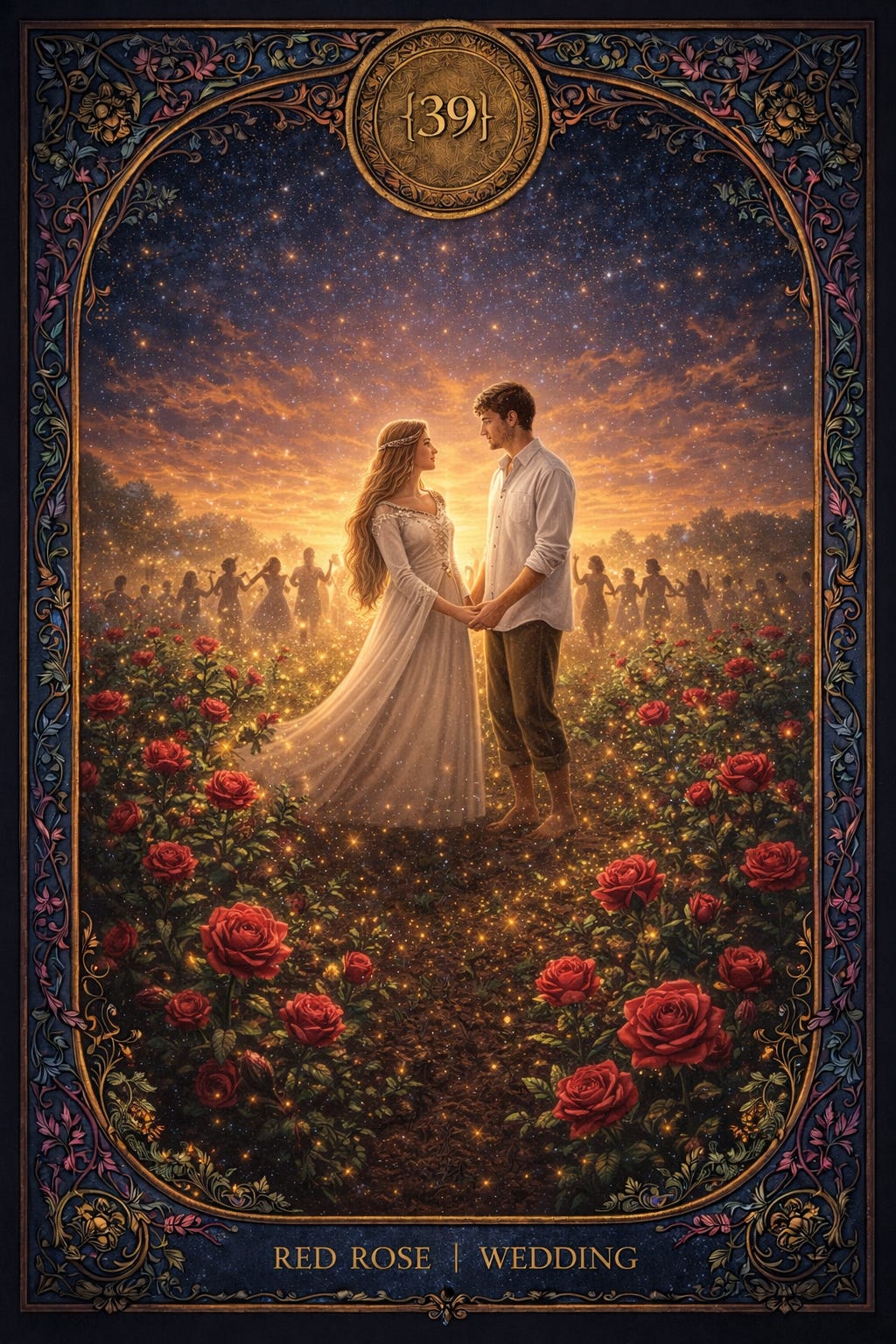
RED ROSE: {39}
The Red Rose is recognised universally as the ultimate emblem of Deep Love, Passion, and Romantic Desire, serving as a Vibrant, Wordless Confession of Intense Affection, such as ‘I Love You.’ Beyond romantic yearning, it symbolises Respect, Admiration, and Devotion, making it a fitting token for Honoring achievements or showing Deep Appreciation. The colour itself signifies the warmth, Fire, and urgency of Emotional Connection, while the thorny stem serves as a Duality of Pleasure and Pain. In contemporary times, the number of roses changes the message—a single Red Rose signifying ‘I Love You’ directly, while a Bouquet representing Profound Commitment, Everlasting Passion, and a ‘Love that has no Bounds.’
WEDDING: {39}
A Wedding is a Ceremonial Act of marrying that signifies the Formal, Public Union of Two Individuals, deeply rooted in the Old English term: Weddian (‘to pledge|make a promise’). Symbolically serving as a Profound Expression of Commitment, Love, and a Shared Future marked by Rituals that vary across cultures but hold universal themes of Community, Transition, and Unity. The ceremony itself, from the Exchange of rings, representing an Unbreakable, Eternal Bond, to the wearing of a White Dress, signifying a Fresh Beginning, Love, the Blending of Families, and the Creation of a Sacred Social Covenant.
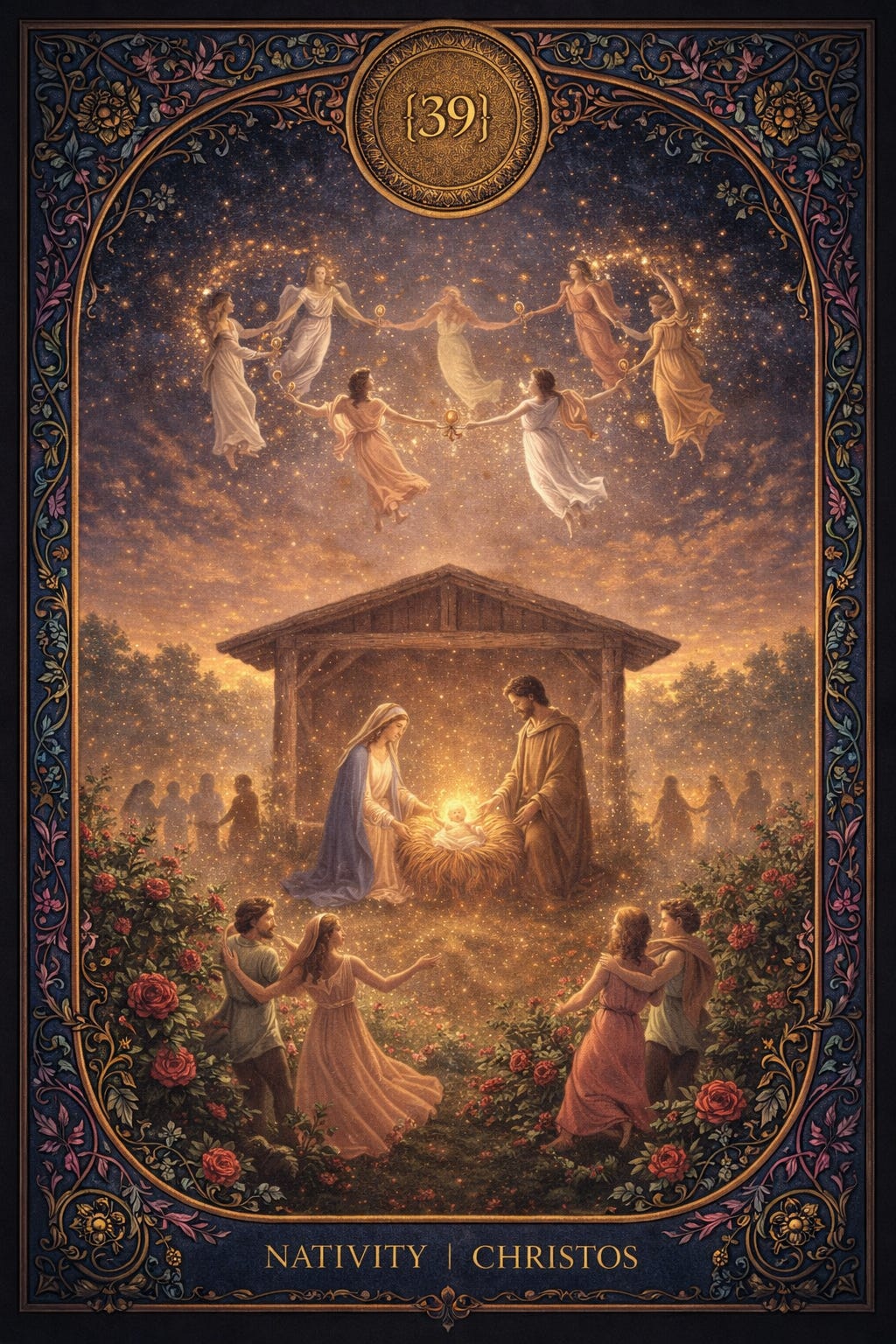
NATIVITY: {39}
Nativity originates from the Latin: Nativus (‘arisen by birth’) and technically refers to the process, circumstances, or place of a person’s birth. While it can be used generically to describe one’s origin, it is most commonly capitalised and used to signify the miraculous birth of Jesus Christ—the Nativity representing the Incarnation, God becoming Human. It focuses on themes of humility, as The Saviour is depicted being born not in a palace, but in a humble stable and laid in a manger—the various elements in the scene, such as the shepherds representing the poor and the Magi representing the wise seeking truth, embodying the Universal Message that the gift of The Saviour is meant for all people.
CHRISTOS: {39}
The Greek word: Christos (Χριστός), derived from Chrio (‘to anoint’), literally translates to ‘The Anointed One’ and serves as the Greek equivalent to Messiah. More than a personal name—it is a Profound Theological Title designating a person Chosen, Empowered, and Set Apart by God for a Sacred Purpose. Historically, it carries connotations of being covered in Oil—a Ritual Act signalling a Transformation into a Holy, Consecrated Entity, while in the context of early Christianity, calling Jesus: Christos was a revolutionary proclamation that he was the long-awaited divine King meant to restore justice and rule in Love. Beyond this, Christos is interpreted in Mystical|Gnostic traditions as a state of spiritual ‘at-one-ment’ or ‘The Christ Within’—a reference to the Divine Light, Highest Spiritual Self, or the Deathless Individuality existing within Every Human Being, rather than solely a historical figure.
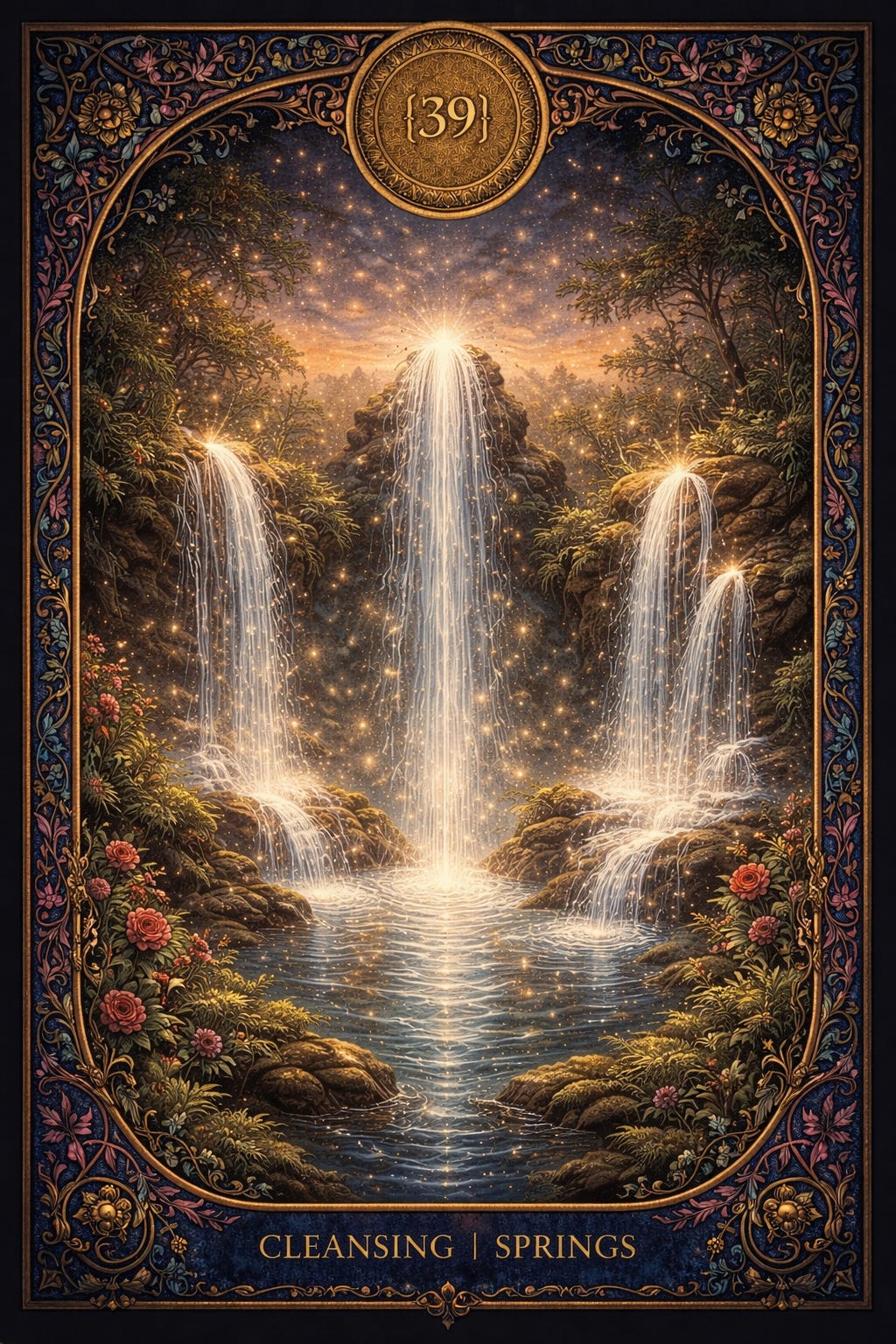
CLEANSING: {39}
Cleansing refers to the Active Process of Removing impurities, dirt, toxins, or undesirable elements to Restore something to a state of Purity, Health, or Functionality. In various cultural and religious traditions, Cleansing Rituals, such as baptism, bathing in sacred rivers, or smudging with herbs, signify the Washing Away of past transgressions and the preparation for a New Phase of life or Deeper Divine Connection—the word serving as a powerful metaphor for Shedding Burdens, Forgiving Oneself, and Returning to an Innocent or Original State of Wholeness.
SPRINGS: {39}
Springs, derived from Old English roots (‘sudden leap|surge|burst’), carries rich symbolism centred on Renewal, Emerging Life, and the Unstoppable Force of beginnings. As a natural phenomenon, Springs of Water symbolise a direct source of Spiritual Purity and Refreshment—a ‘Fountain of Life’ that turns a barren, dry landscape into a place of growth. Phrase like ‘Hope Springs Eternal’ highlight the Everlasting Potential for Rebirth and Optimism that arises even in dark circumstances. Furthermore, Springs’ often implies an abundance of these life-affirming forces, suggesting a Continuous, Overflowing, and Resilient Resurgence of Vitality and Growth.
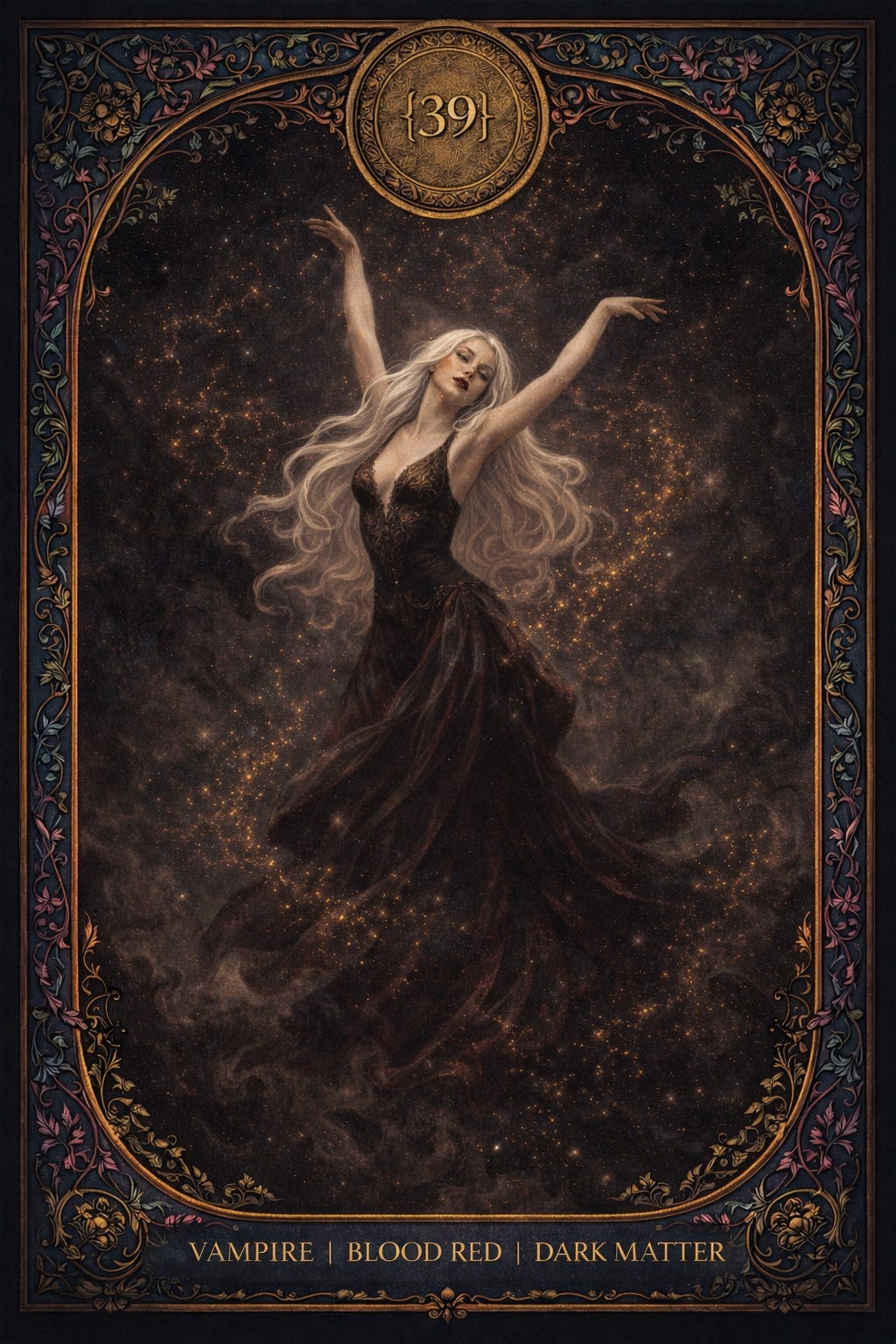
VAMPIRE: {39}
A Vampire is traditionally defined in folklore as a Reanimated, Undead Creature that survives by feeding on the Blood of the living, often possessing supernatural powers like Shape-Shifting, Mesmerising Gazes, and Extreme Longevity. Originating primarily from early 18th-century Eastern European tales of revenants, the Vampire has evolved from a bloated, monstrous parasite into a Sophisticated, Charismatic symbol of Temptation—embodying a multifaceted Blend of Fear and Desire, representing repressed sexuality, the allure of forbidden romance, and the morbid fascination with Immortality. Psychologically, they serve as a ‘Shadow Self’—a Mirror to human anxieties regarding mortality, decay, and the predatory or manipulative aspects of HumanRelationships, serving as a metaphor for the Endless Consumption of Emotional or life Energy.
BLOOD RED: {39}
Blood Red is a Deep, Intense, and Vivid shade of crimson, intrinsically linked to Both the essence of life and the stark reality of mortality—signifying Vitality, Passion, and Strong Emotions. Symbolically, it embodies a Dual Nature, serving as both a marker of Romantic Love and Desire—associated with roses or passionate excitement, and a Warning Sign of danger, violence, anger, or impending destruction. Historically, it has been used to signify Courage, Sacrifice, and power, such as the robes of cardinals, while in many cultural contexts it both serves as a protective force against evil, yet also signifies the bloodshed and aggression of war. Beyond this, Blood Red commands Immediate Attention, commonly used to denote revolutionary ideologies or as a spiritual symbol of Life-Force and Renewal.
DARK MATTER: {39}
Dark Matter represents a Mysterious, Invisible Form of matter that, despite comprising roughly 85% of the total matter in the Universe, cannot be directly observed through electromagnetic radiation like Light, Radio Waves, or X-Rays. In scientific terms, it is recognised not by its appearance, but through its gravitational effects on visible matter, such as serving as a ‘Gravitational Glue’ that prevents galaxies from spinning apart and providing the Scaffolding for cosmic structures. Dark Matter is commonly described as a ‘Ghostly|Hidden’ component of reality—evoking themes of unseen influence and the humbling realisation that something invisible is Holding our Existence Together.
THE ARCANE: {39}
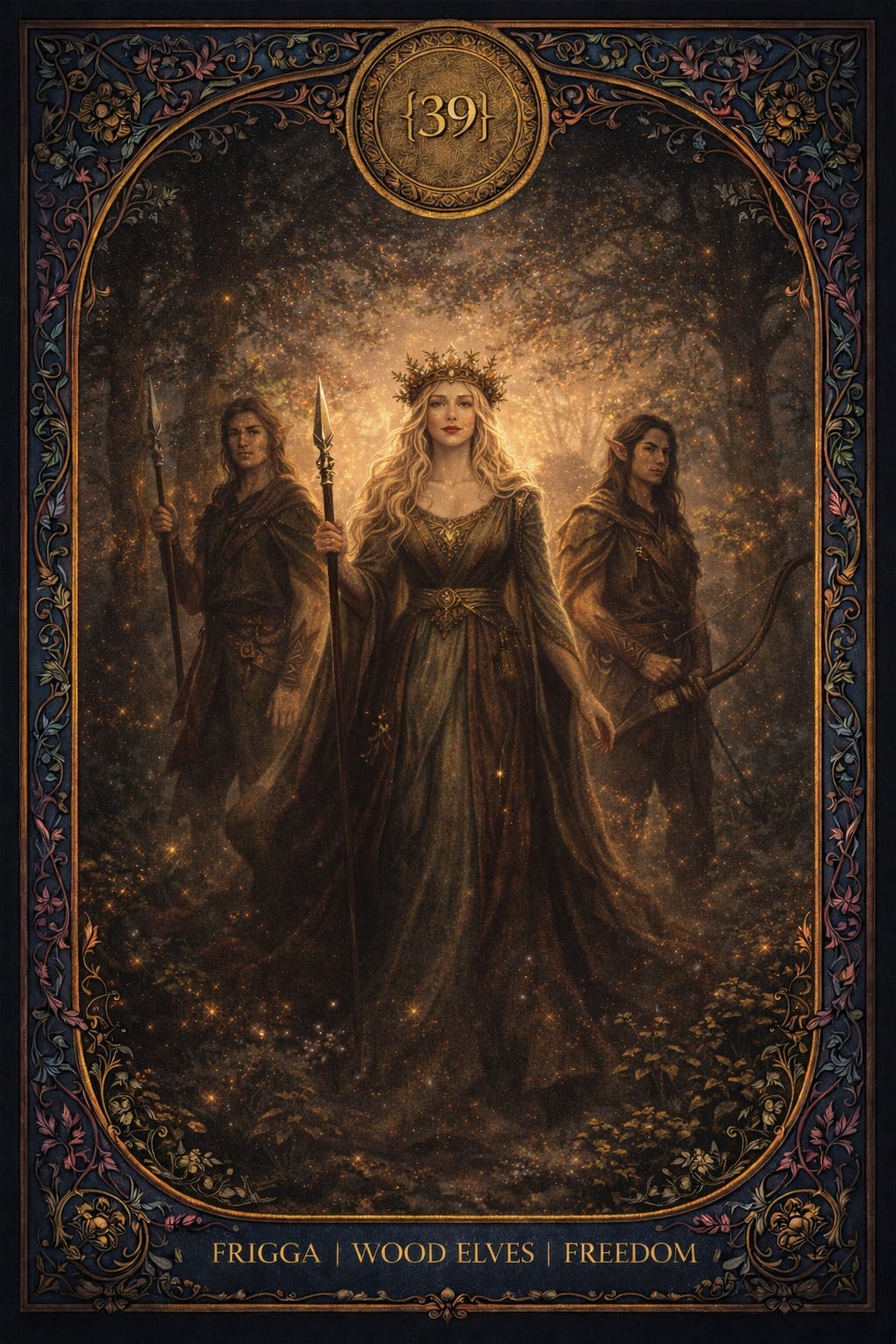
FRIGGA: {39}
The variant and arguably now predominant spelling of the goddess Frigg, Frigga tends to appear in contexts where the goddess is rendered more Accessible, Warmer, and more Domestically Present. The Victorian painting—John Charles Dollman's: Frigga Spinning the Clouds (c. 1900), presents her as the loving mother|wife, the keeper of domestic wisdom, and spinner of fate in an Intimate rather than cosmological sense. While in the MCU, Frigga symbolises the ultimate Maternal Force, balancing regal authority with profound compassion as the Queen of Asgard and mother|adoptive mother to Loki and Thor. Her character represents the Intersection of Love, Wisdom, Magical Prowess, and Mentorship—her role also defined by a fierce, protective power, utilising Illusion Magic and Stealth to Defend her home and family, rather than relying solely on brute strength.
WOOD ELVES: {39}
Wood Elves represent a distinct archetype in fantasy literature and folklore, symbolising the Untamed, Primal, and Protective aspects of nature. Unlike High Elves, who are typically associated with refined civilisation and arcane power, the Wood Elves represent a harmonious, Eco-Centric Existence, serving as Guardians of Ancient Forests, Keepers of Forgotten Wisdom, and Defenders of The Natural Order. Symbolically, Wood Elves signify the Boundary Between civilisation and the wilderness, embodying agility, stealth, and a Deep, Intuitive Magic that is blended with natural surroundings rather than dominating them—often-seen in Green or earthy-toned clothing with a reliance on archery and allied Tree Spirits to signify their role as Elusive and Vigilant Watchers of the forest.
FREEDOM: {39}
Freedom is defined as the power or right to Act, Speak, and Make Choices without external hindrance, restraint, or coercion. It signifies a state of Independence and Self-Autonomy, allowing individuals to pursue their own goals, Express their Authentic Selves, and determine their own paths in life, rather than being mere subjects of another's will. Beyond merely being ‘free from constraints’—such as bondage, fear, or oppression, true Freedom embodies the positive capability to Create opportunities and Fulfil one's full potential. Symbolically heavily associated with imagery that represents the breaking of bonds, such as open shackles, empty cages, or a bird in flight—Freedom is a multifaceted concept that Balances personal liberty with responsibility to others, encompassing both the absence of interference and the enabling conditions for Self-Realisation.
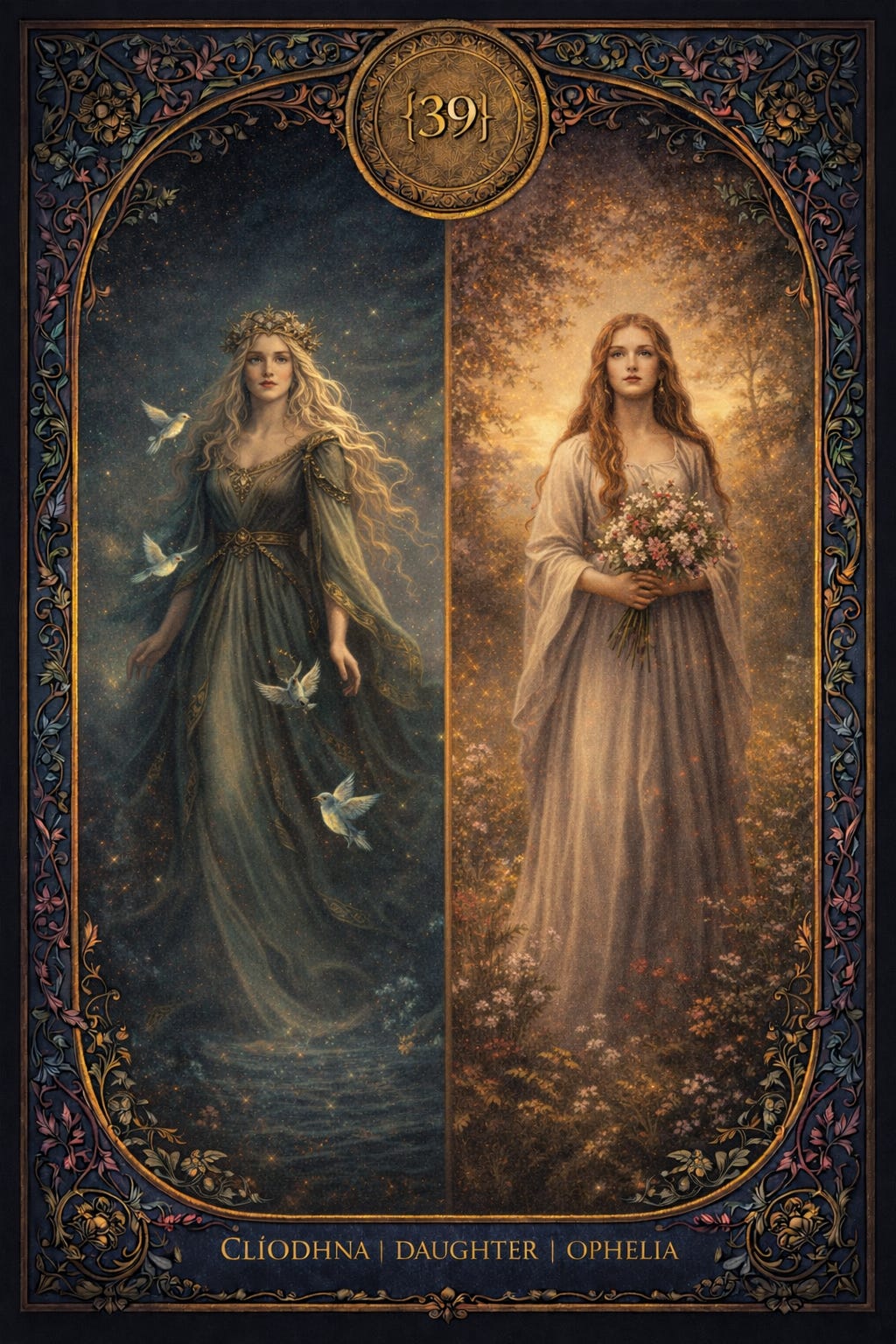
CLÍODHNA: {39}
Clíodhna, a name rooted in Old Irish, translating to ‘shapely|the well-formed one,’ reflecting a rich mythological significance associated with Exquisite Beauty, Sovereignty, and Passionate Love. Primarily revered as a powerful Queen of the Banshees within the Tuatha Dé Danann of South Munster, she is considered a protector of the land, particularly in County Cork, where her sacred dwelling is known as Carrig-Cleena. Symbolically, she embodies the Duality of both love and profound sorrow, depicted as a sea goddess associated with ‘The Ninth Wave’ of the ocean, which represents a Magical, Transformative BarrierBetween the mortal world and the CelticOtherworld. Clíodhna is also strongly associated with healing, as she possesses Three Magical Birds whose sweet song can cure any illness—and as a Sovereign Figure, is closely associated with the Wilder, Chaotic Aspects of nature.
DAUGHTER: {39}
Daughter, rooted in the Old English: Dohtor, signifies a Female offspring or descendant, encompassing adopted children, daughters-in-law, and any female related to her parents. Beyond this, Daughter carries deep symbolic weight, signifying Nurturing, Beauty, and the ‘Tender Object’ of parental care. Symbolically, a Daughter can denote a Continuation of family lineage, offering a Bridge Between generations and a ‘Flower of the House’ who often brings comfort, Joy, and Emotional Connection.
OPHELIA: {39}
Ophelia, derived from the Ancient Greek word: Õphéleia, (‘help|aid|benefit’), is the tragic heroine in William Shakespeare’s: Hamlet. Symbolically, Ophelia represents Extreme Fragility, the loss of Innocence, and the profound tragedy of Beauty and Youth overwhelmed by external forces. In the play, her descent into madness following her father’s murder by her lover, Hamlet, and her subsequent drowning while gathering Flowers, makes her an archetype of a romantic, yet wasted, life, and through her association with the iconic Pre-Raphaelite painting, has become an enduring symbol of Victorian melancholy—a ‘Fallen Woman’ Trapped Between sanity and madness. In modern contexts, she is invoked as an Artistic Muse signifying ArtisticCreation, tragic Love, and a Mirror Reflecting Societal Attitudes toward female grief and psychological instability.
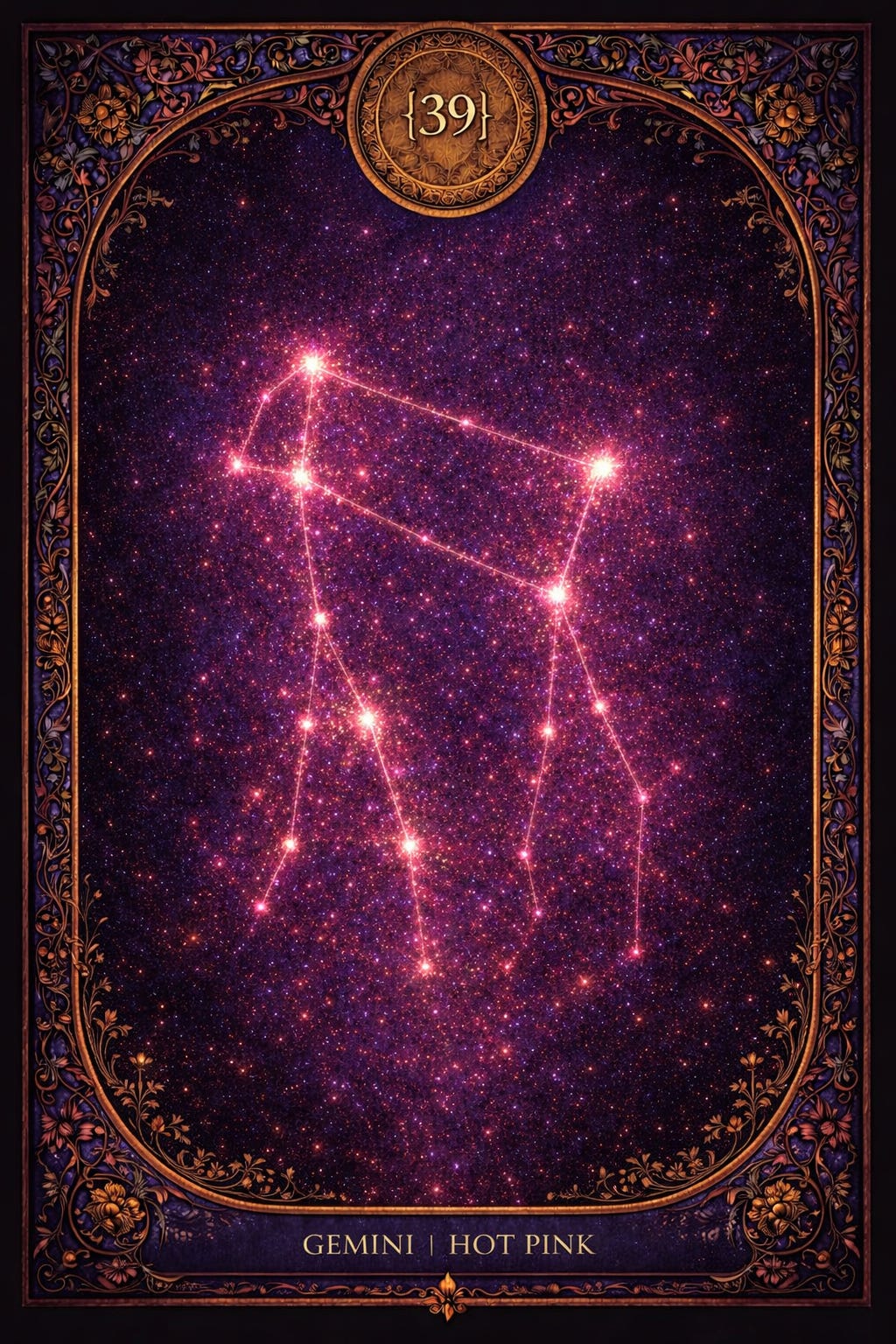
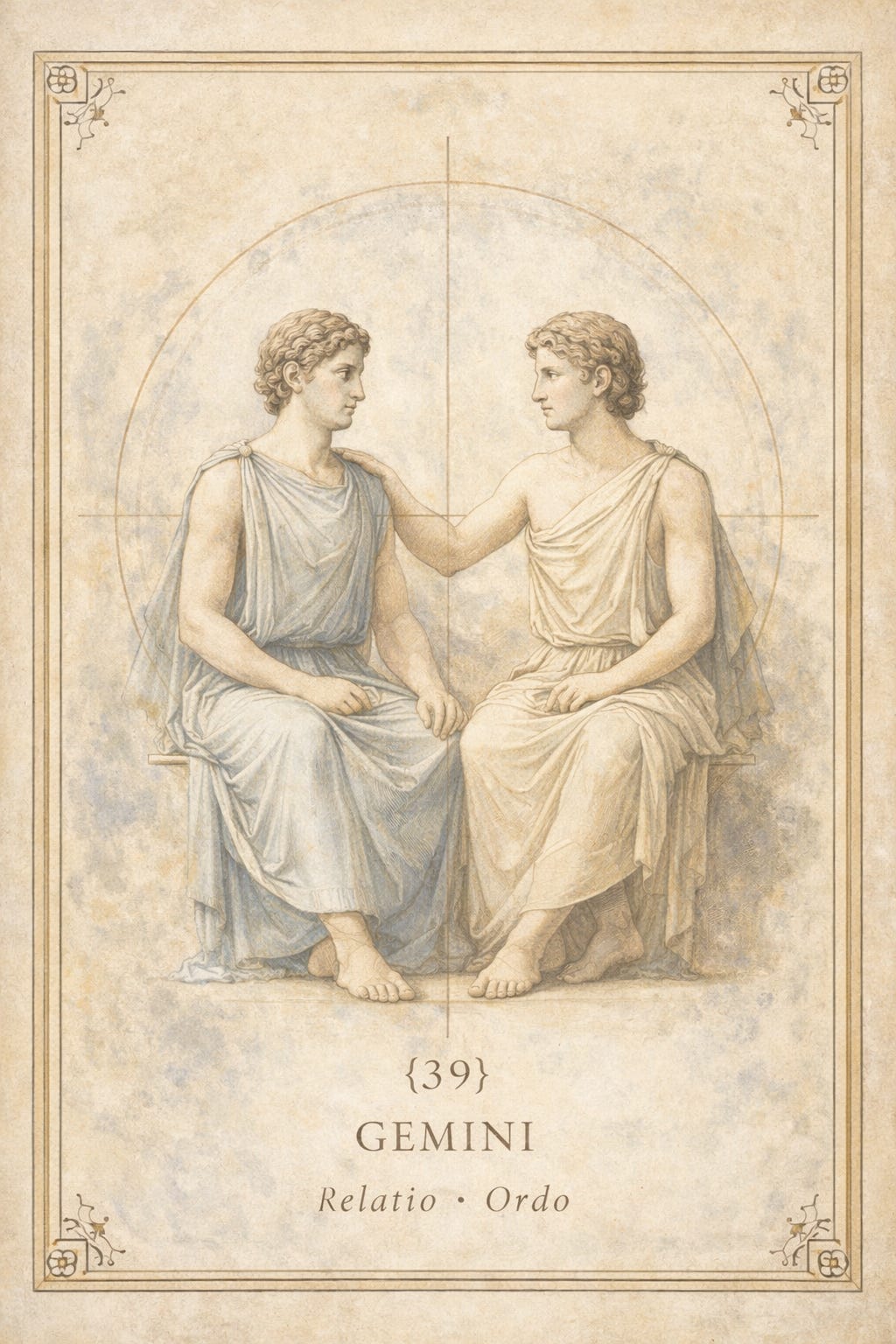
GEMINI: {39}
Gemini, Latin for ‘Twins,’ is the Third Sign of the Zodiac. Covering the period from late May to late June, Gemini represents Dualism and the Balance between Opposing Forces, and is represented by the mythological Twins: Castor and Pollux. Gemini symbolises the Relationship BetweenMortal and Immortal Aspects, Light and Darkness, and the ability to Reconcile Opposing Viewpoints. As an Air Sign ruled by Mercury, the planet of Communication and Intellect, Gemini’s archetype is that of Social Individual who thrives on Exchanging Ideas and Gathering Information—Connecting Different Worlds and encouraging an approach to life that seeks to Bridge the Gap between people and concepts. Gemini’s ‘Twins’ motif signifies Duality, and is commonly associated with the ability to see Multiple Perspectives, Rapid Thought Processes, and the need for Constant Mental Stimulation.
HOT PINK: {39}
Hot Pink is a Vibrant, Intense shade that symbolises unapologetic Boldness, High-OctaneEnergy, and a Playful, Rebellious Spirit. As a saturated, synthetic, and electric hue, it transcends the traditional innocence of soft pink, representing modern femininity, Confidence, and a desire to be seen and remembered. Culturally, Hot Pink functions as an act of Defiance against subtlety and muted aesthetics—linked to Youth Culture, Avant-Garde Fashion, and Powerful, Joyful Self-Expression. While in Colour Psychology, it Commands Attention, encouraging Social Interaction and injecting a sense of Fun and Fearless Optimism into its environment.
GRACIOUS: {39}
Gracious is a multifaceted adjective rooted in the Latin: Gratiosus (‘agreeable|obliging|enjoying favor’) and the Old French: Gracios, which originally meant ‘filled with God’s grace.’ At its heart, Gracious denotes a Blend of Kindness, WarmCourtesy, and a Gentle Demeanour that makes others feel Comfortable and Valued, especially in Social Interactions or Hospitality. It implies a Generous Spirit and Refinement, often associated with Charming Manners and a Polished Lifestyle, such as in the phrase ‘Gracious Living.’ Beyond mere politeness, to be Gracious involves a Compassionate and Forgiving Nature, often shown by treating others with dignity, regardless of their status or the circumstances, and remaining Calm or Thoughtful during difficult moments.
WONDROUS: {39}
Wondrous is a literary adjective meaning Extraordinarily Good, Impressive, or Surprisingly Beautiful, often evoking a sense of awe, marvel, and magic. Derived from Old English roots related to ‘wonder|miracle,’ it carries a connotation of something that causes astonishment, at times Blending the beautiful with the strange. Symbolically, Wondrous implies a profound, almost divine, experience—a departure from the ordinary that leaves the observer Awestruck, often used to describe Natural Beauty, Divine Acts, or Transformative Experiences that inspire Reverential fear or amazement—suggesting not merely delight, but a ‘Wondrous Spectacle’ that compels one to admire its Strangeness and High Quality—used as an intensifier for something undeniably Marvellous.
MARVELLOUS (British|Australian Spelling): {39}
Marvellous derives from the Middle English: Merveillous, meaning that which causes Wonder, Astonishment, or Admiration. In colloquial usage, it serves as a strong Positive Exclamation for something Extremely Good, Enjoyable, or Splendid, such as a Marvellous time or a Marvellous idea. Historically, it has been used to describe sights of Great Beauty, such as a Rainbow, or to signify something worthy of Profound Praise and High Quality, often evoking feelings of being enchanted, silent, or dropped-jawed in astonishment at the Sheer Brilliance of a person or event.
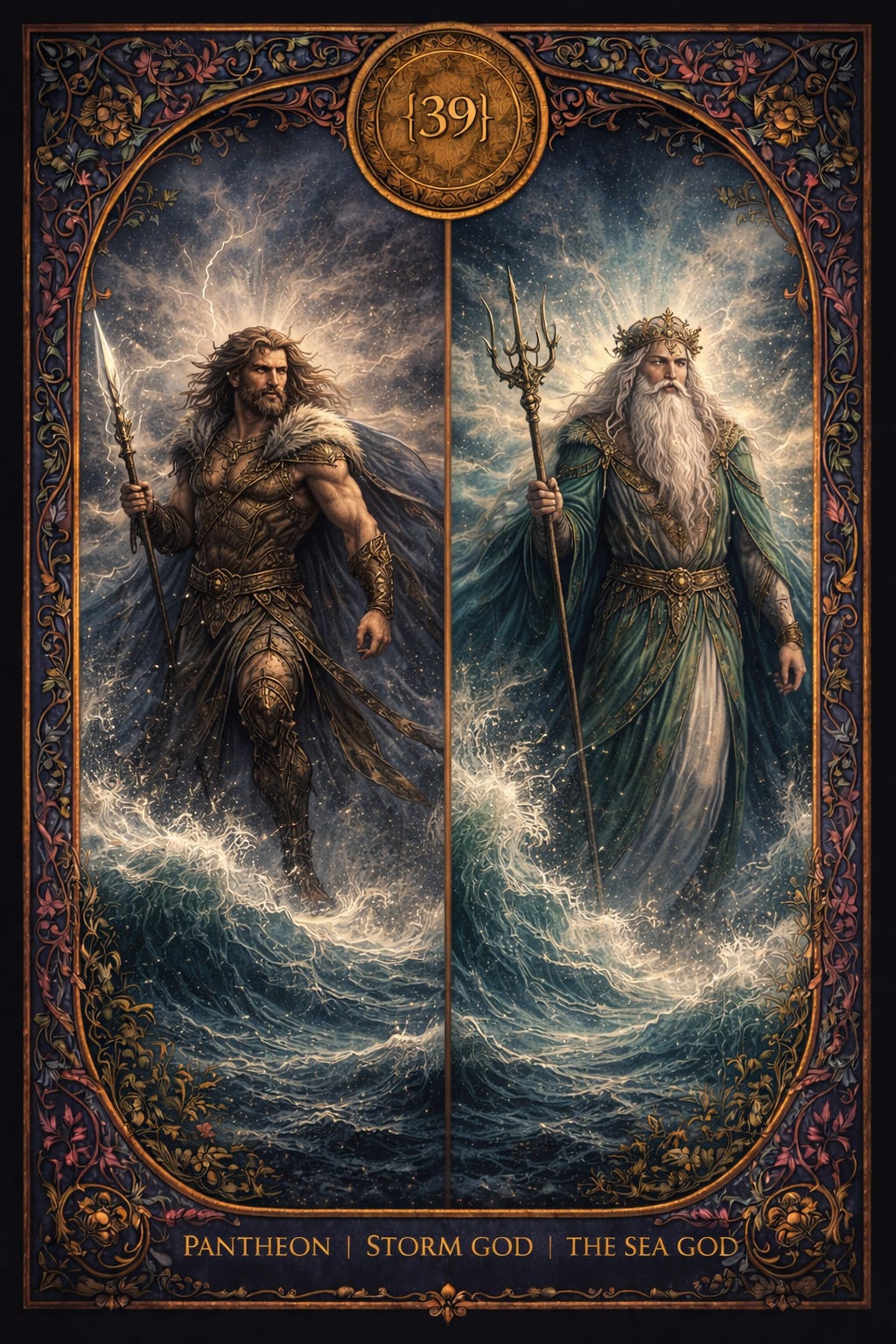
PANTHEON: {39}
A Pantheon, derived from the Greek: Pan (all) and Theos (god), refers to the Complete Set of gods and goddesses within a specific Polytheistic Religion, serving as a Profound Symbolic Mirror of that Society’s Values, Anxieties, and Self-Perception—representing an Organised Hierarchy or Cosmic System, such as the Greek Olympians or Egyptian deities, that manage Nature,Human Civilisation, and the Afterlife. Symbolically, a Pantheon Reflects a Culture’s Worldview: a thunderbolt-wielding autocrat (Zeus|Jupiter) suggests patriarchy and a value of Warrior Skills, while a powerful Mother Goddess often points to an Agricultural Society. Finally, a Pantheon serves to establish Order over Chaos, with deities providing Mythical Explanations for Natural Phenomena and Social Structures, while also serving as patrons of cities to Reinforce Cultural Identity.
STORM GOD: {39}
A Storm God is a powerful, mercurial deity in polytheistic mythologies associated with weather phenomena such as Thunder, Lightning, Rain, Wind, and Hurricanes, representing Both the Destructive and Nurturing Forces of nature—embodying raw, irresistible power, serving as Masters of atmospheric Energy who wield thunderbolts to display their authority, punish the wicked, or break droughts to ensure Agricultural Survival. Commonly depicted as male—such as Zeus, Thor, Indra, or Tlaloc—they frequently hold High Status within a Pantheon—sometimes serving as ‘King of the Gods’ or Protecting a monarch's sovereignty.
THE SEA GOD: {39}
The Sea God, personified in various cultures as figures like Poseidon (Greek), Neptune (Roman), or Varuna (Hindu), embodies the Dual Nature of the Ocean, representing both the Chaotic, Destructive Forces of nature and the Nurturing, Life-Bringing Bounty that Sustains human existence. Symbolically, The Sea God signifies supreme power and authority over the unknown depths, serving as a Protector for mariners and fishermen while demanding Immense Reverence and Fear, and are closely associated with the Subconscious Mind, Unpredictable Emotions, Transformation—the Primal Chaos from which Creation Emerges, often depicted holding a Trident to rule the waves or appearing as a Shape-Shifter. In mythological narratives, The Sea God serves as an Obstacle, Guardian, or ally, embodying ‘Protean Changeability’ and the Ultimate, Uncontrollable Force of The Waters.
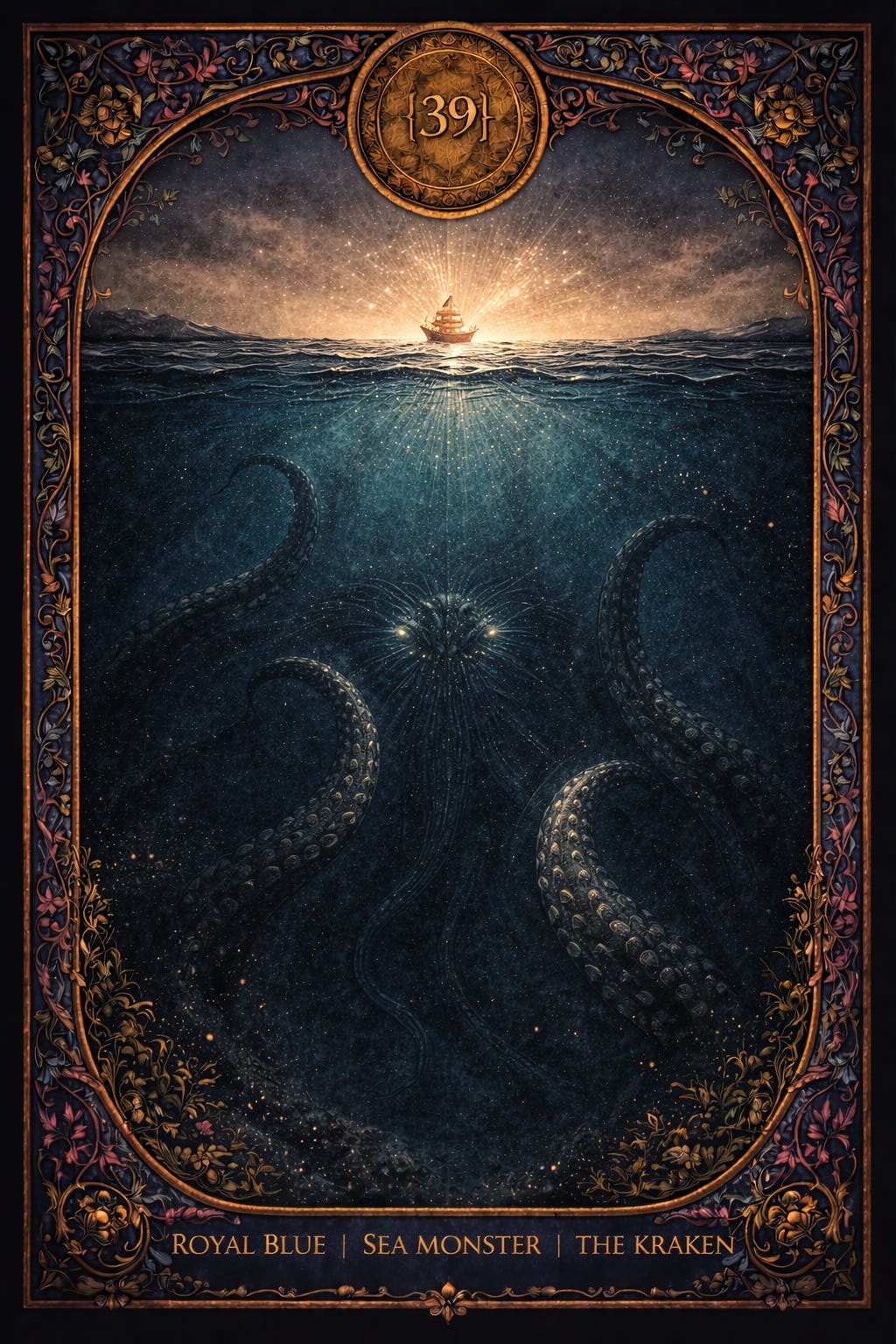
ROYAL BLUE: {39}
Royal Blue is a deep, vivid, and highly saturated shade of Blue that historically and symbolically Expresses Nobility, Dignity, and Superior Status. Originating from a rich fabric created for Queen Charlotte of England in the late 18th century, it is a commanding Colour traditionally associated with power, wealth, and elegance. Unlike the serious, darker tone of Navy Blue, Royal Blue offers a Bold, Refined Impression that Bridges the Gap Between sophistication and bright, energetic appeal. Psychologically, this hue is linked to feelings of Confidence and Dependability, making it popular in professional and ceremonial contexts to Exude Calm Authority. Often linked to Royalty, it is considered a serene yet powerful Colour that evokes the Tranquility of the ocean while Conveying Trustworthiness and Integrity.
SEA MONSTER: {39}
A Sea Monster is a profound archetypal symbol, appearing across global folklore and mythology as a creature of Immense Size and Terrifying Power that dwells in the unmapped or dangerous depths of the Ocean. Symbolically, these creatures embody the Raw, Chaotic, and Destructive Forces of nature that Oppose Ordered Creation, representing the unknown, unpredictable, and mysterious perils of the deep. From a psychological perspective, as noted by Jungian interpretations, the Sea Monster represents The Unconscious Mind and the Shadow, the suppressed fears, memories, or truths that rise from below to threaten The Conscious Self—the Sea Monster reflecting a fundamental human anxiety—that of being consumed by Unseen Forces, whether they are physical dangers like The Kraken, or Emotional, Internal Chaos.
THE KRAKEN: {39}
The Kraken, a legendary Sea Monster stemming from Norse folklore, serves as a profound symbol of the unknown, representing the Untamed Power of the Ocean and The Subconscious Mind. Originating from stories of giant, ship-wrecking cephalopods in the North Atlantic, the Beast embodies humanity’s Profound Fear of the abyss and the sudden, OverwhelmingForces of Nature that lie beyond human control. Its eventual awakening—often tied to Apocalyptic End Times—signifies the Breaking of Constancy, the Inevitability of Transition, and the Final Revealing of Deep Secrets. Modern interpretations frequently utilise The Kraken to represent facing Insurmountable Problems, or as a symbol of the sublime horror inherent in things that are Far Too Large or Too Deep to be fully understood.
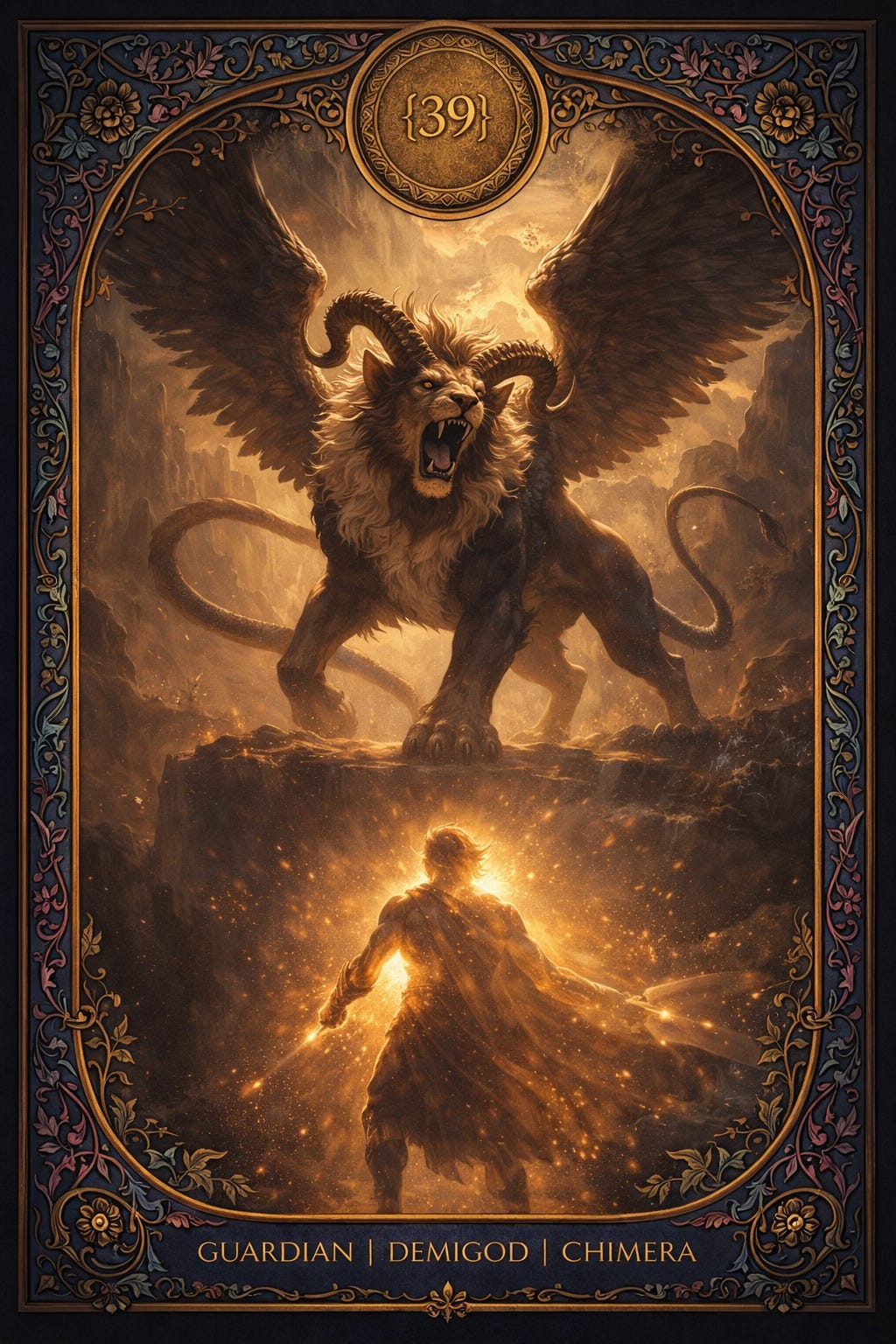
GUARDIAN: {39}
A Guardian is a Keeper, Protector, or Custodian, someone tasked with the Care, Welfare, or legal responsibility of another person, property, or valuable cause. Symbolically, the word represents vigilant watchfulness, unwavering loyalty, and selfless defense against harm—evoking imagery of a ‘Guardian Angel’ or the ‘Threshold Guardian’ serving as a Spiritual Guide, a Warding Barrier Between the physical and the Otherworld, or the ‘Spirit at the Gate’ who safeguards Sacred Places and Knowledge. Rooted in the Old French: Gardien, the word emphasises proactive care and the nurturing of growth. In a broader sense, the Guardian signifies a Keeper of Traditions, a Steward of the Environment, or a Champion of Morality, embodying strength and the commitment to maintaining Order.
DEMIGOD: {39}
A Demigod, derived from the Latin: Semideus (‘half-god’) is a mythological|legendary being born of a Union Between a Deity and a Human, or a mortal who has been Elevated to a Divine Status after Death. Symbolically, these figures represent the Bridge Between human limitations and divine potential, embodying a Mixture of mortality and immortality or Supernatural Talent inherited from their godly parent. They serve as archetypal heroes who often face tragic fates, illustrating themes of Sacrifice, the struggle for Identity, and the Aspiration for immortality, such as Heracles or Achilles. Beyond mythology, the term is used figuratively to describe individuals with Extraordinary Abilities that seem to approach Divinity, or in certain theological contexts, highlighting a being that is subordinate to a supreme deity, serving as an Intermediary Force in the CreatedUniverse.
CHIMERA: {39}
Chimera, derived from the Greek: Khimaira (‘she-goat’) holds both a literal meaning as a monstrous Hybrid from Greek mythology and a figurative meaning denoting a fantastic, unrealistic Idea. Symbolically, the Chimera represents Chaos, the Destructive Forces of nature, and the dangerous potential of Untamed Elements combined into a Single Entity. As a mythological fire-breathing hybrid—typically depicted with a Lion’s Head, a Goat’s Body, and a Serpent’s Tail, embodying the Multifaceted Nature of threats and ‘The Monster Within,’ often serving as a challenge for Order and heroism to overcome. In contemporary language, a Chimera acts as a metaphor for unattainable dreams|delusions that exist only in The Imagination—while in science, represents the biological reality of an organism possessing cells from Multiple Sources, Bridging the mythological concept of a Hybrid with modern, tangible realities of Genetic Mingling.
EMANATIONS: {39}
Emanations refers to the process of Flowing Forth, Issuing, or Radiating from a Source—representing an Outflow of Energy, Substance, or Influence that originates from a Central and commonly Divine or Invisible Origin. Symbolically, the word denotes a Hierarchical Connection between a Perfect, Unchanging Point (‘The One|Absolute’) and the Imperfect, Derivative Material World—inferring a Continuous, Spontaneous Outpouring rather than a planned Creation. As a concept, it represents the Unfolding of Spirit into Matter, emphasising that all manifest things are inherently Connected To|Part of the Divine—yet remain distinct from it in degree and substance. While in literature|psychology, it describes the Tangible Expression of Internal Qualities—Thoughts, Emotions, or Artistic Creations—that emanate from the human mind, heart, or soul.
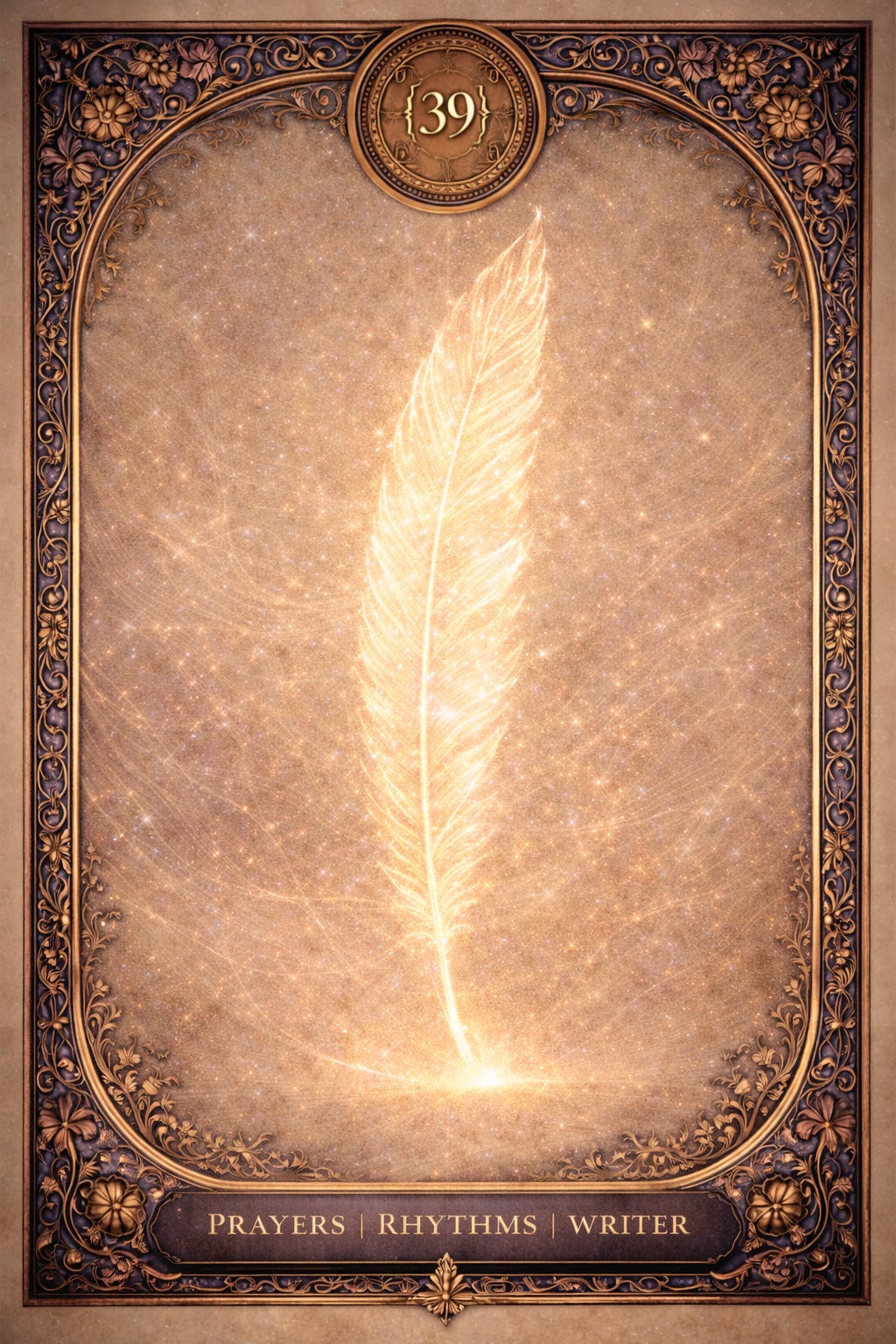
PRAYERS: {39}
The plural noun Prayers represents a shift from individual petition to a Communal, Repetitive, and Expansive spiritual practice. Symbolically, Prayers often represent an established, formal, and Persistent Engagement with the Divine. The plural form is closely associated with Liturgy, representing a collection of established formulas—such as ‘Saying one’s Prayers,’ that provide Structural Continuity to a believer's life. In a theological context, particularly in the use of plural pronouns like ‘Our Father,’ Prayers signifies Charity towards Neighbours—Uniting Personal Needs with the Needs of the Community, and is often used to describe acts of worship where People Gather, highlighting that even when a person is praying alone, they are Engaging in a spiritual practice Shared with Others.
RHYTHMS: {39}
The plural Rhythms shifts the concept of Rhythm from a singular, mechanical beat to a more Complex, Layered, and Organic Experience, signifying the Coexistence of Multiple Temporal Patterns within life, Music, and nature—a ‘Polyrhythmic Reality’ where varied patterns, such as the heart rate, breathing, daily habits, and environmental changes, occur Simultaneously and often Interact—reflecting a Dynamic Interplay rather than a singular movement. While in a broader sense, referring to ‘the Rhythms of Life|Nature's Thythms’ emphasises a ‘timefulness’ and a Deep-Seated Connection to the changing cycles of the world, acknowledging that existence is not a linear march but a series of Overlapping Cycles—seasons, tides, days, and lifetimes, that define a ‘Temporal Framework’ for both human and non-human selves.
WRITER: {39}
A Writer is fundamentally defined as a person who Composes written material—such as books, articles, or stories—committing Thoughts, Ideas, or Experiences into a tangible or digital form. Etymologically derived from roots meaning ‘to cut|scratch|sketch an outline,’ the term evolved from ancient scribes|copyists|clerks into a broader, modern agent noun now signifying anyone who Engages in the act of writing, and is commonly used as a ‘Catch-All Synonym’ for more specialised paths like: ‘author|journalist|screenwriter.’ Beyond this, the term carries deep symbolic significance, for a Writer is a shaper of language, a Witness to life, and a Creator of worlds who brings Unseen Emotions and Abstract Truths our into the Light, navigating the Delicate Balance between Personal Expression and Societal Impact.
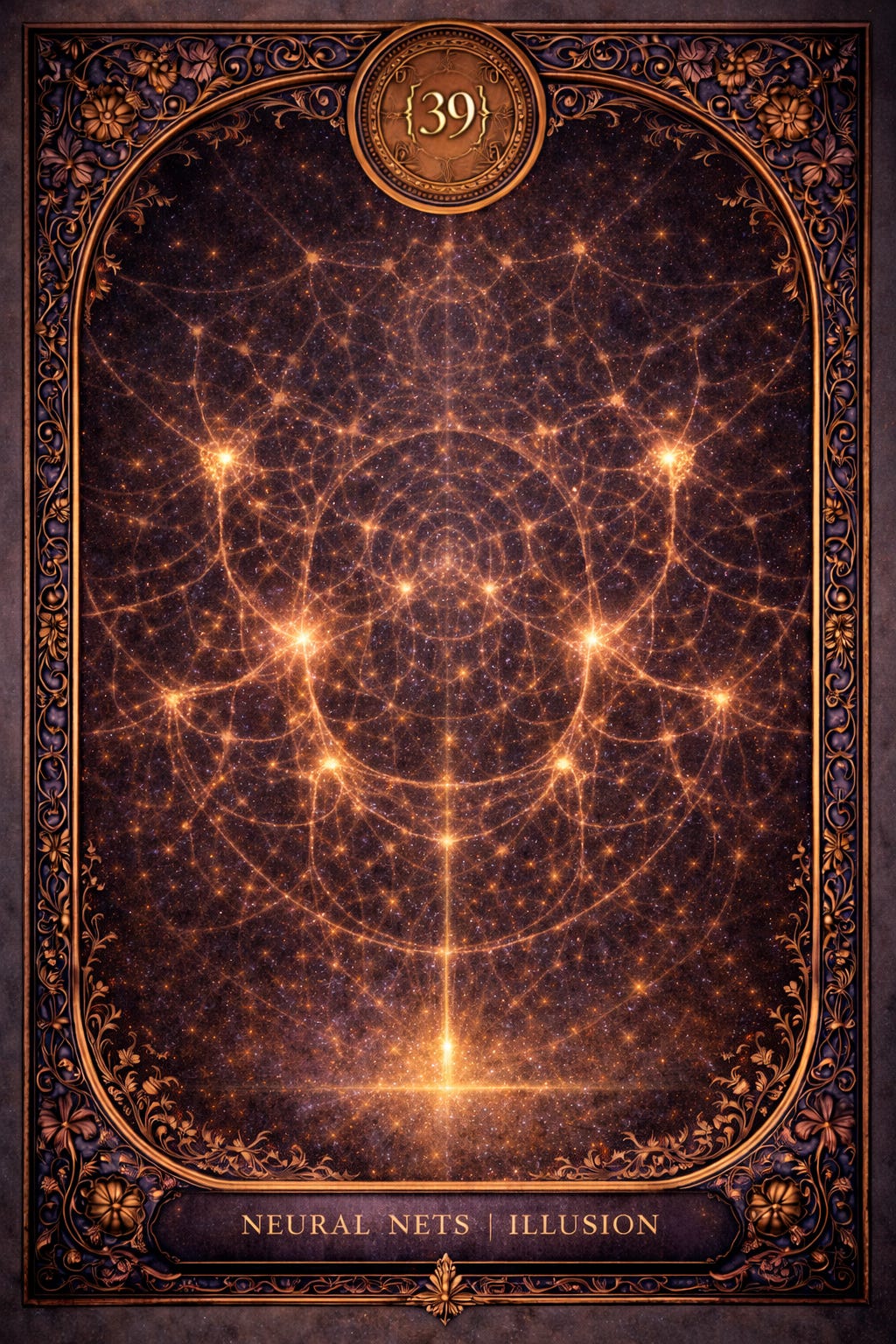
NEURAL NETS: {39}
The plural ‘Neural Nets’ signifies a shift from solitary, rule-based computing toward a Distributed, Adaptive, and Interconnected approach to artificial intelligence, mimicking the Structural Complexity of biological brains—the plural suggesting a Diverse Ecosystem of Specialised Architectures, such as convolutional nets for vision or recurrent nets for Language, working in Parallel to process high-dimensional, unstructured data. Symbolically, Neural Nets represent the ‘black box’ of machine Learning, where knowledge is not explicitly programmed but Emerges from massive datasets through Layers of Weighted Connections, allowing for Pattern Recognition, generalisation, and inferential decision-making that often surpasses human performance in specific tasks.
ILLUSION: {39}
An Illusion is a deceptive appearance|perception|belief that Distorts Reality, making something Appear Different from what it Actually Is. Derived from the Latin: Illudere (‘to play with|to mock’), the word signifies a Sensory Distortion—such as an optical trick where a bent stick is seen in water, or a mental misinterpretation like holding onto a mistaken idea or a false hope. Symbolically, an Illusion represents the Fragility of human perception, the Comfort of ignorance, or the distracting ‘veil of the material world,’ commonly referred to in Eastern philosophy as Maya. Symbolically, it stands for something that ‘Is nothing, ‘Posing Itself As Something,’ serving as a necessary Fiction or a Seductive Distraction that obscures ultimate truth.
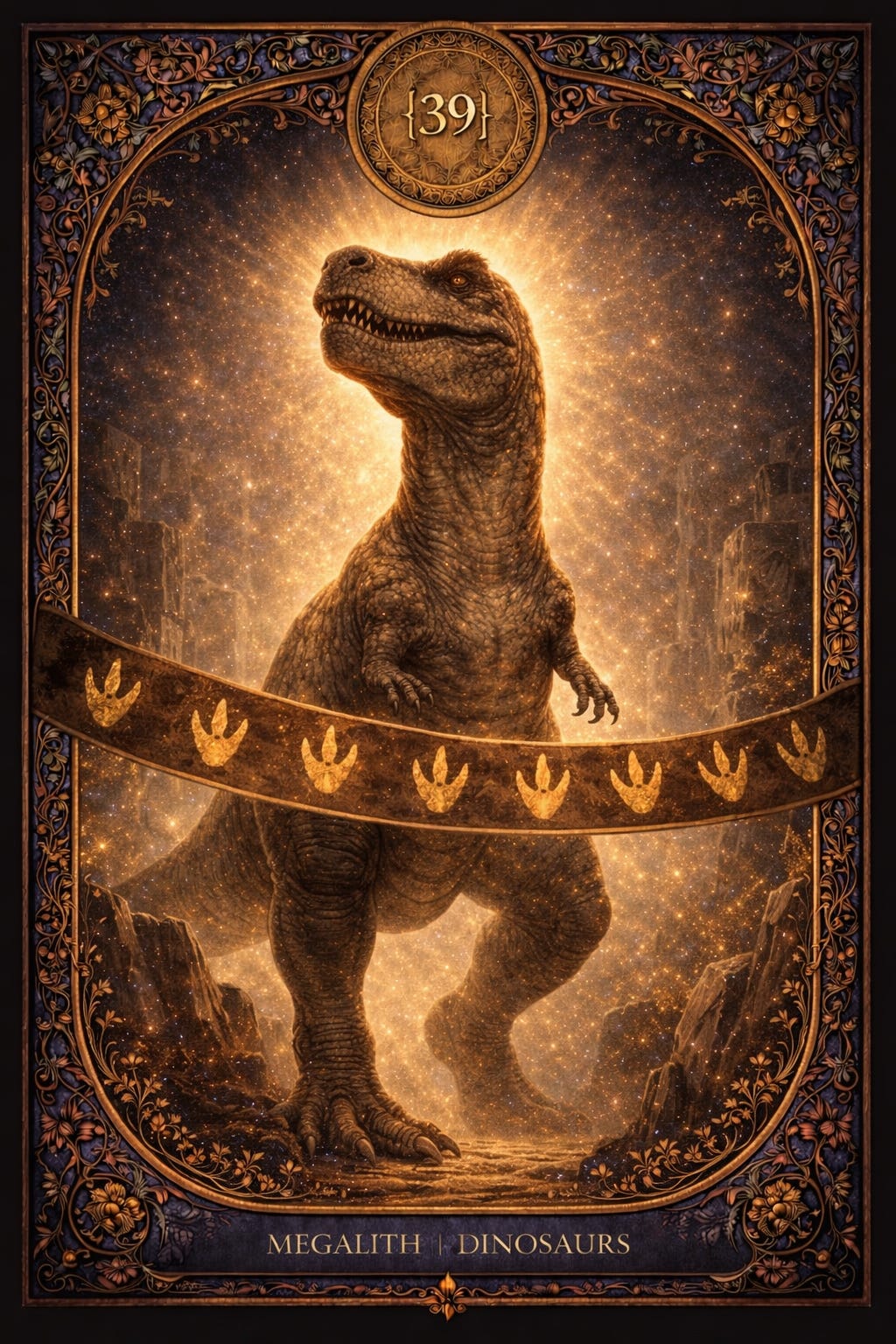
MEGALITH: {39}
Derived from the Ancient Greek words: Megas (‘great’) and Lithos (‘stone’), a Megalith is a very large, often unhewn Stone used to ConstructPrehistoric Monuments. Primarily erected during the Neolithic period|Chalcolithic|Bronze Age, these structures symbolise a Profound Shift in prehistoric human behavior, marking the Transition from Nomadic Hunter-GathererLifestyles to Settled, AgriculturalCommunities that could organise Collective Labor. Symbolically, the Megalith signify a Monumental Investment in Memory, Territory, and Social Identity, serving as Enduring Markers of Cultural Authority in the landscape— inextricably linked to the cult of the dead, serving as Tombs, Passage Graves, or Memorials that facilitated Ancestor Worship, while other alignments demonstrate a clear engagement with Cosmic Forces, aligning with solstices and equinoxes to Bridge the Gap between earth and sky.
DINOSAURS: {39}
Dinosaurs, derived from the Greek: Deinos (‘terrible|wondrous’) and Sauros (‘lizard’), represents a Dualistic symbol that spans from the extinct land-dwelling reptiles who dominated the Prehistoric Era to metaphorical Obsolescence. Symbolically, Dinosaurs are viewed as Terrifying and and Awe-Inspiring, embodying absolute Preeminence, Untamed Nature, and the Raw Strength of the natural world. In the Collective Imagination, they are Paradoxical Figures representing Immense Power alongside a (mistaken) fatal inability to adapt, used metaphorically to describe outdated technologies or failing businesses|ideologies that have become extinct. Culturally, Dinosaurs Link the ‘Deep Time’ of geology with Fantastical, Monstrous Tales that trigger Wonder in children and Nostalgia in adults. As a group, they are simultaneously viewed as dangerous predators and ‘creatures of myth’ safely separated from humanity by Time—representing both Primordial Chaos, and through feathered theropods, the Adaptability and Success of Evolutionary Change.
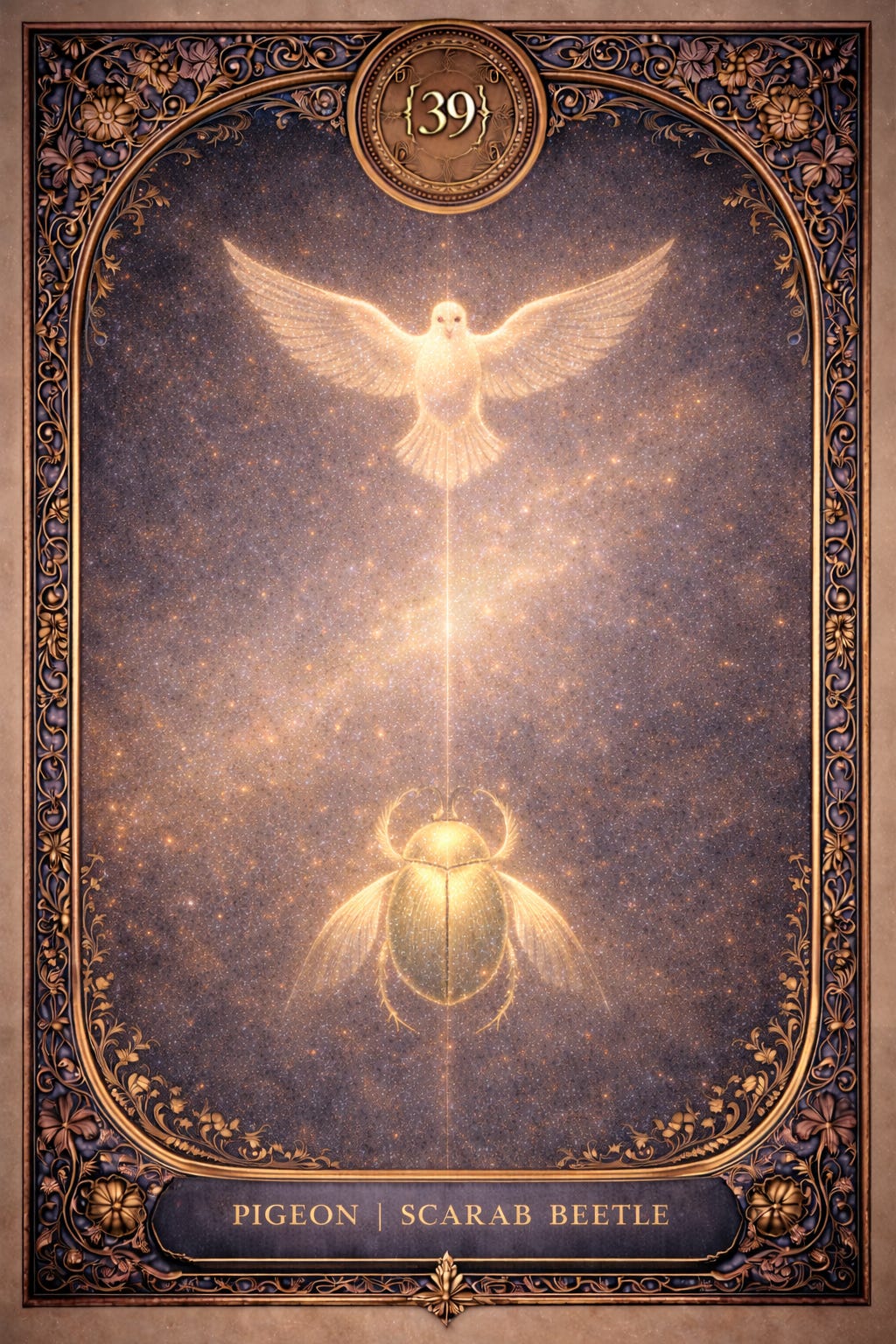
SCARAB BEETLE: {39}
The Scarab Beetle is one of the most potent symbols in ancient Egyptian mythology, embodying themes of Resurrection, Eternal Life, and Divine Protection. Egyptians observed the dung beetle rolling balls of waste, equating this action with the sun god Ra—the god of the rising sun, rolling the sun across the sky each day. Consequently, Scarab Amulets, crafted from green stone or faience and placed over the hearts of the deceased, were used as Protective Talismans to ensure Safe Passage to The Afterlife and to safeguard the soul during the final judgment—while the symbol, with its many variants like the ‘Heart Scarab|Winged Scarab,’ continues to serve as a timeless reminder of life’s Cyclical Nature and the potential for Continuous Personal Renewal and Evolution.
PIGEON: {39}
The Pigeon represents a DualityBetweenUrban Life and a Sacred SpiritualMessenger. As one of the first domesticated birds, they signify Long-Standing, QuietLoyalty, and Devotion, largely due to their Monogamous Nature and Return-To-Home instinct, which has made them emblems of Peace, Hope, and the human Soul in various traditions. In spiritual contexts, they are recognised as Communicators, embodying messengers from the divine, bringing Good Luck—representing the Holy Spirit in Christianity, associations with deities in Hinduism, and Islamic reverence for their role in protecting the ProphetMuhammad—the Pigeon holds a position of Gentle, Persistent, and NurturingEnergy, encouraging Community and finding Joy in the ordinary. While as a ‘Pigeon-Pair,’ it represents Familial Balance, and in literary contexts, signifies Freedom from oppression—Bridging the Gap between the Mundane and the Wondrous.
LION’S MANE: {39}
The Lion’s Mane mushroom (Hericium erinaceus), often called the ‘pom-pom’ or ‘bearded tooth’ fungus—its cascading white spines resemble a Lion’s Mane, carries profound meaning rooted in its unique appearance and medicinal use, representing Mental Clarity, Mind-Body Connection, Strength, and the Intersection of Ancient Wisdom with Modern Wellness. Historically, it was highly revered in Traditional Chinese Medicine|Japanese Culture, where it was known as Yamabushitake—referring to mountain monks who consumed it to Heighten Awareness and Deepen their Meditative States. Its role as a ‘Three Treasure Tonic’ in Eastern Philosophy—catering to Jing (vital essence), Qi (energy), and Shen (spirit)—positions it as a comprehensive symbol of Longevity and Balanced Health. While in modern contexts, Lion’s Mane has evolved to symbolise the Bridge Between nature and neuroscience—a natural nootropic representing the Strengthening of mental pathways, Prevention against cognitive decline, and the pursuit of a Sharp, Serene Mind.
CHICKPEAS: {39}
The plural Chickpeas, carries deep cultural, spiritual, and communal symbolism—viewed as a symbol of Abundance and Prosperity and deeply intertwined with Celebrations and Festivals, serving as a token of Good Fortune in various Mediterranean|Middle Eastern traditions. In Jainism, these ancient legumes are symbolically recognized as a ‘grain’ representing Resilience and the idea that Small, humble entities may be Influenced by Stronger Forces, while in Indian history, they have served as a symbol of Comfort and Community during times of struggle. Their cultural significance spans from being a ‘poor man's bread’ that offers sustenance to the masses, to a ‘baraka’ (blessing) at Sufi festivals, embodying a Connection between the Land, the Labor of the farmer, and the Divine.
NATZARIM: {39}
Natzarim (נְצָרִים) is a Hebrew term derived from the root: Natzar (נָצַר), which translates to ‘To Watch|To Keep|To Guard.’ Historically, the term refers to the first-century followers of Yeshua (Jesus) of Nazareth, who were recognized as a distinct sect within Second Temple Judaism that accepted Yeshua as the promised Messiah. Symbolically, Natsarim represents the ‘Watchmen|Guardians’ of the truth, often connecting to the prophetic imagery of ‘branches’ (netzer) in Isaiah 11:1, representing a Messianic offshoot from the root of Jesse that bears fruit. This group identified themselves by their dedication to keeping the Torah—including the Sabbath and dietary laws, while in modern times, the term is used by believers who seek to restore the Hebrew roots of their faith, viewing themselves as a ‘Set-Apart’ remnant who guard the Everlasting Covenant and reject modern church traditions in favour of the Torah-keeping lifestyle of the original apostles.
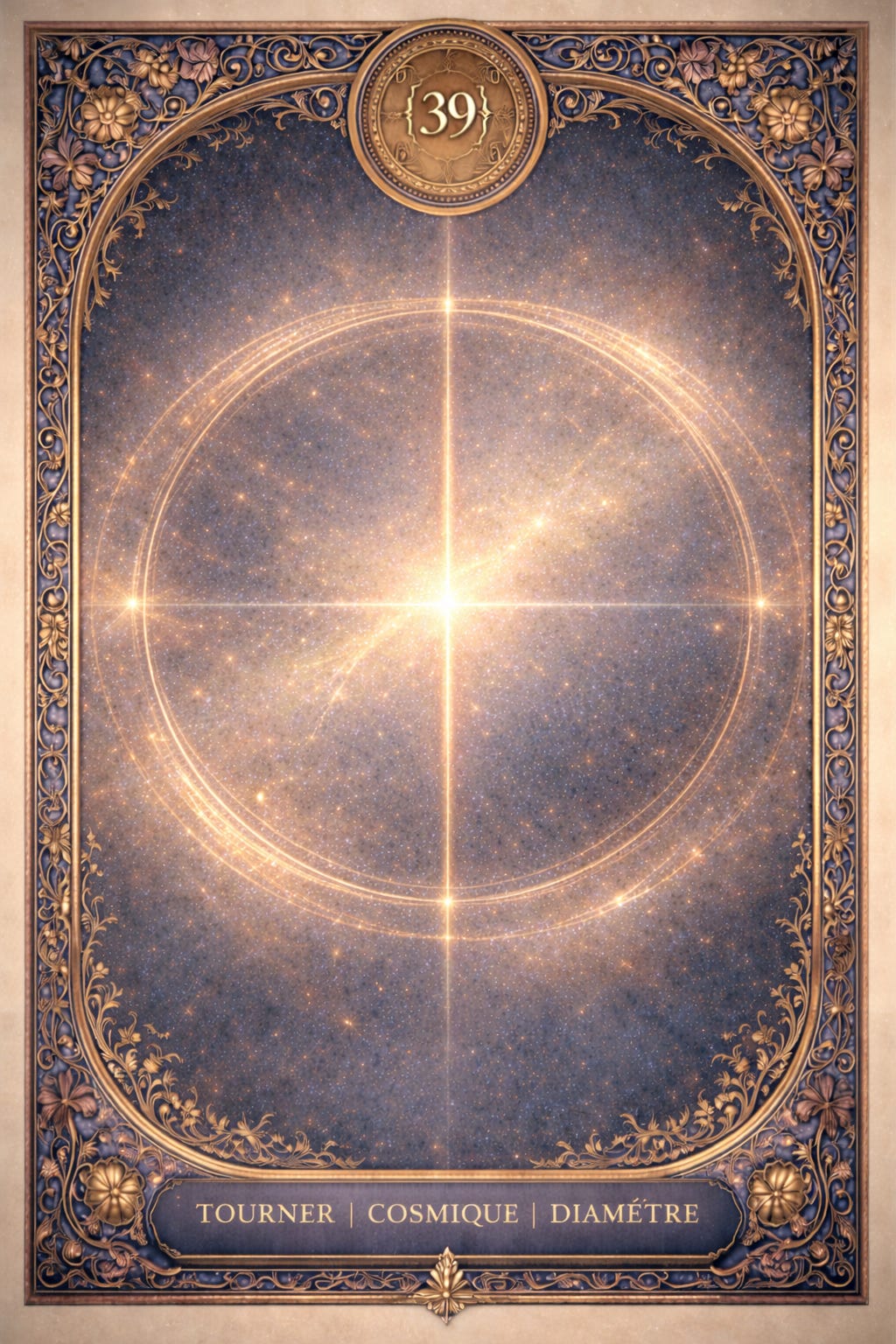
TOURNER (French): {39}
The French verb: Tourner, derived from the Latin: Tornare (‘to turn or lathe’) fundamentally means to Turn, Rotate, Revolve, or Change Direction, but it carries a rich, multifaceted symbolism in daily language—representing transition and the inevitable Flow of time. Literally used for Circular Movements, such as spinning (tourner sur soi-même) or turning a key, it symbolises Action and Operation, particularly in the expression ‘Faire Tourner,’ meaning to get a machine or a business running. Figuratively, Tourner often signifies the Shifting Nature of circumstances, such as in Le Temps Tourne (the weather is turning) or La Situation A Tourné Au Vinaigre (the situation has turned sour). Symbolically, it represents closure and renewal, most prominently in the phrase Tourner La Page (to turn the page), which signifies moving on from the past and Beginning a New Chapter.
COSMIQUE (French): {39}
Cosmique denotes a Connection to the Vastness of the Universe, distinguishing itself from solely Earth-centric views. In French, it is commonly used in contexts such as Rayons Cosmiques (cosmic rays) or Poussière Cosmique (cosmic dust), highlighting its scientific, astronomical association. Symbolically, the term is applied to describe phenomena that are profoundly Vast, Orderly, or Divine, capturing the essence of a Larger, Interconnected Reality. Beyond the scientific, it often carries a Spiritual, Philosophical, or even Abstract connotation, indicating something ‘Cosmic’ that touches upon the fundamental truths of existence.
DIAMÈTRE (French): {39}
The French term: Diamètre (masculine noun) refers to the Diameter of a shape, defined as a straight line passing through the centre of a circle or sphere ConnectingTwo Opposite Points. Symbolically, it signifies a Central, Measuring and BindingLine—Bridging Two Opposite Sides and establishing the measure or width of an object, representing a Direct Connection through the Centre, and symbolising precision and Integrity of Design.
YTTRIUM: ATOMIC ELEMENT {39}
Atomic Element {39}: Yttrium (Y), represents a Profound Intersection of HiddenRarity, technological Luminescence, and industrial Strength, embodying the ‘rare earth’ classification despite not technically being a lanthanide. It signifies the Unveiling of Hidden Complexity, as its compounds were once mistaken for ‘simple earths’ before Revealing their distinct metallurgical nature. Symbolically, it is a pioneer of Colour, having historically powered the red phosphors in television sets, while in modern applications, it is Central to the Creation of pure white LED light and high-temperature superconductors, marking it as a ‘Connector Element’ that enables advanced Energy and Communications.