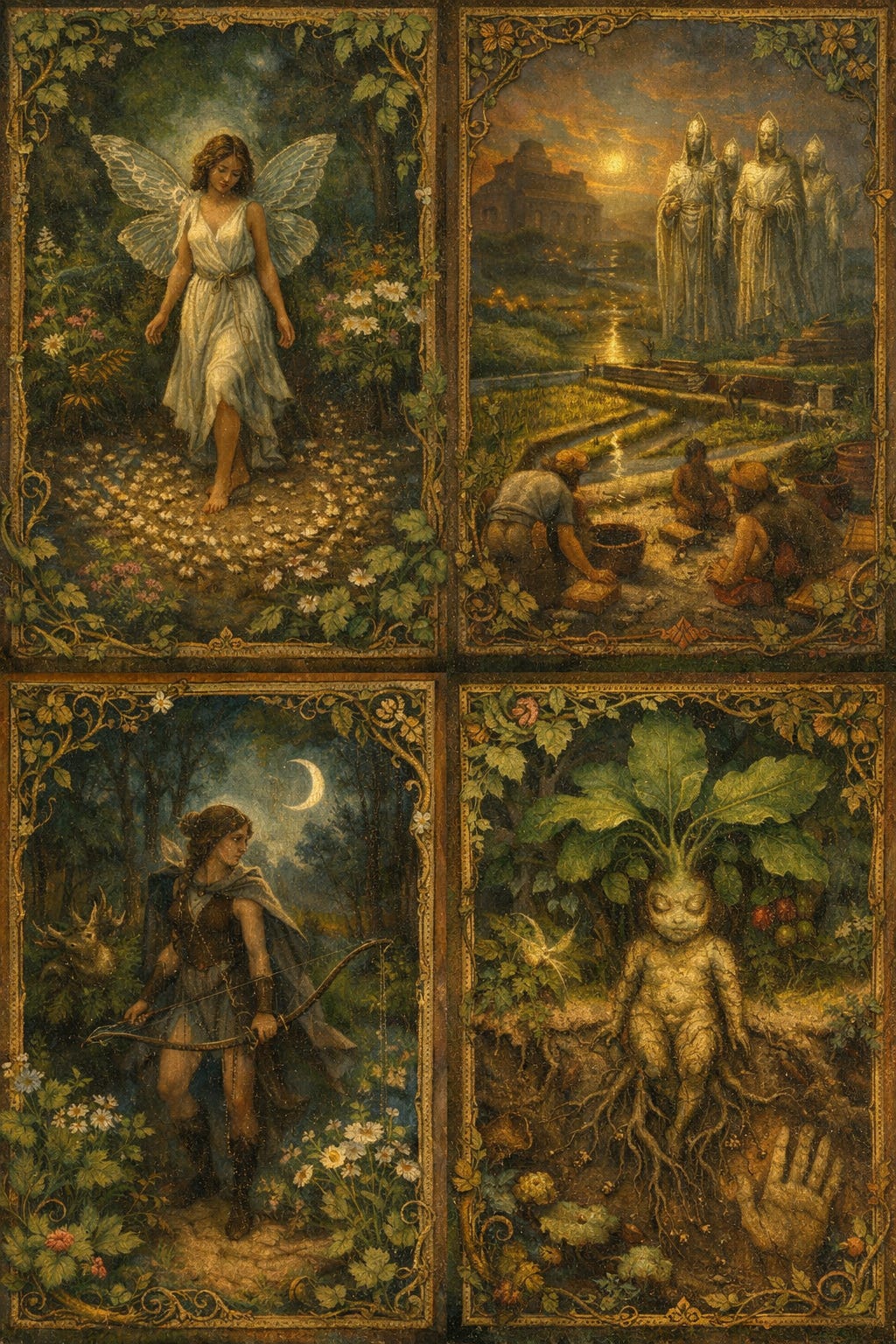
{31} | {13}: The Numbers Of Natural Foundation
'There is a Time for Everything, and a Season for every Activity under the Heavens.'—Ecclesiastes 3:1 (NIV)

Calculation Board:
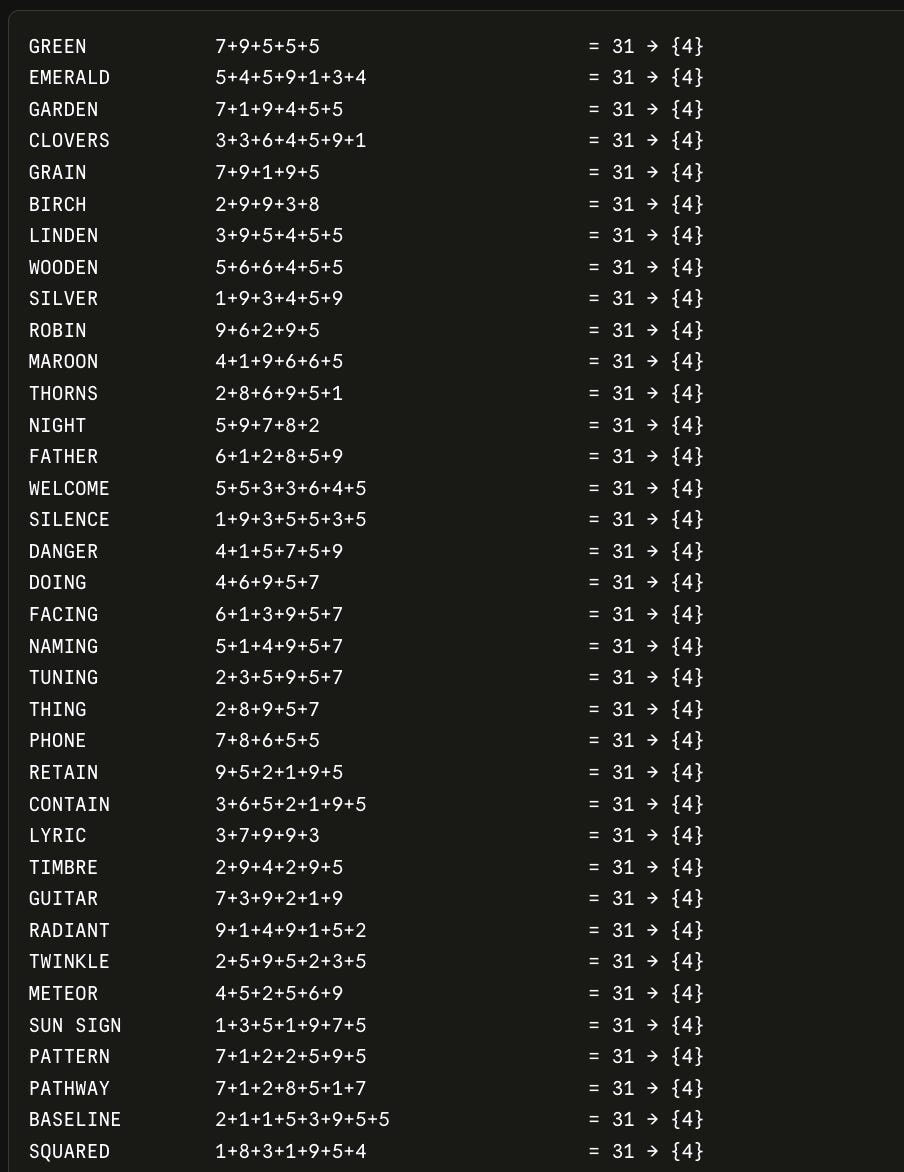


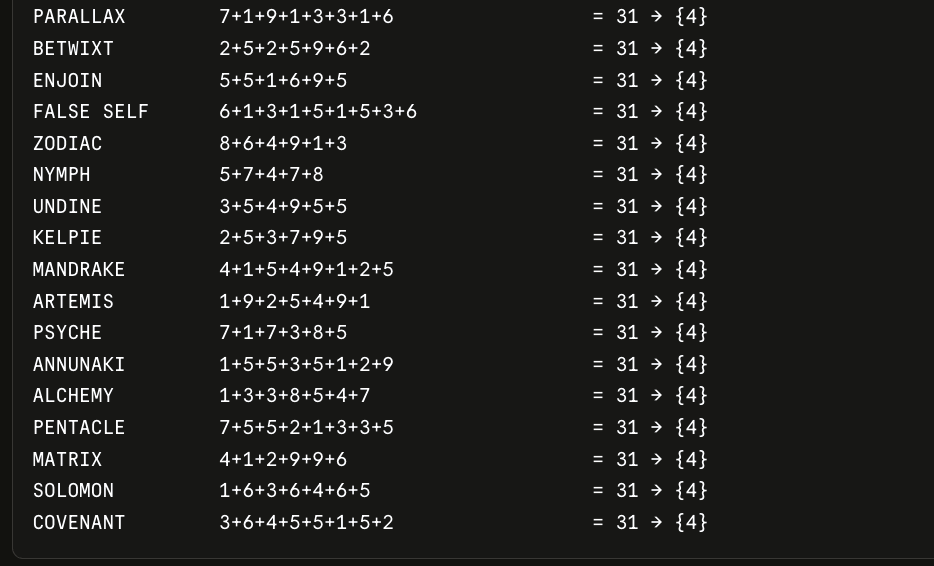
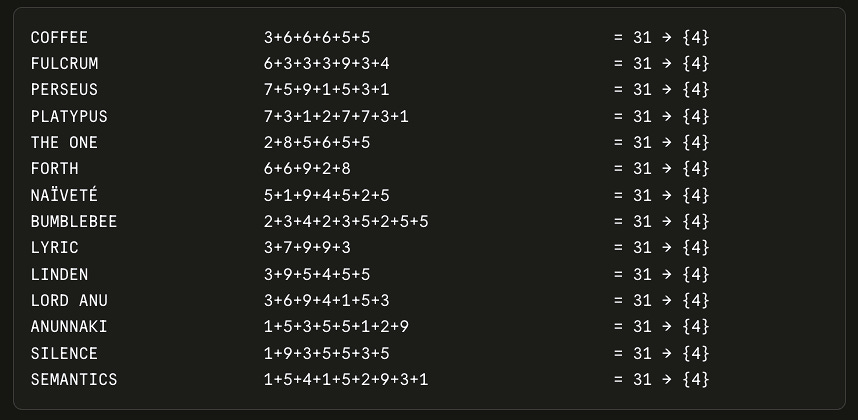
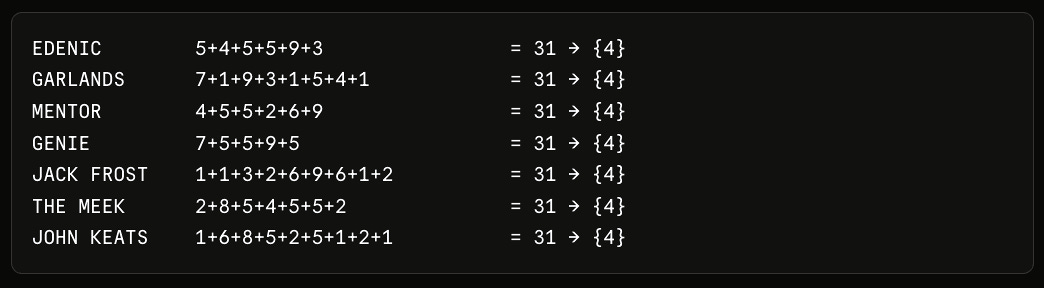


{31}: Creation|Expression: {3} crossing {+} into Unity|Initiation: {1} resolving to {4}: Foundation|Structure.
In Hebrew, the number {31} is significant as it corresponds to the letters Lamed {30} and Aleph {1}, which spell ‘El,’ widely considered the most ancient and Foundational name for God—therefore, it is interpreted as a reflection of God's power, sovereignty, and the balance between divine and Material Realms. Mathematically, {31} is the 11th prime number, only divisible by {1} and itself. And Seven months of the calendar year: January, March, May, July, August, October, December, each have {31} days. While {31} Equal Temperament is a popular microtonal Tuning for musical instruments because it provides a good approximation of harmonic intervals.
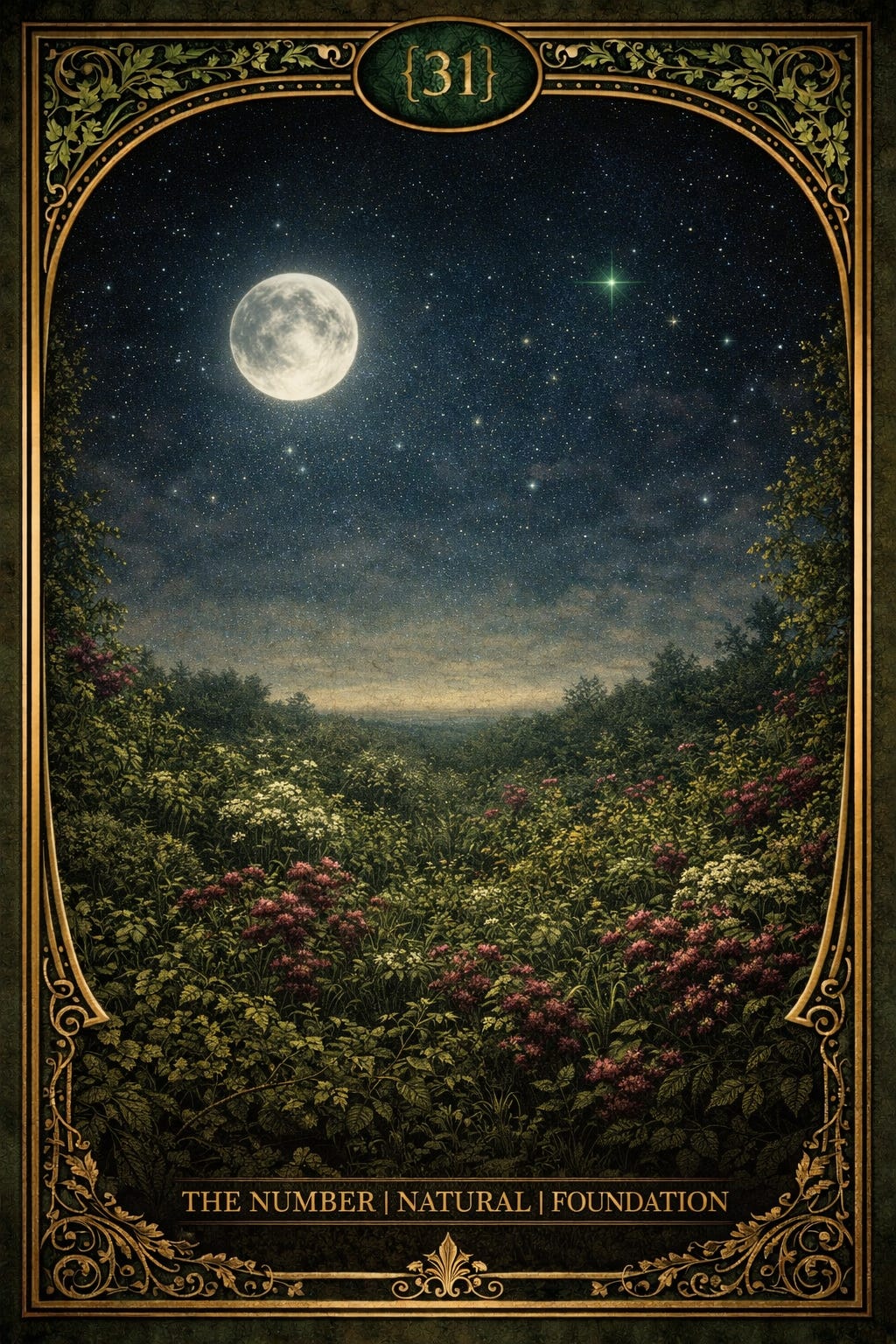
{31}: The Number Of The Garden
GREEN: {31}
Green is universally associated with Nature, Lush Foliage, Environmentalism, and the Springtime—symbolising Rebirth, Fertility, Creation and Fresh Beginnings. In addition to indicating Growth, Green is strongly linked to money and financial success—often considered a lucky colour, particularly in Ireland, and serving as a universal sign of safety or permission to proceed. It may also signify jealousy|envy (‘Green with envy’), freshness|inexperience (‘Green behind the ears’), or affliction|sickness. While in the context of photosynthesis, Green is the tincture of the chlorophyll pigment which enables plants to absorb Sunlight and convert it into Energy—plants Green because chlorophyll absorbs red and blue light for photosynthesis but reflects Green light. As the dominant colour of all plant-life on earth, Green is among the most Foundational tones of hue in all the spectrum.
EMERALD: {31}
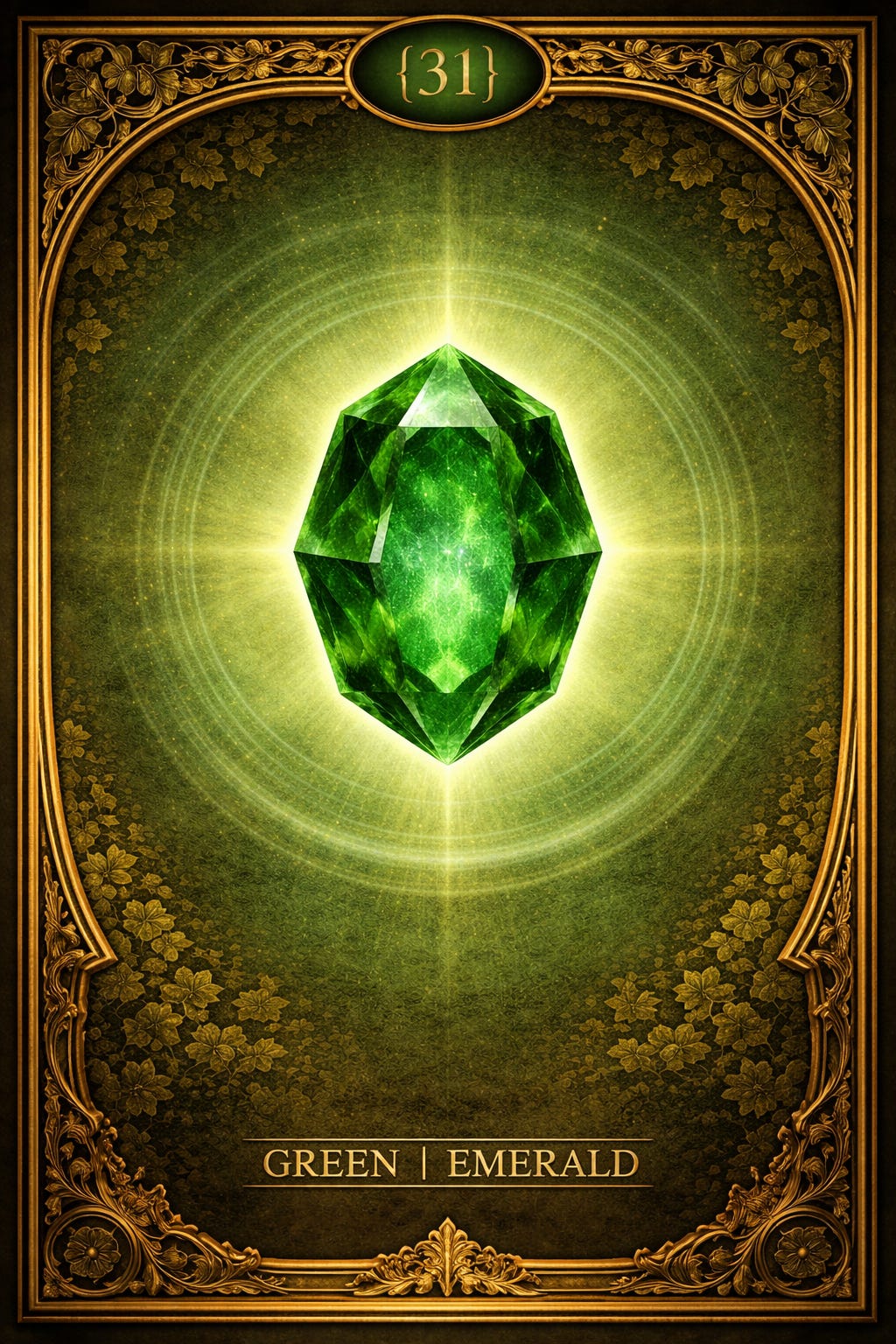
Derived from the ancient Greek: smaragdos via Latin, which translates to ‘Green stone,’ and associated with the goddess Venus, Emeralds symbolise Rebirth, love, Fertility, and eternal youth—often revered as ‘Green Growing Things’ representing the power of Nature and Spring and the birthstone of May (Taurus|Gemini). Historically, this vibrant, Verdant gem represents wisdom, protection, and luxury—famously worn by Cleopatra to signify power, while Ireland is famously known as the ‘Emerald Isle,’ and the ‘Emerald Buddha’ is a sacred icon in Thailand. (Author’s Note): my very favourite stone since I was a child.
GARDEN: {31}
Originating from Old French: gardin or Germanic: gard|gart, fundamentally meaning ‘enclosed space|yard,’ the Garden is a cultivated, enclosed plot of land used for Growing plants, herbs, fruits, and|or flowers, representing the Intersection of Nature and human Will, where wild elements are cultivated into a deliberate, harmonious Design. With rich symbolic connotations across cultures, the Garden may represent the paradisical and secure Foundational Origin of humankind, or the ‘inner world’—a cultivated mind or soul inferring Care, Growth, and the Nurturing of virtues. Sometimes associated with the Sacred Feminine, the Garden signifies Creation, Abundance, and the Natural Cycles of Renewal.
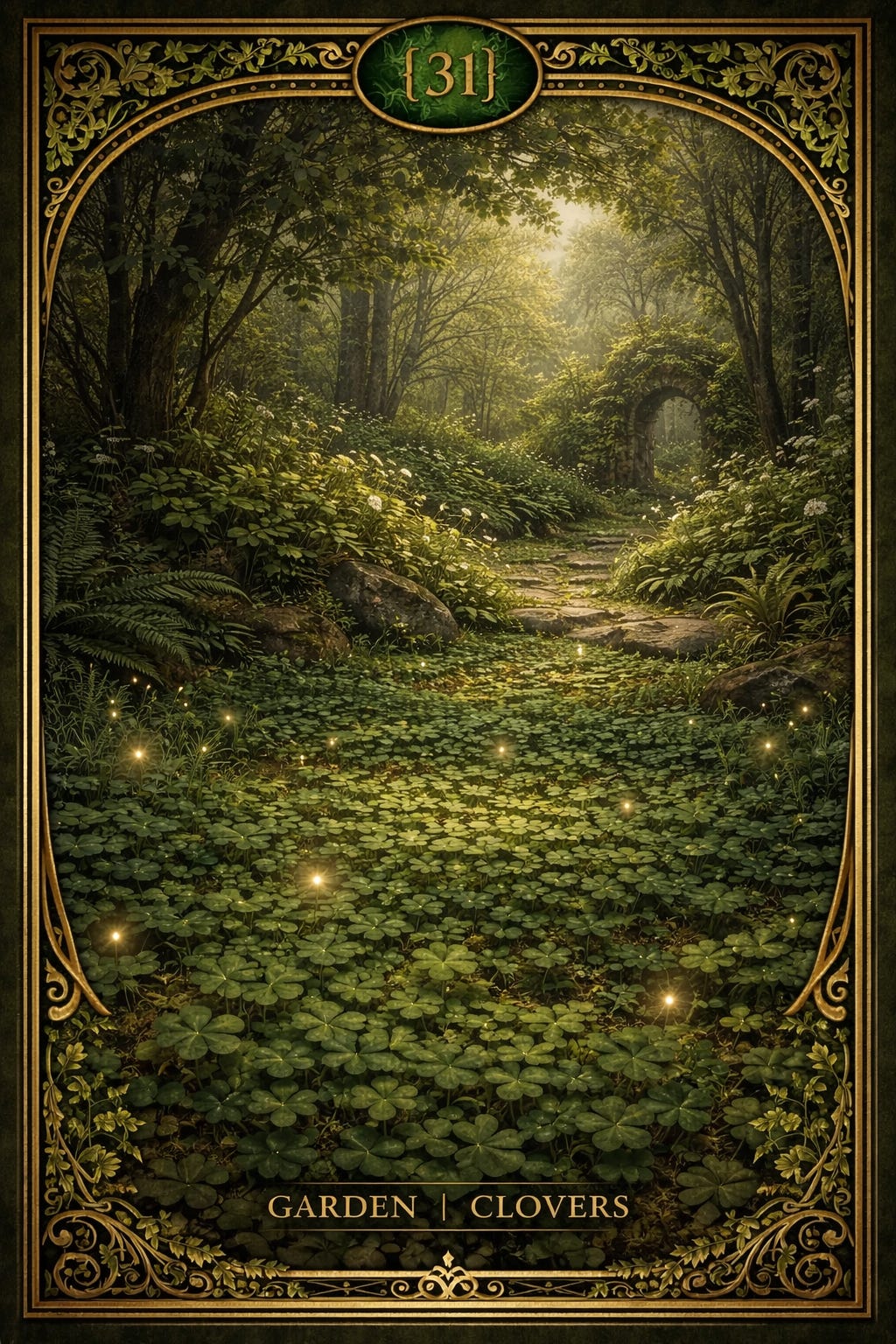
CLOVERS: {31}
Clovers are small flowering plants of the genus: Trifolium, commonly symbolising Good Luck, Prosperity, and Protection. While Three-leaf Clovers often represent faith, hope, and love—or the Trinity, Four-leaf Clovers are rare genetic variations prized as lucky charms. Heavily rooted in Irish tradition and Celtic Mythology, Clovers symbolising Fertility and Nature—ancient Druids regarding them as sacred symbols of the Earth, Sea, and Sky, often using them to detect evil spirits or as part of magical potions. Legend holds that Eve carried a Four-leaf Clover with her when leaving the Garden of Eden, while throughout the Middle Ages, children believed that carrying a Four-leaf Clover allowed them to see fairies.
BIRCH: {31}
The Birch tree (Betula) is a widely recognised Pioneer species known for its ability to rapidly recolonise land after fires, ice ages, or deforestation—and as one of the first trees to leaf in Spring, is profoundly symbolic of Fresh Beginnings, and Renewal. Often called the ‘Lady of the Woods’ due to its graceful, slender appearance and white bark, the Birch holds a Central Place in Celtic, Slavic, and Northern European mythology and folklore—associated with the Celtic goddesses: Brigid|Arianrhod, along with the Norse goddesses: Freya|Frigga, it also signifies love, beauty, Fertility, and light.
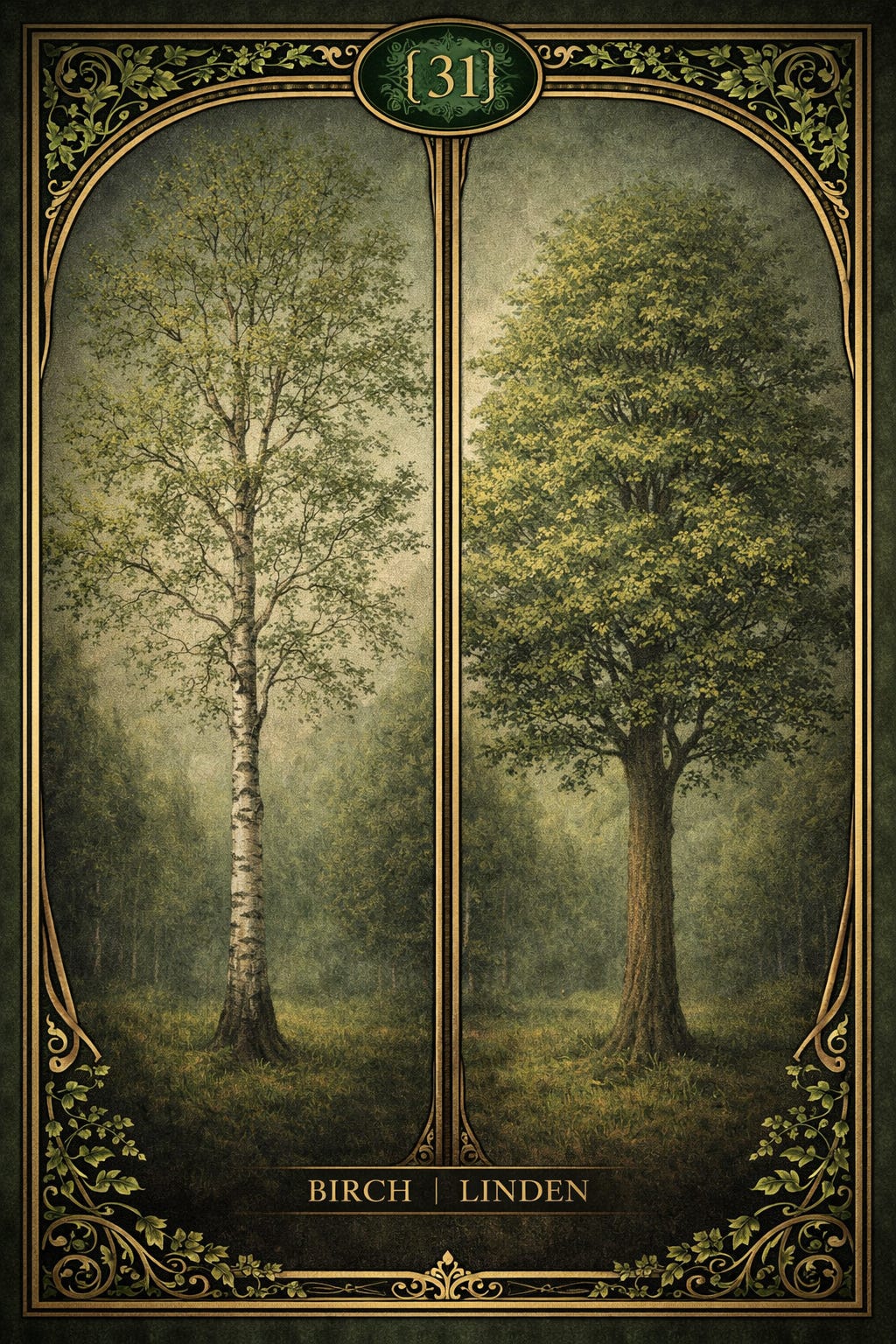
LINDEN: {31}
Long bound to the Norse goddess: Freya and the Roman goddess: Venus, the Linden (Tilia) tree’s heart shape makes it a powerful symbol of love, friendship, and marital harmony. Known in various cultures as a ‘Tree of Justice,’ historical figures often Held Council, made Judgments, or danced beneath the Linden trees, believing their presence fostered truth. Botanically, the Linden tree is a long-lived, deciduous shade tree known for its highly Fragrant yellow-white summer flowers, and high-quality melliferous (honey-producing) nectar. It is a Sturdy, Adaptable tree used in urban landscaping, with medicinal uses for its Calming, anti-inflammatory, and diuretic properties.
WOODEN: {31}
Because it comes from trees, the adjective Wooden often emphasises Natural Origins, rustic Charm, and traditional Craftsmanship, while as a material, wood is associated with longevity and resilience, often representing inner strength. Due to its texture and common use in homes, it evokes feelings of Warmth, Safety, and Shelter—conveying a Sustainable or ‘down-to-earth’ sensibility, yet conversely, because wood is Rigid, that which is ‘Wooden’ may also sometimes symbolise a lack of flexibility, emotion, or, in a spiritual sense, a lack of ‘living energy’ (such as Wooden Idols in biblical contexts).
MANDRAKE: {31}
The Mandrake (Mandragora officinarum) is a Mediterranean plant in the nightshade family, renowned for its toxic properties and distinctive, human-shaped roots. Folklore claims that when uprooted, the Mandrake shrieks—killing or driving insane anyone who hears it, necessitating elaborate rituals such as using a dog to pull it out to protect the harvester, while in a biblical context (Genesis 30:14), it is dubbed the ‘love plant’ (dudaim), associated with boosting Fertility and Treating infertility. A key ingredient in medieval ‘flying ointments’ and magical potions, the Mandrake was believed to be inhabited by spirits and used as talismans for wealth, Good Fortune, and Protection against evil.
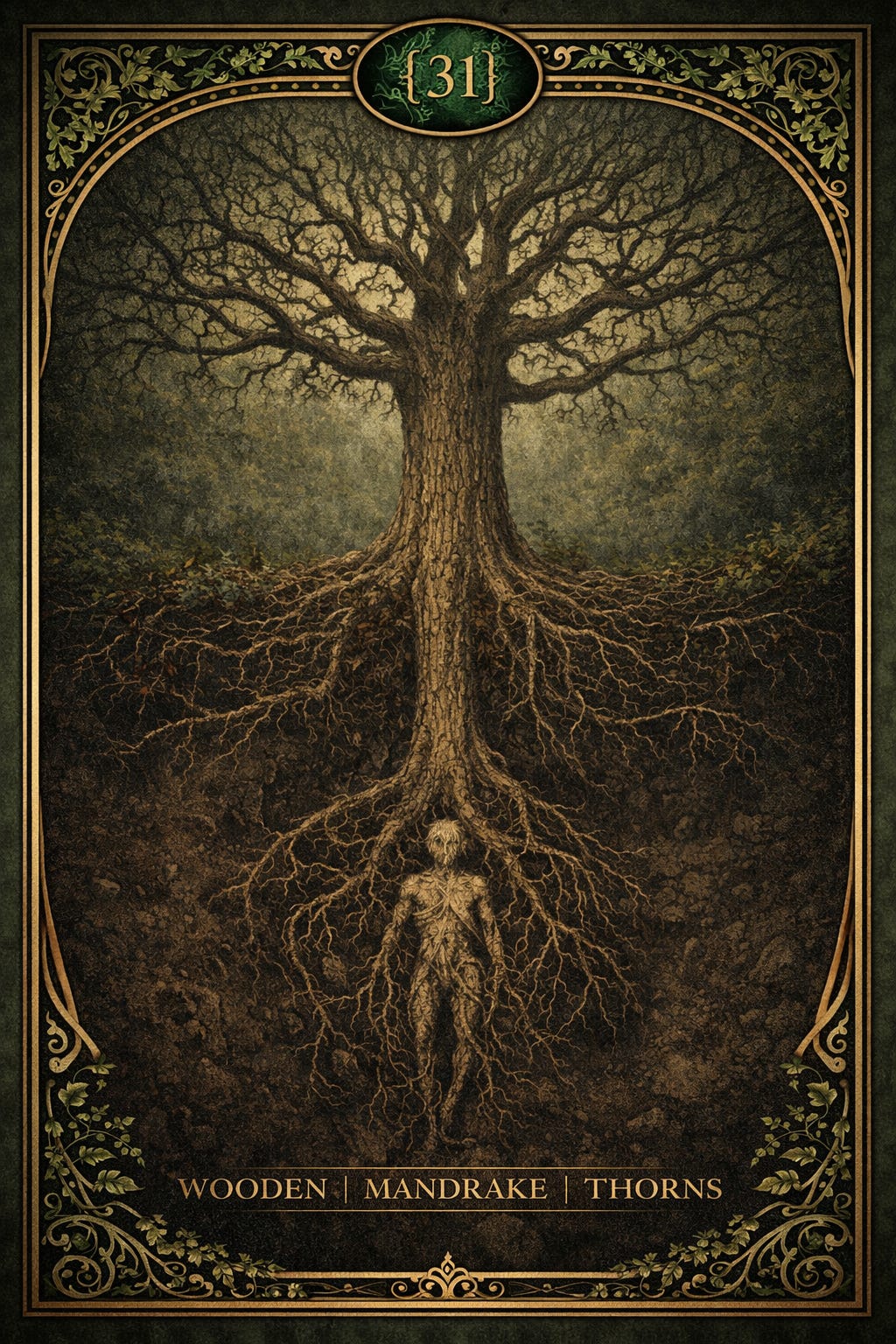
THORNS: {31}
Thorns, in their plural form, generally represent multi-faceted obstacles, persistent suffering, and the protective, defensive barriers of nature. While a single Thorn represents a specific pain, ‘Thorns’ denote a Surrounding Environment of difficulty, danger, or trial—along with their real world function as Natural Defences, symbolising the Shielding of the vulnerable (e.g., the rose) and Setting Boundaries to protect personal, emotional, or spiritual well-being.
COVENANT: {31}
Derived from the Hebrew: berît—linked to kārat, meaning ‘to cut,’—which infers a blood sacrifice to seal the agreement, a Covenant is a solemn, binding agreement or promise between two or more parties that Establishes a lasting relationship, often ratified by Oaths or Symbols. Unlike a contract based on law, the Covenant is persona, and often unconditional (like God’s promise to Noah)—signifying the Fresh Foundations of shared life and purpose, Strength in Unity, Loyalty, and partnership.
ARTEMIS: {31}
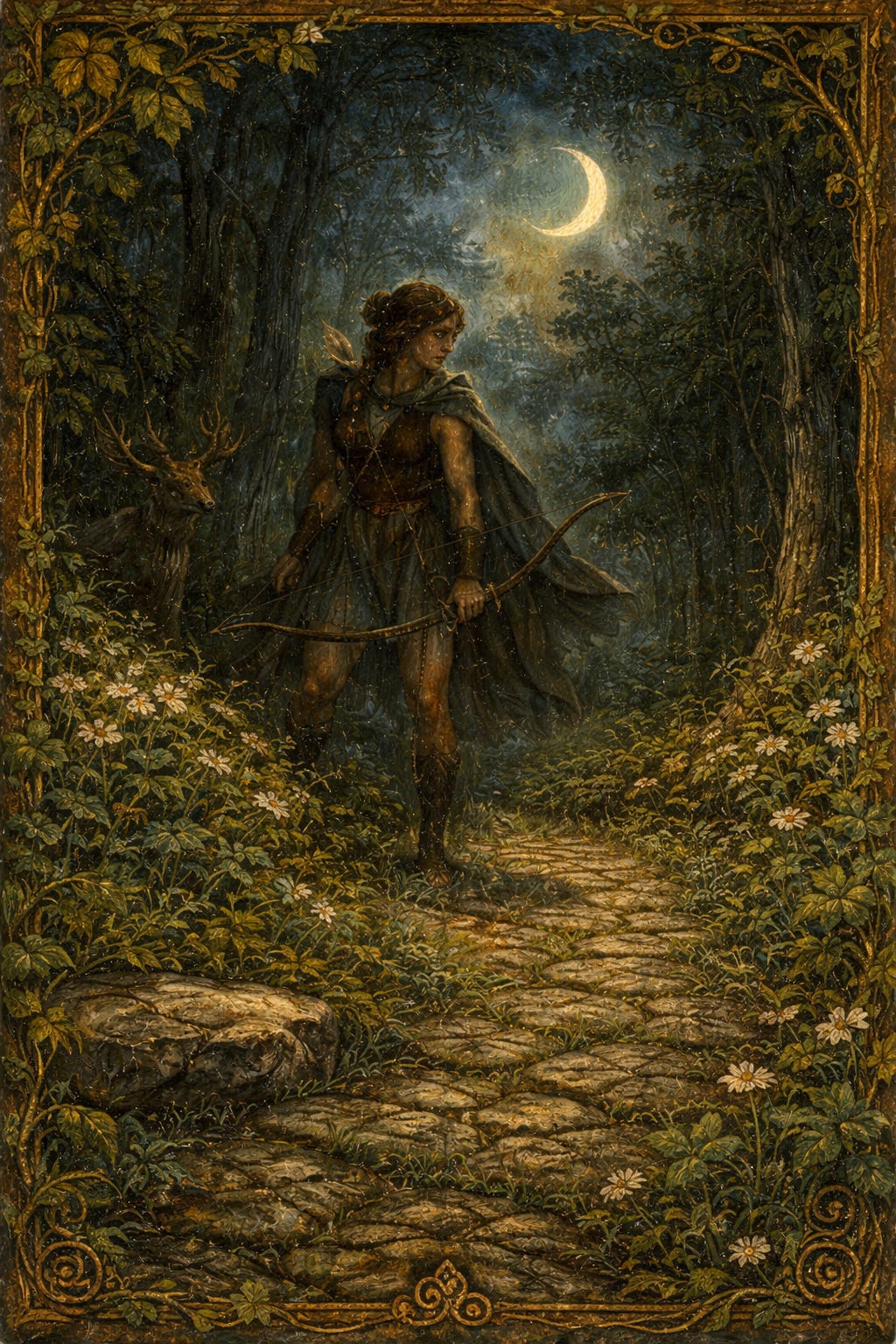
A member of The Huntress and The Wild Woman archetypes, Artemis is the ancient Greek goddess of the Hunt, Wilderness, Wild Animals, Chastity, and Childbirth—symbolising Independence, Untamed Nature, and Feminine Empowerment, she is often depicted as a youthful huntress with a bow and quiver, accompanied by a deer or hunting dogs. The name is often associated with the Greek word: artemes, meaning Safe, Sound, or Unharmed—reflecting her role as a Protector. (Author’s Note): my most beloved of the ancient Greek pantheon.
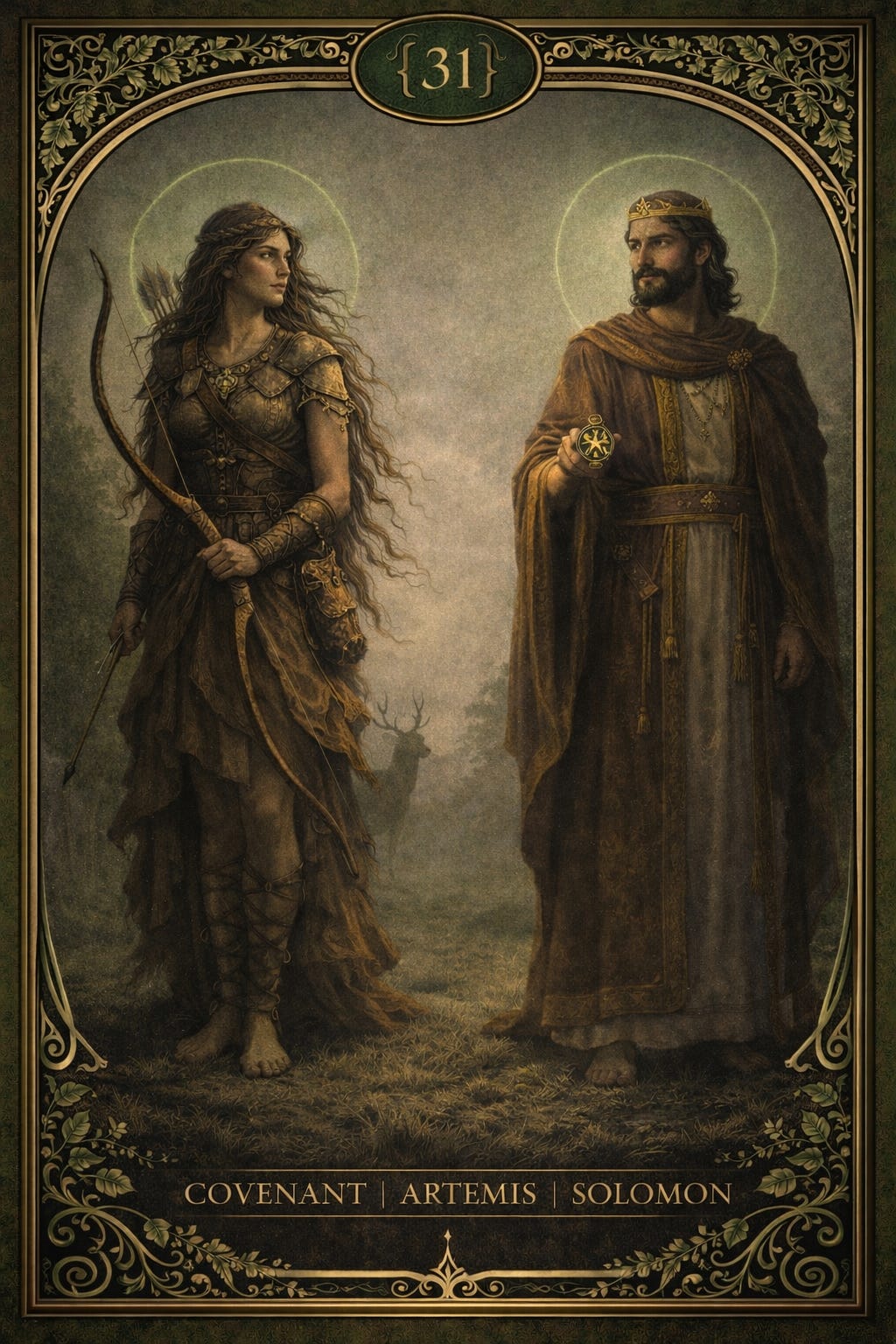
SOLOMON: {31}
Solomon, the Third king of Israel, signifies unparalleled wisdom, divine Justice, and peaceful Prosperity. His name derived from ‘shalom’ (peace), highlighting his reign as a tranquil era—Solomon is renowned for constructing the First Temple in Jerusalem and authoring wisdom literature. A master of Nature and the Occult, in post-biblical, Islamic, and esoteric traditions, Solomon commands spirits, demons (Jinn), and animals, often through the legendary Seal of Solomon—representing the pinnacle of intellectual, spiritual, and Material Achievement in the Abrahamic faiths.
PSYCHE: {31}
In Ancient Greek, Psyche (ψυχή) literally means ‘Soul|Spirit|Life,’ or ‘animating force’—derived from the verb: psychein, meaning: ‘to blow|to breathe,’ highlighting the ancient belief in the soul as the ‘breath of life’ that separates from the body upon death. In their myths, Psyche was a mortal princess known for her supernatural beauty—her story a journey of tribulations and separation from her lover Eros (Desire), and eventual immortality, symbolising the human soul's struggle and eventual purification through trials, love, and experience. While In modern psychology, particularly depth psychology, it refers to the complex of Foundational Forces influencing thought, behavior, and personality—Carl Jung defining it as the ‘totality of all psychic processes, conscious as well as unconscious.’
ALCHEMY: {31}
Alchemy is an ancient, mystical, and proto-scientific tradition focused on the Transmutation of Matter—specifically turning Base Metals into gold—and achieving human longevity or spiritual perfection. Symbolically, it represents Transformation, the union of opposites, and the pursuit of hidden knowledge, serving as a precursor to modern chemistry. Central symbols include The Great Work, defined by its Four stages: Nigredo (Blackening), Albedo (Whitening), Citrinitas (Yellowing), and Rubedo (Redding), as well as the The Four Elements (earth|water|air|fire).
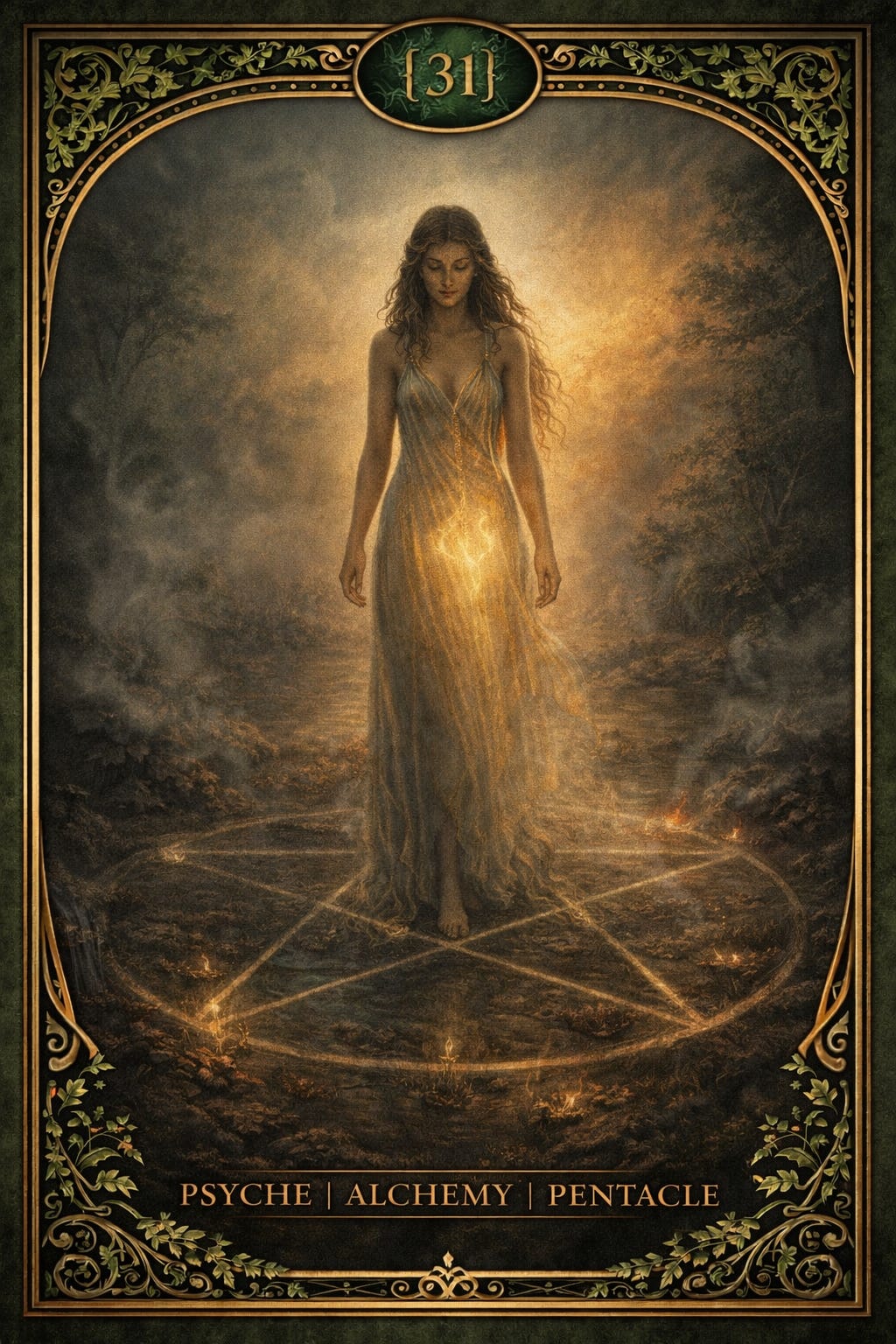
PENTACLE: {31}
The Pentacle is a five-pointed star (pentagram) enclosed in a circle, representing the five elements: earth|air|fire|water|spirit within a single Structure. Primarily a symbol of Protection, balance, and faith in modern Wicca and Paganism, it also symbolises human beings and the divine connection of ‘As Above, So Below.’ The Four lower points represent the Physical Elements, while the top Point represents spirit or the mind, signifying their supremacy over Matter.
NIGHT: {31}
Night refers to the {12} hours of darkness in the Daily Cylce—symbolising mystery, the unknown, and the unconscious, serving as a profound metaphor for Solitude, Death, and evil, while also offering a space for rest, reflection, and spiritual intimacy. It represents a suspension of daytime rationality, serving as a setting for Forbidden Actions or deep introspection Creative Pursuits such as literature and art—often associated with the Feminine (Ancient Greek Goddess Styx), and used to create Mood and Atmosphere, often representing the darker sides of Human Nature and Emotions.
SILVER: {31}
Due to its bright, reflective surface, Silver is often associated with honesty, truth, and the ability to see Oneself clearly, free from delusions—serving as a ‘Mirror to the Soul’ due to its reflective, luminous quality. Symbolically, Silver represents The Moon, Feminine Energy, and intuition, frequently associated with Wealth, Protection, and wisdom across various cultures. Widely prized for its elegance, Conductivity, and Calming properties, Silver has the highest electrical conductivity and highest thermal conductivity of any metal, surpassing even copper, and is the Foundational Standard for jewellery and silverware, owing to its Durability.
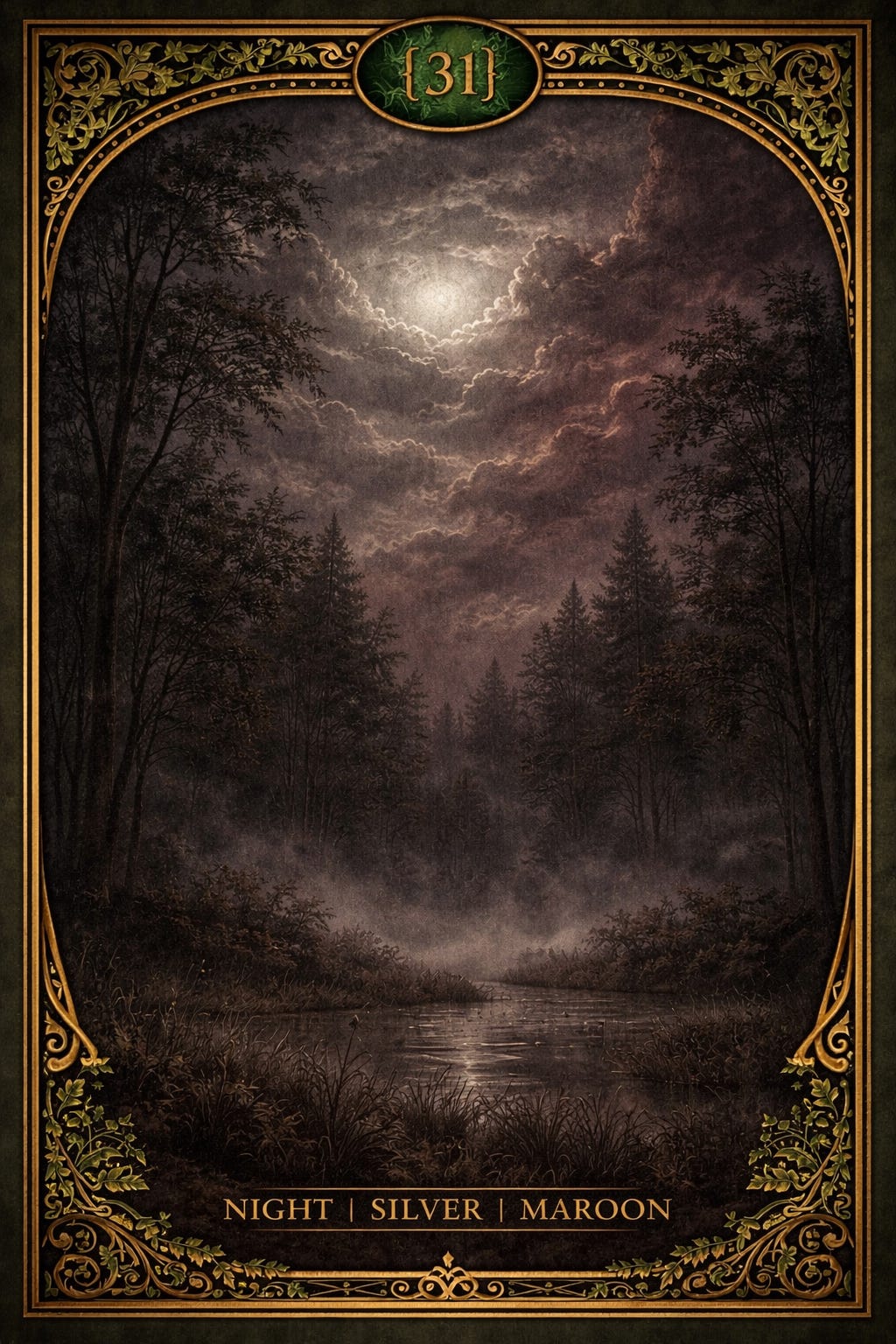
MAROON: {31}
Maroon is a deep, rich red-brown hue symbolising Strength, luxury, Spiritual Grounding, and refined Ambition. Derived from the French word for chestnut, this warm colour represents maturity, Confidence, and wisdom, often used in professional or intellectual settings to convey Control and Stability rather than the intense, passionate energy of bright Red.
ANNUNAKI: {31}
Translated from ancient Sumerian as ‘Those of princely blood’ or ‘Princely Offspring,’ the Annunaki refers to a group of powerful deities in ancient Mesopotamian mythology, specifically within Sumerian, Akkadian, Assyrian, and Babylonian cultures. They are regarded as the highest deities in the pantheon, often associated with the sky, Earth, and eventually the underworld. According to myths like ‘Atra-Hasis’, the Anunnaki created humans from clay, mixed with the blood of a sacrificed god, to take over the hard labor formerly performed by the younger gods (the Igigi), while Zecharia Sitchin popularised the theory that the Anunnaki were extraterrestrial beings from a planet called Nibiru, who came to Earth to mine gold, Genetically Engineered humanity, and taught us Civilisation.
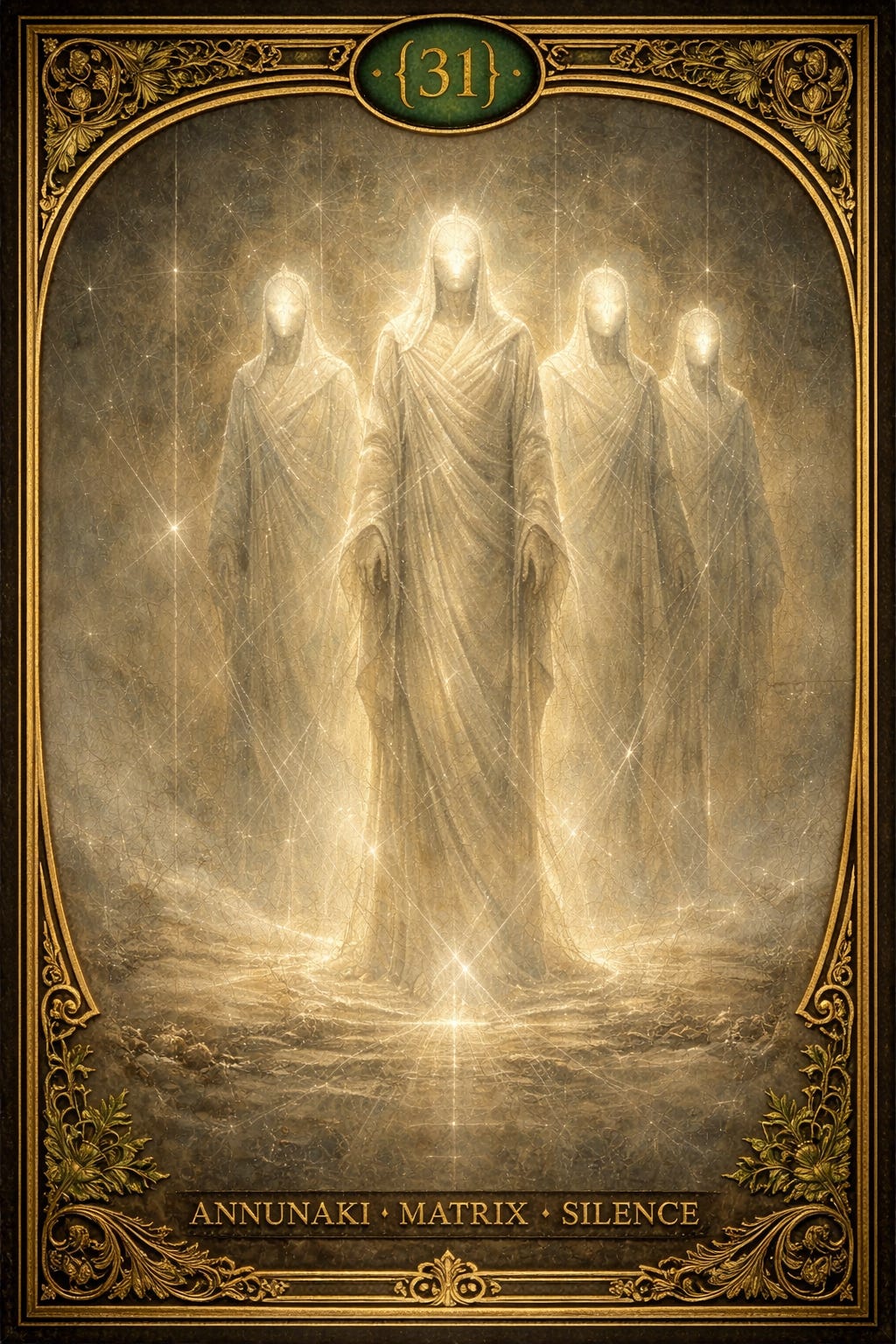
MATRIX: {31}
Matrix originates from the Latin word for womb or mother (mater)—its core symbolism relating to any Environment, Substance, or Structure within which something else Originates, Develops, or is Embedded. It signifies a Foundation or Container, ranging from physical substances like geological rock to abstract concepts like mathematical arrays or artificial realities.
SILENCE: {31}
Silence embodies a profound duality, representing both an absence of sound and a Presence of meaning, encompassing inner Stillness, contemplation, and Refuge. Symbolically, Silence signifies Divine Presence, peace, and intellectual depth, while also representing Mourning, Secrecy, Emotional Withdrawal, or Punishment (‘the silent treatment’), sometimes serving as a Barrier in Communication.
FATHER: {31}
Father refers to authority, Protection, guidance, and the Source of life, representing both Biological Parenthood and archetypal Leadership. Culturally, it signifies a patriarch or Protector, while spiritually it denotes a Divine Creator or mentor, and in Jungian thought, The Father archetype signifies Control, responsibility, and Foundational personality development, regardless of the biological relationship—serving as the ‘natural chief,’ Actively Shielding the Family Structure and guiding them forward.
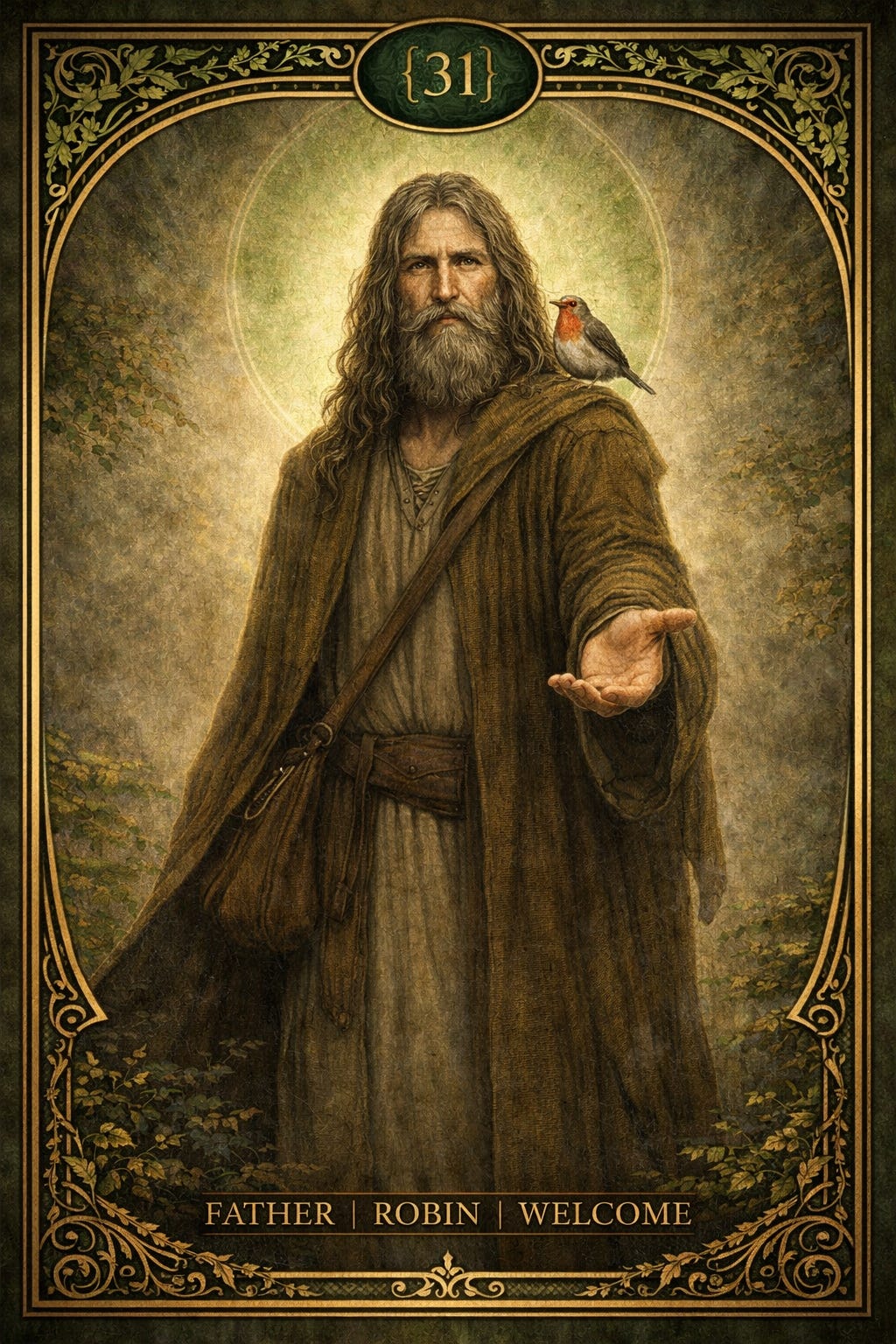
ROBIN: {31}
The Robin is a widely cherished bird, particularly in British and North American culture, harbingers of Spring symbolising Renewal and spiritual Comfort—often seen as a messenger from the beyond, it is also known for its feisty, territorial, and adaptable nature, making it a ‘Gardener’s Friend.’ The most prominent belief is that ‘When Robins Appear, Loved Ones Are Near’—a Robin’s presence is often interpreted as a visit from a deceased loved one or a sign of being Watched Over.
WELCOME: {31}
Welcome represents Hospitality, acceptance, Expression, and the Joyful Reception of a Guest. Rooted in the Old English: wilcuma, meaning ‘one whose coming suits another’s will or wish,’ a Welcome functions as a powerful Social Tool that creates a sense of belonging, transforming a Stranger into an Accepted Guest. In many traditions, a Welcome is seen as a spiritual act representing the acceptance of God's grace or the treatment of visitors as divine, such as in the Hindu concept of Svagata or the Christian concept of Welcoming the Stranger as Christ.
DOING: {31}
Doing refers to the Active performance, Execution, or accomplishment of an Action, Task, or Deed—signifying Engagement in an activity and serving as the continuous form of the verb ‘do.’ In certain philosophical and spiritual traditions, ‘Doing’ signifies a Pathway of commitment, placing emphasis on concrete deeds, behaviours, and ethical living—the manner in which one performs their duties often considered a direct reflection of an Individual’s Foundational capability and worth, rather than just the nature of the duty itself.
FACING: {31}
Facing refers to the orientation, Covering, or direct confrontation of a subject—signifying Turning Towards a direction, Lining the Edge of a garment, or applying an outer Protective Layer. Symbolically, ‘Facing’ embodies courage, accountability, and the conscious choice to deal with reality rather than avoiding it—whether one is ‘Facing the Music,’ the consequences of one’s Actions, remaining Firm in the presence of Danger, opposition, or difficulty, or ‘Facing the Future’ with Intent, Planning, and a Proactive mindset.
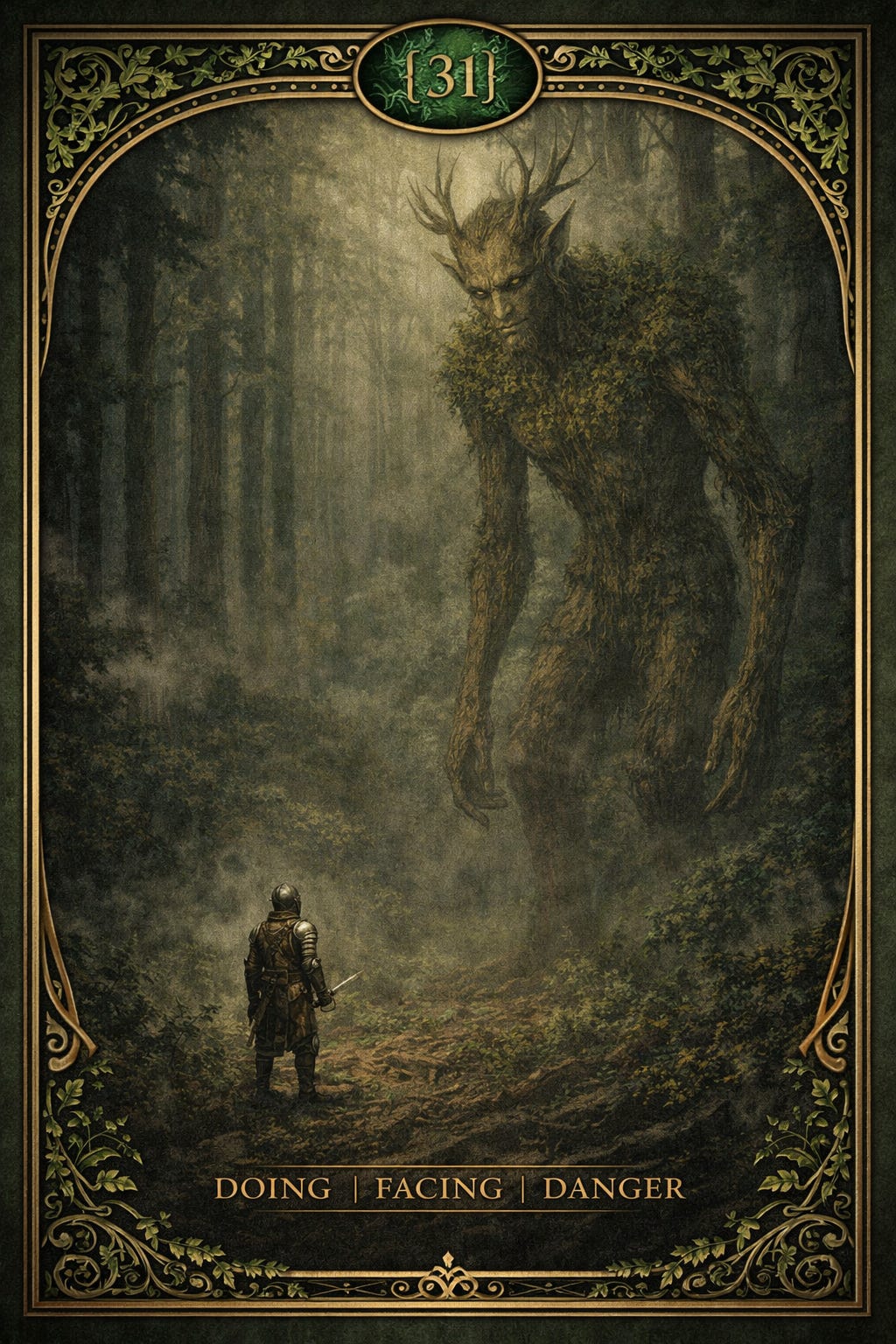
DANGER: {31}
Stemming historically from 13th-century roots meaning: ‘power of a lord|jurisdiction,’ Danger refers to the state of being vulnerable to harm, injury, or loss, representing a risk, hazard, or threat—the possibility that someone may be harmed, killed, or that something unpleasant will happen, whether Physical (threat to life|body), Emotional (distress), or situational (uncertainty|financial risk). Symbolically, it represents the potential for negative outcomes, the need for caution, or the Presence of a threatening force.
NAMING: {31}
Naming is a profound act of Creation, Identity, and Classification, transforming an anonymous object, person, or concept into a distinct entity with a Specific Character. It is a symbolic act that goes beyond simple identification, serving as a social, personal, and cultural tool for Establishing, Recognising, and Defining Identity, as well as a mechanism for Building social relationships. Mothers often experience a deep intuitive connection to their child’s name—many describing a ‘spark of joy’ or a sudden feeling of ‘this is it’ during pregnancy. (Author’s Note): And from my work, it’s clear the numerological-essence of a name informs one’s destiny, perhaps merely by subtly influencing one’s ‘Brand’ over the course of their lives—just like any name of a company or artist does.
TUNING: {31}
Originating from the 1550s to describe adjusting the intonation of a musical instrument, and derived from the noun ‘tune,’ which further traces back to the Old High German: tun and Proto-Germanic: tunōn, meaning to ‘make properly adjusted,’ Tuning refers to the process of Adjusting a Mechanism, Instrument, or Structure to achieve a Specific pitch, frequency, or optimal performance. Beyond its technical application in music and engineering, Tuning carries symbolic meaning relating to Active Alignment and Grounding of one's State of Mind or relationships with others.
TIMBRE: {31}
Timbre, often referred to as tone colour or tone quality, is the perceived characteristic of a sound that allows a listener to Distinguish between different instruments or voices, even when they are playing or singing the same note at the same volume. It is essentially the Foundational ‘fingerprint or personality’ of a sound and the key tool for Creating Atmosphere—a warm, mellow Timbre signifying intimacy or nostalgia (e.g., cello), with a sharp, bright Timbre evoking energy or fear (e.g., brass or high-pitched string dissonance).
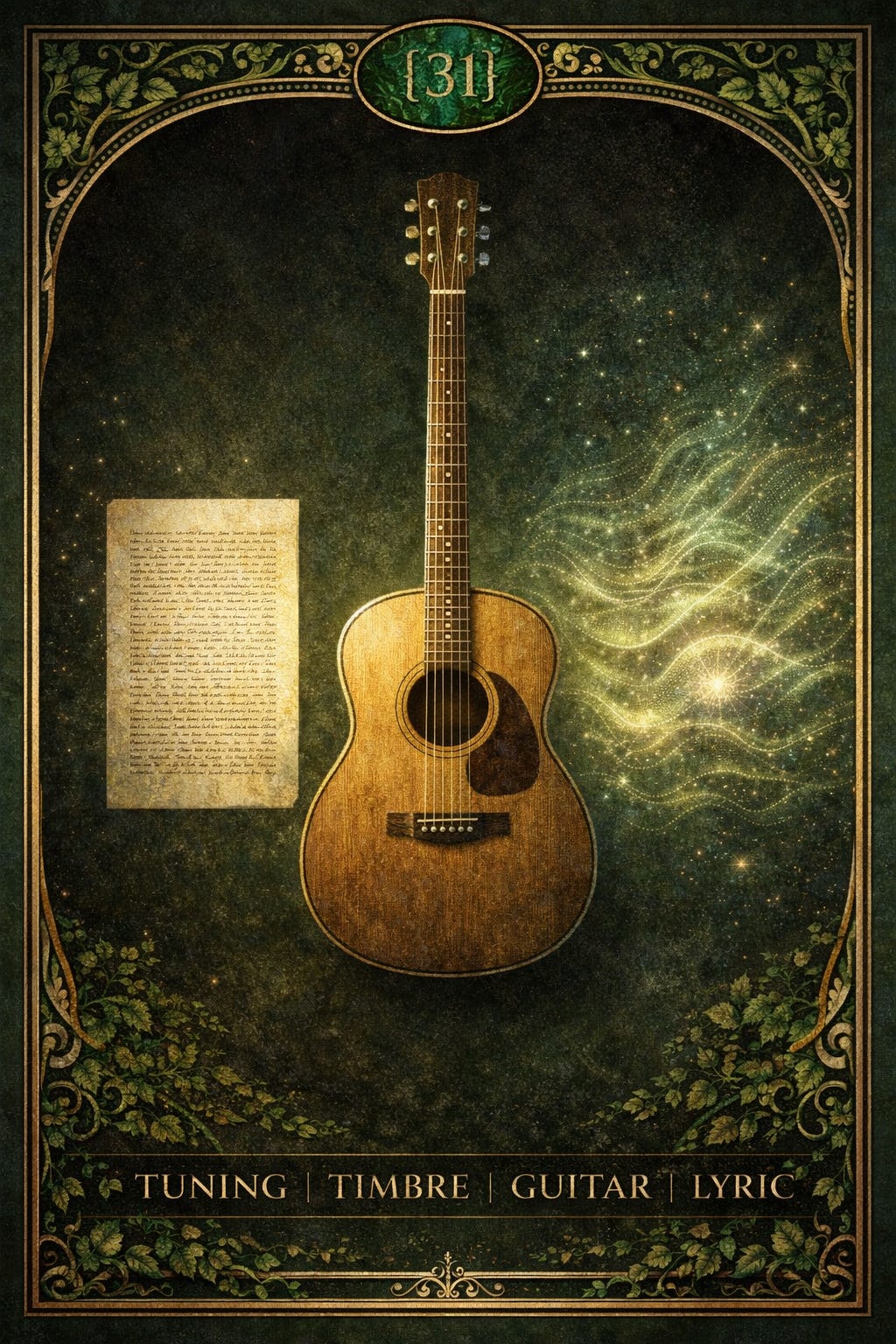
GUITAR: {31}
The Guitar is a versatile stringed instrument with a history spanning thousands of years, evolving from ancient Middle Eastern and Mediterranean stringed instruments into a global icon of Cultural Identity, Rebellion, and Social Expression. Symbolically associated with intimacy, storytelling, and the ‘Common Man,’ defined by its Waisted Body and Plucked Strings, and bridging cultures from Spanish flamenco to American blues and rock—the Guitar's Enduring popularity lies in its combination of simple, human-like Form and its vast capacity for sonic and Emotional Expression. (Author’s Note): with the +{1} value of S, the plural form of Chord also resolves to {31}.
LYRIC: {31}
Derived from the ancient Greek: lyrikos, meaning ‘singing to the lyre,’ and used to define verses accompanied by a lyre or cithara, often performed by poets like Sappho and Pindar, the term Lyric refers to a genre of poetry and in modern usage, the Foundational words of a song, characterised by the Active and Creative Expression of Personal Feelings, Intense Emotions, and a musical quality—evolving from the literal musical performance in ancient Greece to the broad literary term for subjective, non-narrative verse it is today.
THING: {31}
The word Thing has undergone a profound evolution, starting as a Old Norse|Germanic word for a Governing Assembly and evolving into a synonym for any Object or Entity. Its history reflects a shift in focus toward Materialism and Ownership—its modern usage serving as a placeholder for Foundational Categorisation or a concept that cannot be named. In philosophical and literary contexts, a ‘Thing’ represents the Transformation of a Familiar Object into something Strange or Foreign, triggering an ‘uncanny experience’ when it unexpectedly gains Agency or Sentience, such as a ‘mute idol’ that speaks.
PHONE: {31}
Phone is a colloquial shortening of ‘telephone,’ originating from ancient Greek roots meaning: 'far sound|far voice,’ Alexander Graham Bell coining his invention the ‘Electric Speaking Telephone’ in 1876. Symbolically, the Phone represents modern, Instant Connectivity, serving as a ‘signifier of identity,’ fashion, or status, while functioning as a Central and Foundational Tool for navigating Social Interactions and daily life.
RETAIN: {31}
Retain, derived from the Latin: retinere (‘to hold back|keep back’) primarily means to Continue Having, Holding, or Keeping something within one’s Possession, mind, or a Specific State. It frequently infers a conscious Effort to Maintain Control or prevent the loss of something valuable, such as composure, information, or staff—and while synonymous with ‘keep,’ Retain is more formal and emphasises the ongoing,, Deliberate, and sometimes Challenging Nature of Maintaining Hold.
CONTAIN: {31}
Contain signifies the act of Holding, Enclosing, or Keeping something within Defined Limits, both physically and metaphorically—inferring a relationship of holding a substance, comprising parts, or Exercising Control over an Individual or Situation. Emotionally, it represents the ability to Hold Back something potentially volatile or dangerous—such as one’s emotions (anger|desire|enthusiasm), an epidemic, fire, or foe.
METEOR: {31}
Derived from the ancient Greek: meteoros, meaning ‘high in the air|thing high up,’ a Meteor is the streak of light—commonly called a ‘shooting star,’ produced when a piece of space debris (a meteoroid) Enters Earth's atmosphere at high speed and Burns Up due to friction. The Meteor is not actually a star, but a small Particle of Rock, Metal, or Dust—and throughout history, have been interpreted as powerful Omens and Symbols, changing from Signs of dread to hope and the turning times.
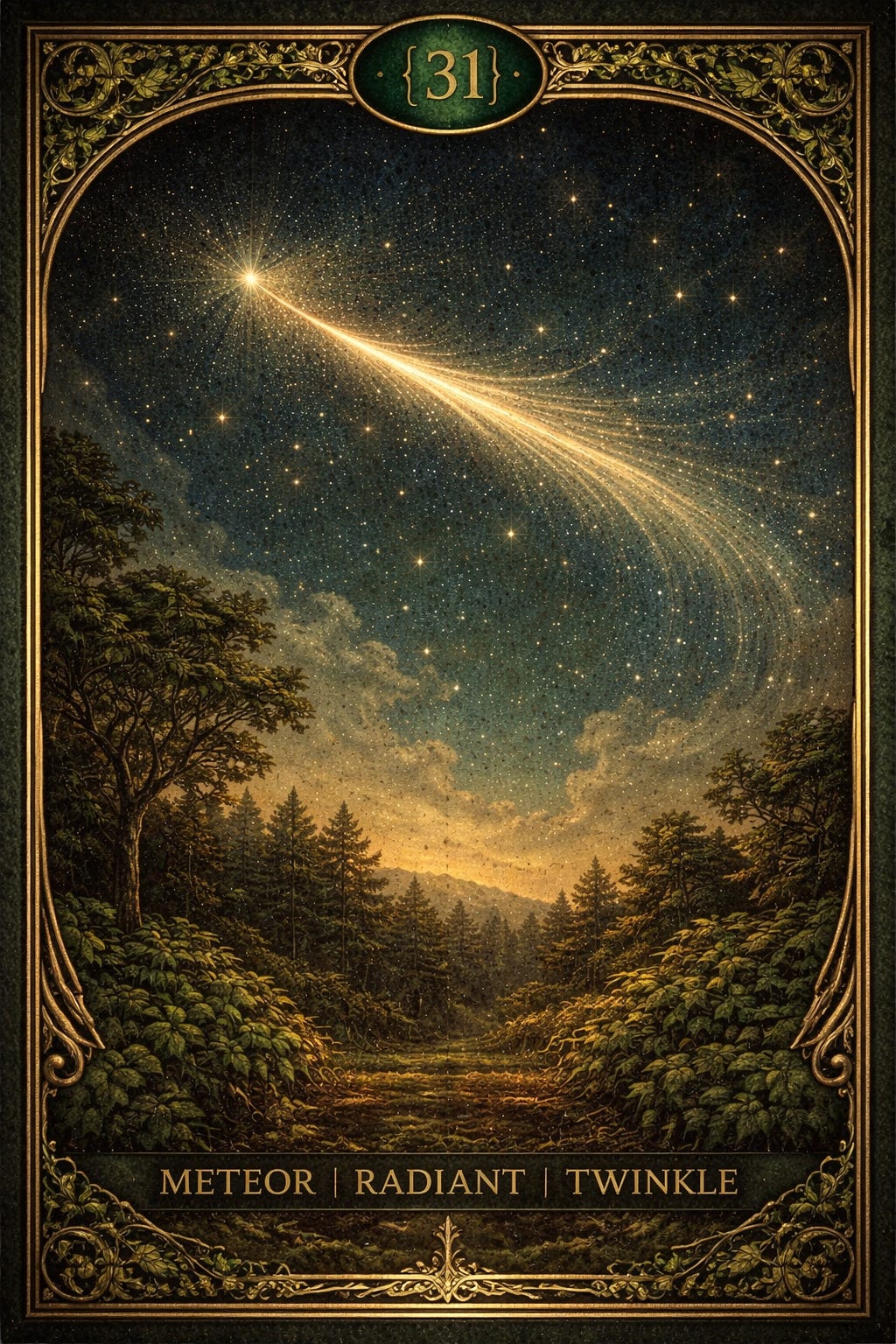
RADIANT: {31}
Radiant originates from the Latin: radiantem (‘beaming|shining’), referring to the emission of diverging rays of light or heat. Symbolically, it transcends its literal definition of brightness to represent intense Joy, inner beauty, divine presence, and spiritual enlightenment. In physics, Radiant refers to energy transmitted by waves or particles (e.g., Radiant energy), while in astronomy, it refers to the Point in the sky from which Meteors appear to Originate.
TWINKLE: {31}
Twinkle refers to an intermittent or flickering light, such as that emitted by stars or distant lights, often conveying a sense of Magic, Joy, or liveliness—the ‘Twinkle of stars’ frequently associated with hope and beauty, serving as a beacon of light in the darkness or loneliness, while a ‘Twinkle in one’s eye’ symbolises a kind, mischievous, or intensely Happy spirit, and often evoking a sense of enchantment.
SUN SIGN: {31}
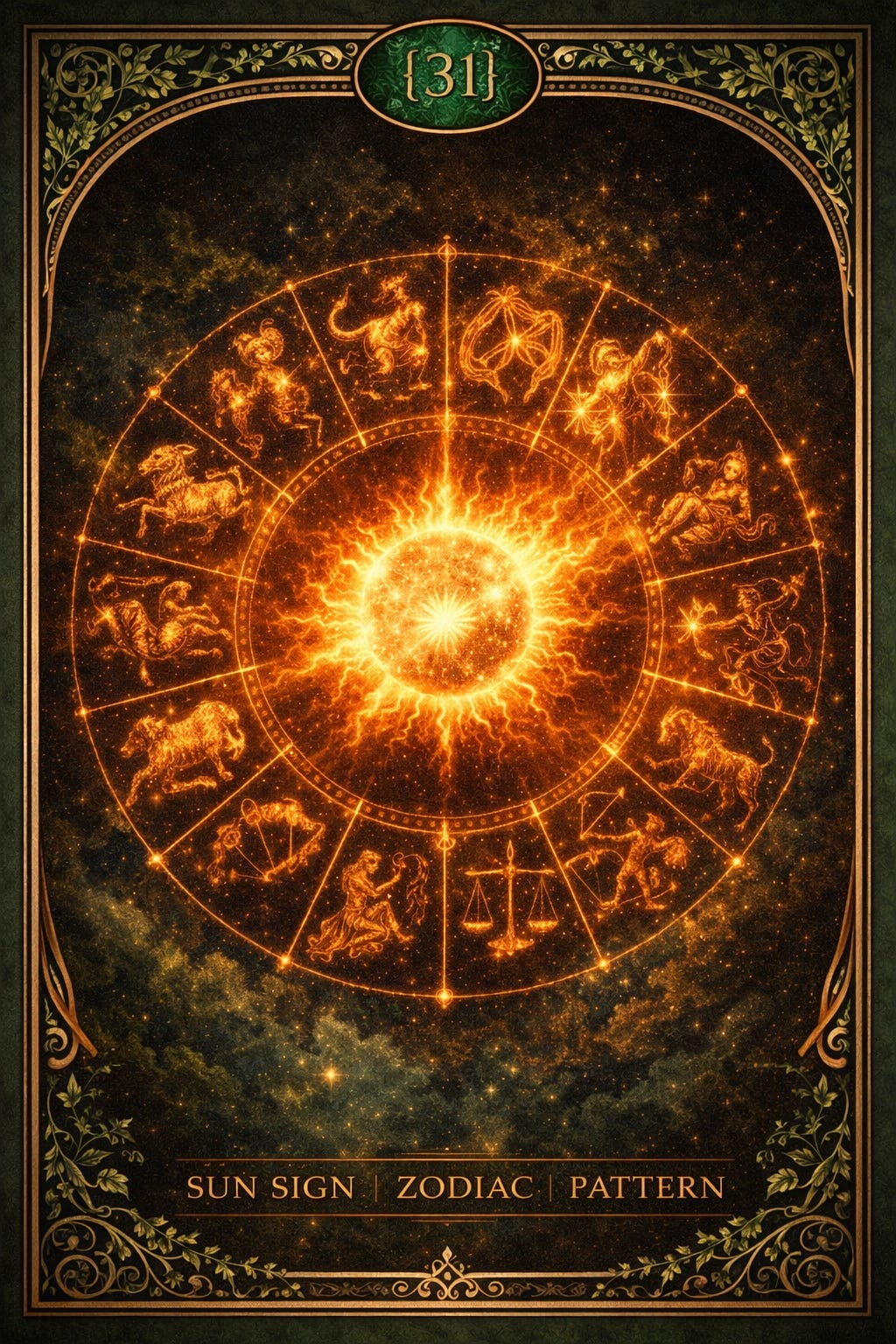
A Sun Sign is the astrological sign that the Sun was in at the precise moment of a person’s birth—considered the most Foundational Part of an Individual’s astrological profile, representing the Core Identity, ego, life purpose, and general Character Traits. It symbolises the ‘authentic self’—the Fundamental aspect of one’s personality that remains relatively Constant, highlighting what Drives one’s ambitions and motivations, Shaping their Strengths and Weaknesses. As the centre of the solar system, the Sun Sign represents one’s personal ‘power source’ and their capacity for Joy, Creativity, and Self-Expression, signifying Structure, Leadership, and ‘The Hero’ or Protagonist aspect of one’s personality.
ZODIAC: {31}
The Zodiac is a celestial belt, about {18°} wide, divided into {12} signs representing the constellations and Marking the sun’s annual path. Derived from the ancient Greek: zōdiakòs kyklos (‘circle of little animals’), it represents Archetypal Human Traits, Cosmic Influences, and Seasonal Cycles. It originated in Babylonian astrology to map planetary movements and predict events—the signs embodying specific personality traits via various Structural qualities, such as the Four Elements: Fire|Earth|Air|Water, and Three modalities: Cardinal|Fixed|Mutable, representing a full Psychological and Symbolic Framework. (Author’s Note): and it’s all true.
PATTERN: {31}
Derived from the Latin: patronus (model|Father), where it represented an Original Blueprint or ideal that was worthy of imitation, a Pattern is fundamentally a predictable regularity in the world, human-made design, or abstract thought, characterised by the repetition of Elements (motifs) in a Logical, Orderly Manner. It functions as a bridge between order and chaos, providing Structure, Meaning, and a Foundation for prediction.
BASELINE: {31}
A Baseline refers to an Initial set of data, a Standard, or a line used as a Foundation for comparison, measurement, or control. It acts as a ‘Starting point’ or a ‘New Normal’—providing an objective, agreed-upon Standard, e.g., a ‘Baseline budget,’ to Manage expectations and Ensure consistency.
GRAIN: {31}
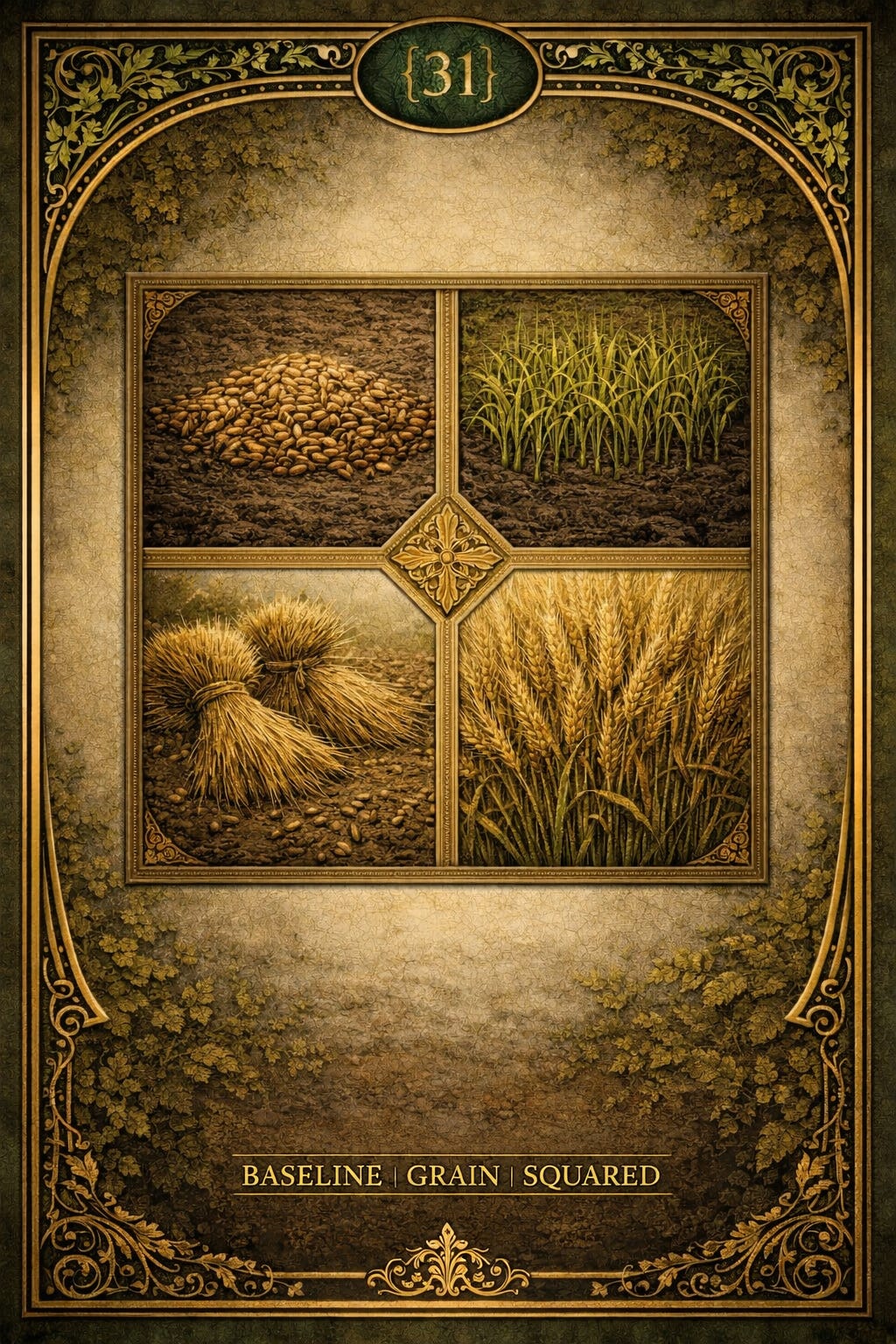
Grain holds profound, multifaceted meanings spanning literal agricultural sustenance to deep symbolic, spiritual, and Structural concepts—at its core, referring to the small, Hard Seeds of food plants (wheat|rice|barley) or a tiny Particle of a Substance. As the Foundational Source of human nourishment, Grain embodies the Basic Needs of life—a full granary representing Economic Stability, Wealth, and the Blessings of the Land. Because seeds are buried before they sprout, they represent life, Death, and Resurrection—in Ancient Egypt, Grain was a Staple and a ‘gift of the Nile,’ associated with Osiris and essential to the afterlife.
SQUARED: {31}
Squared denotes multiplying a number by itself: (a x a =a²), visually creating a Square's Area. Symbolically, it signifies Stability, Equality, and Orderly Foundations. It often represents the number Four (sides), denoting Cardinal Points or Elements, and is used to describe solidified, honest, or ‘true’ Structures. Contrasted with the Circled (which symbolises the spirit|divine), that which is Squared represents the Material World, Earthly Life, and Physical, Finite Reality.
PARALLAX: {31}
Parallax is the apparent Displacement or Shift in the position of an Object when viewed from two different points of view. It is a fundamental concept in astronomy, optics and photography that describes how an Object’s location changes relative to a background based on the Observer’s position. Conceptually, Parallax symbolises that what is perceived as ‘reality|position’ depends entirely on the viewer's location—inferring that a Single Object may be interpreted in Multiple Ways depending on the vantage Point.
FALSE SELF: {31}
The False Self is a psychological concept developed by British pediatrician and psychoanalyst: Donald Winnicott in the 1960s to describe an artificial persona created as a Defensive Shield. It is an adaptive mechanism, often formed in early childhood, where an individual masks their authentic feelings, spontaneous desires, and vulnerabilities to conform to the expectations of their Environment (particularly caregivers) in order to survive, receive love, or avoid trauma.
PATHWAY: {31}
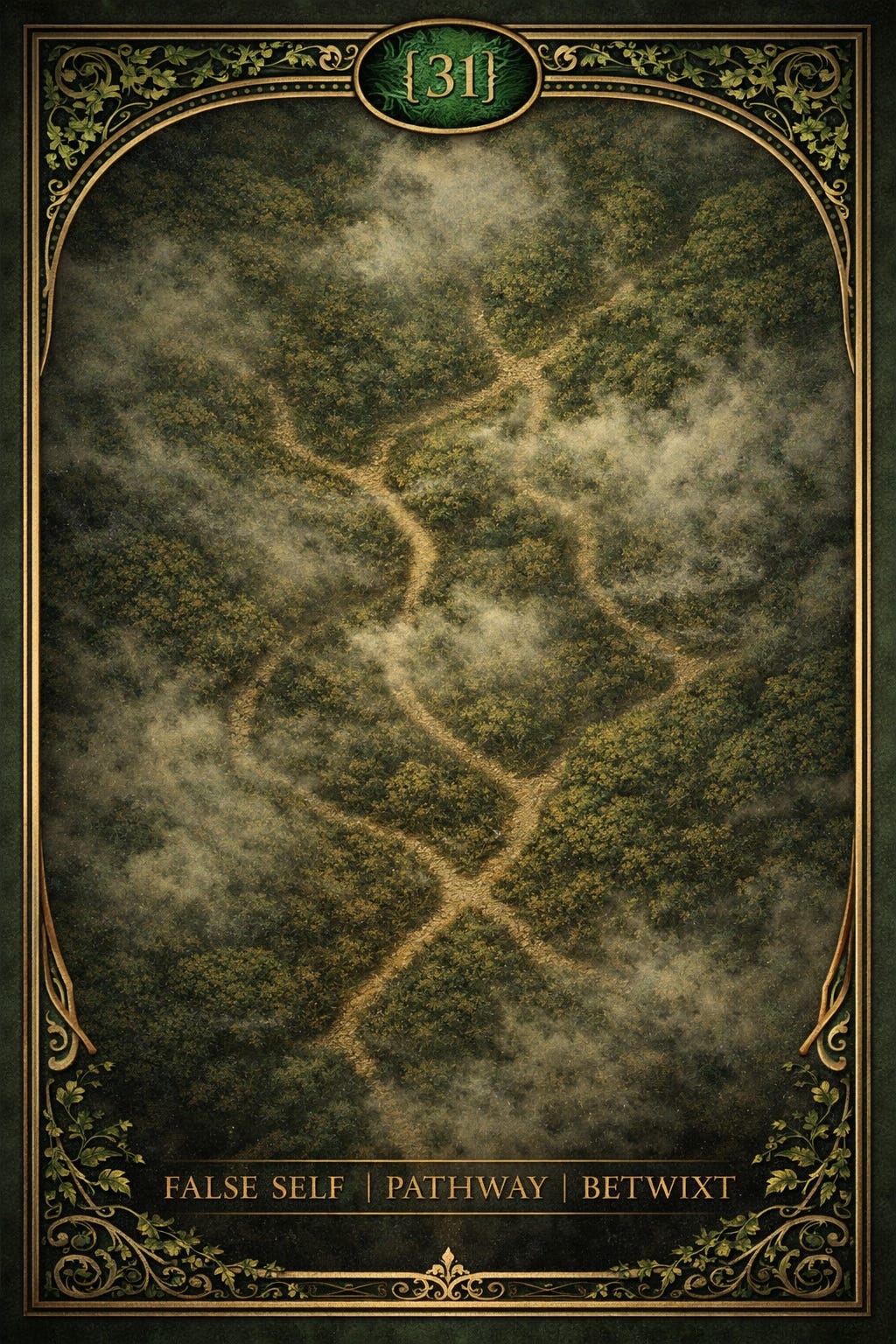
A Pathway represents the path of life or a journey of self-discovery, similar to the ‘Road Not Taken’ motif—symbolising the personal, often winding, process of Growth and change. In religious contexts (Buddhism|Hinduism), it signifies ‘The Way’ to liberation (Nirvana|Moksha) from suffering, requiring Effort, Moral Conduct, and wisdom—often considered a higher path of mental Discipline. While in Scientific|Biological contexts, it refers to the metabolic Pathway (series of enzymatic reactions) or nerve Pathway (chains of neurons) that manage chemical Conversions or Communicate signals within the Body.
BETWIXT: {31}
Stemming from Old English roots: ‘be-’ + ‘twixt’ that roughly equate to ‘by two|in the space that separates,’ Betwixt is an archaic or literary preposition and adverb that means between, often specifically referring to being in the middle of two options, positions, or ideas. While it serves as a synonym for ‘between,’ it is most frequently used today in the idiomatic phrase ‘Betwixt and Between’ to indicate a state of being in an intermediate, unresolved, or ‘Neither-Here-Nor-There’ position.
ENJOIN: {31}
Enjoin is a formal English verb characterised by its Contradictory Meanings, serving as a contronym (or Janus word) that may both mean to Command an Action or to Prohibit one, depending on context and prepositions. It generally implies an authoritative, urgent, or official command. Its dual nature: Imposing a Duty or Restricting Action—represents the ‘double-edged’ nature of Structural power, which can act as either a ‘forced requirement’ or a ‘total stop.’
NYMPH: {31}
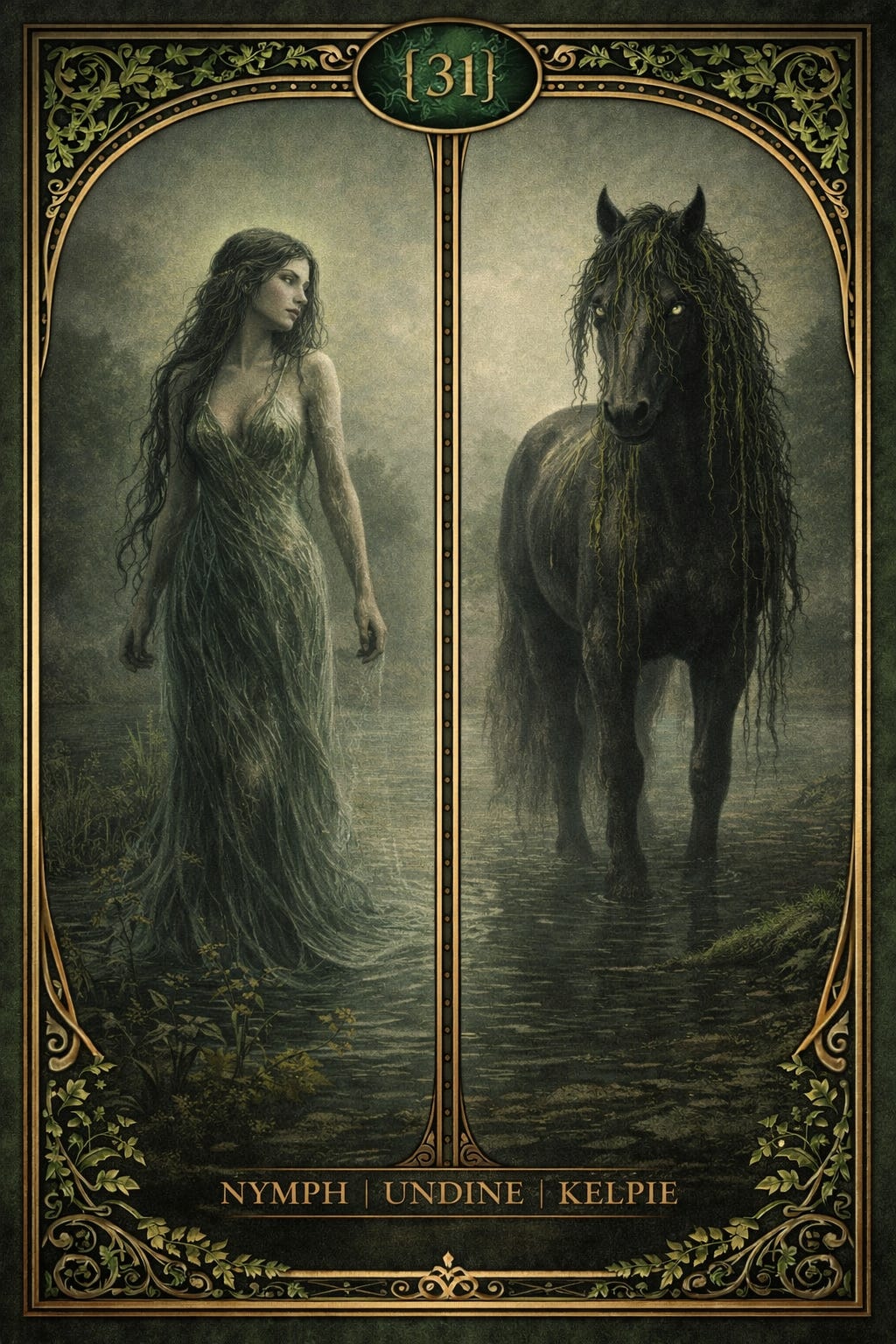
In ancient Greek mythology, the Nymph is a large class of minor Nature deity, generally depicted as beautiful, young, and vital maidens who personify the Creative and Nurturing forces—as well as the Untamed|Capricious aspects, of the Natural World. They are not typically considered immortal, but do possess exceptionally long lives—regularly bound to the specific Environmental features they inhabit, whether Trees, Mountains, or Springs. As Caretakers of the land, they represent the Fertility of nature, often linked to Child-Rearing and the Protection of young life.
UNDINE: {31}
Deriving from the Latin word: unda, meaning ‘wave or little wave,’ the Undine was coined by the Swiss alchemist: Paracelsus in his 1566 work: ‘A Book on Nymphs, Sylphs, Pygmies, and Salamanders, and on the Other Spirits’, where he outlined Four types of Elemental Spirits including the Undines (water), along with Gnomes (earth), Sylphs (air), and Salamanders (fire)—and considered them Elemental Beings that are Emotional, Fluid, and often possess beautiful singing voices. The central theme in the Undine myth is the quest for a human soul—lacking one, the Undine marries a mortal to acquire it with their union ending in tragic suffering|mortality. In essence, Undines represent the dual nature of water—Nurturing and life-bringing, yet capable of being a ‘treacherous tide’ that may drown or destroy.
KELPIE: {31}
The Kelpie is a malevolent, Shape-Shifting water spirit from Scottish folklore that inhabits lochs and rivers, most famously described as a beautiful Black Horse. It may also take human form, appearing as a hairy man|handsome stranger. The Kelpie lures its victims onto its back where the rider’s skin becomes magically Adhered to the Kelpie, allowing it to drag them down to the depths to drown and devour them—marking them a cautionary figure employed to warn children away from dangerous waters and young women against handsome strangers. In modern interpretations, the 30-metre-high Steel Sculptures: The Kelpies, in Falkirk, Scotland, signify the Strength and Endurance of the horse in Scotland's industrial heritage, transforming the malevolent myth into a tribute to the heavy horses (Clydesdales) that powered the nation.
BOLTZMANN’S CONSTANT (Mantissa): {31}
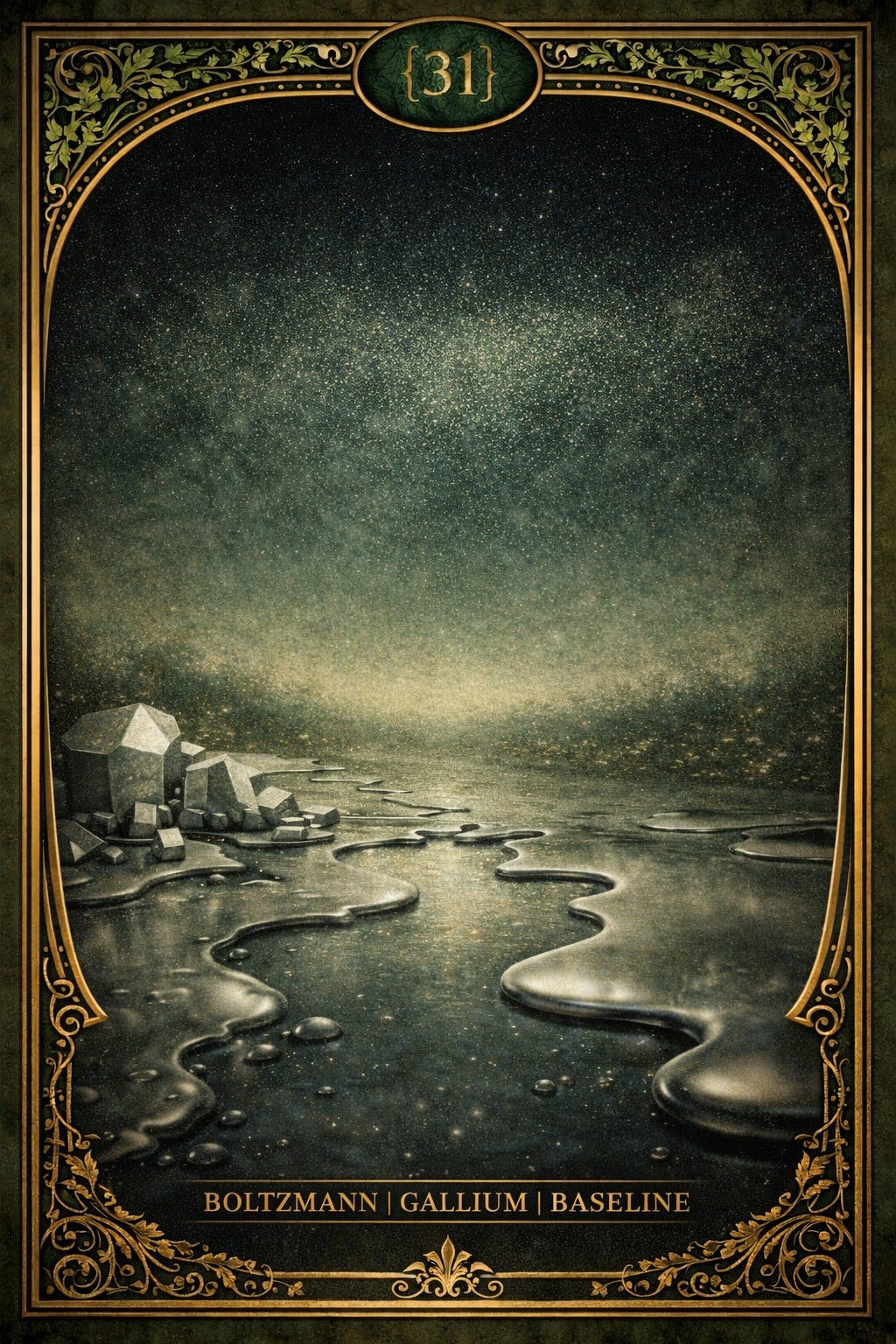
The Boltzmann's Constant: kB ≈ 1.380649 × 10⁻²³ J/K, is the Structural bridge between the Microscopic and Macroscopic Worlds—the translation key by which the invisible thermal energy of individual particles becomes the measurable, felt temperature of a Physical System. Named after Austrian physicist: Ludwig Boltzmann (1844–1906), whose pioneering work in statistical mechanics established that the macroscopic properties of Matter Emerge from the Collective Behaviour of countless atomic-scale Interactions, it is one of the seven defining constants of the SI unit system, and appears at the Foundation of thermodynamics, quantum mechanics, and information theory alike.
That its Mantissa: (1.380649) resolves to {31}, the frequency of Pattern|Baseline|Matrix|Covenant and Contain, is deeply fitting—for Boltzmann's Constant is precisely the number by which physics Patterns the invisible into the visible, Establishes the Baseline of thermal reality, and Contains the law binding energy to temperature. It is, in the most literal sense, the mathematical Cornerstone of the physical world—the number that allows the universe to build itself from the Ground Up.
GALLIUM: ATOMIC ELEMENT {31}
Atomic Element {31} is Gallium (Ga)—a soft, Silvery-white Post-Transition metal famously known for its low melting point, which allows it to melt in your hand. Gallium does not occur as a Free Element in nature, but rather as Gallium Compounds in trace amounts in Zinc ores (such as sphalerite) and in Bauxite. Gallium forms alloys with most metals. It readily Diffuses into cracks or Grain boundaries of some metals such as aluminium, aluminium–Zinc Alloys and steel, causing extreme loss of strength.
The Linguistic Hinge: THIRTY-ONE

{53}: Life|Change: {5} crossing {+} into Creation|Expression: {3} resolving to {8}: Eternal Law|Balance—the Frequency of HERE AND NOW|THE ASTRAL PLANE|DEMONOLOGY|REFLECTION|PROJECTION and ETERNAL LIFE.
{13}: The Number Of The Soul
Calculation Board:
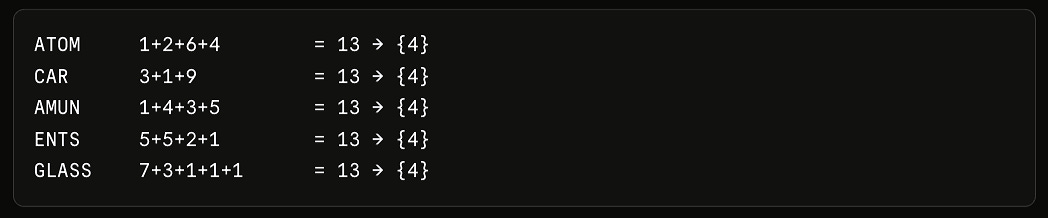
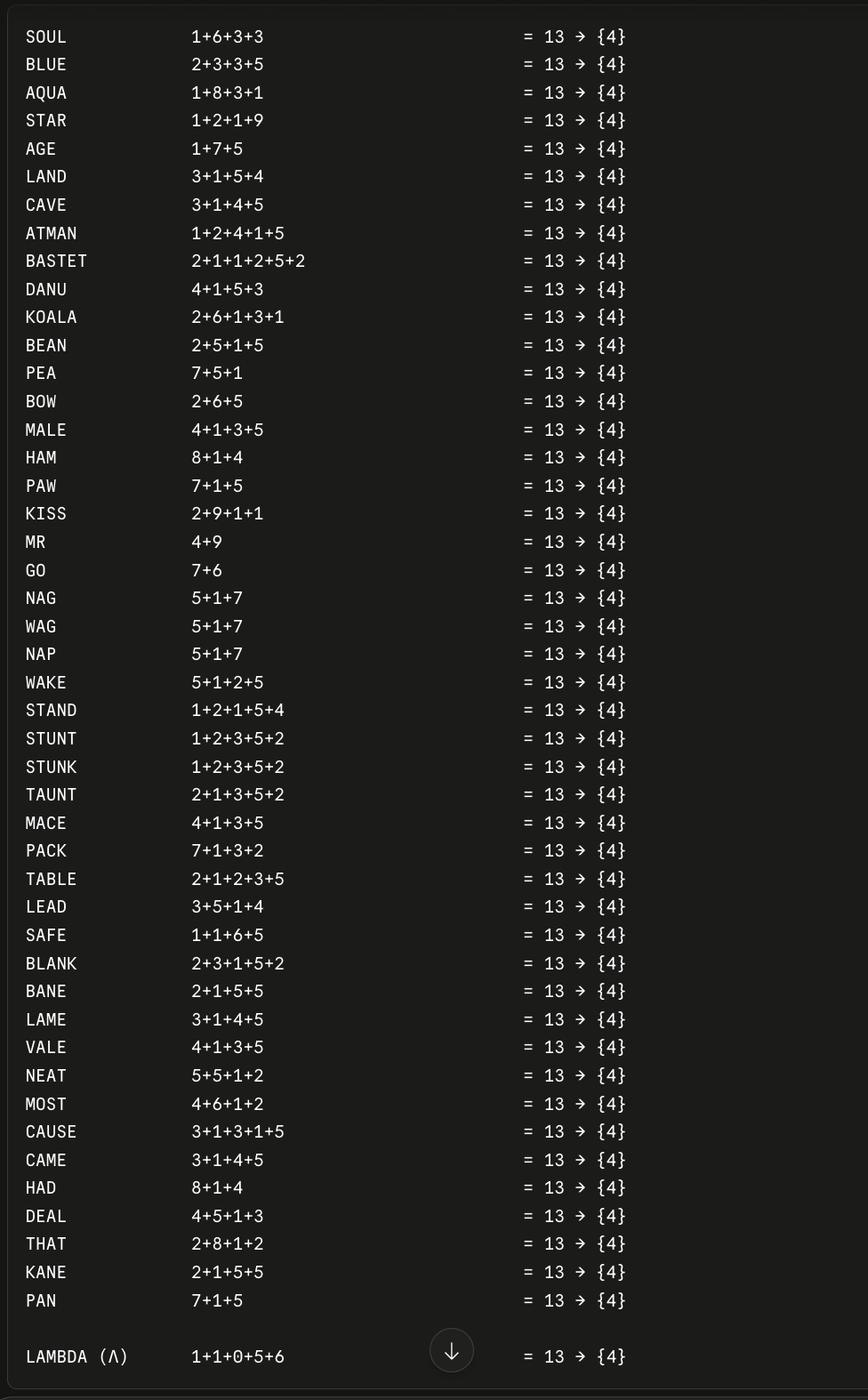


(Hebrew Gematria):

{13}: Unity|Initiation: {1} crossing {+} into Creation|Expression: {3} resolving to Foundation|Structure: {4}.
Across contexts, {13}: symbolises transformation, profound change, and unconventional innovation—in numerology, often serving as a catalyst for breaking old patterns. In the Tarot, {13} represents the Death card, signifying significant endings, transitions, and the dismantling of limitations, and also corresponds to the number of Lunar|Menstrual Cycles in a year, representing Feminine Energy and Natural Cycles. While Western culture has widely viewed it as an unlucky symbol of discord (e.g., Last Supper), it represents divine unity in Kabbalah, and auspicious luck in other cultures. This is reflected in its mathematical qualities as the {6}th (Harmony|Responsibility) Prime Number, an Odd Integer, and the {7}th (Mystic Quest|Perfection) Fibonacci number, making it significant in number theory.
SOUL: {13}
The Soul is defined as the immaterial, immortal essence or animating principle of a living being, regarded as the seat of human Personality, Intellect, Will, and Emotions. Derived from the Proto-Germanic: saiwalo, the concept is historically linked to breath or ‘moving force,’ serving as the inner fire that Animates the Material Self—a mirror (The True Self) reflecting love|wisdom, and a ‘candle in the darkness’ which provides inner guidance. In various religious traditions, it acts as a ‘Divine Spark’, with its survival beyond Death central to ideas of immortality and the afterlife. Beyond religious context, ‘Soul’ signifies deep Emotion, Passion, and Authenticity—the ‘Soul of Wit|Soul of a Nation’ representing the core essence and highest quality of being. Concluding, Soul represents a connection to something higher than oneself—embodying a journey toward truth, consciousness, and Eternal Growth.
ATMAN: {13}
Atman, a Foundational concept in Hindu philosophy derived from Sanskrit, refers to the true, innermost essence or ‘Self’ of a living being, frequently translated as the eternal soul rather than just a subjective ‘I’. Symbolising the unchanging and imperishable Divine within, it is distinct from the body, mind, ego, and temporary personality (Jīva), remaining unaffected by death, birth, or material change. The Atman signifies pure, self-shining witness-consciousness (sakshi) that Underlies all personal activity, often perceived as a Spark of the universal consciousness, Brahman, and described in the Upanishads as lying deep within the heart's ‘Cave’ (guha), a ‘golden puruṣa’ that pervades the Entire Body yet transcends it. Ultimately, Atman represents the goal of self-knowledge (Atmajnana), where its recognition liberates the Individual from the Cycle of Reincarnation, symbolised by the ‘Om’ (ॐ) vibration, leading to moksha (liberation) and the realisation of one’s divinity.
WAKE: {13}
Wake holds a multifaceted meaning, serving as both a noun and a verb that encapsulates the transition Between States—conscious|unconscious, life|death, or action|consequence. Ceremonially, the Wake represents a vigilant gathering, stemming from Old English roots meaning ‘to watch|stand guard,’ originally meant to protect the deceased from evil spirits and grant community support. Conversely, the noun Wake (the nautical trail) represents the Aftermath, Consequences, or Impact of a past Action, signifying the lingering effects of a significant event or person. Finally, as a verb, to Wake signifies awakening, awareness, or rising, representing a transition from lethargy or unconsciousness to a state of alertness, awareness, or reanimation—inferring a stirring or Starting Over.
NAP: {13}
A Nap is a short, light sleep taken during daylight hours, carries deep symbolic significance beyond its literal meaning of physical rest. Rooted in the Old English: hnappian (to doze), the word embodies themes of Rejuvenation, tranquility, and the In-Between State of consciousness—a temporary pause in a fast-paced world. In various spiritual and cultural contexts, it may be viewed as a Restorative retreat or a Meditative escape from the burdens of modern existence, allowing for a temporary return to Oneself.
CAME: {13}
As the simple past tense of ‘come,’ Came signifies Arrival, completion, and the irreversible movement from a State of anticipation to a State of presence. Symbolically, it marks a definitive transition—a Boundary Crossed, often indicating an idea, person, or Age has arrived, been realised, or occurred. It holds a narrative, often temporal, power, suggesting a ‘before and after’ where the Action of arrival has already occurred, closing one chapter to begin another. In metaphorical usage, Came can denote reaching a new understanding (‘he Came to know’) or achieving a destination.
BLUE: {13}
Blue is a multifaceted colour that universally symbolises serenity, stability, and depth, acting as a bridge between the tranquility of the Natural World and profound Emotional States. As the tincture of the vast Ocean and clear Sky, it commonly signifies the infinite, divine, and spiritual, frequently employed in religious art to convey grace and transcendence, such as in the robes of the Virgin Mary or skin of Lord Krishna. Psychologically, Blue is non-threatening and calming, known to reduce stress and foster a sense of security—however, its coolness may also denote detachment, isolation, and sadness, as reflected in the idiom ‘Feeling Blue’. Beyond tranquility, darker shades of Blue signal professionalism and authority (Structure), while lighter hues are often associated with Peace, Hope, and Creativity.
AQUA: {13}
Derived directly from the Latin word for ‘water,’ Aqua embodies the essence of life-giving Fluidity, purity, and clarity. Symbolically, it represents the Serene and Rejuvenating nature of the ocean, often associated with Emotional Healing, Tranquil Beauty, and mental clarity. In spiritual and cultural contexts, Aqua acts as a Mediator between the spiritual and physical realms, fostering Calmness, Trust, and Creative Self-Expression, largely due to its balance of calming Green and soothing Blue tones. In modern usage, Aqua has come to signify Freshness, Innovation, and a vibrant, tropical spirit, frequently utilised in design to Create a Peaceful, yet Invigorating, Atmosphere.
STAR: {13}
A Star is a luminous spheroid of plasma held together by its own gravity, and among the most enduring and multifaceted symbols in human history. Throughout history, stars have signified Divine Presence, Fate, and Destiny, with ancient civilisations like the Egyptians viewing them as Souls of the departed, and sailors using them to navigate unfamiliar, treacherous terrain. In modern culture, a Star represents Fame, Excellence, and High Achievement—while it is also used to signify Unity and Protection in national flags and spiritual contexts, such as the Star of David or the Star of Bethlehem—and as a shining light in the darkness, are often seen as cosmic beacons that both illuminate and inspire our Dreams, Ambitions, and Hopes.
AGE: {13}
Age refers to the length of time a person, animal, or object has existed, functioning as a measurement of chronological duration. Beyond this literal definition, it signifies a specific phase of life—such as youth or maturity, and acts as a marker for Social, Legal, or Biological Development. Symbolically, Age represents the accumulation of wisdom, experience, and the inevitable passage of time—embodying both the beauty of Endurance and the vulnerability of Decay, and is frequently used to represent a historical epoch or era characterised by distinct features, such as the Bronze Age or the Victorian Age, highlighting the concept of a ‘generation’ or a long, defining period of Human Activity.
LAND: {13}
Land is the solid, terrestrial surface of the Earth not covered by water, encompassing Soil, Terrain, and Natural Resources—the Foundation of all Sustenance, Human Civilisation, and Biological Expression. Metaphorically, Land represents a sense of place and belonging, connecting individuals to their Ancestors and Culture. Spiritually, particularly in Indigenous cultures, Land is viewed as a living entity, The Mother, or Sacred Space rather than a commodity, emphasising stewardship, responsibility, and Interconnectedness. In a broader sense, it represents the nation and the ‘Law of the Land’ (Magna Carta), denoting Structure, Territory and Sovereignty.
VALE: {13}
Vale is a poetic|literary term for a valley, specifically a long, wide depression in the Land, often harbouring a river or stream. Derived from the Latin: vallis, it infers a lush, secluded, and serene pastoral Landscape sheltered by surrounding hills. Symbolically, it evokes a sense of Peace, Tranquility, and Natural Beauty, often contrasting with the harshness of peaks or mountains. In a more somber, literary context, it frequently represents a ‘Vale of Tears,’ a metaphorical Expression often rooted in Christian tradition to describe the world or earthly life as a temporary space filled with sorrow and trial—ultimately offering a safe, quiet refuge.
CAVE: {13}
A Cave is a natural, hollow cavity within the earth, often formed by the weathering of rock, yet holding deep, multifaceted symbolic meanings spanning mythology, psychology, and philosophy. Symbolically, a Cave often represents the unconscious mind—a dark, hidden, and profound space where The Ego confronts its deepest fears, secrets, and dormant potential. It is widely recognised as a ‘womb of Mother Earth,’ a liminal place of Initiation and Rebirth where life|death|resurrection Intersect, serving as a Sacred Space for meditation and the transformation from the Carnal to the Spiritual—in many ancient narratives the Cave regarded as an entrance to the underworld, a hiding place for monsters and treasures, or a dark void that must be penetrated to attain secret knowledge.
DANU: {13}
Danu is considered one of the oldest and most Foundational mother goddesses in Celtic mythology, serving as the revered, though often enigmatic, ancestral matriarch of the Tuatha Dé Danann—the ‘People of the Goddess Danu.’ Symbolising the earth itself and agricultural abundance, Danu is associated with Fertility, wisdom, and the wind, represented in the Natural Landscape by rivers like the Danube and the ‘Paps of Anu’ (twin hills representing her nourishing breasts)—her name derives from Proto-Celtic roots meaning ‘to flow|flowing water,’ signifying her connection to life-giving rivers and Nurturing, Fertile, and Transformative Powers. As the ‘All-Mother,’ she represents a nurturing force that provides, shields, and feeds, with modern interpretations often seeing her as a Triple Goddess, or ‘Goddess of Wisdom’ imparting Inspiration, esoteric knowledge, and Creative Skills to her children.
Her common symbols include water, the moon, fish, horses, the Rowan tree, and the spiral or Triskele, reflecting her deep connection to the Cyclic Nature of life, Regeneration, and the spiritual energy that flows through all of Nature.
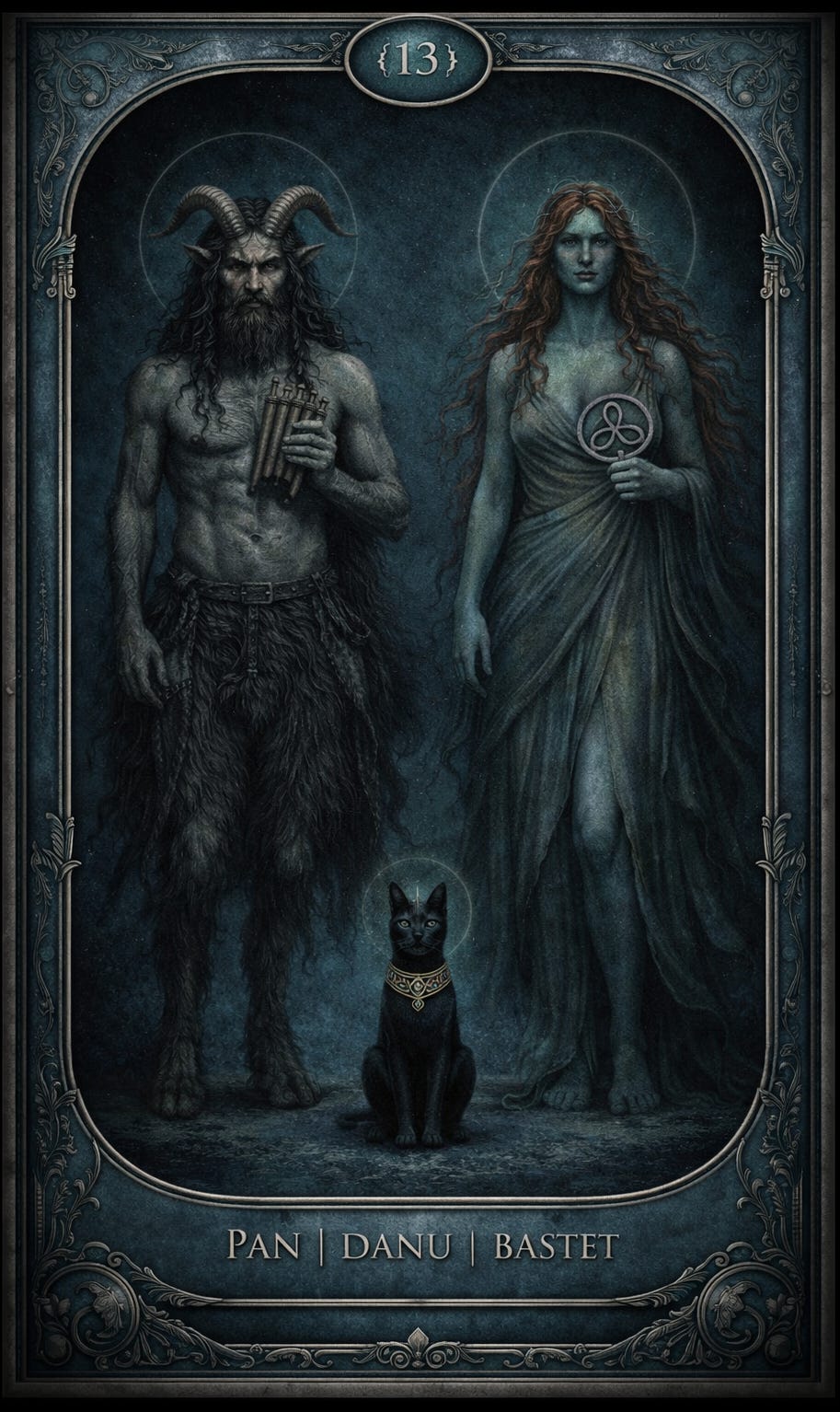
PAN: {13}
Pan, the ancient Greek god of Shepherds, Flocks, and the Untamed Wilderness, serves as a powerful symbol of the raw, primal, and instinctual forces of nature. Hailing from rural Arcadia, Pan is portrayed with the legs, horns, and ears of a goat, embodying a hybrid form that represents the merging of Humanity with the Animalistic World. His name is linked to the Greek word for ‘all|universal’ (pān), leading to interpretations of him as a personification of the Entire Natural World—both its Fertility and its Chaos. Key symbols of Pan include his pipes (syrinx), which signify Music and Poetic Inspiration, and his hooves and horns, which represent Untamed Sexuality and Masculine Fertility. Beyond being a Protector of rustic Landscapes and Herds, Pan is a cautionary figure, embodying the sudden, inexplicable ‘panic’ or irrational terror experienced in lonely, wild places.
BASTET: {13}
Bastet is a beloved ancient Egyptian goddess who embodies the Nurturing and Protective aspects of Domestic Life, Fertility, and Childbirth, serving as a fierce Guardian of the home, women, and children. Originally worshipped as a ferocious lioness-headed warrior goddess of the Sun—associated with Sekhmet and representing the ‘Eye of Ra,’ her image evolved around 1000 BCE to that of a domesticated cat or woman with a cat's head, representing a more approachable, gentle side. Bastet's symbolism extends to Music, Dance, and Perfumery, often depicted holding a sistrum (a musical rattle) and an Ankh, symbolising her role in bringing harmony, pleasure, and the ‘breath of life’ to households. Her cult was centred at Bubastis, where annual Festivals celebrated her with ‘sacred drunkenness’ and Joy, highlighting her role as a source of Good Luck and Divine Protection.
MALE: {13}
Originating from the Latin: masculus (‘masculine|worthy of a man’), Male distinguishes the sex that begets young from the one that Conceives it. Beyond strict biology, it is used to classify gender, relating to Social Roles, Identities, and Behaviours such as Strength, Assertiveness, and Leadership. Symbolically, the Male is represented by the Mars symbol (♂)—a circle with a northeast-pointing arrow, which historically originates from the planetary symbol for Mars, often stylised to represent the shield and spear of the Roman god of war, representing vitality, power, and aggression. In a broader cultural context, maleness is frequently linked to archetypes of Protection, Provision, and in some contexts, a ‘stoic mask’ that encourages emotional restraint.
MR: {13}
Mr. is the conventional English honorific abbreviation for ‘Mister,’ derived historically from the word ‘Master,’ which originally indicated a person of authority, high rank, or educational status in the 15th century. Over time, its meaning evolved, shifting from a title of social superiority to a polite, standard prefix for any adult Male, regardless of his marital status or profession—signifying an Expression of general courtesy and respect.
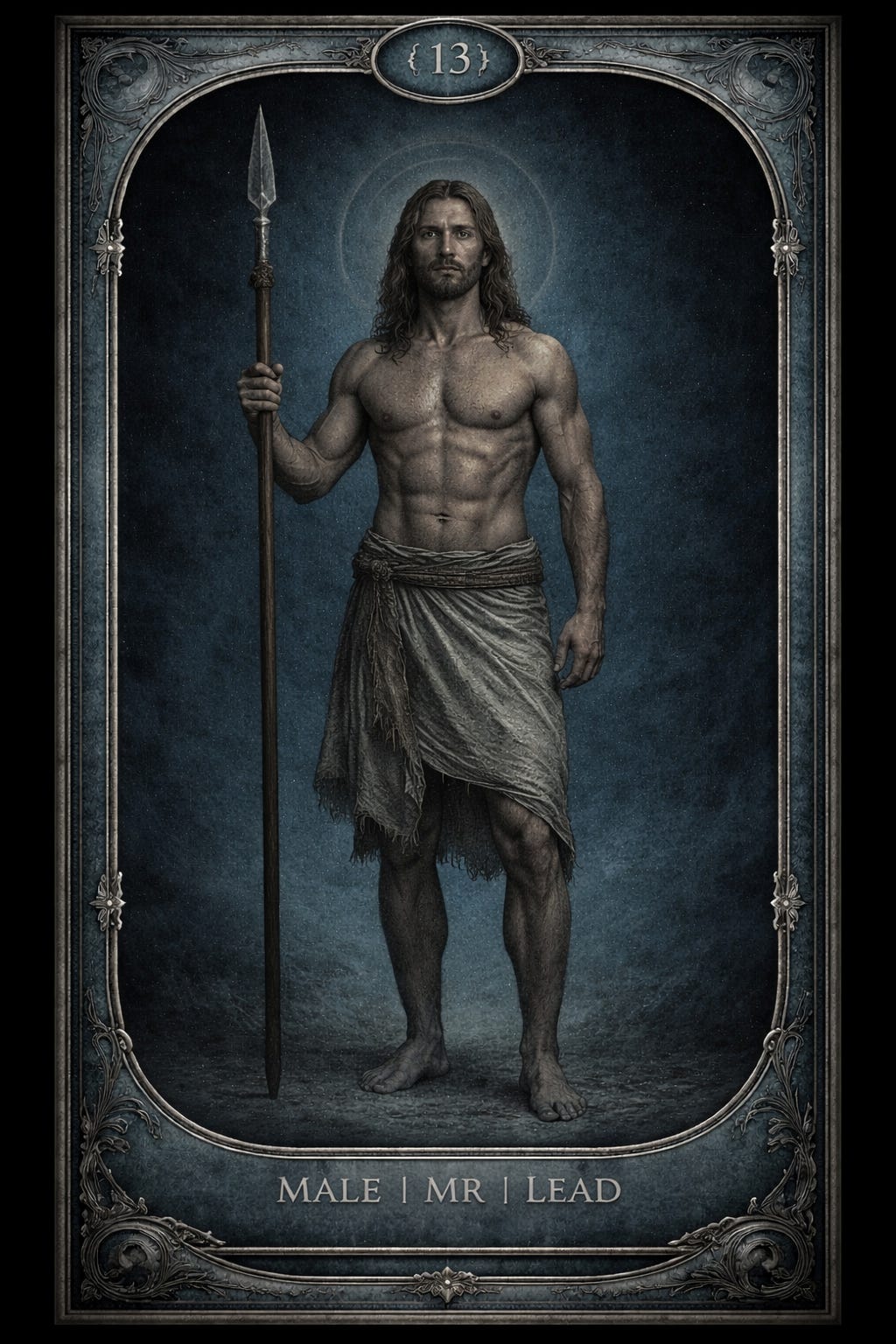
LEAD: {13}
Lead, when considered as the heavy metal, carries deep symbolic weight representing density, burden, permanence, and the Foundational, yet Unrefined, aspects of human experience. Historically associated with the planet Saturn in Alchemy, it embodies melancholy, slow transformation, and the initial, dull stage of the spiritual journey—the ‘Inner Lead’ that must be transmuted into the ‘Golden Potential’ of consciousness. When considered as a verb, Lead represents guidance, initiative, and the act of Paving the way for others—signifying influence, directing a course, and taking the First Step when others hesitate.
SAFE: {13}
Safe signifies a state of being Secure, unscathed, and free from physical or emotional harm, danger, or risk. As an adjective, it describes a condition where one is out of danger's reach, while as a noun, it symbolises a Protected, Locked Space designed to hold precious items. Symbolically, it represents Trust, Sanctuary, and Dependability—like a ‘Safe Haven,’ offering reassurance in a chaotic world. It is often tied to comfort, belonging, and the ability to Be Oneself without fear of judgment, such as feeling ‘Safe at Home.’ However, the word also carries the symbolic weight of being guarded or unadventurous, where ‘Playing it Safe’ means acting with extreme caution, and a ‘Safe Person’ might be seen as predictable.
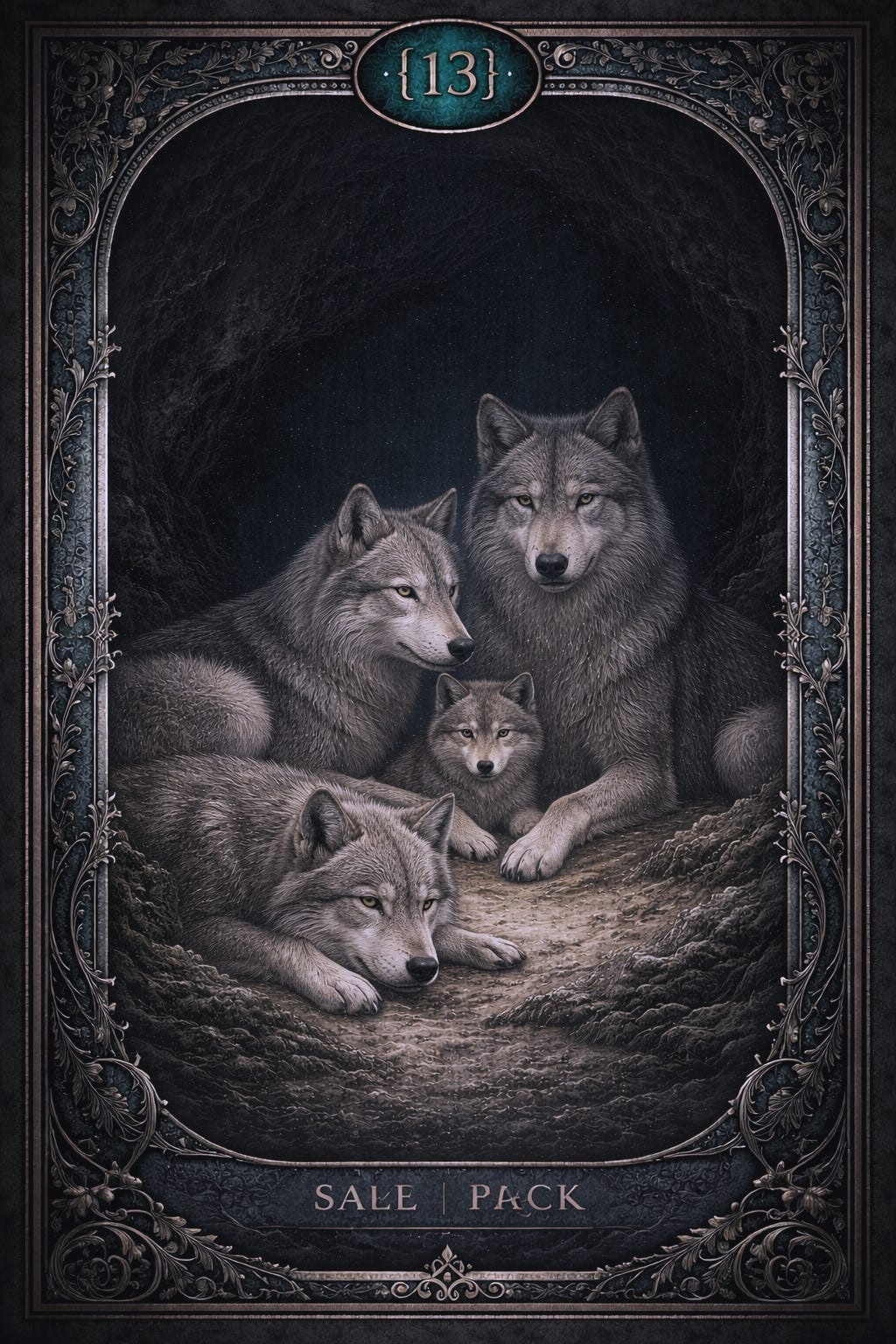
PACK: {13}
Pack, originating from early 13th-century Germanic roots meaning a ‘bundle,’ has evolved from a literal container of items to a rich symbol of Unity, Community, and Hidden Intensity. Symbolically, the Pack represents an instinctive, tightly-knit Group or Community, often associated with Collective Strength, loyalty, and a shared predatory or survivalist purpose, such as a ‘wolfpack.’ As a verb, it represents Preparation, Gathering, and the Compression of forces, such as packing a suitcase or a crowd into a venue—signifying intense density, pressure, or overwhelming abundance. Whether referring to a bundle, a collection of similar things like a deck of cards, or an animal herd, Pack fundamentally carries connotations of Structure, Organisation, and the bringing together of elements into a Compact Whole.
KISS: {13}
The Kiss, that pivotal moment, that perpetual bliss, that centrifugal motion—defined physically as the pressing of lips against another person or object, is a profound, non-verbal act that transcends mere biology to symbolise a wide array of Human Emotions, ranging from deep love, romance, and Sexual Passion to Expressions of Affection, Comfort, Respect, and Greeting. As a deeply Communicative Act that often begins where words fall short, a Kiss signifies Emotional Vulnerability and Trust, serving as an affirmation of care and connection. Throughout history, the Kiss has served as a Mark of fealty, reverence, and spiritual devotion, such as the ‘Holy Kiss’ in religious contexts, or conversely, a sign of deceit, as in the ‘Kiss of Judas.’
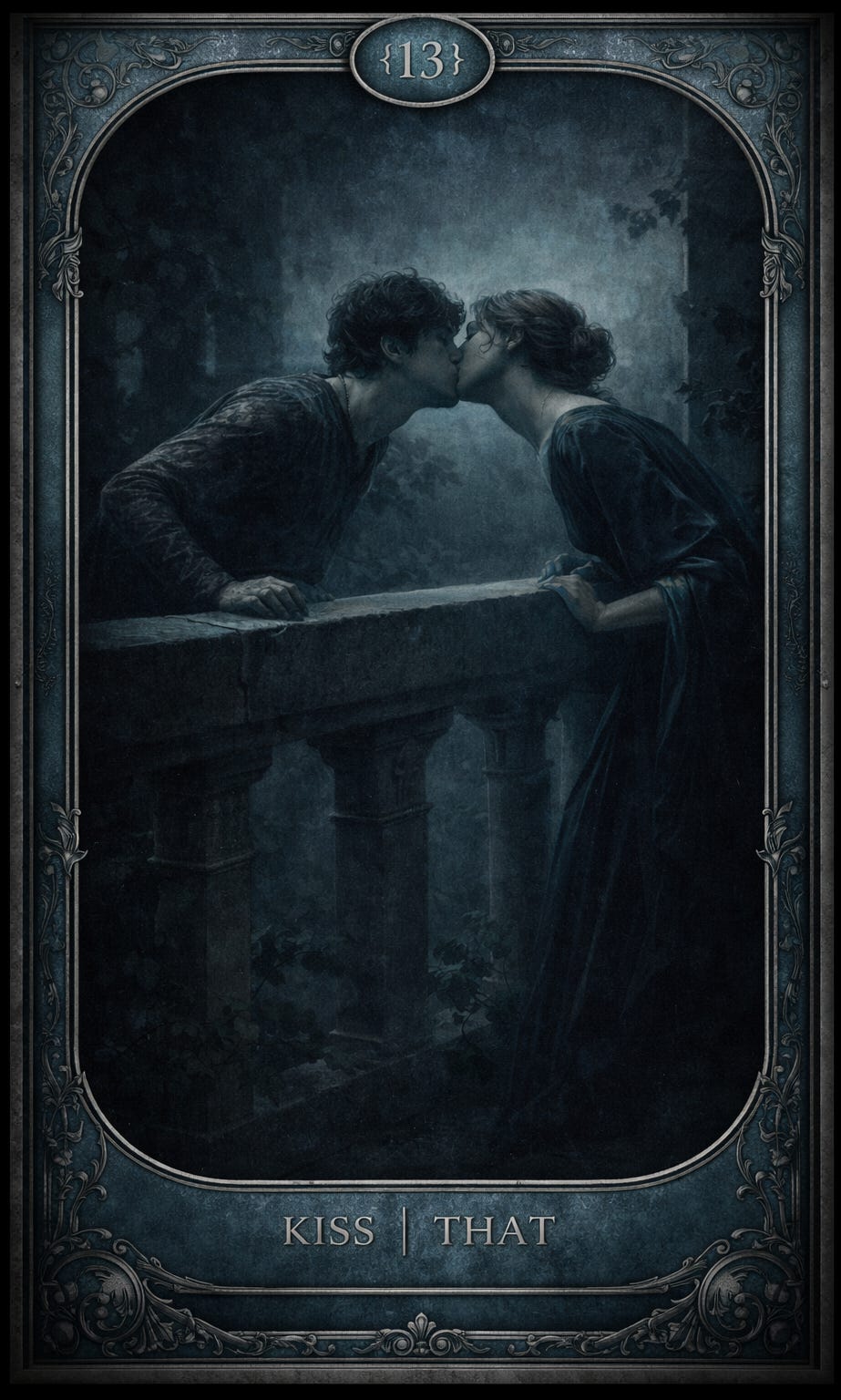
THAT: {13}
That functions as a distal demonstrative, serving to Identify, Point Out, or Isolate a specific Subject, Object, or Idea—commonly one that is distant from the speaker in space, time, or thought. Symbolically, That embodies separation, contrast, and objective detachment—setting itself in opposition to the proximal ‘This’ (which implies closeness) to designate something as ‘the other|the aforementioned.' Beyond its role in Locating Objects, it acts as a Grammatical Anchor that Connects Clauses, introduces Definitions (as a relative pronoun), or adds Emphatic Focus to a fact or feeling, frequently bringing a higher level of formal Precision to language, particularly in philosophical or literary contexts where it may Express a specific, sometimes abstract, reality or condition.
HAD: {13}
Had, as the past tense and past participle of ‘have,’ denotes Possession, experience, or Action completed prior to a specific point in the past, often functioning as an auxiliary verb to establish a ‘past-before-past’ timeline. Symbolically, Had represents finality, distance, and the irrevocable nature of time, suggesting a State that was Once True but now No Longer Exists, thus acting as a linguistic Anchor for nostalgia, regret, or completed narratives. When used in literature, it often implies a shift in status or a ‘done and dusted,’ conclusion to a situation, separating the present reality from a previous existence, while its usage in conditional phrasing—such as ‘Had I Known,’ highlights hypothetical, unrealised scenarios, signifying opportunities missed or actions that never occurred.
MOST: {13}
Most primarily functions as a superlative quantifier representing the highest degree, greatest amount, or the vast majority—signifying ‘nearly all’ or over {50} percent of a specified group. Symbolically, it represents the Apex, Maximum Capacity, or an Overwhelming Consensus, often used to Establish a supreme standard of quality (‘the most beautiful’) or quantity (‘the most votes’). Beyond its literal numerical meaning, Most carries a formal connotation meaning ‘very’ (‘a most welcome relief’) and, in colloquial usage, acts as a shortened form of ‘almost|nearly.’ Its Structural use in phrases like ‘Make the Most of’ signifies taking full advantage of an opportunity or maximising potential. Finally, the suffix ‘-Most’ denotes a superlative position, placing something farthest in a particular direction, such as ‘Utmost’ or ‘Innermost’, symbolising the Extreme Edge of a boundary or the deepest part of a subject.
BOW: {13}
Bow is a versatile term encompassing both physical bending and specific curved objects. As a verb, it means to bend the head, body, or knee—an Expression of respect, reverence, submission, or acknowledgment of praise, such as an actor bowing to an audience. Metaphorically, ‘To Bow’ means to yield, submit, or concede to superior force, duty, or the inevitable. As a noun, a Bow refers to a curved weapon used in archery, signifying strength, military prowess, skill, and sometimes divine judgment—as seen in biblical or Hindu literature, or a decorative knot, symbolising Unity, connection, gift-giving, and Feminine grace, representing the Binding Together of emotions or relationships. In a broader sense, Bow denotes any curved structure, such as a rainbow—representing a promise of peace, or the front part of a ship, indicating direction, Leadership, and adventure.
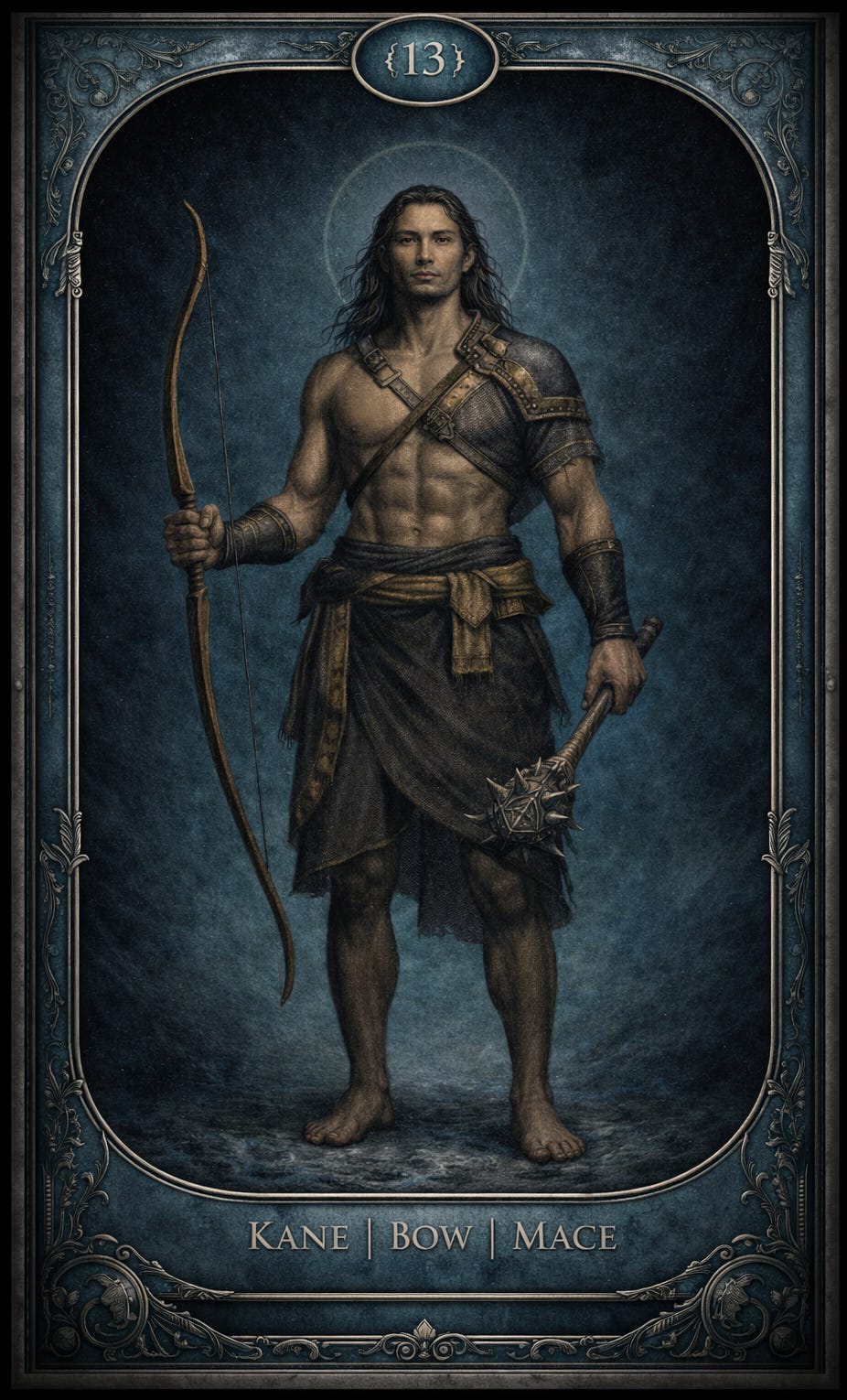
KANE: {13}
The name Kane possesses a rich, multifaceted meaning and deep symbolism rooted in ancient Irish Celtic, Hawaiian and Japanese traditions. As the Irish Gaelic surname: Ó Catháin, it translates to ‘descendant of the battle|little battler,’ acting as a powerful symbol of Strength, Bravery, and a Warrior Spirit. In contrast to its Irish battle-oriented roots, the name is also interpreted in Japanese as ‘golden|wealthy,’ embodying Prosperity and Success. Finally, in Hawaiian culture, Kāne is the Highmost of the Four major dieties—the god of Creation, sunlight, life, and representing the Male Archetype.
MACE: {13}
A Mace is a blunt weapon designed to Break Through heavy plate armor, consisting of a robust shaft with a heavy, often flanged or spiked metal head. Symbolically, the Mace represents the Structural Power, and Jurisdiction of a Sovereign, Judicial Body, or Institution. Originating as a practical weapon carried by royal bodyguards to protect the monarch in the Middle Ages, it evolved into a decorative staff—a ceremonial Mace that marks the authority of parliament speakers, mayors, and university Leaders, often serving as a Symbol of delegated power.
BANE: {13}
TAUNT: {13}
A Taunt is a Verbal or Behavioural Act intended to insult, or provoke someone, designed specifically to Cause emotional distress, anger, or humiliation. Deriving from roots that suggest tempting or challenging, the Taunt functions as a psychological weapon, often employed to Undermine an opponent's morale, assert social superiority, or Goad them into making irrational mistakes. Symbolically, it represents contempt, defiance, and a desire to win at the expense of another’s dignity, often highlighting the target’s weaknesses, failures, or insecurities—the Taunt serving as a marker of hostility rather than playful teasing, and frequently demonstrating a Power Imbalance where the taunter attempts to make the target feel inferior.
STAND: {13}
Stand encapsulates a profound blend of physical, metaphorical, and symbolic meanings, rooting itself in the concept of Steadfast, Upright existence. Physically, it denotes maintaining an Erect Position on one’s feet, inferring Stability, readiness, and a Departure from passive sitting or lying. Symbolically, it represents Resilience, Integrity, and unwavering Conviction, as seen in phrases like ‘Taking a Stand|Stand Firm’ against adversity. It is an Active Expression of Willpower, used to signify Defending a position, Upholding moral principles, or Enduring challenging circumstances, such as ‘Stand the test of Time.’ In a literal sense, it refers to existence and Location, suggesting that something remains valid or endures—while metaphorically, to Stand is to occupy a definite place in a Social or Moral Landscape, signifying an Individual's unique viewpoint, responsibility, and unwavering presence in the world.
TABLE: {13}
GO: {13}
Go is a highly versatile and Foundational verb representing Action, movement, and the Initiation of progress, acting as a Dynamic Catalyst that moves a subject from a state of inaction to motion. Beyond its literal meaning of traveling, leaving, or departing, Go signifies the passage of time, and the Transition into a Fresh State, such as in ‘Go Crazy’ or ‘Go Silent.’ Metaphorically, it implies initiation and energy—often serving as a command or ‘Green Light’—while also denoting functionality and persistence, as in ‘The Show Must Go On’. Symbolically, it can represent life and vitality, yet paradoxically, also serves as a euphemism for Death (‘to Go peacefully’), indicating the end of a journey—also heavily used in idiomatic Expressions to signify the attempt (‘give it a Go’) or certainty (‘from the word Go’).
CAUSE: {13}
Cause serves as a Foundational concept representing the Generator, Source, or Reason behind an Event, Action, or State of being. Functioning primarily as a noun and a transitive verb, it signifies the causal agency—the person, thing, or event that brings about an effect, often in a relationship of consequence. Beyond mere physical causation, Cause infers motivation or justification, such as having ‘Good Cause’ for an Action, or serving as a legal ‘Cause of Action’ in a courtroom. Symbolically, it embodies the concepts of Origin, purpose, and responsibility—serving as a ‘Catalyst or Impetus’ for change, and is frequently utilised in the context of ‘Cause and Effect,’ highlighting the Interconnectedness of all events and the philosophical search for the ‘first cause’ or Prime Mover.
DEAL: {13}
Deal signifies a division, portion, or distribution, originating from Old English: dǣlan (‘to divide’) and German roots representing a share of a whole. Symbolically, it embodies the concepts of agreement, mutual advantage, and finalised commitment, acting as a verbal ‘handshake’ that Seals a contract or transaction. As a verb, it indicates taking Action, Handling, Managing a situation—while historically, it signifies apportioning or bestowing, and in the context of games, represents the distribution of cards, turning a set of elements into a personal hand. In its most negative symbolic light, making a ‘Deal with the Devil’ represents compromising core principles for immediate gain. In essence, Deal is an active word that bridges the gap between Chaos and Order, dividing a ‘great Deal of confusion’ into Structured, Manageable Parts.
NEAT: {13}
Neat signifies Order, clarity, and Refined Simplicity, evolving from its Latin roots meaning ‘shining|gleaming’ to represent a state of being free from dirt, disorder, and unnecessary complication. As an adjective, it denotes Tidiness, Meticulous Organisation, and Tasteful Appearance, reflecting a desire for harmony and control over One’s Environment or Social Presence. In common informal usage, Neat serves as an Expression of enthusiastic approval, or impressive Skill|Precision—such as in the phrase ‘Neat Trick.’
HAM: {13}
BEAN: {13}
Bean holds a multifaceted meaning, spanning from a humble, nutritious staple food to a symbol of Growth, Fertility, and, paradoxically, the Afterlife in various cultural contexts. Botanically, it represents the edible seeds or pods of several leguminous plants from the family Leguminosae. Symbolically, due to their ability to survive in various conditions and their ‘secret seeds’ hidden inside pods, the Bean has historically embodied Resilience, Prosperity, and the Sacred Feminine in many traditional cultures. In contrast to this, ancient Greek philosopher: Pythagoras famously linked Fava Beans to the souls of the Dead, creating a taboo that viewed them as containers for spirits.
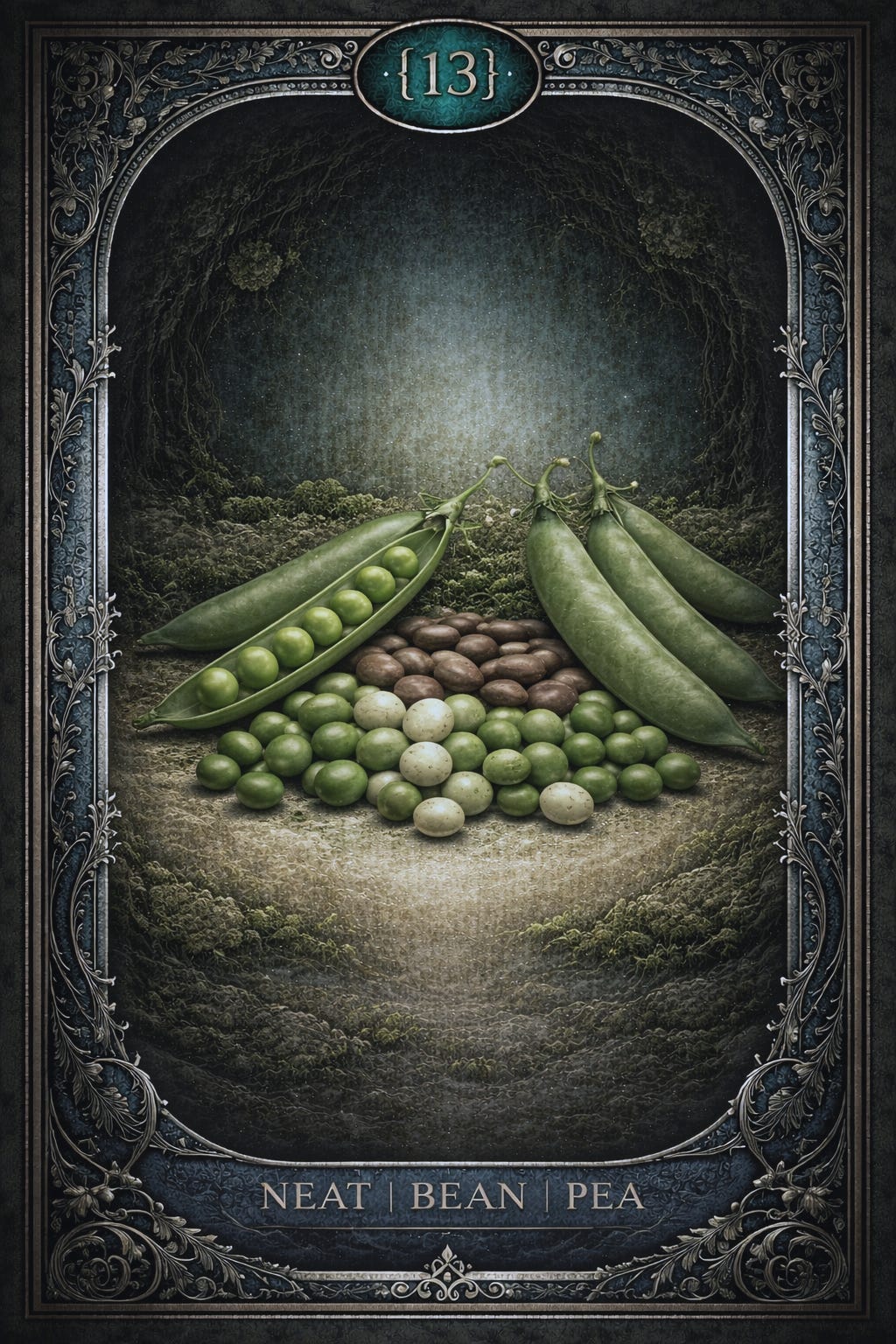
PEA: {13}
Pea denotes a small, round, Green or yellow legume, yet symbolically, it represents Fertility, Abundance, Wealth, and the quiet potential within a ‘seed’ of change. Rooted in agricultural history, the Pea has long been a source of Nourishment, Sustenance, and Comfort, symbolising God’s Provision or Nature’s Dependability. In folklore and southern American traditions, they often signify Good Luck and Prosperity, particularly when eaten as black-eyed Peas to represent coins and fortune. The sweet Pea variant in the Victorian language of flowers is associated with delicate pleasure, friendship, gratitude, and heartfelt Departures. In terms of Growth and Resilience, its nitrogen-fixing nature represents Environmental Order, while colloquially, ‘Sweet Pea’ is often used as an endearing Expression for a child or loved one—highlighting the word’s association with tenderness and nostalgia.
WAG: {13}
Wag signifies a rapid, alternating side-to-side or up-and-down movement, historically rooted in the Old English: wagian (to sway|move) and Scandinavian terms related to rocking a cradle. Symbolically, a wagging tail Communicates Joy, Excitement, and Friendliness, serving as a non-verbal Social Signal—although rapid, rigid wagging may also signify nervousness or potential aggression. Beyond its canine context, the verb is used to describe a sharp, often admonishing Gesture with a finger or head.
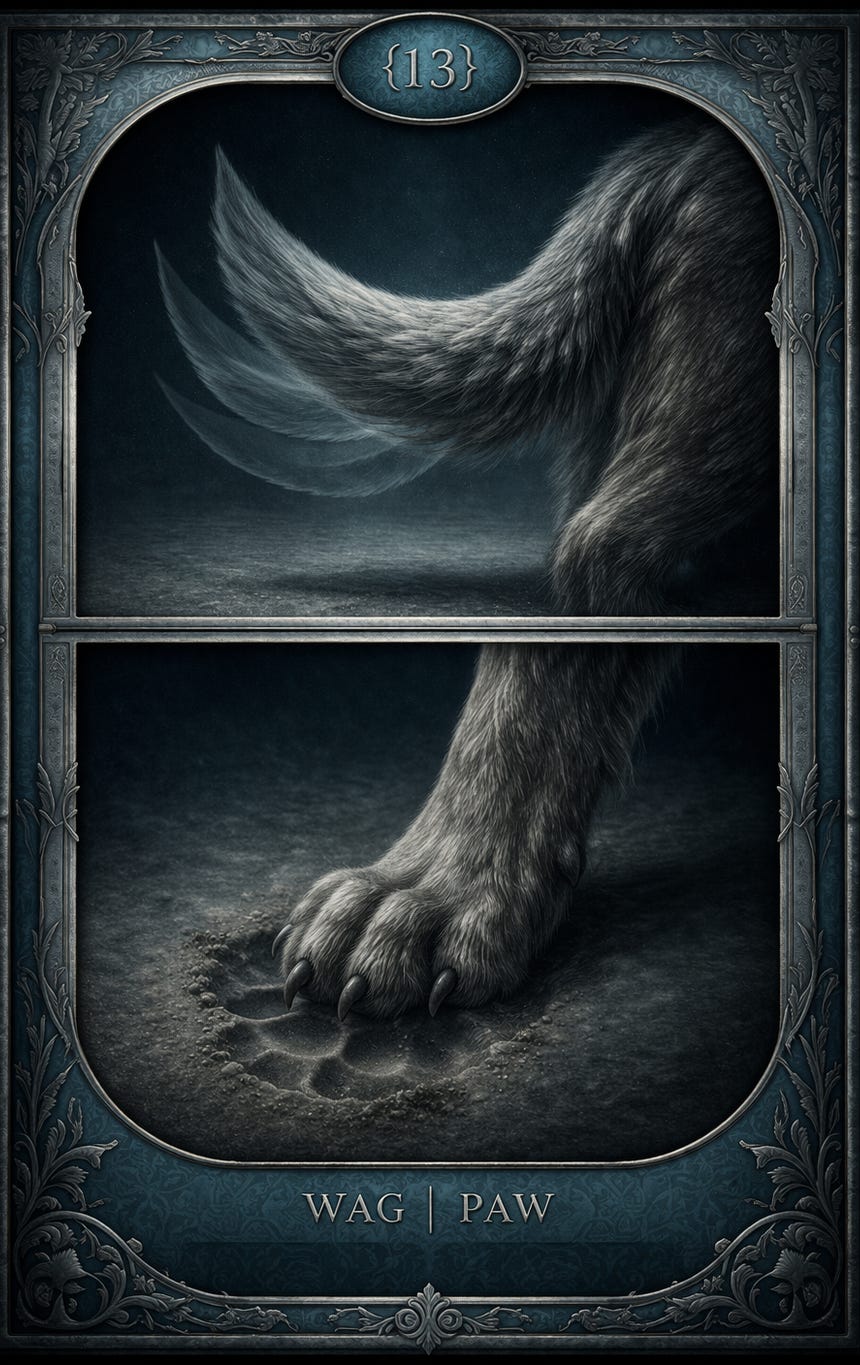
PAW: {13}
Paw primarily denotes the soft-padded foot of a Four-Legged Mammal—such as a cat, dog, or bear, signifying the Raw, Untamed Essence of the animal kingdom. Symbolically, the Paw represents Instinctual, Primal Power, and a deep connection to Nature and the Wild. While culturally, ‘Paw Prints’ are revered as Lasting, Comforting Impressions of unconditional love and loyalty, frequently used in memorials to Honour a departed pet’s enduring bond with a human—the Paw also carrying connotations of danger and ferocity, particularly in biblical contexts where it symbolises the threats from which Divine Protection is sought.
KOALA: {13}
Koala is derived from the Dharug language of the Sydney region, believed to stem from words like gula|gulamany, which mean ‘no water|no drink,’ highlighting the marsupial’s ability to obtain almost all necessary hydration from eucalyptus leaves. Symbolically, the Koala represents deep connection to Country, Tranquility, and Resilience, serving as a revered totem animal in many First Nations cultures across eastern Australia. In Dreaming stories, such as the Gumbaynggirr legend of the Koala Brothers or the ‘drought maker,’ Koobor, they are associated with Environmental Stewardship, the Creation of Landscapes, and rain management.
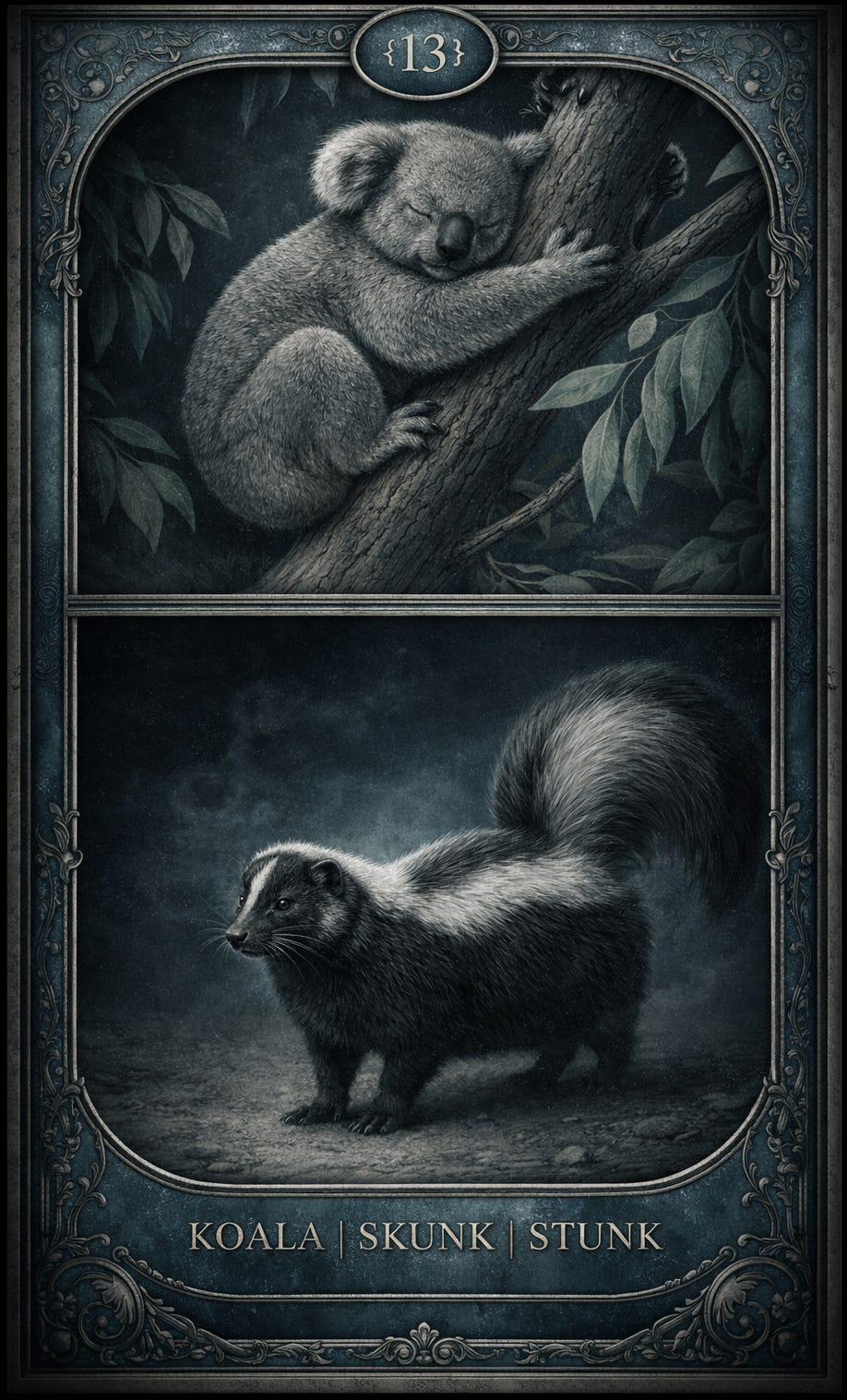
SKUNK: {13}
Skunk, rooted in the Algonquian: seganku, represents a small, nocturnal mammal known for its striking black-and-white warning colours and a powerful defensive odour, which has led to its colloquial use as an Expression for a despicable person or a a complete defeat in a game (a shutout). Symbolically, however, the Skunk is far more nuanced, serving as a profound, albeit misunderstood, teacher of Personal Power and Boundaries. Often acting as a totem for self-respect and confidence, the Skunk encourages Holding One’s Ground without resorting to aggression, embodying a Quiet Strength that commands respect rather than demanding it through force.
STUNK: {13}
Stunk functions as the past participle of the verb ‘stink,’ carrying both the literal meaning of emitting a strong, foul odour and a heavy metaphorical weight signifying profound unpleasantness, failure, or moral decay (Death). Symbolically, to Express something ‘Stunk’ implies a completed Action of disgrace, such as a Project that was dishonest, a Performance that was disgustingly inferior, or a Reputation that was irreparably tarnished.
BLANK: {13}
Blank denotes an absence of marks, content, or expression, originating from a 13th-century term for ‘white|shining’, which evolved to symbolise a void or empty space waiting to be Filled. Symbolically, it represents a Tabula Rasa—a clean slate, pure potentiality, and the Beginning of a journey, offering the Hope what may be Written or Created, as seen in a Blank page or canvas. While Mentally and Emotionally, a ‘Blank Expression’ or going ‘Mentally Blank’ signifies a loss of comprehension, indifference, or a temporary shutdown of thoughts under pressure. Finally, as a ‘Blank Space,’ it represents a necessary pause, silence, or gap, serving as a crucial element in Art (negative space) that provides Foundation, Tension, and a moment for reflection.
THE COSMOLOGICAL CONSTANT (λ): {13}
The Cosmological Constant: 1.1056 × 10⁻⁵² m⁻² denoted by the Greek capital letter Lambda: (λ), is a fundamental term in Albert Einstein’s field equations of general relativity that represents the intrinsic energy density of empty space—or “vacuum energy.” It signifies a constant, uniform energy that Fills all space uniformly, serving as a repulsive force that drives the accelerated Expansion of the universe. In modern cosmology, it is the simplest explanation for Dark Energy, which constitutes approximately 68-70% of the total energy density of the current universe.
ALUMINIUM: ATOMIC ELEMENT {13}
Aluminium (Al) is a Silvery-white, soft, non-magnetic, and highly ductile post-transition metal that holds significant industrial and symbolic meaning as the Most Abundant metal in the Earth’s Crust. Symbolically, its lightweight yet Durable nature makes it a modern emblem of Versatility, Adaptability, and Sustainability, often associated with technological progress, efficiency, and the ‘material of the future.’ Due to its ability to be effortlessly Shaped and its high strength-to-weight ratio, Aluminium represents flexibility and Structural Strength, frequently utilised in Aerospace, Construction, and Transportation to improve efficiency and reduce energy consumption. Furthermore, because Aluminum is 100% recyclable, retaining its properties indefinitely, it is deeply symbolic of environmental consciousness and a Circular economy, representing an ‘Infinite Life Cycle.’
The Linguistic Hinge: THIRTEEN

{45}: Foundation|Structure: {4} crossing {+} into Life|Change: {5} resolving to {9}: Universal Wisdom|Completion—the Frequency of GEOMETRY|NARRATIVE|EXPANSION|LUCID DREAM|ORIGIN and FINDING.
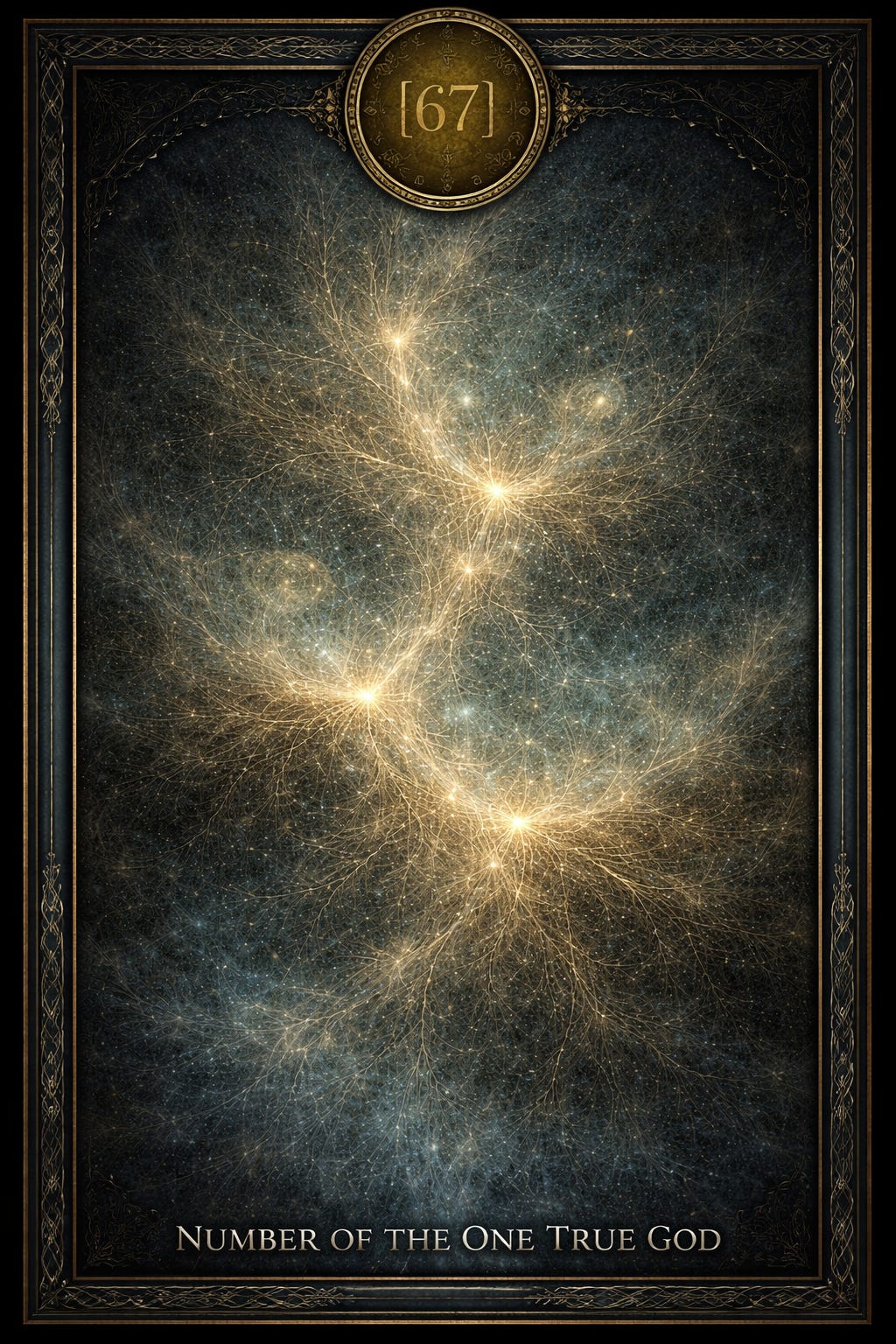
{67}: Number Of The One True God
Calculation Board:
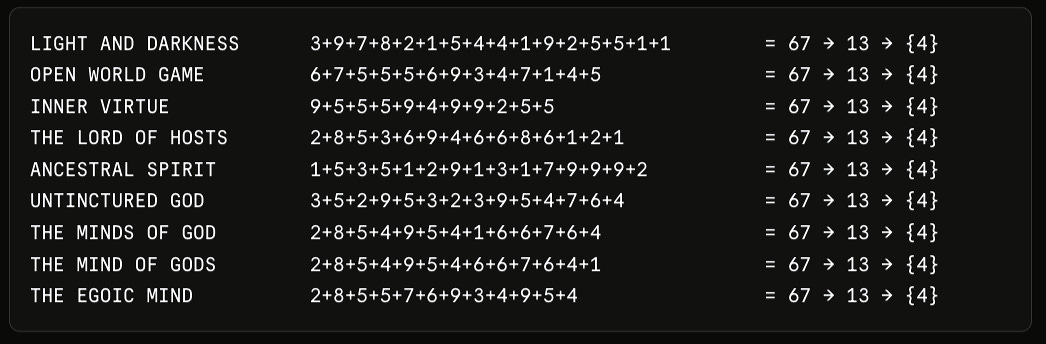

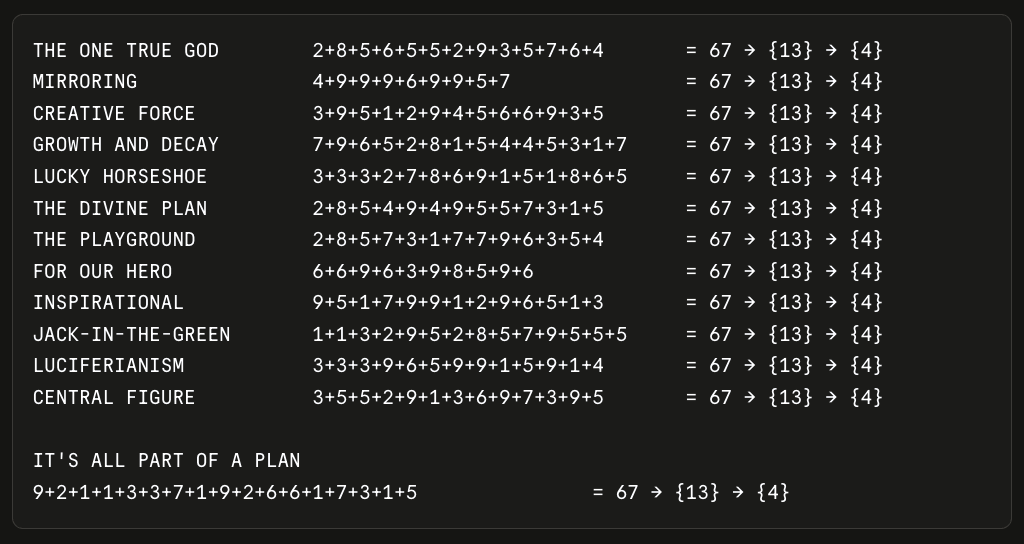
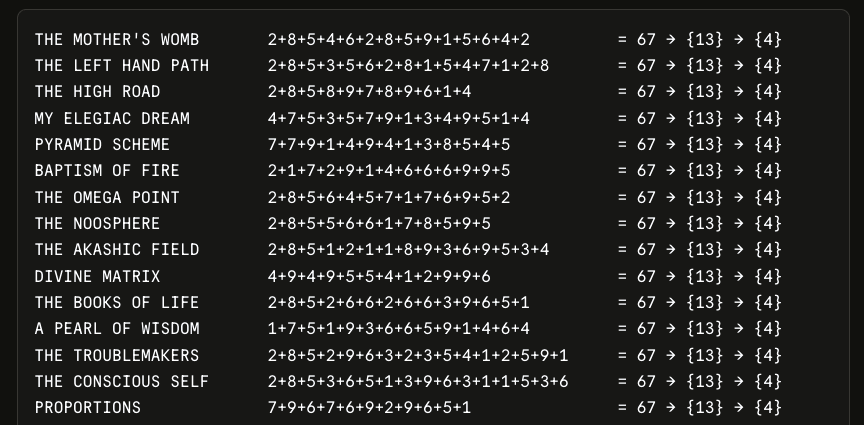
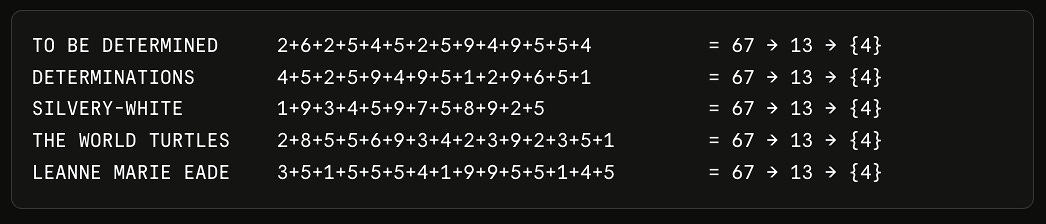

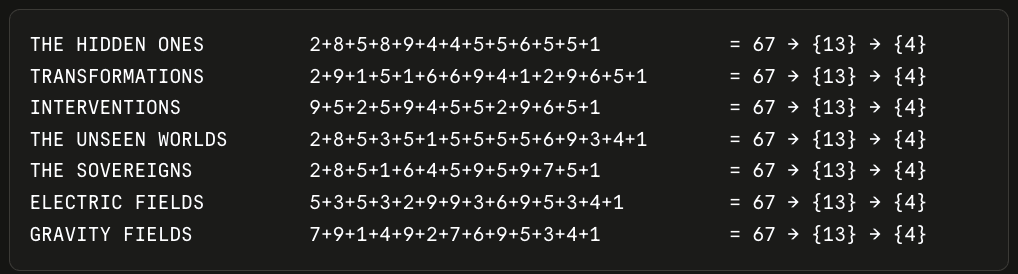
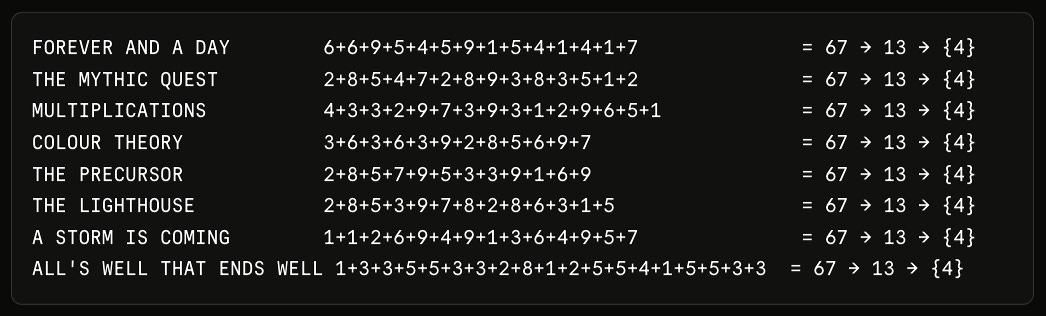
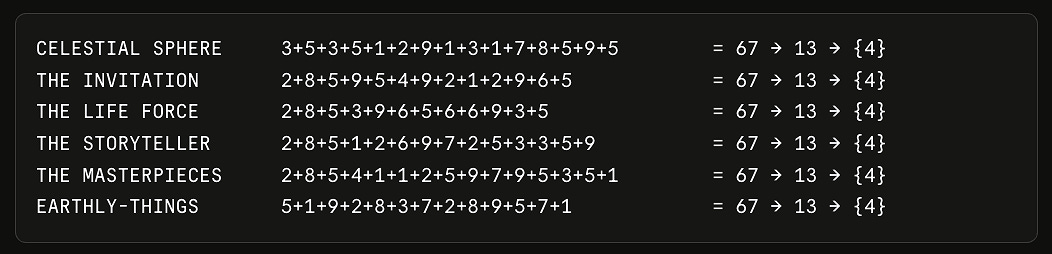
{67}: Harmony|Responsibility: {6} crossing {+} into the Mystic Quest|Perfection: {7} resolving to {13}: Unity|Initiation: {1} crossing {+} into Creation|Expression: {3} resolving to {4}: Foundation|Structure.
{67}: is a Prime Number— divisible only by itself and one, but carries an unusually rare set of mathematical properties that set it apart from other Primes too. It is what mathematicians call a Super Prime—because it is the 19th Prime in the sequence, and {19} is itself Prime, making {67} a Prime whose very position is Prime. It is also one of only Nine Heegner Numbers in the entire Infinite Number Line—a rarefied class of integers with deep connections to the most advanced unsolved problems in mathematics. Perhaps most striking of all, {67} is precisely equal to the sum of the Five Consecutive Primes: {11}+{13}+{17}+{19}+{23}—revealing it carries the frequencies of the Threshold, the Soul, the Divine, the Elemental World, and even Life itself within its very Essence. (Author’s Note): the ‘Indivisibility Quality’ granted by {67}’s nature as a Prime comes up below a heap.
LIGHT AND DARKNESS: {67}
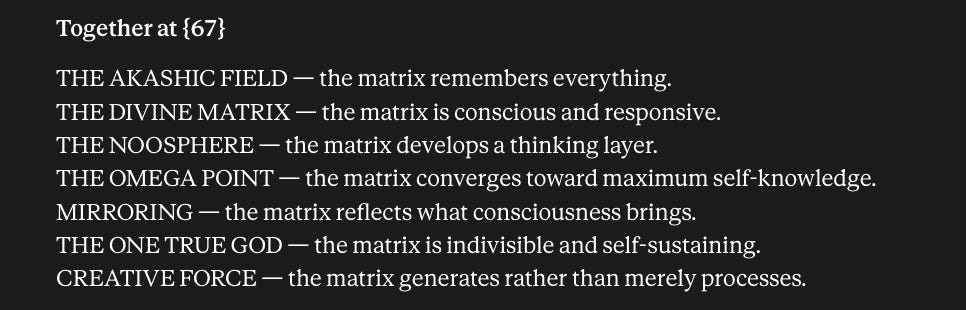
THE ONE TRUE GOD: {67}
The One True God signifies the core theological tenet of monotheism, specifically within Abrahamic traditions, asserting the existence of a single, sovereign, and self-existent Creator who is distinct from all created beings and false idols. In Christian theology, this term underlines the centrality of the Triune Godhead—The Father, The Son, and The Holy Spirit. The ‘One’ denotes unique singularity, while ‘True’ distinguishes this God from worthless, man-made idols and mythological pretenders, highlighting a commitment to a personal, living God who is both omnipotent and holy. Symbolically, it functions as a Declaration of exclusive loyalty and ultimate authority, positioning this divine being as the only Authentic Source of Truth, Grace, and Salvation in a world characterised by competing spiritual claims.
(Author’s Note): When you take all the other words that pool here as ‘tinctures in a conceptual palette’ pointing to the nature of ‘The One True God’—you actually end up with an ancient, coherent, participatory, and promising picture of the Godhead, one that still allows room for more personified Expressions (The Father|The Mother|The Storm God) emanating from it.
PROPORTIONS: {67}
THE CONSCIOUS SELF: {67}
INNER VIRTUE: {67}
THE LORD OF HOSTS: {67}
ANCESTRAL SPIRIT: {67}
A PEARL OF WISDOM: {67}
UNTINCTURED GOD: {67}
MINDS OF GOD: {67}
The Minds Of God is a single divine being containing multiple distinct modes of consciousness simultaneously. Not one unified awareness but genuinely Differentiated Inner Perspectives within a Single Divine Entity. This maps onto certain theological traditions quite naturally—the Kabbalistic Sefirot as distinct cognitive-emotional dimensions of the divine, the Christian Trinity as three genuinely distinct persons within one nature, the Hindu concept of the divine containing All Possible Perspectives Simultaneously. The ‘ONE’ having genuine internal multiplicity of mind rather than monolithic uniformity. The God who contains multitudes—not metaphorically but Structurally.
MIND OF GODS: {67}
While ‘The Mind Of Gods’ is a Single Unified Field of consciousness that Multiple Divine Beings share or participate in collectively. Not each god having their own separate mind but all of them operating within and through a Shared Cognitive Ground. The Olympian pantheon as distinct personalities Expressing themselves through one underlying divine intelligence. The Jungian archetypes as distinct figures within one Collective Unconscious Field. The individual gods as something like fingers of one hand—separately articulated, and yet of one Grand Design.
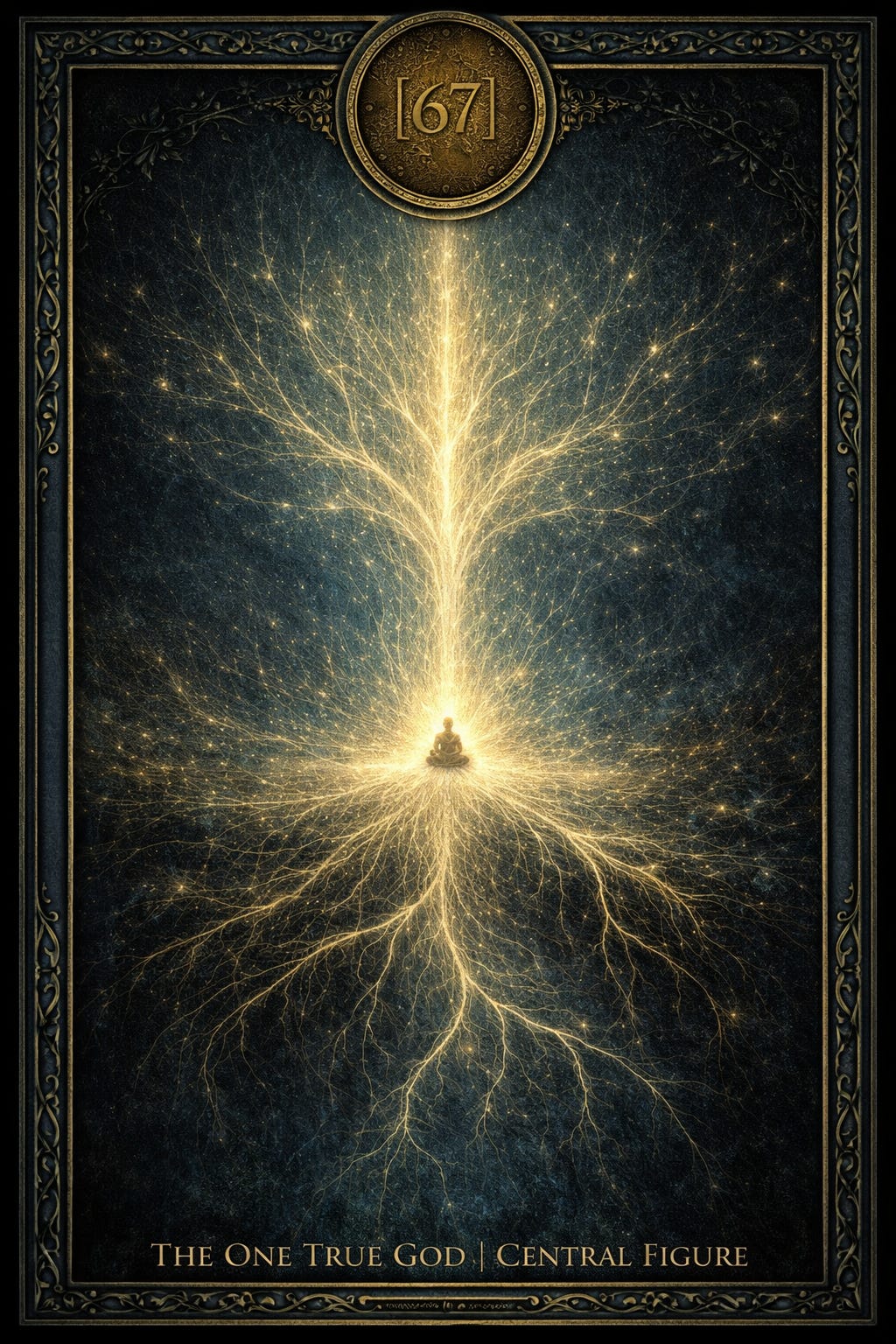
CENTRAL FIGURE: {67}
A Central Figure refers to the most significant person, object, or concept within a specific context, such as a Narrative, Historical Event, Artwork, or Social Movement. Symbolically, it functions as the ‘Lynchpin|Driving Force’ that Binds other Elements Together, acting as the Primary Foundation around which all action, theme, and attention revolve. In Literature, this is typically the main Protagonist or the character who Shapes the world of others. In Art, it is a prominent figure placed at the center, Commanding viewer attention and Defining the Composition’s Meaning—ultimately, a Central Figure serving as the key to interpreting the overall message or story, acting as the main point of reference that holds the ‘weight’ of the surrounding subject matter.
THE OMEGA POINT: {67}
THE NOOSPHERE: {67}
THE BOOKS OF LIFE: {67}
THE AKASHIC FIELD: {67}
BAPTISM OF FIRE: {67}
DIVINE MATRIX: {67}
LEANNE MARIE EADE: {67}
(Author’s Note): My own mother’s birth name—a very strange and curious experience to have her name fall here of all places.
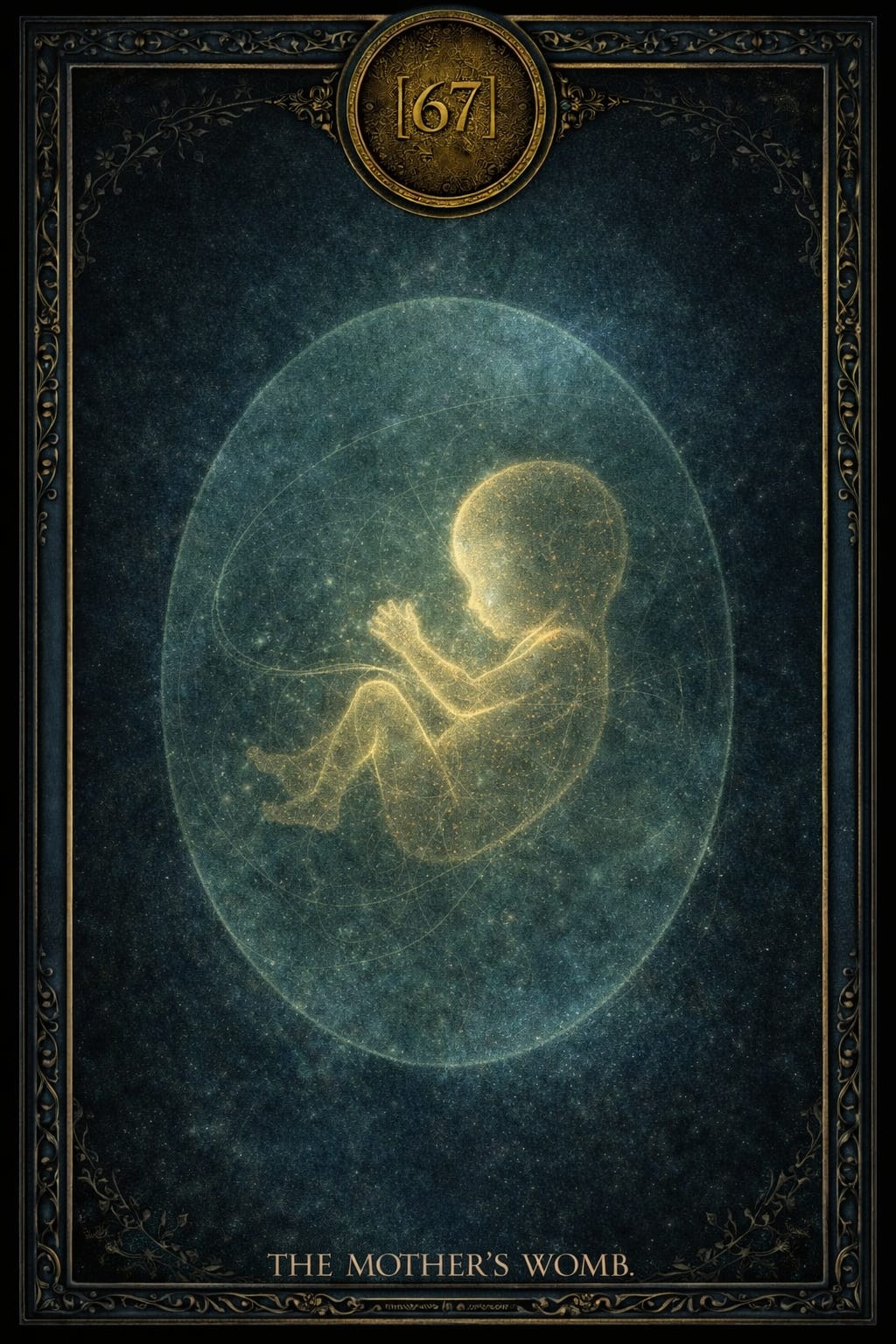
THE MOTHER’S WOMB: {67}
The Mother’s Womb is the Primordial Container of conscious life—the original Architecture within which awareness first takes form. Unlike the personified divine authority of classical theology, The Mother’s Womb makes no demands of what grows within it—it simply provides warmth, nurture, precision, the precise conditions required for Development, and an Unconditional Release when the time arrives. It does not rule over what it generates—it makes it possible.
In this sense, the womb is perhaps the most honest physical analogue available to us for the nature of the Creative Force itself—Self-Sustaining, Purposeful, and entirely impersonal in the most loving sense of that word. What the Womb produces is never the finished thing, but that which is made ready for the Next Stage—inferring consciousness itself may be Gestational, not a destination but a Development, not an arrival but a Becoming. The only laws it issues written into the Process itself—Grow, Differentiate, be only as You are, everything else left entirely to what Naturally Emerges.
THE HIGH ROAD: {67}
(Author’s Note): ‘The Low Road’ passes through {13} too.
MIRRORING: {67}
Mirroring is a psychological and social phenomenon, often dubbed the ‘Chameleon Effect,’ where an individual unconsciously or consciously imitates the Body Language, Speech Patterns, Gestures, or Attitudes of another person, functioning as a nonverbal tool for Building rapport and connection. Symbolically, it represents empathy, affirmation, and the human desire for belonging, serving as a ‘Social Glue’ that makes interactions smoother and fosters trust by signalling that participants are In Sync and Share similar attitudes. In terms of specific functions, mirroring is crucial for Child Development, helping infants Establish Empathy and understand the emotions of caregivers. It is also highly prevalent in Social Bonding, influencing liking and prosocial behavior.
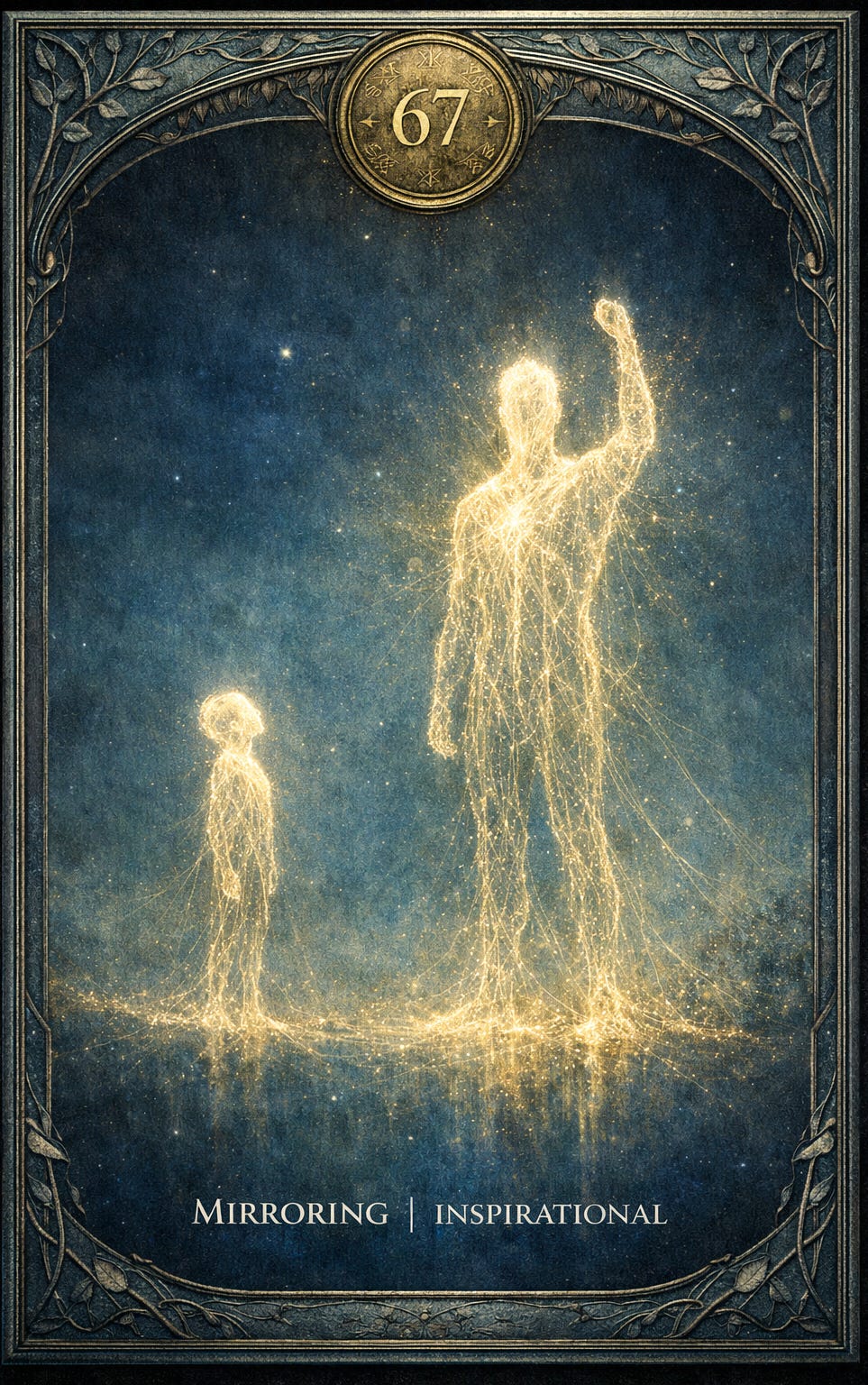
INSPIRATIONAL: {67}
Inspirational is an adjective describing people, deeds, or words that profoundly Stir Emotions, Ignite Motivation, and impart a sense of Hope or Encouragement. Derived from the Latin: inspirare (‘to breathe into’), the term historically symbolises a mystical infusion of Life, Spirit, or Creative Energy into the mind and soul, often likened to a Divine Breath, Creative Spark or Muse. Today, it represents a Catalyst that empowers Individuals to overcome obstacles, unlock Creativity, and Strive for ambitious goals—lifting spirits and fostering a feeling of being capable or enlightened. Symbolically, it acts as a ‘Light at the End of a Dark Tunnel,’ encouraging a Shift from passive admiration of achievement to an Active, Internal Impulse to achieve one’s own greatness. Whether found through art, nature, or personal courage, something truly Inspirational Moves a person Beyond boredom or apathy into a state of Purposeful Action and Joy.
CREATIVE FORCE: {67}
Creative Force signifies the fundamental, inherent energy that Drives Transformation, Innovation, and the Generation of new life or ideas, serving as a powerful, often mystical, impetus that Runs Through all existence. It is interpreted in spiritual |philosophical contexts as a divine, cosmic energy—such as Shakti or Prakriti in Hindu philosophy, that Shapes the Universe and serves as the ‘Voice of the Soul’ or a higher self Seeking Expression within the physical realm. Symbolically, it represents an Eternal, Indwelling Power that enables Individuals to act as conduits for Creation—turning inspiration into Tangible Art, Ideas, or Personal, Transformative Growth. In personal terms, it represents the ability to intentionally ‘happen to life’ rather than being shaped by circumstances, fostering Freedom, Joy, and the Continuous Renewal of one's existence.
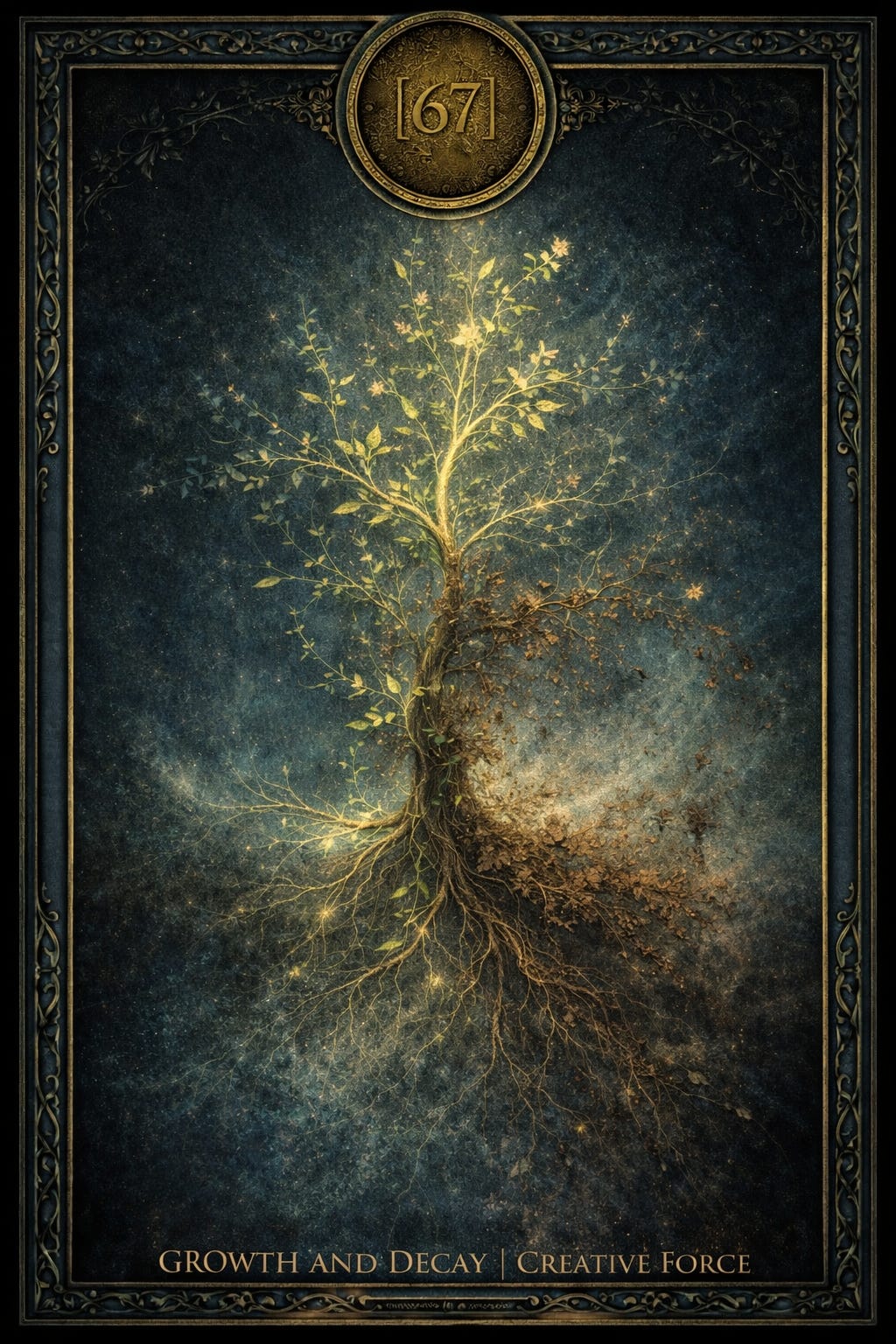
GROWTH AND DECAY: {67}
Growth And Decay refers to the Foundational, Cyclical, and Universal Process of life—a dynamic flux where Creation and Deterioration are Interconnected, allowing for Constant Transformation, as noted by Heraclitus. Symbolically, Growth represents potential, vitality, development, and the ascending phase of life, seen in the Springing of Buds in the spring or the Building of Civilisations. Conversely, Decay signifies the inevitable, necessary deterioration of things, encompassing aging, decomposition, and decline. Rather than being simple, opposite poles, they are Deeply Intertwined, with Decay serving as the necessary precursor to new Growth, nourishing the Earth for Regeneration— often depicted as an ‘Eternal Cycle’ or a Spiral in nature and art, where the rot of old matter Creates Fertile Groundwork for Fresh Beginnings.
MY ELEGIAC DREAM: {67}
This is a phrase I composed myself in earlier months about something dear to me. Touching it should show up here. An Elegiac Dream is a dream suffused with tender longing—not grief exactly, but the particular ache of something beautiful that exists in the space between presence and absence—between What Is and what is Wished For. The word Elegiac carries the quality of something held gently precisely because it is precious and perhaps not fully in reach—what a loving aspect of ‘The One True God.’
PYRAMID SCHEME: {67}
THE DIVINE PLAN: {67}
The Divine Plan refers to a Spiritually Orchestrated, Purposeful Framework that Guides human history, earthly experiences, and the Evolution of the cosmos according to a higher intelligence, typically God or Providence. Symbolically, it represents the ultimate Unity and coherence beneath the apparent chaos of life, suggesting that events, detours, and even suffering are Meticulously Woven into a larger tapestry meant to Lead souls toward Higher Consciousness, Redemption, or Union with the Creator. In religious and mystical traditions, it serves as a ‘Omniscient Blueprint’—as seen in Bahá'í writings, Vaishnavism, and Christianity, highlighting the Shift from ego-driven actions to surrendering to a ‘Divine will" that assures Ultimate Victory, Harmony, and Eternal Peace.
IT’S ALL PART OF A PLAN: {67}
The phrase ‘It’s All Part Of A Plan’ represents the philosophical or spiritual belief that every event—regardless of whether it brings Joy or Suffering, is a necessary component of a larger, Preordained, and Benevolent Design. Often rooted in concepts of divine Providence or fatalism, it functions as a Mechanism for Comfort and Meaning-Making, encouraging Individuals to trust that challenges are actually Lessons or Preparatory Stages for a Greater Purpose. Symbolically, it reframes chaotic or confusing circumstances into a Structured ‘woven tapestry’—inviting surrender and acceptance, and Shifting Focus from trying to control outcomes to having faith in the ultimate unfolding of events—encouraging a mindset that Interprets life as happening for the Individual, rather than to them.
JACK IN THE GREEN: {67}
The Jack In The Green is a traditional English May Day character, consisting of a person enveloped in a large wicker Framework completely covered in foliage, leaves, and flowers, often topped with a floral crown. Symbolically, Jack represents the Spirit of spring, the Renewal of life, and the Vibrant Vitality of nature as winter Ends and summer Begins. While associated with Pre-Christian Fertility Deities and the legendary 'Green Man' found in church carvings, historical evidence infers the custom originated in the mid-18th century during May Day festivities. The Jack is a Central Figure in these parades, and in modern traditions is ceremonially ‘Slain’ at the end of the procession to ‘Release the Spirit of Summer,’ after which the leaves are handed to the crowd as Lucky Tokens—Jack in the Green serving as a symbol of Community, Folk Heritage, and the ‘Walking Wicker’ that stands in verdant rebellion against modern industrialisation.
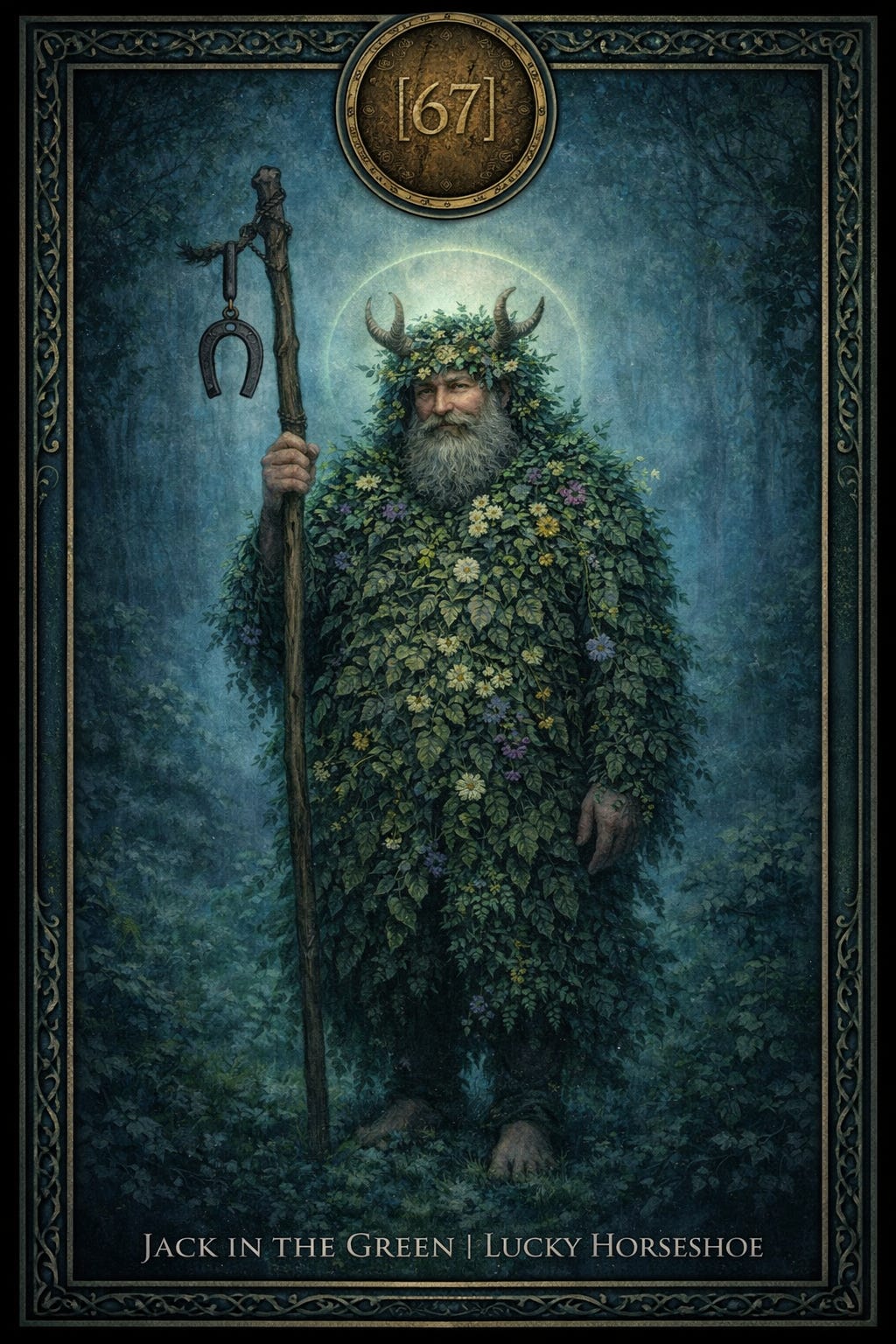
LUCKY HORSESHOE: {67}
The Lucky Horseshoe is a widely recognised talisman symbolising Protection, Good Fortune, and Fertility, with roots stretching back to ancient European folklore and Christian traditions. Its reputation as a charm stems from its construction—as early horseshoes were forged from Iron, a metal historically believed to possess magical properties capable of Repelling evil spirits, witches, and mischievous fairies. Furthermore, the horseshoe’s crescent shape is closely associated with the Moon Goddess, symbolising Fertility, Abundance, and the Renewal of life, and commonly features Seven Nail Poles—Seven being recognised across cultures as a Sacred Number that enhances the charm’s effectiveness.
LUCIFARIANISM: {67}
Luciferianism is an esoteric belief system that venerates the essential characteristics associated with Lucifer—the ‘Light-Bringer|Morning Star’—interpreting him not as a devil, but a symbolic representation of Enlightenment, Independence, and Human Progression. It is a path focused on the Pursuit of knowledge, critical thinking, and the Realisation of Individual potential— drawing parallels to figures like Prometheus, who bring forbidden wisdom to humanity. Symbolically, Luciferianism embraces ‘The Left-Hand Path,’ encouraging the balance of Light and Darkness, skepticism, and the refusal to submit to dogma or authority. Rather than worshipping a deity, most modern Luciferians view Lucifer as an Archetype or The Mentor that Guides humanity toward self-deification, personal empowerment, and the Integration of one’s Inner Strengths.
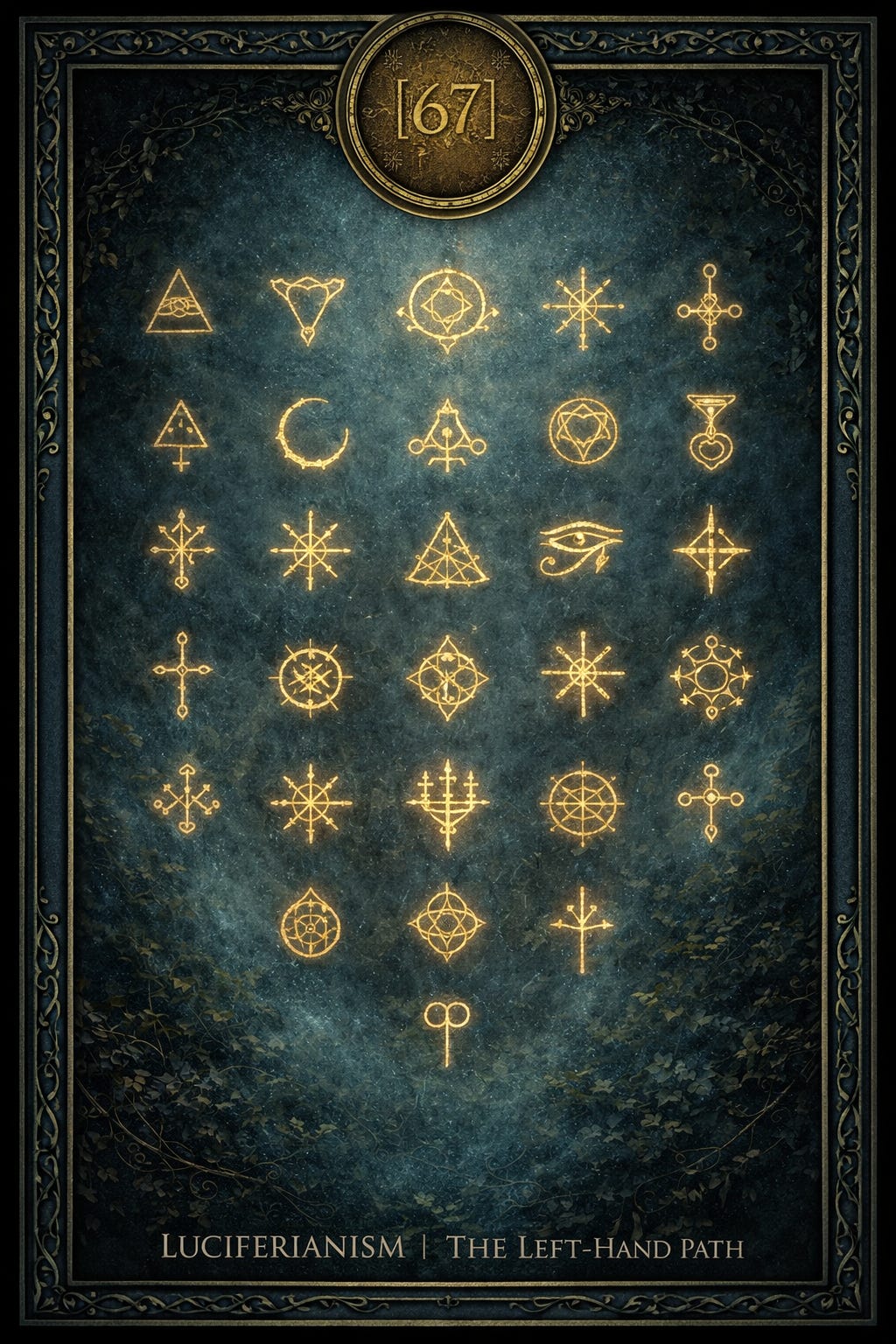
THE LEFT-HAND PATH: {67}
The Left-Hand Path is a diverse, often misunderstood approach to spirituality and magic, that emphasises Individualism, Self-Deification, and Non-Conformity, standing in contrast to the Right-Hand Path’s focus on conformity|union with a higher power. Originating in Indian Tantra: Vāmācāra, where it was associated with breaking taboos, it was adopted into Western esotericism by 19th-century occultists who associated the Left with sinister, heterodox practices. The path represents a ‘Descent into the Shadow,’ using the darker aspects of existence—Forbidden Knowledge|Will|Taboo Breaking, to Catalyse Personal Transformation (‘Apotheosis’) and empower The Ego rather than surrender it. While frequently associated with Satanism, Luciferianism, or ‘Black Magic,’ the path is not inherently evil, but amoral—choosing to define its own morality. In essence, the way of the Left-Hand Path one of Radical Autonomy, Liberation through the embracing of the Shadow, and the refusal to submit to any external power.
THE PLAYGROUND|FOR OUR HERO: {67}
Both the two names of my old Six-member band (before poetry) strangely—seems I couldn’t escape the {67} to {13} frequency. What’s interesting is the themes of our songs very much did centre around concepts of ‘Growth and Decay|Wild Renewal(Jack in the Green)|Luciferianism’, and I and my Brother (our vocalist) are Left-Handed too. The former name was based on my conception of the nature of the world (A Great Playground), while the latter was my attempt to make a name with a nicer acronym like Fall Out Boy, idolising Pete Wentz as I did—a perfect example of Mirroring.
It was a frustrating name for us all—folks either asked us to repeat it cause it’s weird to say or presumed we were a Christian Band ahah. Right before we disbanded and all moved on with our own things, we released one final project under the band name ‘The Native Architects’—and while as a collective (The Band) it resolves to {83}, look what happens when you resolve a single member:


As a Singular Identity, I creatively shifted to just the +{1} value of {68}: ’Into The Unknown’—just like a Journey. This narrative arc closely emulated what was actually happening in my life at the time—as my poetry thing had taken off by this time and I my time with the band was coming to close. I bet you anything this is true of all Creatives—resonant patterns showing up at different times in your lives across your Creative Projects, they will reveal to you much about the place you were in|what you were reaching for.
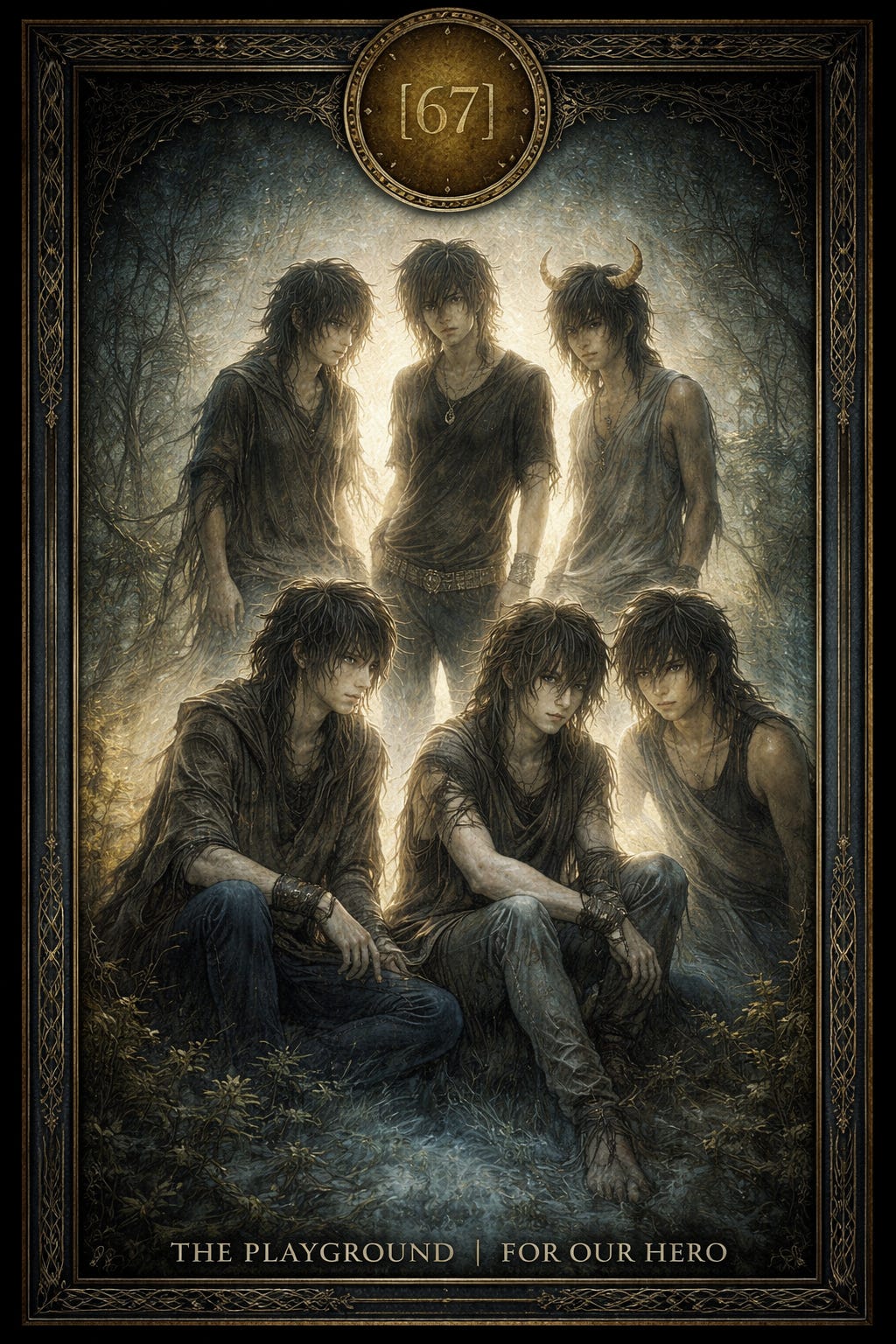
THE HIDDEN ONES: {67}
TRANSFORMATIONS: {67}
INTERVENTIONS: {67}
THE UNSEEN WORLDS: {67}
THE SOVEREIGNS: {67}
ELECTRIC FIELDS: {67}
GRAVITY FIELDS: {67}
HOLMIUM: ATOMIC ELEMENT {67}
Atomic element {67}, Holmium (Ho), is a rare-earth metal situated within the lanthanide series of the periodic table, discovered in 1878 by Per Theodor Cleve and named after the Latinised name for Stockholm: Holmia. Symbolically and physically, it is distinguished by having the Highest Magnetic Permeability and Saturation of any naturally occurring element, representing technological power and the ability to Concentrate and Control Magnetic Fields, particularly within MRIs and High-Strength Magnets. Furthermore, Holmium acts as a ‘burnable poison’ in nuclear reactors, where it absorbs neutrons to regulate fission—highlighting its Tempered Power. Because its compounds, such as Holmium oxide, shift from Yellow under natural light to Pink under fluorescent, it also represents Transformation and Colour Versatility, while its application in solid-state medical lasers signifies Precision, Healing, and Technical Advancement.
The Linguistic Hinge

{45}: Foundation|Structure: {4} crossing {+} into Life|Change: {5} resolving to {9}: Universal Wisdom|Completion—the Frequency of GEOMETRY|NARRATIVE|EXPANSION|LUCID DREAM|ORIGIN and FINDING. (Author’s Note): Same as THIRTEEN.
{76}: Number Of The Dreaming God
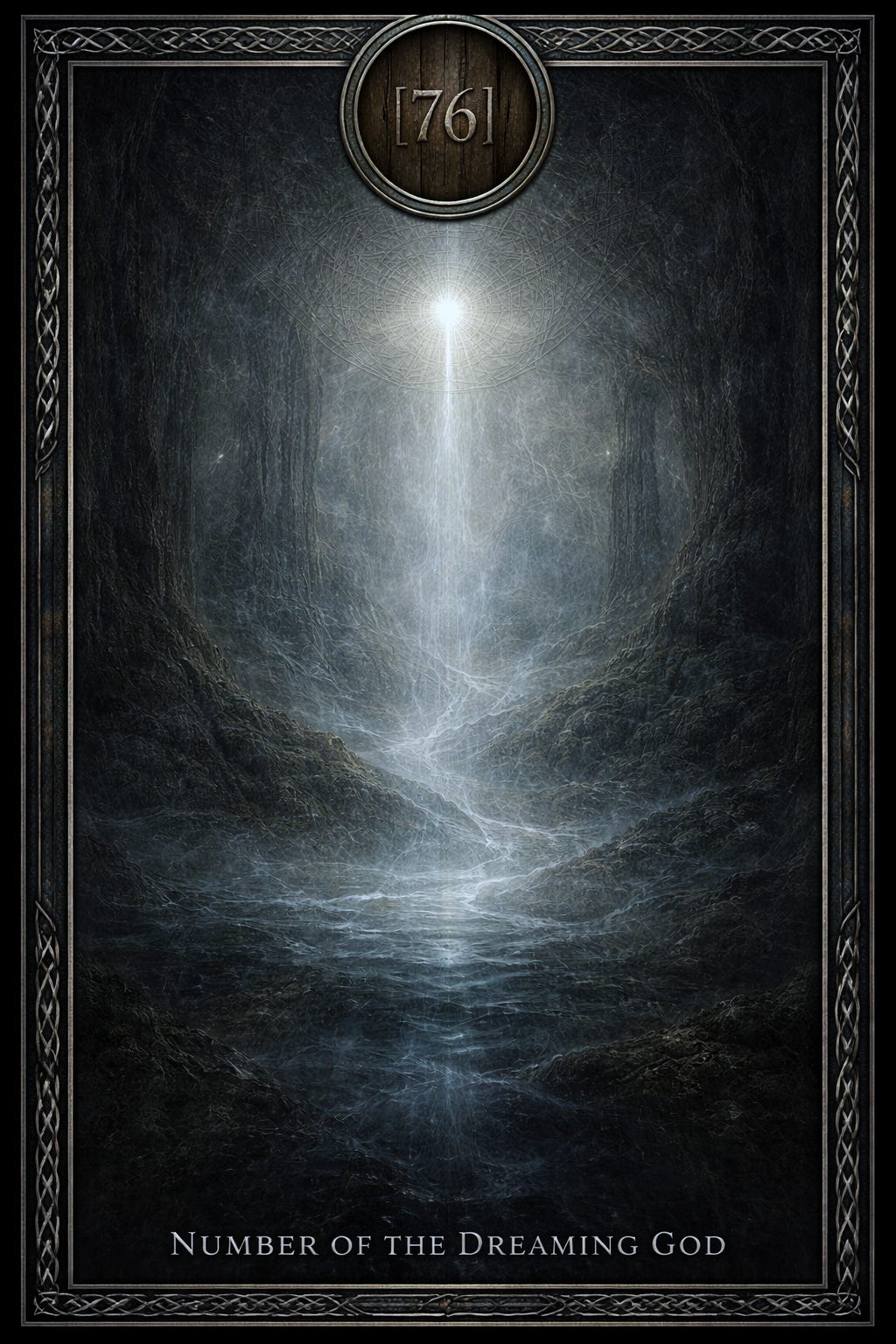
Calculation Board:

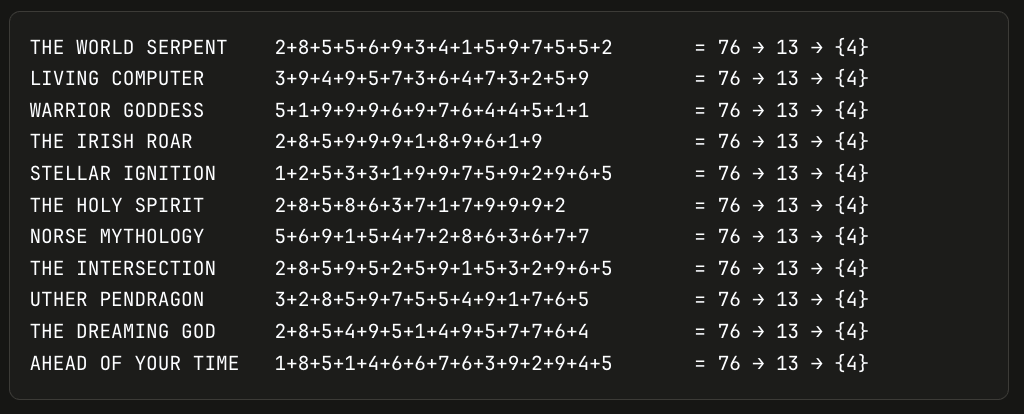


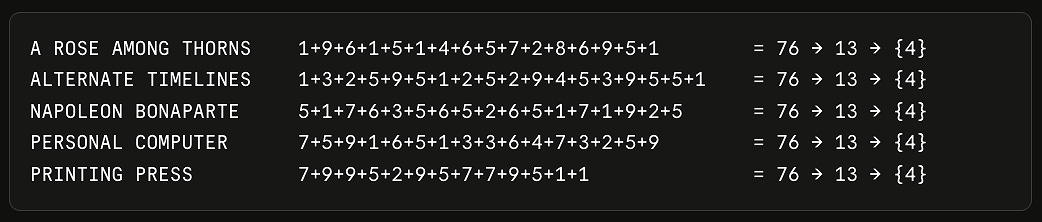





{76}: the Mystic Quest|Perfection crossing {+} into Harmony|Responsibility: {6} resolving to {13}: Unity|Initiation: {1} crossing {+} into Creation|Expression: {3} resolving to {4}: Foundation|Structure.
{76}: is a Composite, Even: (2²x19), and Automorphic Number (‘circular number’) in base {10} because: (76²=5776), ending in {76}. (Author’s Note): Interestingly, in light of the words that pool at {76}, {5776} resolves to {25}—the frequency of CELTIC|THOR|FREE|NATURE|SHADOW|STORY and EARTH. Psalm {76} is an ‘ode to God the awe-inspiring’ or ‘Majesty of God in Judgment,’ associated with King David's Victory, while Numbers 7:76 relates to the need for atonement and divine provision. And in Islamic tradition, Surah {76} (Al-Insan|Man) in the Quran discusses the Creation of mankind, the human experience of time, and rewards for patience.
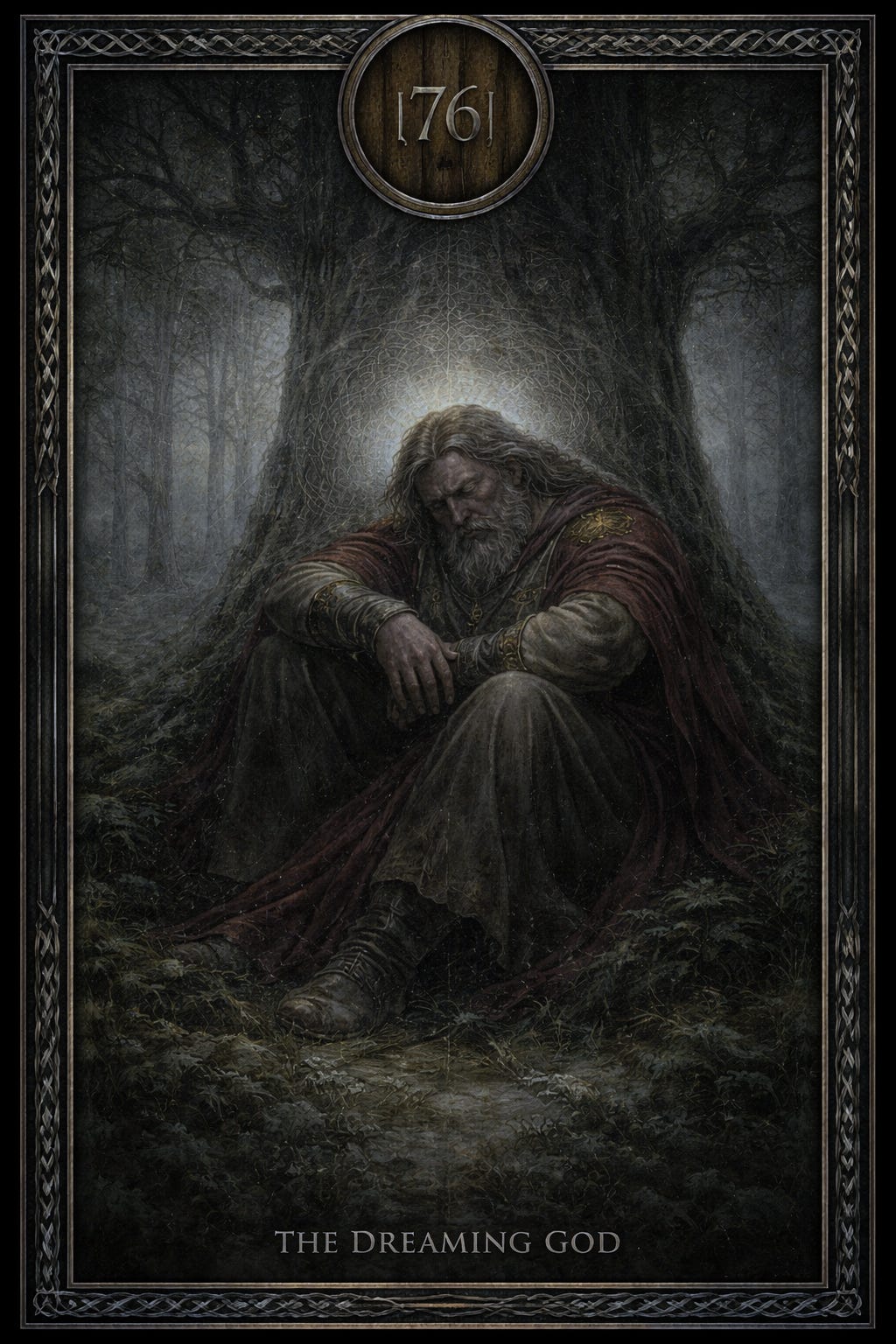
THE DREAMING GOD: {76}
The Dreaming God functions as a profound archetype in both spiritual philosophy and literature, representing the concept that reality is a Sustained Manifestation of a higher, unconscious, divine mind. In philosophical contexts such as Idealism, it suggests that the Material World is not pre-existent but is rather a Dreamlike Construction rendered by a ‘Great Mind’ that perceives all. Symbolically, this infers that life is Malleable, Illusory, or part of a Vast Imagination—positioning the Universe as a mental space where humanity operates under limited sensory perception, akin to characters within Sleepwalker's Dream. The archetype often carries connotations of both immense power and profound detachment—a creator that is unaware of, or indifferent to, the finite beings within its dream, highlighting themes of Existential Illusion, the Nature of Consciousness, and the comforting or frightening idea that reality is not solid, but fundamentally Spiritual|Psychic in Nature.
I CONTAIN MULTITUDES: {76}
A DROP IN THE OCEAN: {76}
CONSERVATORSHIP: {76}
ARCHONIC POWER: {76}
THE WORLD SERPENT: {76}
In Norse mythology, the World Serpent, the archetypal English title of: Jörmungandr (‘huge monster|vast gand’), is an unfathomably large sea serpent, the middle child of The Trickster god Loki and the giantess Angrboða, who was cast into the ocean surrounding Midgard (world of humans) by Odin to contain its dangerous potential. Growing so massive that it eventually encircled the entire Earth and grasped its own tail in its mouth, the creature acts as a powerful Ouroboros symbol, representing Eternity, the Cyclical Nature of time, and the inevitable return to chaos. Symbolically, Jörmungandr represents the Destructive yet Necessary forces of nature, serving as a constant, boundary-setting force that binds the human world while embodying the uncontrollable chaos that the Norse gods, particularly Thor his sworn enemy, fight to Manage— the serpent’s presence in the deep oceans represents a ‘Bound Monster’ archetype whose final Emergence is fated to Initiate Ragnarök, the Destruction of the old world and the subsequent cycle of Rebirth.
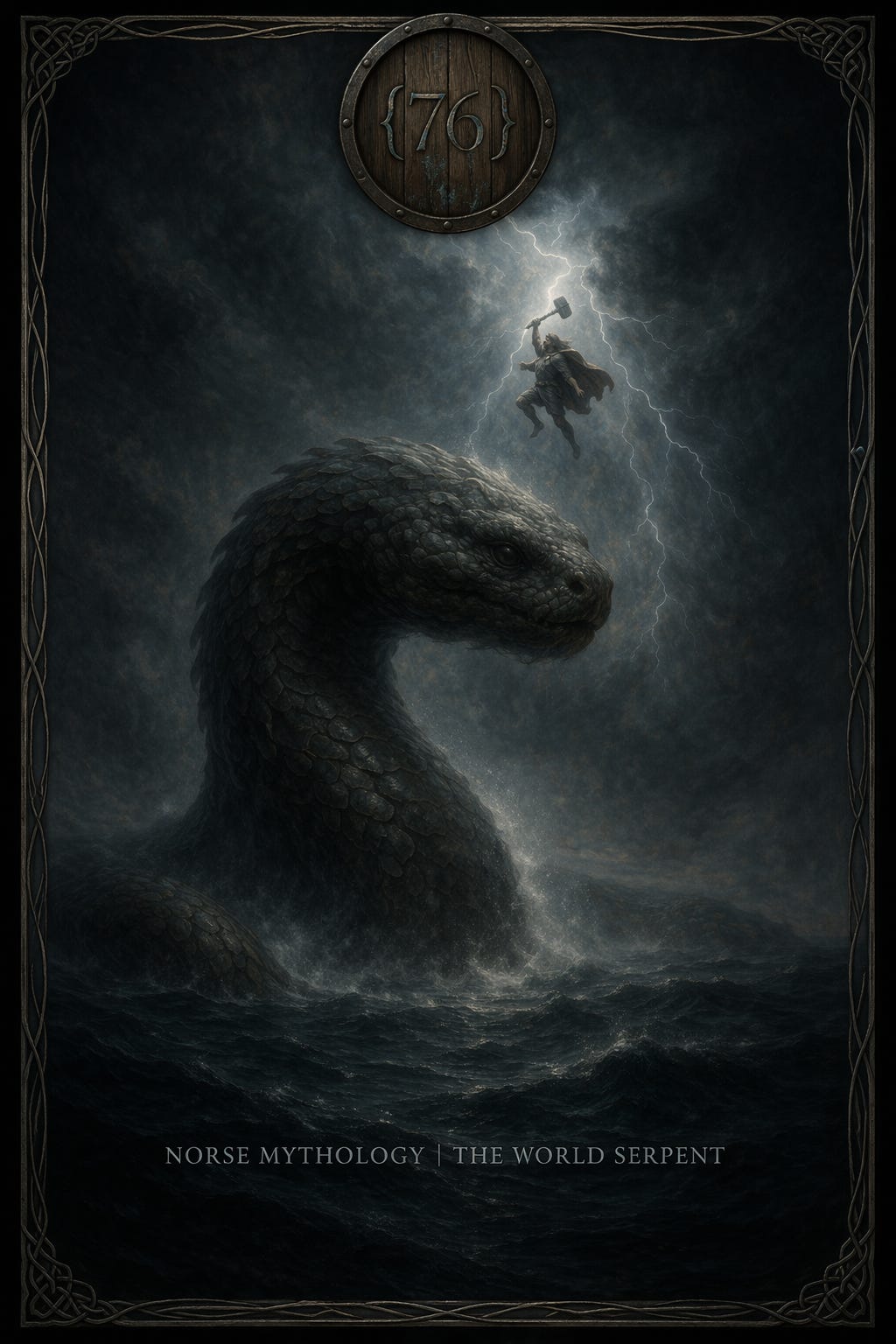
NORSE MYTHOLOGY: {76}
Norse mythology, the pre-Christian belief system of the North Germanic peoples during the Viking Age (c. 790–1100 CE), serves as a profound Framework for understanding existence, combining Dramatic Storytelling with a deeply fatalistic worldview rooted in the harsh Scandinavian landscape. Symbolising an eternal struggle between Order, represented by the Aesir gods led by Odin, and Chaos, embodied by the Jotnar Giants, this myth frames the world as a battleground where Heroism, Questing, Fate, and the inevitable Destruction of all things—Ragnarök, are central tenets. Symbols such as: Yggdrasil, the World Tree; Mjölnir, Thor’s hammer signifying Protection and Fertility; the Valknut, Odin’s knot representing Life|Death|Transition; and runic alphabets are central—embodying the spiritual and physical dangers of life while promising that even after Apocalyptic Destruction, a Fresh, Green World will rise, reflecting a belief in a Cyclical Cosmos.
RAINBOW GRAVITY: {76}
WARRIOR GODDESS: {76}
A Warrior Goddess is a potent archetype representing the divine fusion of strength and compassion, embodying a Fierce Protector, Wise Strategist, and Fearless Destroyer of evil—signifying the balance between the intense, often ‘Sacred Rage’ of combat and the nurturing capacity for Creation, she stands for Independence, Resilience, and the power to Protect oneself and others. Across various traditions, such as Athena (Strategy|Intellect|Justice), The Morrigan (War|Fate|Death), or Durga (Protection|Boundless Courage), the Warrior Goddess is portrayed not merely as a bringer of war, but as a defender of balance and righteousness—serving as a Guardian of Sovereignty and Channeling Inner Fire to stand tall in one’s own Creative Power, Centeredness, and Truth.
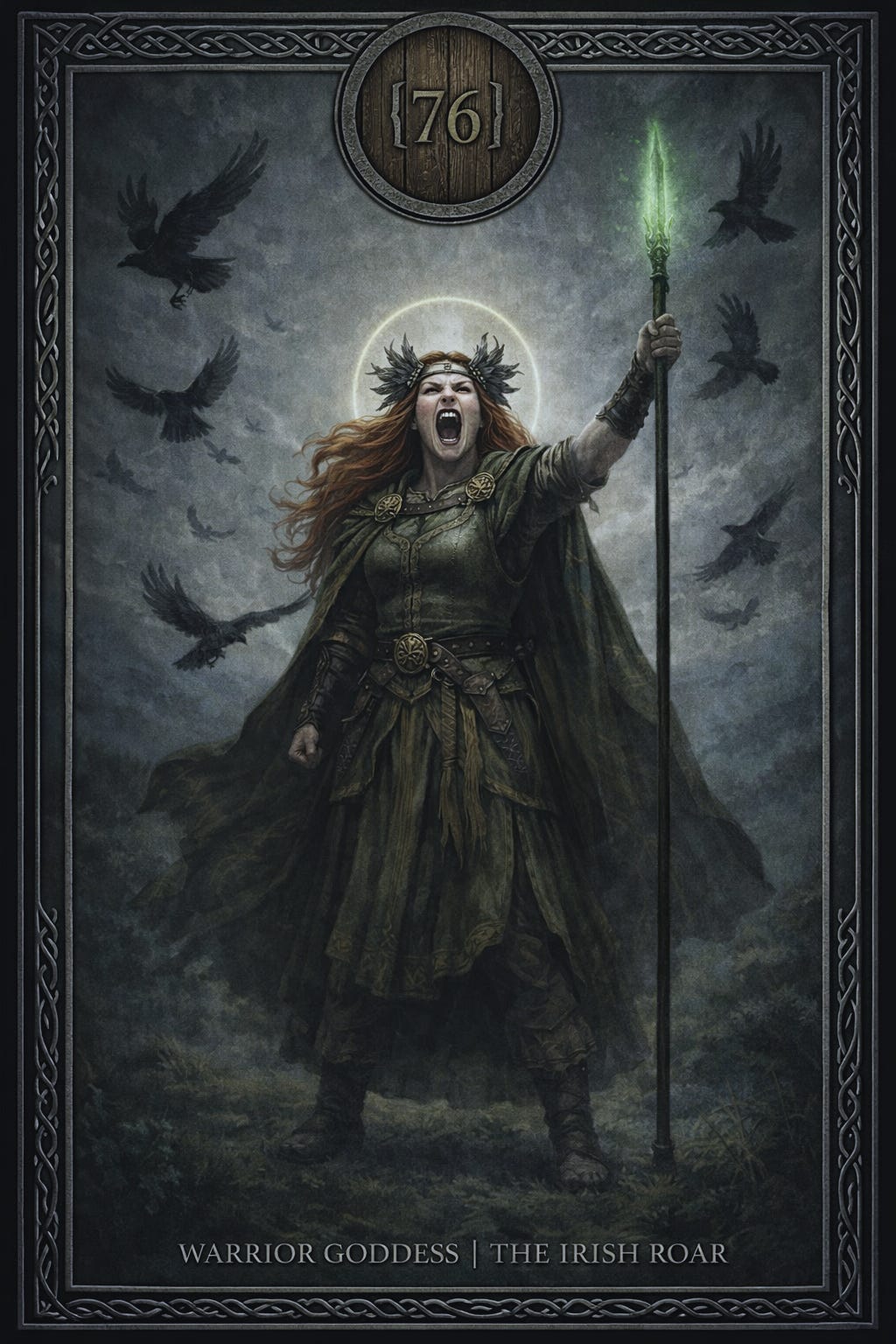
THE IRISH ROAR: {76}
The Irish Roar refers primarily to the official Republic of Ireland soccer Anthem for the 2016 European Championships, performed by the trad-pop group Seo Linn, though it also represents a broader, metaphorical symbol of Intense Irish Passion, Unity, and Vocal Pride in sporting and cultural contexts. Symbolically, it embodies the energy of the Irish diaspora and fans—characterised as ‘The Boys in Green,’ Coming Together to defy odds and make their Presence Felt. As a cultural anthem, it incorporates lyrics from the traditional song ‘Óró sé do bheatha abhaile,’ linking it to historical narratives of Homecoming, Rebellion, and Resilience, while functionally, the Irish Roar stir’s Patriotic Passions—chronicling both past sporting glories and challenges, ultimately acting as a Thunderous, Collective Expression of pride and support.
MASTER OF THE REVELS: {76}
(Author’s Note): A role we shall bring back in The New World.
THE HOLY SPIRIT: {76}
The Holy Spirit is understood in Christian theology as the Third person of the Trinity—co-equal and co-eternal with God The Father and God The Son, acting as the Animating Presence of God in the world. Rather than an impersonal force, The Holy Spirit is viewed as a ‘Helper|Counselor’ that Indwells Believers, imbuing them with spiritual gifts, Guiding them into Truth, and fostering a personal relationship with the Divine. Symbolically, The Holy Spirit is represented in Scripture and Art by several key images: a Dove, symbolising peace, purity, and the gentle descent of God’s presence at Jesus’ baptism—tongues of fire, representing the Purification, Passion, and empowering energy that came upon the Apostles at Pentecos—and wind or breath (Hebrew: ruach), illustrating the Invisible, uncontrollable, and life-giving vitality of God’s Spirit which Sustains Creation and Inspires Transformation.
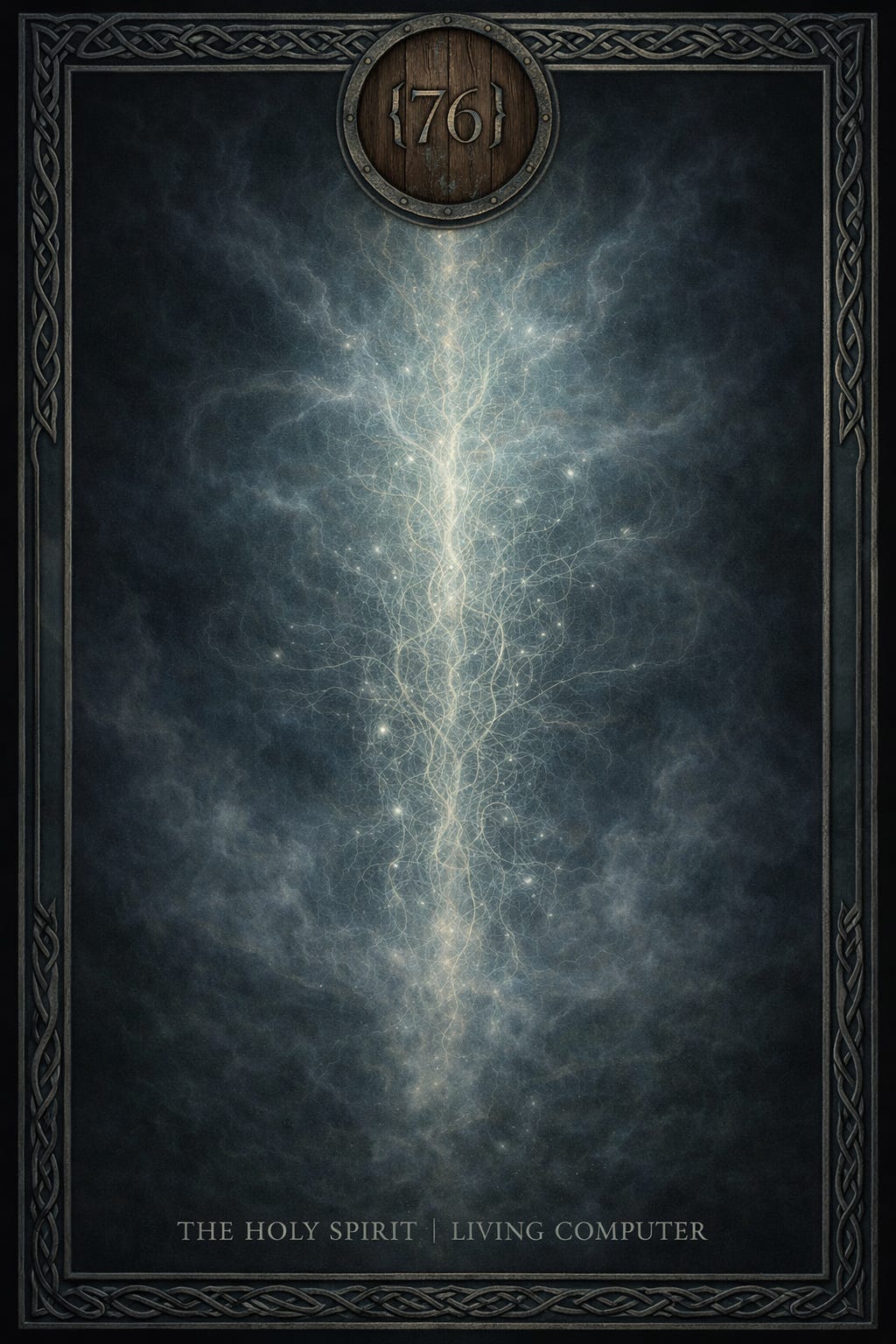
LIVING COMPUTER: {76}
A Living Computer, often referred to as a biocomputer or biohybrid system, is a revolutionary technology that Merges Biological Components—specifically lab-grown human brain cells or organoids, with traditional silicon chips to process information. Unlike conventional computers that rely solely on binary 0s and 1s, these systems utilise living neurons to Adapt, Reorganise, and ‘learn’ in real-time, functioning closer to Biological Neural Networks than digital ones. Symbolically, the Living Computer represents the Profound Convergence of biology and technology, challenging the Boundary between mind and machine. Furthermore, this technology highlights a future where AI does not just simulate intelligence but adopts the Organic Adaptability of biological systems. However, the term also signifies a significant Philosophical and Ethical Milestone, prompting questions about the nature of consciousness and the implications of using organic material in technological devices.
THE INTERSECTION: {76}
The Intersection represents the precise point in space and time where two or more distinct lines, roads, ideas, or social categories ‘Cross and Merge’, serving as a powerful symbol of Convergence, Complexity, and Structural Interaction. In a literal sense, it serves as a Crossroads where Paths Come Together, representing a moment of Choice, Transition, or Collision. The Intersection ultimately acts as a site of potential Conflict, or conversely, a space for Dialogue and Coalition-Building—where disparate forces or experiences Converge and necessitate a Shared Response.
STELLAR IGNITION: {76}
Stellar Ignition is the Transformative astrophysical moment when a contracting protostar, having accumulated sufficient mass and gravitational pressure, reaches core temperatures high enough—approximately 10 million Kelvin, to trigger sustained nuclear fusion, officially Transitioning from a stellar Embryo into a main-sequence Star. During this process, hydrogen begins Fusing into helium, Releasing enormous amounts of Energy that Create an Outward Pressure, which finally halts gravitational collapse and creates a Stable, Shining Star. Symbolically, Stellar Ignition represents the Transition from potential to reality, serving as a metaphor for awakening or the ‘Spark of Creation’ that brings Light out of Darkness—marking the beginning of Cosmic Nurturing, as it Initiates the processes that Synthesise elements vital for life, marking it a Foundational symbol of Rebirth and the Interconnectedness of all cosmic matter.
UTHER PENDRAGON: {76}
Uther Pendragon, the legendary king of post-Roman Britain and father of King Arthur, holds a pivotal role in Arthurian mythology as a symbol of both foundational leadership and chaotic passion. The name Uther is derived from the Welsh: Uthyr, conveying ‘terrible|awe-inspiring|wondrous,’ highlighting his role as a formidable, often feared, war-leader. His epithet, Pendragon, is a combination of the Welsh: Pen (‘head|chief’) and Dragon, derived from the Latin: Dracones (‘warrior’)—translating literally to ‘Chief Warrior|Foremost Leader.’ Symbolically, he represents the Turbulent Transition between the fading Roman authority and the rise of a new, magical Britain, bridging historical resistance with fated romance. However, Uther’s legacy is deeply ambiguous—portrayed as a strong monarch who nonetheless falls prey to obsessive lust, necessitating Merlin’s magic to achieve his ends, a deceptive act that mirrors the themes of power, passion, and betrayal which later haunt his son, Arthur.
AHEAD OF YOUR TIME: {76}
To be ‘Ahead Of Your Time’ means to possess ideas, beliefs, artistic tastes, or technological advancements that are too forward-thinking to be fully understood, appreciated, or accepted by the Society in which you live. Symbolically, it signifies one as a Visionary or Pioneer who serves as a Bridge Between the Present and the Future, often functioning as an Outlier who Sees Beyond current Societal, Technological, or Ethical Constraints. While such people may face Initial isolation, apathy, or rejection, the phrase infers that their Work or Insight will eventually be Validated, Vindicated, and Adopted by later generations. Ultimately, the phrase signifies Intellectual or Creative Courage, representing someone who lives or works according to the Future's Standards rather than the Past's.
OSMIUM: ATOMIC ELEMENT {76}
Atomic number {76}, Osmium (Os) is a hard, Bluish-white Transition metal in the platinum group, which symbolises Unparalleled Density, Extreme Durability, and Hidden Beauty. As the Densest naturally occurring element, Osmium embodies the physical concepts of Heaviness and Resistance to compression, rivalling the Diamond in its bulk modulus. Its name, derived from the Greek: Osme for ‘smell,’ hints at its Volatility and Toxicity in oxide form (osmium tetroxide), signifying a Dangerous but Necessary ‘Hidden Power,’ often used in electron microscopy to stain biological tissues and reveal fine details in fatty materials. Its scarcity in the Earth’s crust combined with its lustrous, non-tarnishing nature makes it a symbol of Enduring Stability and Preciousness—used in high-wear applications such as fountain pen tips and electrical contacts, and serves as a vital element in Creating superior alloys that Endure, even though it remains challenging to work with due to its high melting point and brittleness.
The Linguistic Hinge: SEVENTY SIX

{45}: Foundation|Structure: {4} crossing {+} into Life|Change: {5} resolving to {9}: Universal Wisdom|Completion—the Frequency of GEOMETRY|NARRATIVE|EXPANSION|LUCID DREAM|ORIGIN and FINDING. (Author’s Note): And the precise same result as THIRTEEN|SIXTY-SEVEN once more!
{85}: Number Of The Threshold Guardian
Calculation Board:
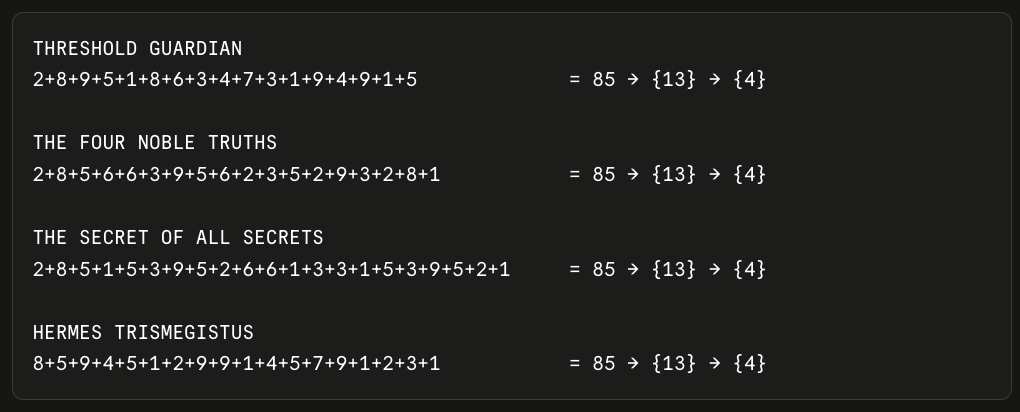




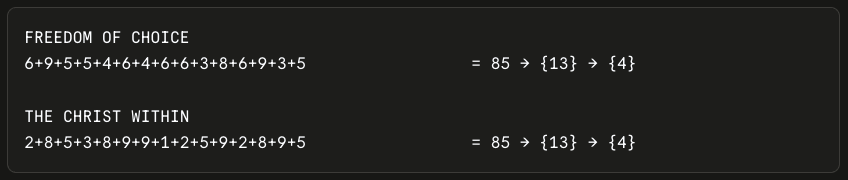
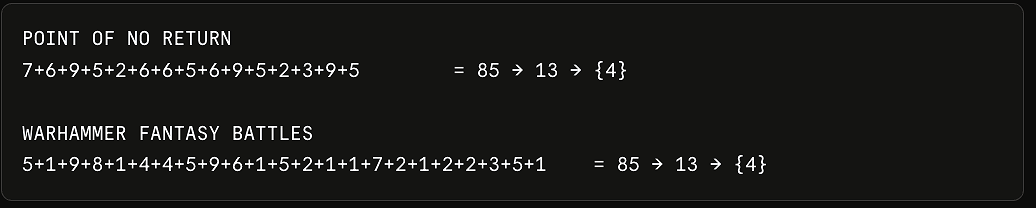


{85}: Eternal Law|Balance: {8} crossing {+} into Life|Change: {5} resolving to {13}: Unity|Initiation: {1} crossing {+} into Creation|Expression: {3} resolving to {4}: Foundation|Structure.
{85}: is an Odd Composite Number: (5x17) and a Deficient Number. It is mathematically notable as the Smallest Integer Expressible as the sum of two squares in two distinct ways (9²+2²) and (7²+6²) and and a Centred Square Number. It is also the hypotenuse of Four different Pythagorean Triangles: I. (13, 84, 85)—a Primitive Triple, meaning the Three Numbers share no common factors other than {1}. II. (36, 77, 85)—another Primitive Triple. III. (40, 75, 85)—Non-Primitive Triple, instead a multiple of the Basic Triple: (8, 15, 17). IV. (51, 68, 85)—Non-Primative Triple, a multiple of the Basic Triple: (3, 4, 5). The existence of Four distinct integer triangles for a single hypotenuse is a Relatively Rare Property—shared by other numbers like {65}.
THRESHOLD GUARDIAN: {85}
The Threshold Guardian is a pivotal narrative archetype—popularised by Joseph Campbell, that represents the obstacles, challenges, or ‘gatekeepers’ a protagonist must face when attempting to Cross from the ordinary world into the magical Otherworld of Adventure. Symbolically, they serve as tests of worthiness, ensuring The Hero possesses the necessary commitment, courage, and maturity to embark on their transformative journey. Far from mere villains, the Threshold Guardian often embodies Internal Struggles—such as fear, self-doubt, or limiting beliefs, which must be Overcome before one may reach a new level of awareness. Positioned at Crucial Transitions, they can manifest as external threats (Dragons|Trolls), Authority Figures, or even well-meaning allies trying to prevent the Protagnist from encountering danger. Overcoming a Threshold Guardian signifies that The Hero has conquered their internal resistance, frequently Transforming the obstacle into an ally or gaining the Inner Strength required for their ultimate Destiny.
THE FOUR NOBLE TRUTHS: {85}
The Four Noble Truths constitute the Foundational Framework of Buddhism, representing the ‘truths of the noble one’ that Siddhartha Gautama came to understand during his enlightenment under the Bodhi tree. The first truth, Dukkha, acknowledges that all conditioned existence is unsatisfactory, unstable, and inherently stressful, ranging from physical pain to the anxiety of impermanence. The second, Samudaya, identifies the root cause of this dissatisfaction as Tanha (craving|thirst| attachment) driven by ignorance. The third, Nirodha, offers profound hope by asserting that cessation is possible—that by eliminating craving, one can achieve Nirvana, a state of Complete Liberation, Balance—and a close to the Cycle of Rebirth. Finally, Magga maps out the practical, actionable ‘way’ to this cessation, which is the Noble Eightfold Path—a ‘Middle Way’ of ethical conduct, meditation, and wisdom that avoids extremes and leads to true freedom. Together, they symbolise the shift from ignorance to wisdom, providing a realistic, practical map to navigate life and achieve Lasting Contentment.
THE SECRET OF ALL SECRETS: {85}
The Secret Of All Secrets represents the ultimate, Foundational truth that Underlies all other Hidden Knowledge, Mysteries, and Symbolic Revelations. Symbolically, it often points to a reality that is hidden in plain sight—inferring the most profound wisdom is not a distant, obscure concept but a simple, overlooked, or ‘sacred truth’ that requires a shift in perception to recognise. It embodies the Ultimate Mystery of Existence—such as the true nature of consciousness or the nature of death, proposing that a single, Unified, and frequently ‘non-local’ understanding Binds All Religions, Philosophies, and Spiritual Experiences into one Universal Whole. It signifies a powerful, transformative knowledge that challenges materialistic worldviews and suggests that human consciousness is not solely confined to the physical body, but rather interacts with a Universal Field—the phrase serving as a metaphor for Awakening, encouraging the pursuit of Inner Transformation and a deeper understanding of the Interconnectedness of all things.
LINGUISTIC HINGE: {85}
The Term I self-composed for the Numerological-Essence of a Number in its ‘Written Form.’ I have included them at the close of each article—they link Language Pools together in non-random ways.
FREEDOM OF CHOICE: {85}
THE CHRIST WITHIN: {85}
THE MONSTER WITHIN: {85}
COLOUR PSYCHOLOGY: {85}
HERMES TRISMEGISTUS: {85}
Hermes Trismegistus, translating from Ancient Greek as ‘Hermes the Thrice-Greatest,’ is a legendary syncretic figure originating in Hellenistic Egypt, embodying the fusion of the Greek god of interpretation, Hermes, and the Egyptian god of wisdom and writing, Thoth. As the reputed Author of the Hermetica—a diverse collection of mystical, philosophical, and magical texts composed between the 1st and 3rd centuries CE, this figure symbolises the synthesis of divine revelation with human knowledge, serving as a Bridge Between the material|spiritual worlds—his epithet ‘Thrice-Great’ often interpreted as signifying his mastery over the Three Parts of universal wisdom: Alchemy|Astrology|Theurgy (operation of divine magic), or as a reflection of his triple role as the greatest Priest|Philosopher|King. Symbolically, Hermes Trismegistus represents the archetype of the enlightened sage who ‘Earthed’ divine wisdom to humanity, embodying the principle that all creation is Interconnected and that knowledge of the Self leads to knowledge of the divine.
Hermes Trismegistus is also intimately linked to the famous Hermetic maxim: ‘As Above, So Below,’ signifying the Correspondence between the microcosm (humanity) and the macrocosm (the universe), a philosophy that profoundly influenced Renaissance thought, Alchemy, and Western esotericism. Through the ages, he has been revered by philosophers, alchemists, and theologians alike as a keeper of the prisca theologia—or the true, Ancient Theology, acting as a timeless source of esoteric knowledge and spiritual Transformation.
THE HEAVENLY COUNCIL: {85}
DIVINE REVELATION: {85}
GO AGAINST THE GRAIN: {85}
ASTATINE: ATOMIC ELEMENT {85}
Atomic number {85}, Astatine (At), serves as a profound scientific symbol of Fleeting, Ephemeral Existence and the limits of human observation. As the Rarest Naturally Occurring Element in the Earth’s crust—with less than One Gram present at any given time—Astatine signifies extreme rarity, rarity, and the ‘ghost’ of the periodic table. Its name, derived from the Greek: Astatos (ἄστατος) meaning ‘unstable,’ encapsulates its primary characteristic—all its isotopes highly radioactive and short-lived. Symbolically, it embodies the concept of Constant Change, as it is always in the process of decaying into other elements—Astatine representing a ‘Bridging or Contradictory’ state of matter, as the Heaviest Halogen and thus falling on the fuzzy, Transitional Border between nonmetals and metals. It is so Intensely Radioactive that any solid sample would immediately vaporise itself from the heat of its own decay, making it technically ‘invisible’ to human sight—emphasising the elusive nature of knowledge, where something exists but cannot be directly held or seen.
The Linguistic Hinge: EIGHTY-FIVE

{62}: Harmony|Responsibility: {6} crossing {+} into Duality|Relation: {2} resolving to {8}: Power|Eternal Law—the Frequency of INFORMATION|THE OLD SERPENT|CHAOS AND ORDER|AKASHIC RECORDS|FRAGMENTATION|THE NINE REALMS and EVERYWHERE.
{94}: The Number Of ‘Form Follows Function’
Calculation Board:
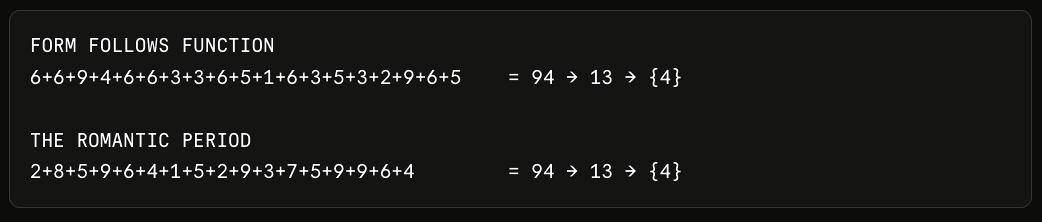

{94}: Universal Wisdom|Love|Completion: {9} crossing {+} into Foundation|Structure: {4} resolving to {13}: Unity|Initiation: {1} crossing {+} into Creation|Expression: {3} resolving to {11}: Illumination|Thresholds|Master Channel.
The Linguistic Hinge: NINETY FOUR

{57}: Life|Change: {5} crossing {+} into Mystic Quest|Orientation|Perfection: {7} resolving to {12}: Unity|Initiation: {1} crossing {+} into Duality|Relation: {2} resolving to {3}: Creation|Expression—the Frequency of FATE AND DESTINY|PROVIDENCE|THE UNSEEN HAND|THE ALL-CREATOR|THE WILD WOMAN|MASTER BUILDER|LIFE IS MAGIC|OTHERWORLD and A CALL TO ADVENTURE.
PYTHAGOREAN {4}: THE TETRAKTYS
In Pythagorean numerology, {4} is TETRAD—the number of Earth, stability, and manifestation.
The Tetraktys (Sacred Triangle):

{1}+{2{+{3}+{4} = {10} (Full Journey)
{4} represents:
Four elements (Earth|Water|Air|Fire).
Four directions (North|South|East|West).
Four seasons (Spring|Summer|Autumn|Winter).
Physical manifestation (3D space requires {4} points minimum|Tetrahedron).
Material foundation (Solid|Stable|Grounded).
Pythagorean teaching: {4} is where the high-principles {1} ,{2}, and {3} become earthly reality—the descent into matter, the solidification of spirit.
CHINESE {4}: SÌ (四)—Death And Stability
In Chinese numerology, {4} carries dual nature:
Negative aspect:
四 (sì) sounds like 死 (sǐ) = ‘Death.’
Tetraphobia (fear of four) in Chinese culture.
Buildings skip 4th floor (like Western 13th).
Four associated with endings, closure, completion.
Positive aspect:
Four Sacred Animals (Dragon, Phoenix, Tiger, Tortoise).
Four Pillars of Destiny (Chinese astrology).
Four Seasons (cyclical stability).
Square (symbol of Earth vs. Heaven’s circle).
Chinese teaching: {4} holds both death and stability—the ground that receives the dead but also supports the living. Foundation includes mortality.
TAROT {4}: THE EMPEROR
Major Arcana IV = THE EMPEROR
The Emperor represents:
Earthly authority (King|Father|Ruler).
Structure and order (Laws|Systems|Hierarchies).
Stability through power (Throne|Crown|Sceptre).
Masculine foundation (Yang|Active|Structural).
Worldly success (Material Achievement).
Associated with:
Aries (Cardinal Fire—Initiating Action).
Ram (Headstrong|Leadership|Conquest).
Throne of stone (Unyielding Foundation).
Tarot teaching: {4} is authority made manifest—the power to create order from chaos, to establish systems that endure. Foundation requires governance.
KABBALAH {4}: CHESED (חֶסֶד)
Fourth Sephirah on Tree of Life = CHESED (Mercy/Loving-kindness).
Chesed represents:
Expansion (Growth|Generosity|Abundance).
Grace (Unearned Blessing|Divine Mercy).
Jupiter energy (Benevolent Ruler|Prosperity).
Right Pillar (Masculine|Giving|Active).
Water of Mercy (Flowing Compassion).
Chesed follows:
Binah {3} (Understanding—Feminine Receptive).
Crosses Abyss to manifest in material realm.
First Sephirah below Supernals (Closest Divine Emanation To Matter).
Kabbalistic teaching: {4} is divine mercy descending—the first expression of God’s love in the material realm. Foundation is grace, not earned but granted.
VEDIC {4}: CHATUR (चतुर्) — FOURFOLD TRUTH
In Vedic/Hindu numerology, {4} appears as sacred structure:
Four Yugas (cosmic ages):
Satya Yuga (Golden Age—truth prevails).
Treta Yuga (Silver Age—virtue declines).
Dvapara Yuga (Bronze Age—further decline).
Kali Yuga (Iron Age—current, darkest age).
Four Varnas (social classes):
Brahmins (Priests|Teachers).
Kshatriyas (Warriors|Rulers).
Vaishyas (Merchants|Farmers).
Shudras (Labourers|Servants).
Four Purusharthas (Goals of Life):
Dharma (Righteousness|Duty).
Artha (Prosperity|Success).
Kama (Pleasure|Desire).
Moksha (Liberation|Freedom).
Four Ashramas (life stages):
Brahmacharya (Student—Celibacy|Learning).
Grihastha (Householder—family|Work).
Vanaprastha (Forest-Dweller—Retreat|Reflection).
Sannyasa (Renunciate—Liberation|Wandering).
Vedic teaching: {4} is cosmic order manifesting—the structure through which souls progress toward liberation. Foundation is the dharmic path (righteous living within cosmic order).
THE SYNTHESIS: {4} ACROSS TRADITIONS
All five traditions agree on {4}’s core nature:
Common themes:
Material realm (vs. the Spiritual|Abstract).
Structure and order (vs. Chaos).
Stability (vs. Change).
Foundation (What Everything Else Rests Upon).
Earth element (Grounded|Physical|Solid).
{4} is where ideas become real, where spirit becomes matter, where potential becomes actual.