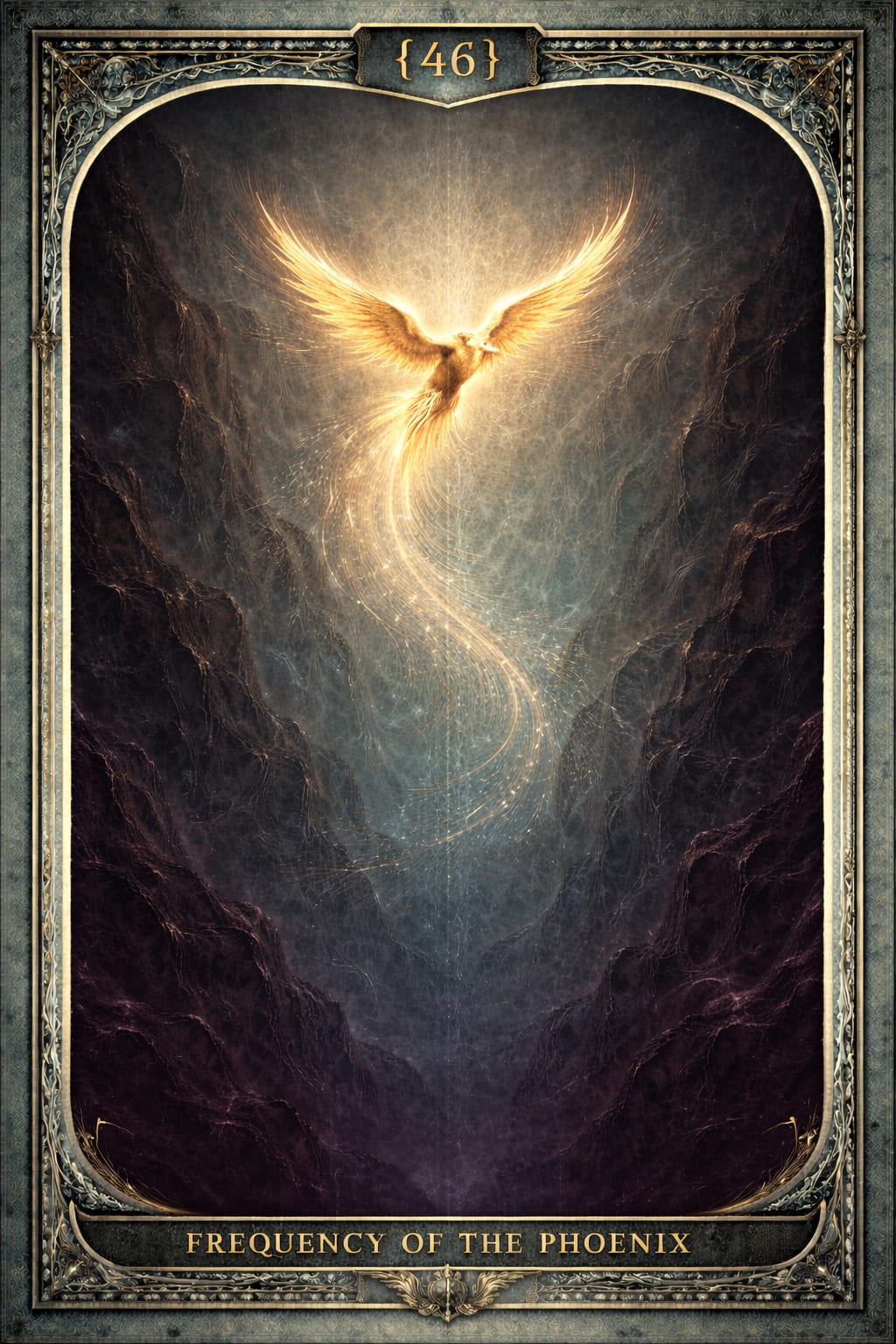
{46}: Frequency Of The Phoenix
'Be still, and know that I am God'—Psalm 46:10

Calculation Board:
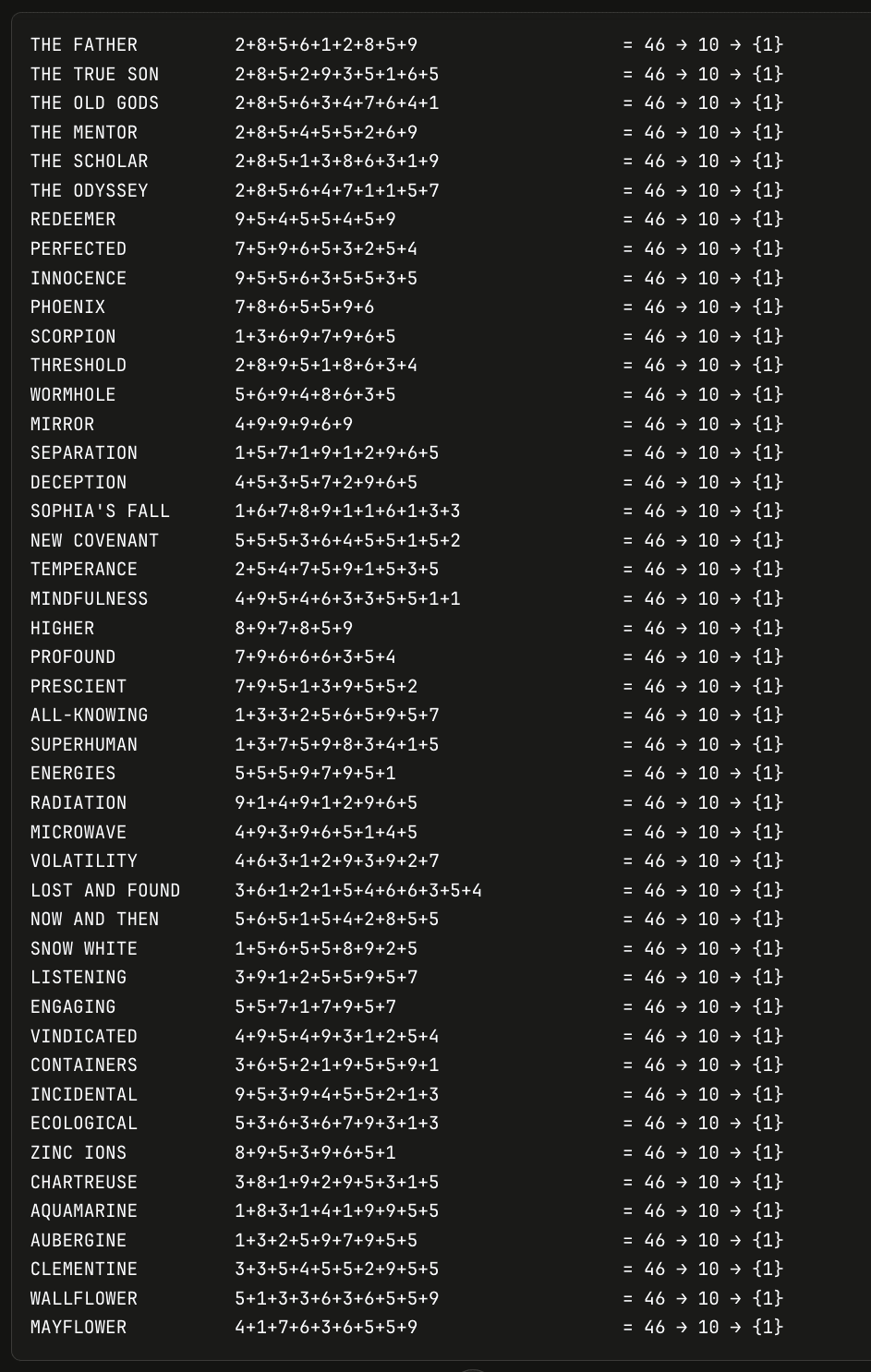
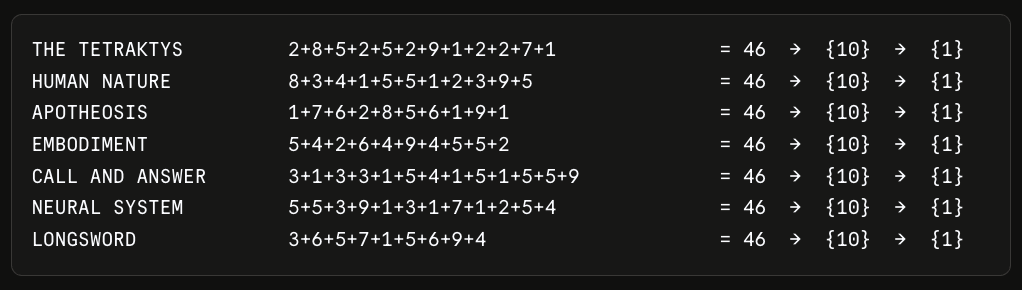

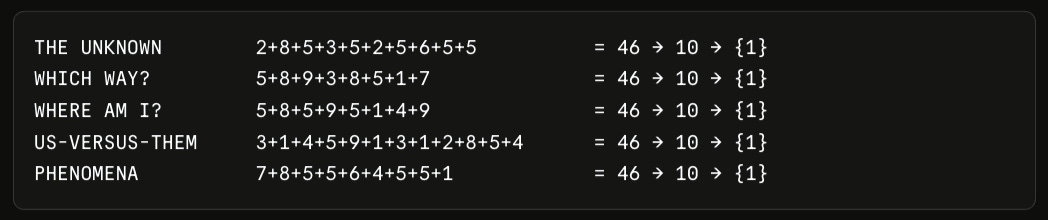






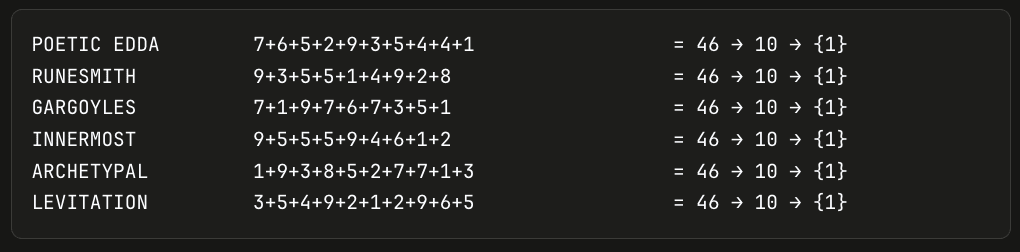
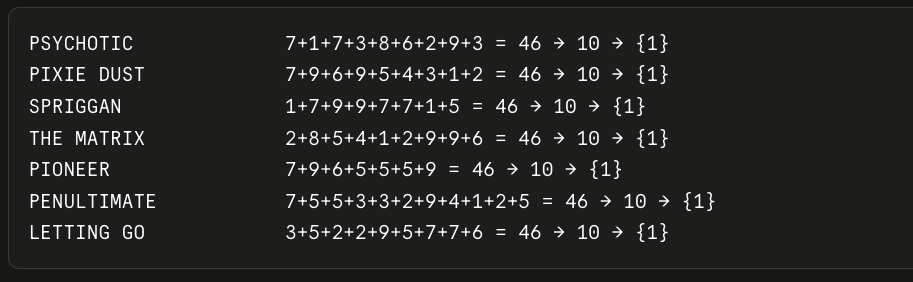
{46}: Foundation|Structure: {4} crossing {+} into Harmony|Responsibility: {6} resolving to {10}: Unity|Initiation: {1} crossing {+} into the Void|Unknown|Potential: {0} resolving to {1}: Unity|Initiation.
{46}: is most significantly the total number of Chromosomes in the human body—{23} pairs. Mathematically, it is recognised as a centred triangular number, and an Enneagonal number—a polygon with nine sides and nine angles, {9} being the number of Universal Wisdom|Completion, and is the ‘largest even integer’ that cannot be expressed as the sum of two abundant numbers.
THE FATHER: {46}
The Father is the head of the Christian Trinity and a Foundational, universal symbol in Jungian psychology and wider myth, serving as the masculine principle of Structure, Unity, and Conscious Awareness. Archetypally, it is expressed in a number of forms—from the ‘Good Father’ archetype, such as Mufasa (Lion King) or Atticus Finch (To Kill A Mockingbird), or ‘The Tyrant’, such as Darth Vadar (Star Wars) or the titan Kronos, father of Zeus, of ancient greek myth who would devour his children out of fear of prophesy. In Hinduisim, ot is often used to describe Ishwara (the Lord) as the Source of the universe and sustainer, while in Gnostic traditions, The Father is often seen as ‘The One’—Source of all divine light, and the ultimate, Unknowable, godhead.
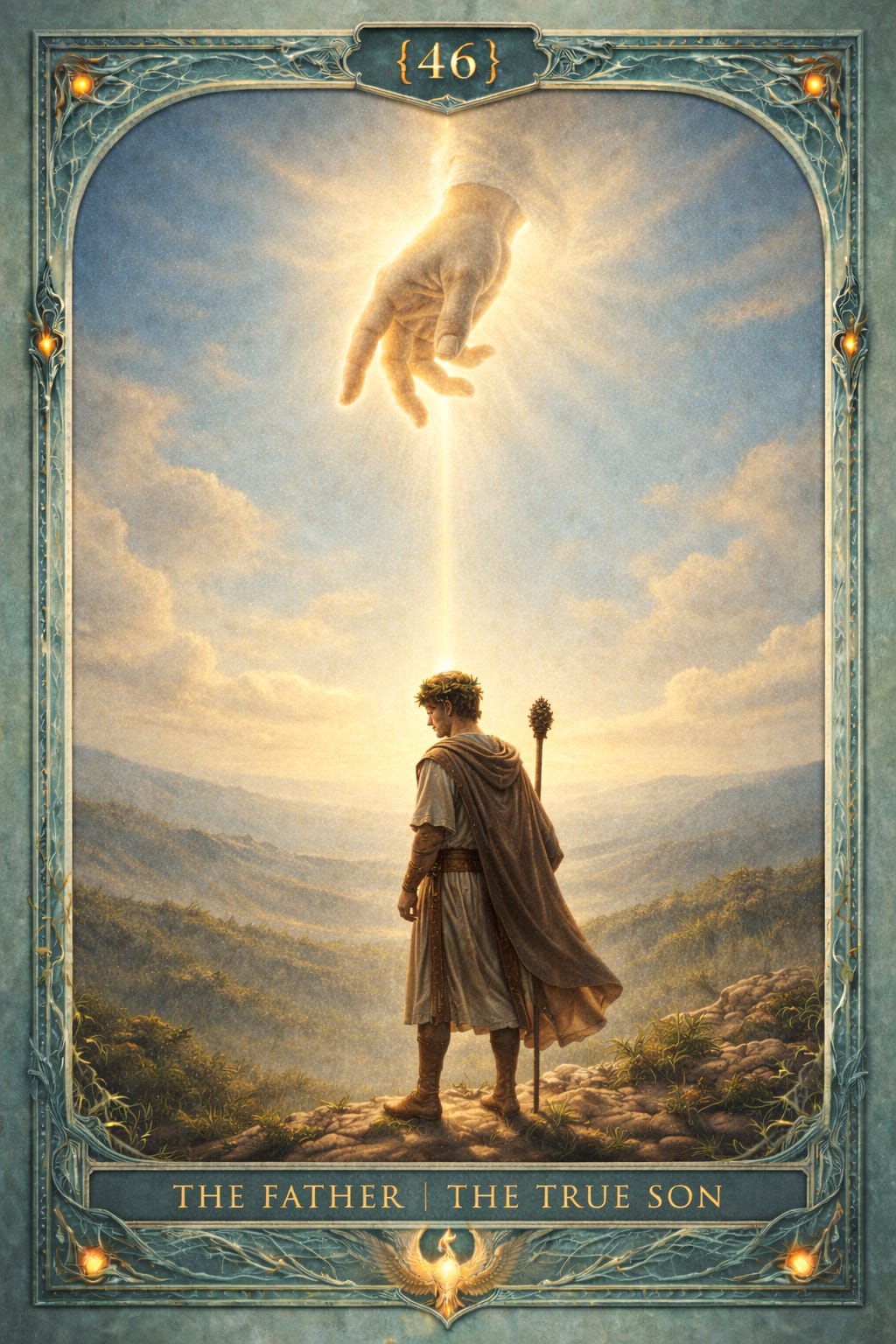
THE TRUE SON: {46}
The archetype of The True Son represents a figure of rightful inheritance, authenticity, and spiritual or destined maturity. He is a key component of the Hero’s Journey and mythological narratives, often functioning as the genuine heir who Restores Unity, legitimacy, and truth to a corrupted or chaotic realm. The True Son embodies the ‘Spirit or Will of The Father (or higher, divine power)—in many traditions eventually realising that he and The Father are One, signifying the Unification of heaven and earth. He is is sometimes the product of a special or miraculous birth, and may be orphaned or exiled, needing to prove his worthiness before he may Return—mythological expressions including Horus, Perseus, King Arthur, Gilgamesh, and Jesus Christ, with modern interpretations including Simba (Lion King), Luke Skywalker (Star Wars), and Harry Potter.
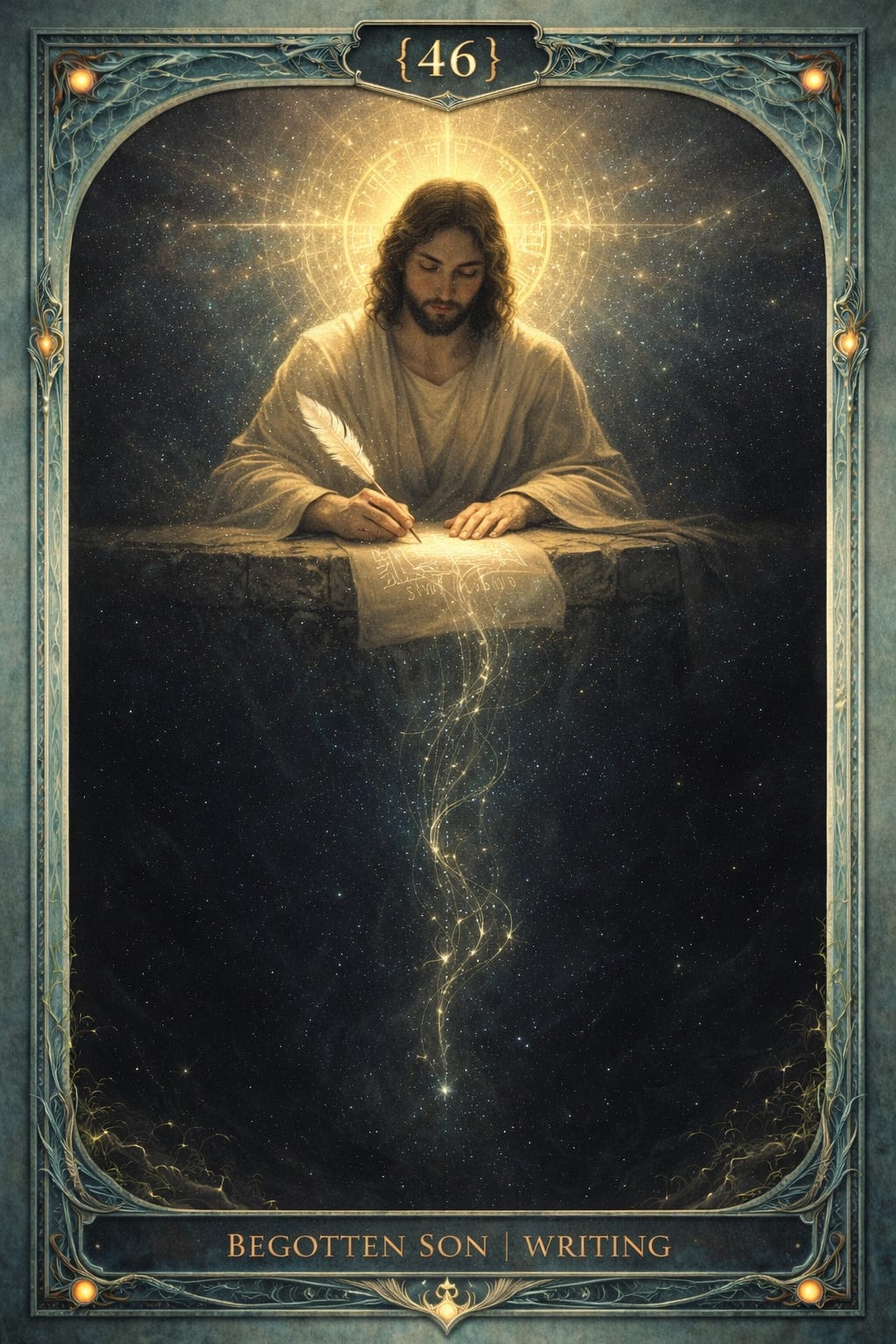
BEGOTTEN SON: {46}
Begotten Son is a theological term primarily used in Christianity to describe a unique relationship between God, The Father, and Jesus Christ, emphasising that Jesus is ‘One of a kind,’ sharing the same divine nature and essence as God, rather than being a created being. A Core Tenet established in the Nicene Creed (325 AD), the term comes from the Greek word: monogenes, which translates to ‘only|one and only|unique,’ and highlights that Jesus is not just a son of God by adoption (as believers are), but the Son by nature.
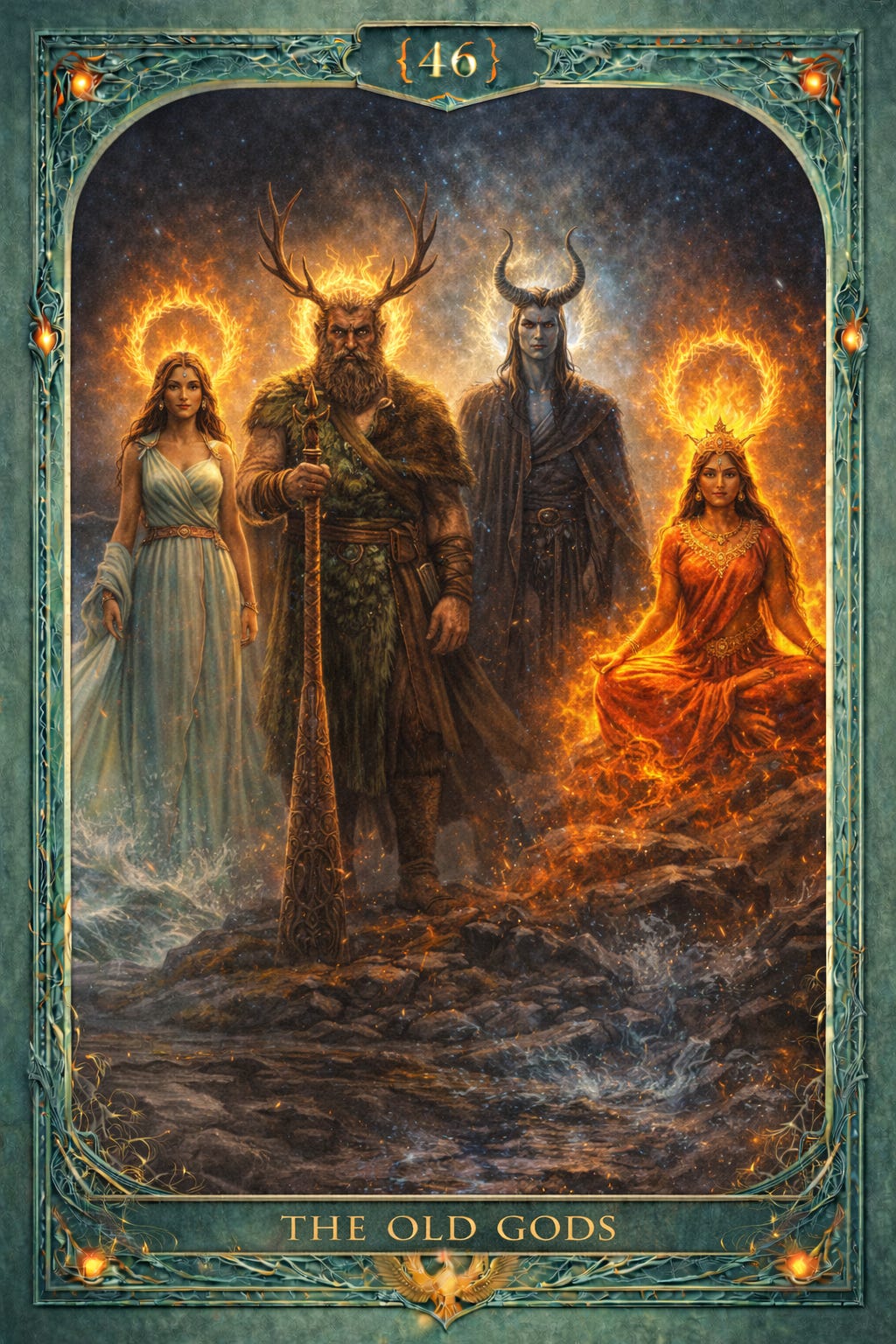
THE OLD GODS: {46}
The term ‘The Old Gods’ generally refers to deities, spirits, or cosmic entities that predated a currently dominant religion or civilisation, symbolising older, often nature-oriented, or forgotten traditions—frequently used to refer to pre-Christian, pagan religions (Norse|Celtic|Hellenic) as a sign of respect or reverence. They often feed on belief, and without it, weaken, grow old, and even die, and in many contexts, are seen as demanding and at times dangerous, often associated with ancient rituals like blood sacrifice. Unlike ‘new religions,’ which are regularly organised and structured, with a focus on purity, The Old Gods are wilder and hot-blooded—often tied to nature, such as the Rivers, Forests, and Mountains, or primordial principles like Love, War, and Wisdom, representing a Direct, Raw Connection to the Natural World rather than a distant, transcendent deity.
THE ODYSSEY: {46}
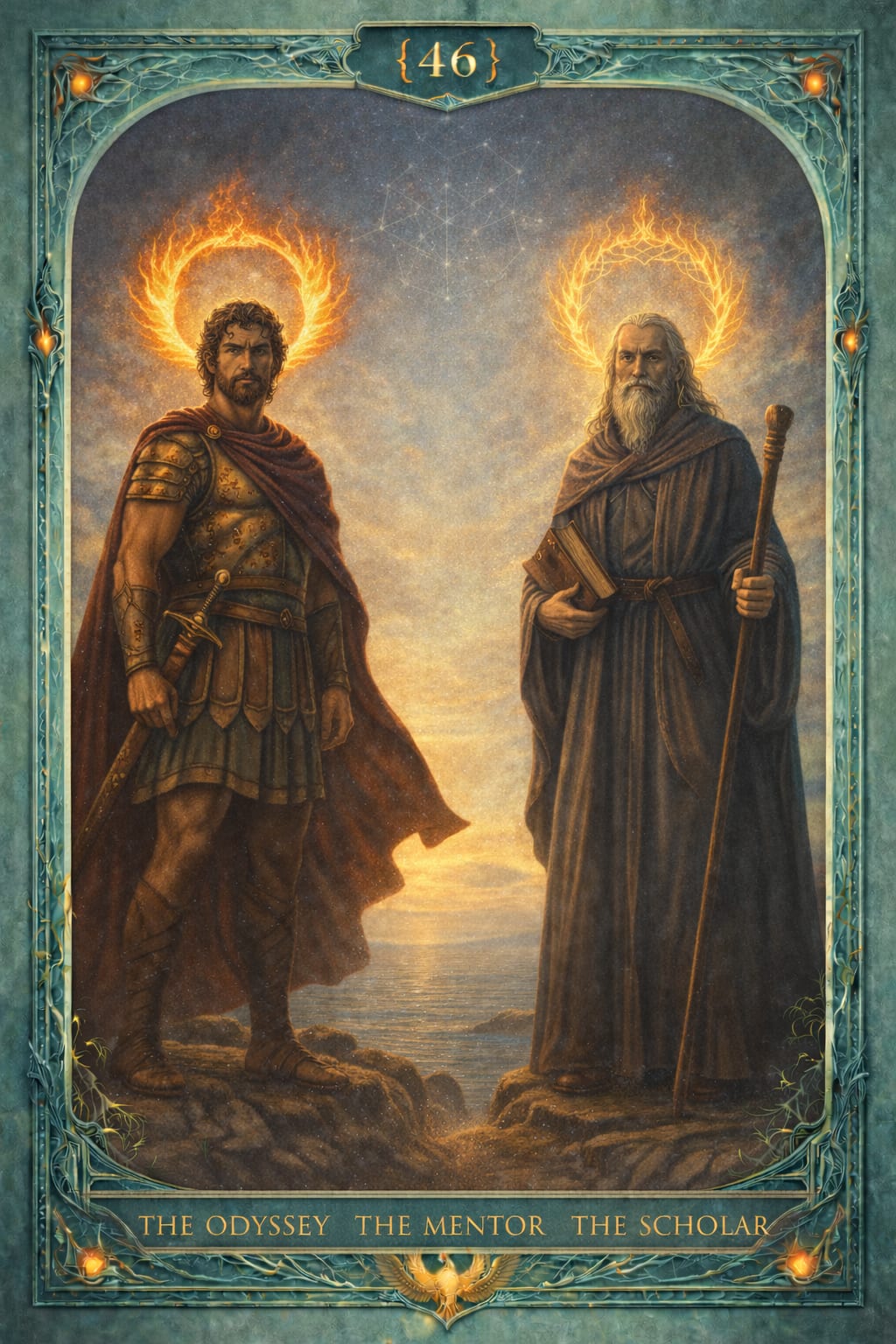
The Odyssey is an ancient Greek epic poem by the fabled poet Homer chronicling Odysseus’s Ten-year Journey home from the Trojan War. The Epic symbolises the human struggle for Survival, Personal Growth, and the pursuit of Belonging—serving as a metaphor for the human story, highlighting the need to overcome obstacles (temptations|fears) to achieve or Return to one’s True Self and Home, highlighting the necessity of both wit and Perseverance, and embodying the Unpredictability, the Trials, and Dangerous Adventures of life.
THE MENTOR: {46}
The Mentor archetype is a wise, experienced guide—often a former hero or parental figure, who provides the Protagonist with knowledge, training, tools, or magical gifts necessary for their Journey. They symbolise the Passing of knowledge, tradition, or power from one generation to the next, helping The Hero navigate complex moral dilemmas and serving as an ethical guide. The Mentor often dies or leave at turning points in the story, forcing the Protagonist or group to stand on their own and apply the lessons they have learned—archetypal expressions including the great Merlin of Arthurian myth, Gandalf (Lord of the Rings), Dumbledore (Harry Potter), and Obi-Wan Kenobi (Star Wars).
THE SCHOLAR: {46}
The Scholar archetype represents the universal human drive to understand the world through logic, data, and knowledge. It is characterised by a desire for objective truth and intellectual stimulation—aiming to analyse and comprehend the ‘what and why’ of existence. The Scholar functions as the ultimate subject matter expert—a researcher, scientist, or academic figure who spends years Mastering a Specific Discipline. Frequently represented by symbols associated with learning and quiet contemplation, such as great, leather-bound books, owls, and feather quills—The Scholar is a mentor figure who will often appears in a storyline with crucial, sometimes unwanted, advice to guide The Hero, such as with Gandalf (Lord of the Rings), Dumbledore (Harry Potter), or Yoda (Star Wars).
REDEEMER: {46}
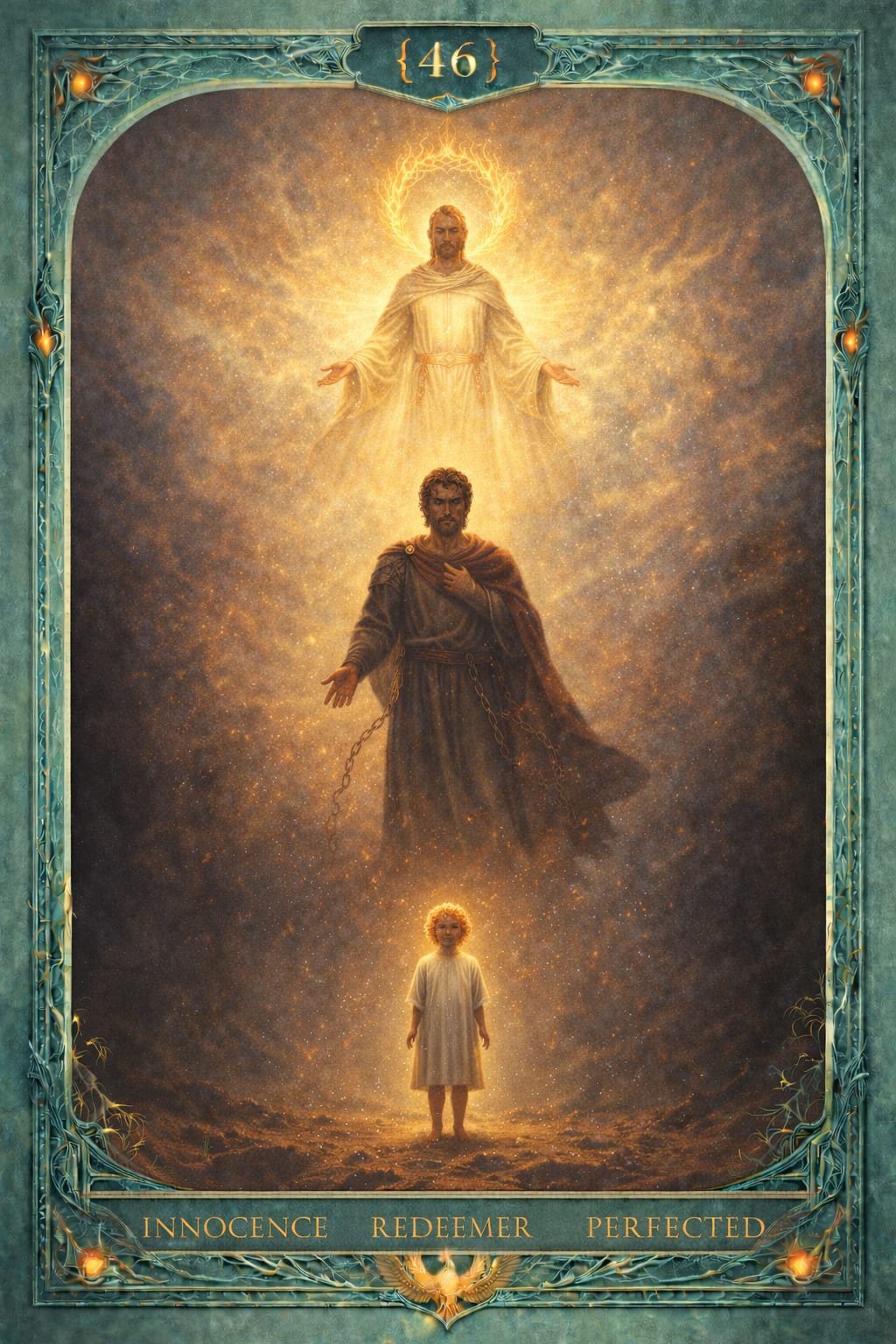
The term Redeemer carries profound theological and symbolic significance, primarily rooted in biblical, legal, and spiritual contexts. At its essence, it refers to one who rescues, saves, or buys back something or someone that was lost, enslaved, or sold into bondage—often by paying a price. The title is used for Jesus Christ, who is believed to have paid the ultimate price (his own blood|life) to redeem humanity from the slavery of sin and its consequences, while in the Old Testament, God is frequently depicted as the ultimate Redeemer of Israel, rescuing them from physical, social, and spiritual bondage, such as in the Exodus from Egypt.
PERFECTED: {46}
The term Perfected refers to the maturation, or finalisation of a process, moving beyond mere flawlessness to signify a purpose or intended goal has been achieved. Derived from the Latin: perficere (‘to finish|bring to an end’), it implies a Transition from a state of development to a state of Wholeness. Perfection rarely means sinless, human-level flawlessness. Instead, it symbolises spiritual maturity, and being ‘Complete’ or fully developed according to God's purpose. In Hebrews 10:14, it indicates that through Christ's sacrifice, believers are ‘Perfected for all time’ in their standing before God, even while they are still being sanctified (sanctification an ongoing process). In Gnosticism|Christian Mysticism, a ‘Perfected One’ represents an elevated state of being that has received divine grace and embodies pure light or truth. And in Hinduism|Buddhism, Perfected Beings (Siddhas) are those who have Attained liberation (moksha|nirvana), Transcended karma, and Freed themselves from the cycle of rebirth—representing the very Pinnacle of spiritual development.
INNOCENCE: {46}
Often associated with childhood, Innocence represents a state of being untainted by evil, sin, or corruption, signifying purity, naïveté, or worldly experience—often symbolised by youth, lambs, doves, and the colour White, representing a ‘blank slate’ or untainted, gentle perspective before encountering the harsh realities of life, while in a legal context, Innocence is the absence of guilt regarding a crime or wrongdoing. It is often viewed as a ‘state of bliss’ characterised by contentment and a lack of prejudice, likened to a mind not yet corrupted by cynicism—and sometimes viewed as a Return to an ideal, pre-burdened state of existence.
PHOENIX: {46}
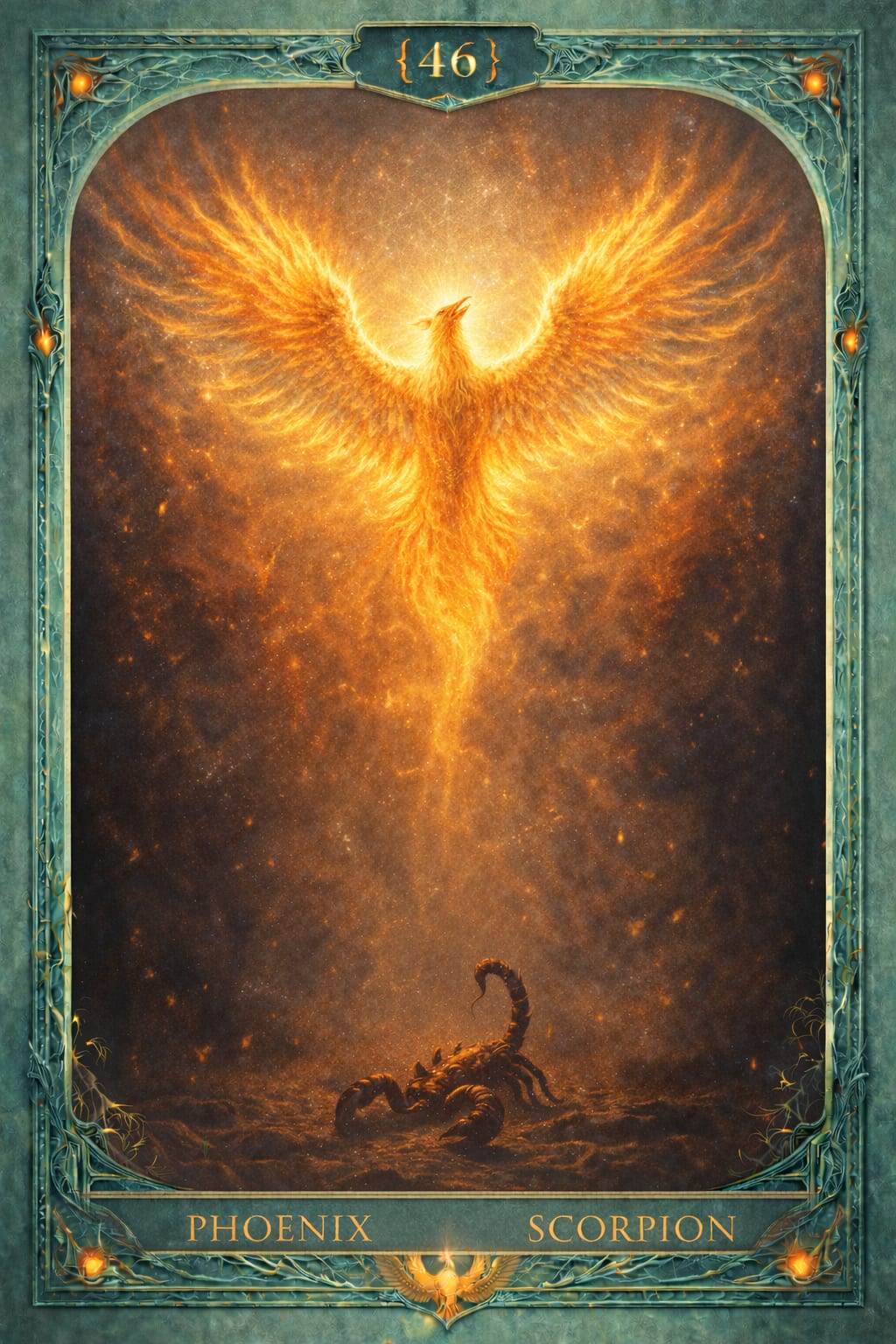
The Phoenix is a mythical, fire-consuming bird symbolising Eternal Renewal, Resurrection, and Resilience. Rising from its own ashes, it represents the triumph of life over death, and hope. Associated with the sun and immortality, it has historically represented the Roman Empire, Christ, and Cyclical Regeneration. While astrologically, the Phoenix is considered the Highest, most Evolved, and most Transformative symbol of the Scorpio zodiac sign—though primarily represented by the Scorpion, it also encompasses a three-stage Evolutionary Journey: Scorpion, Eagle, and Phoenix, representing the sign’s capacity for intense spiritual and personal Metamorphosis.
SCORPION: {46}
The Scorpion is a powerful, dual-natured symbol representing both dangerous, lethal destruction and protective, healing, or regenerative power. It signifies resilience, adaptability to harsh conditions, and self-defense, often serving as a fierce guardian against evil spirits, or as a symbol of intense, transformative, and sometimes treacherous emotion. In ancient Egyptian culture, the goddess Serqet (Selket) was a, scorpion deity who healed stings and protected the dead. Similarly, in some Asian traditions, it is considered a guardian against evil and bad luck. While astrologically the Scorpion is the primary symbol for Scorpio, the eighth sign of the zodiac. It represents intense passion, transformation, mystery, and deep emotional power. As a water sign ruled by Pluto (modern) and Mars (traditional), Scorpio represents the Journey from darkness to light, often associated with death, rebirth, and the ability to navigate life's most complex, hidden aspects.
(Author’s Note): In a strange and interesting exception, across Biblical texts the Scorpion is almost universally condemned as a symbol of danger or demonic forces—Jesus himself placing them alongside the Serpent in evil and lowliness, granting his followers authority to ‘Tread on them.’ Not sure I’m about that.
THRESHOLD: {46}
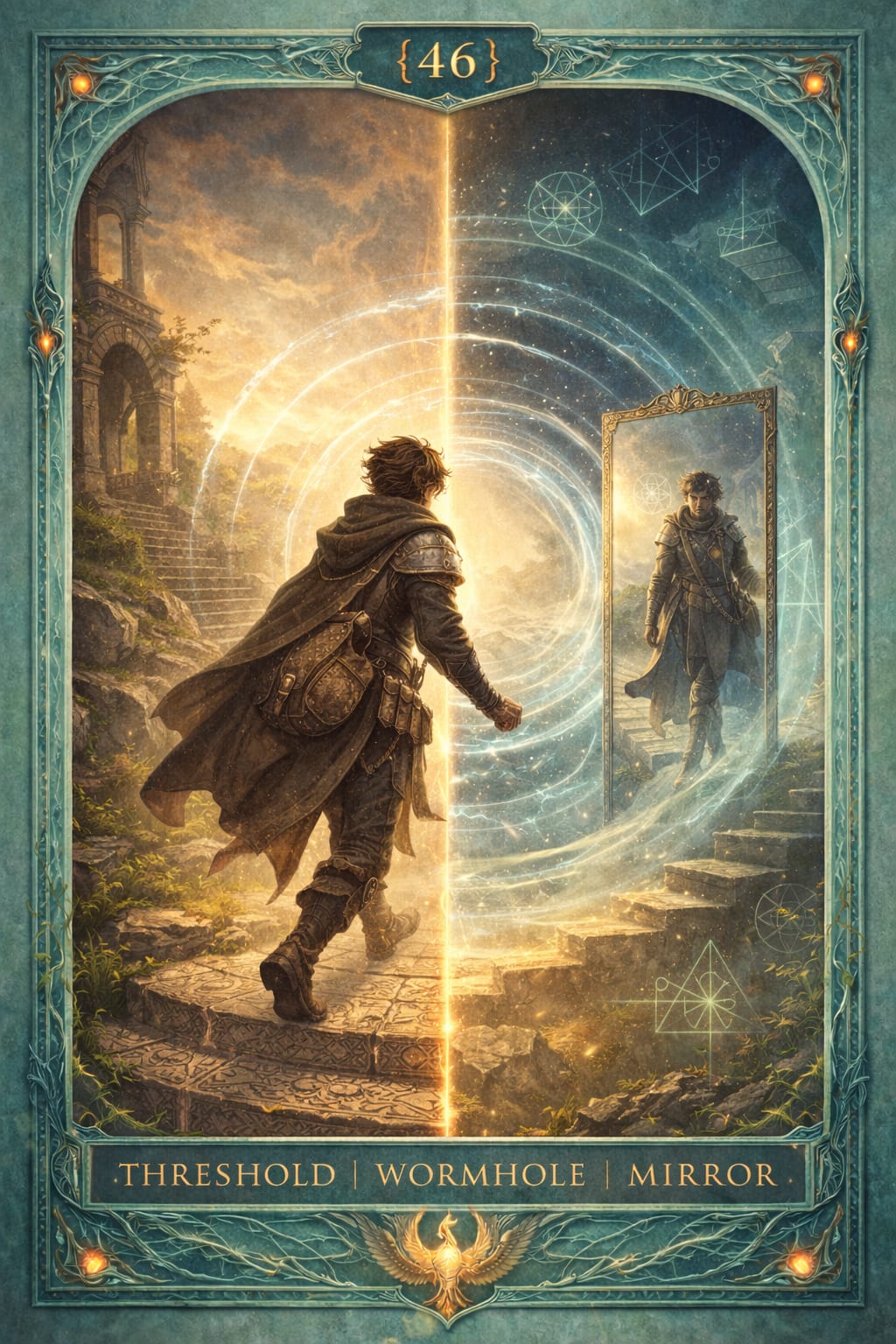
The Threshold is a fundamental narrative and psychological concept representing the boundary between the known (conscious) world and the unknown (unconscious|adventure) realm—signalling the critical Transition Point and ‘liminal space’ where an individual must face fears, doubts, and obstacles to achieve Growth, Transformation, or Initiation. In storytelling, the Threshold is rarely unguarded. The Threshold Guardian archetype tests The Hero's resolve, courage, and worthiness before they can enter the ‘Otherworld.’ These guardians are not always villains—they may arrive in the form of the The Mentor archetype, obstacles, or internal demons that must be overcome, outsmarted, or bypassed. While in a physical sense, the Threshold is the Single strip of wood, metal, or stone that forms the Foundation of a doorway—the sill one must step over to enter a Room, House, or Building
WORMHOLE: {46}
A Wormhole is a theoretical, topological feature of spacetime that Connects Two Distant Points in the universe, acting as a shortcut through space, time, or both. Conceptually, it is often referred to as an Einstein-Rosen bridge, first proposed in 1935 and coined by John Wheeler, the term derives from imagining a worm eating through an apple—how on traveling its surface the worm must Journey around the curved exterior, but by burrowing ‘Through the Centre’ it takes a significantly shorter path. The Wormhole symbolises the ability to Bypass limitations, serving as ‘interstellar highways’ in science fiction that allow Travel Across vast cosmic distances within a human lifespan.
MIRROR: {46}
Mirror carries profound symbolic weight, transcending its physical function of reflecting light to represent, among other things truth, self-awareness, vanity, and deception. Historically, the Mirror has been regarded as magical objects, Gateways to other dimensions, or tools for Divination. While the archetypal meaning of the Mirror spans across psychology, mythology, and spirituality contexts, generally representing self-reflection, truth, the Boundary Between conscious and unconscious, and Transformation—a symbol that reveals both the external persona and the internal ‘shadow self’, often serving as a tool for Introspection and Individuation. While in Literature, ‘one’s Mirror’ is the often The Hero’s dark but equal match—or as in the case of Threw The Looking-Glass, an ‘inverted anti-world’ that can be more honest or fantastic than reality.
SEPARATION: {46}
Separation, often referred to in Jungian and alchemical contexts as separatio, is the necessary, often painful process of cutting apart, dividing, and differentiating elements of the psyche to foster consciousness and maturity—the fundamental movement from a state of unconscious fusion (the massa confusa|original unity) to a state of Distinct, Individual Existence. While in Gnostic contexts, Separation refers to the existential and cosmic alienation of the divine spark (the human soul) from its true home in The Pleroma (fullness|heavenly realm) and its entrapment within the material world. This separation is not merely a moral failure, but a metaphysical condition caused by the ‘Fall’ of Sophia (Wisdom) and the subsequent creation of the flawed material universe by the Demiurge.
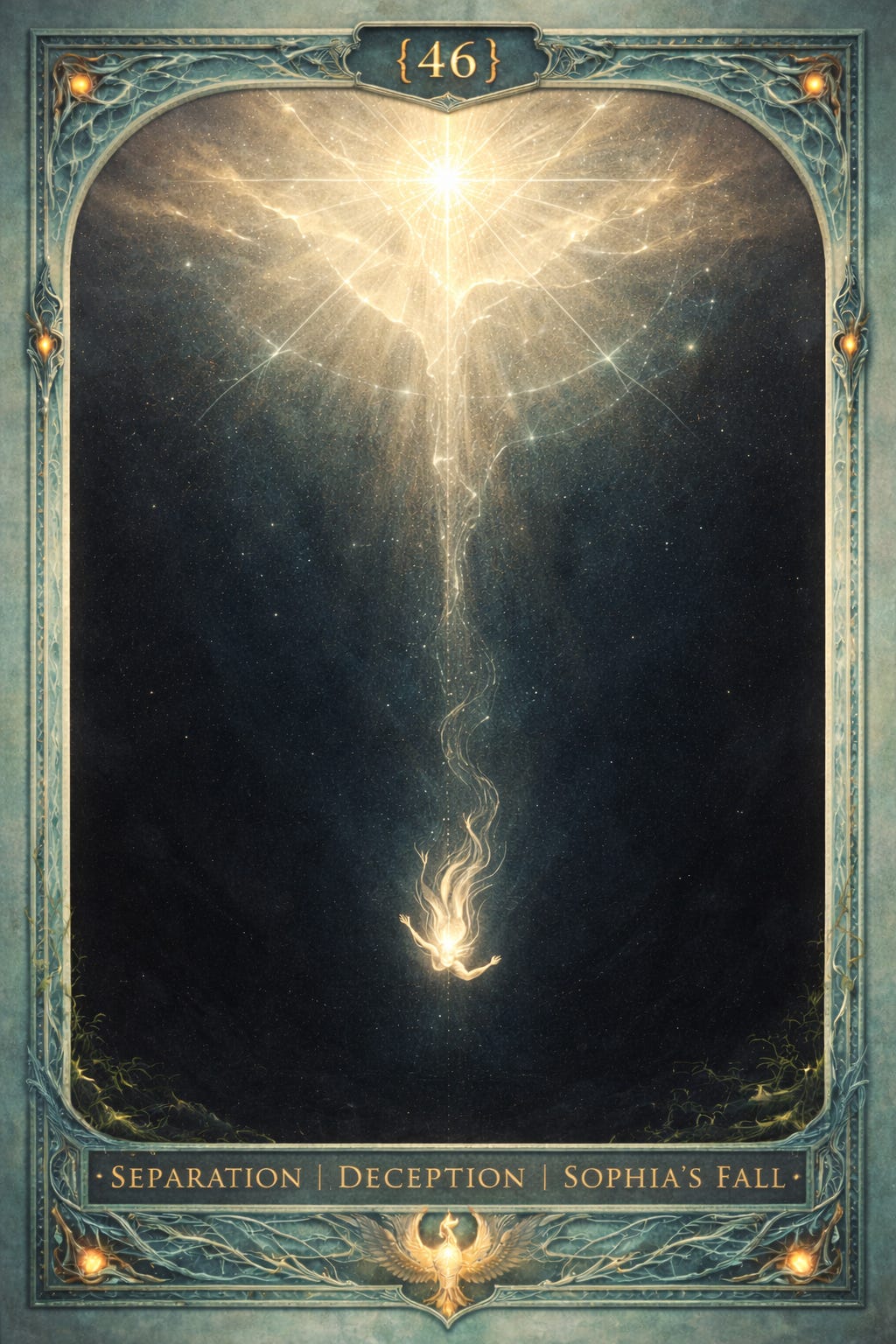
DECEPTION: {46}
Deception represents the intentional act of misleading, tricking, or concealing the truth to manipulate situations, escape consequences, or gain an advantage. It functions as a powerful narrative device to build tension, define character morality, and explore themes of betrayal, trust, and the complexity of human relationships. Stories featuring Deception often suggest that ‘looks can be deceiving,’ ‘everyone is hiding something,’ and that one’s Deception may eventually define their Identity—also explored as a survival mechanism or a way to maintain appearances.
SOPHIA’S FALL: {46}
In Gnosticism, Sophia’s Fall is a Foundational myth detailing how Divine Wisdom (Sophia) descended from the realm of light (Pleroma) into the darkness of the void (Kenoma), resulting in the creation of the material world and the human condition—representing the Separation of the soul from the divine, the Initiation of consciousness, and the longing for reunion with the Source. (Author’s Note): Also known as Sophia’s Decent.
NEW COVENANT: {46}
The New Covenant is a central theological concept in Christianity, originating as a prophetic promise in the Hebrew Bible (Jeremiah 31:31–34) and fulfilled in the New Testament through Jesus Christ. It signifies a new, spiritual relationship between God and humanity, characterised by internal transformation, grace, and direct access to the Divine, replacing the external, law-based Old Covenant (Mosaic Covenant). A key aspect is the indwelling of The Holy Spirit, which empowers believers to live according to God's Will from within, rather than relying on external obedience, representing a Transformation from a ‘heart of stone’ (disobedient) to a ‘heart of flesh’ (responsive to God)—symbolising Spiritual Rebirth.
TEMPERANCE: {46}
Temperance is one of the Four cardinal virtues in Western thought (along with Prudence|Justice|Fortitude)—not merely the absence of desire, but the mastery over and proper ordering of it. Aristotle defined it as the Middle Ground between the vices of excess (self-indulgence|intemperance) and deficiency, while it also names Fourteenth card of the Tarot (XIV), where Temperance is depicted as an angel—often Iris or Michael, pouring liquid between two vessels, symbolising the alchemy of life where one Blends opposing forces such as emotion|reason, active|passive to create a Unified Harmony.
FORTITUDE: {46}
Fortitude is another of the Four cardinal virtues in Western thought, where it , embodies Inner Resilience, Enduring Stability, and the Strength to uphold the other virtues. Derived from the Latin: fortis (‘strong’) and sharing roots with the word ‘fort,’ suggesting a fortified, unshakeable character—Fortitude more universally represents the mental and emotional strength to endure pain, adversity, or danger with courage. It is a ‘firmness of mind’—a combination of bravery and long-term perseverance, often described as Grit or Tenacity.
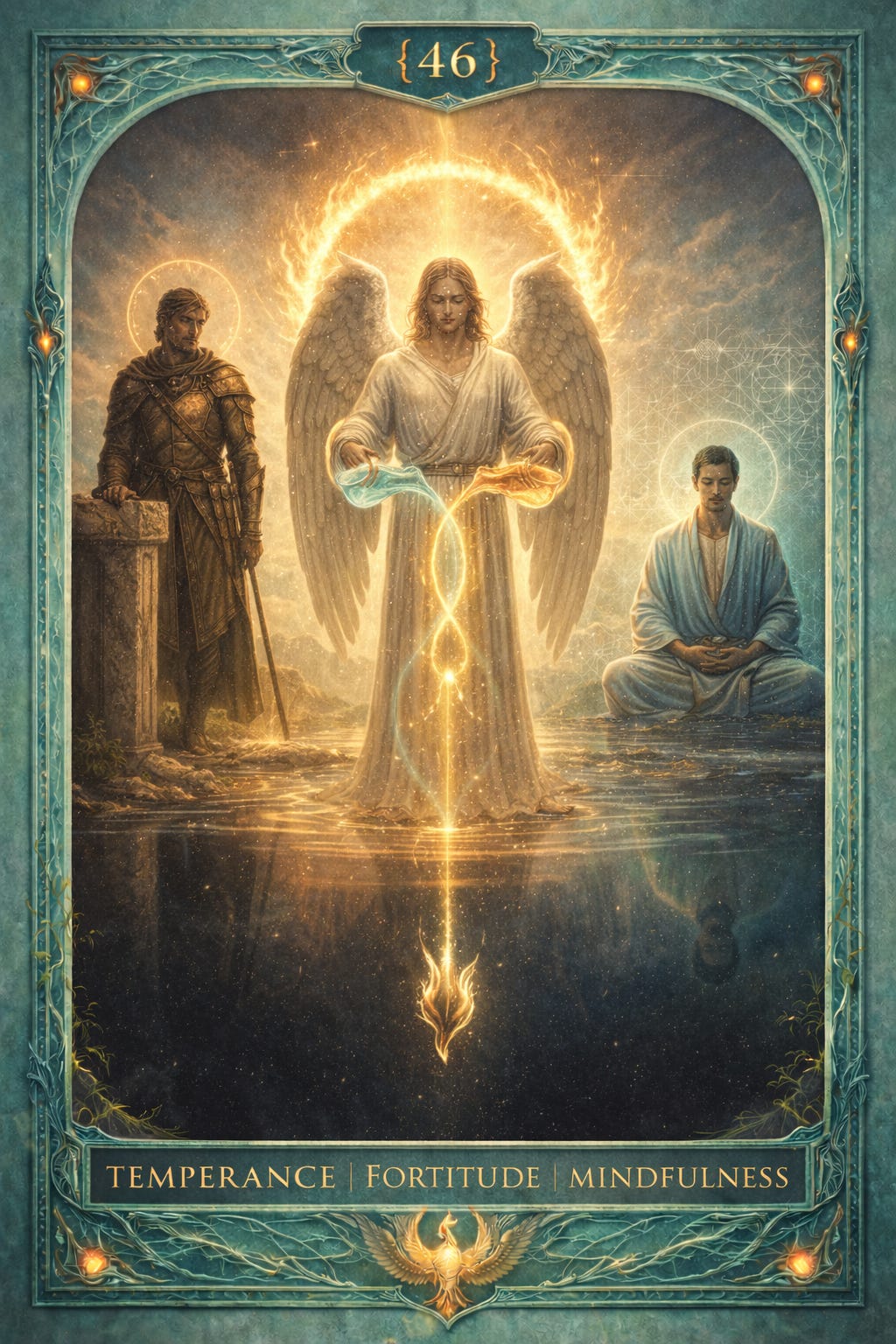
MINDFULNESS: {46}
Mindfulness is defined as the intentional practice of paying attention to the present moment with openness, curiosity, and without judgment. It bridges ancient Eastern meditative traditions—specifically the Buddhist concept of sati (awareness|attention|recollection)—with modern Western psychology, largely popularised by Jon Kabat-Zinn’s Mindfulness-Based Stress Reduction (MBSR) program. It concerns focusing on the here-and-now, observing one’s thoughts, emotions, and sensations without labelling them either ‘good or bad.’ and is often considered a compound of ‘Heart and Mind,’ emphasising that awareness should be accompanied by compassion and kindness.
HIGHER: {46}
In the 17th-century referring to ‘euphoria or intoxication’, Higher denotes a greater position, rank, or degree, symbolising superiority, Advancement, and Spiritual Elevation. Literally, it means elevated physically, while metaphorically, it implies enhanced quality, complexity (as in education|math), increased value, or divine, noble, and transcendent states—signifying a Shift from the Mundane to Superior, or a noble and moral purpose, as in a ‘Higher Calling.’
PROFOUND: {46}
The word Profound, derived from the Latin: profundus, meaning ‘deep or before the bottom,’ generally signifies something that is intellectually deep, emotionally intense, or Far-Reaching in Impact. While it can mean physically deep, it is almost exclusively used in modern English to describe abstract depth, such as Profound Thought, Profound Sadness, or a Profound Change. It carries a weightier, more serious, and formal connotation than the word deep, and represents wisdom or truths that are not immediately obvious and require Study to grasp.
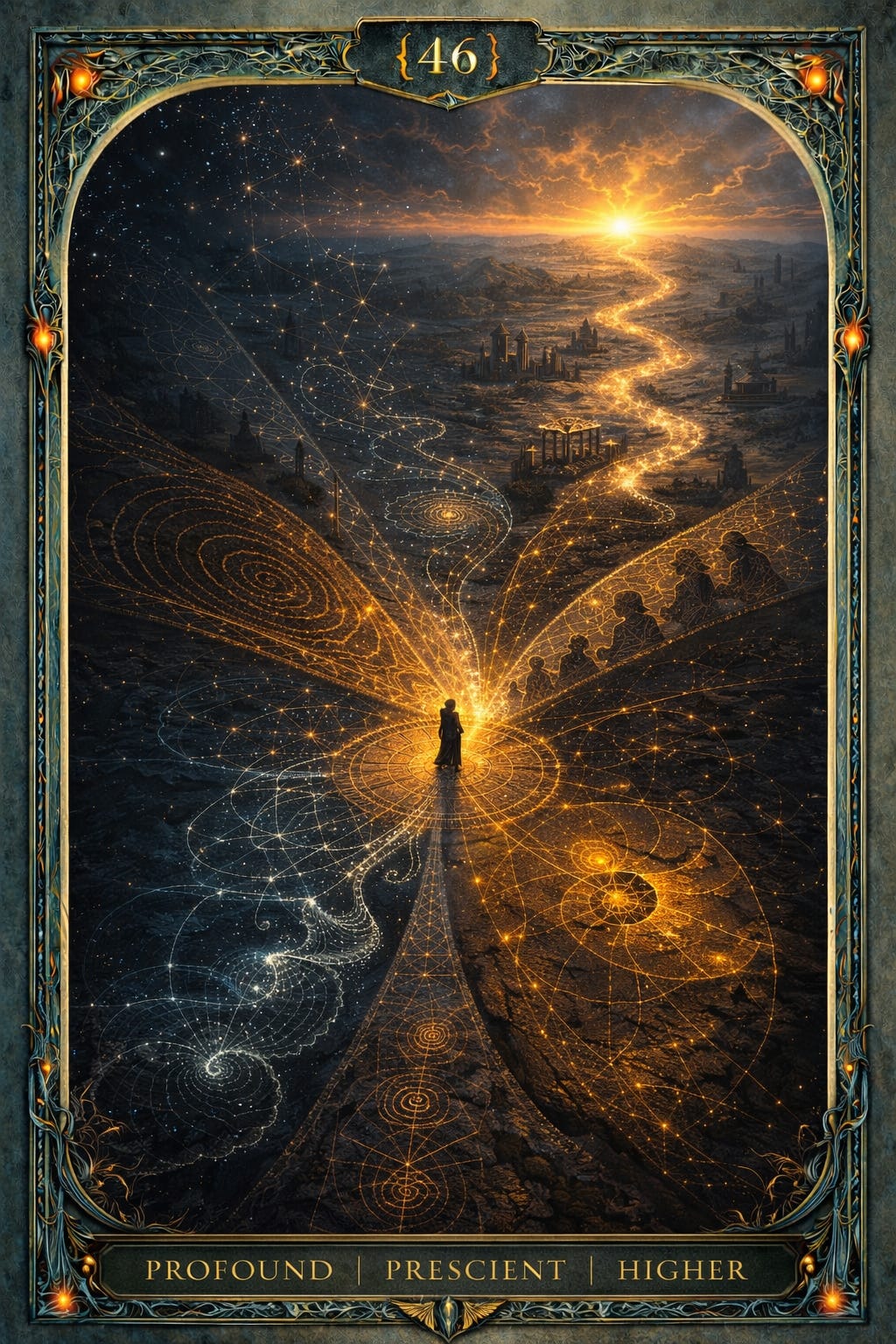
PRESCIENT: {46}
Prescient is an adjective used to describe someone or something that has knowledge of events before they take place, or shows keen foresight and anticipation of the future—suggesting a high level of insight, rather than just lucky guessing. The word originates from the Latin: praescire (‘to know beforehand’), which combines prae (‘before’) and scire (‘to know’)—closely related to the roots of ‘science and conscience.’ While historically inferring mystical, seer-like abilities (clairvoyance), in modern usage, it increasingly represents deep, informed, analytical understanding rather than magic.
ALL-KNOWING: {46}
All-Knowing refers to the capacity to possess complete, infinite, and unlimited knowledge of all things—past, present, and future. It is derived from the Latin: omnis (‘all’) and scientia (‘knowledge’). Symbolically, it represents the pinnacle of wisdom, ultimate divinity, and an ever-present, unwavering conscious awareness of the entire universe. The concept of an All-Knowing Deity often raises theological questions, such as how humans can have free will if their future actions are already known—some Christian interpretations responding that an omniscient God can choose to limit knowledge (‘controlled lack of knowledge’) to fully share in human nature and allow for genuine human choice.
SUPERHUMAN: {46}
Superhuman refers to abilities, traits, or beings that Exceed the natural, standard Limitations of human beings in physical, mental, or spiritual capacity. Symbolically, it represents the aspiration to Overcome Limitations, the pursuit of perfection, or the divine, appearing in contexts ranging from mythology and philosophy to science fiction and modern technology. Historically, Superhuman traits were associated with gods, angels, or divine grace—particularly in religious narratives like Buddhism and Hinduism, where enlightened beings display magical or extraordinary abilities. While in modern contexts, the Superhuman heroes of comic books and film have served as cultural archetypes and role models across generations.
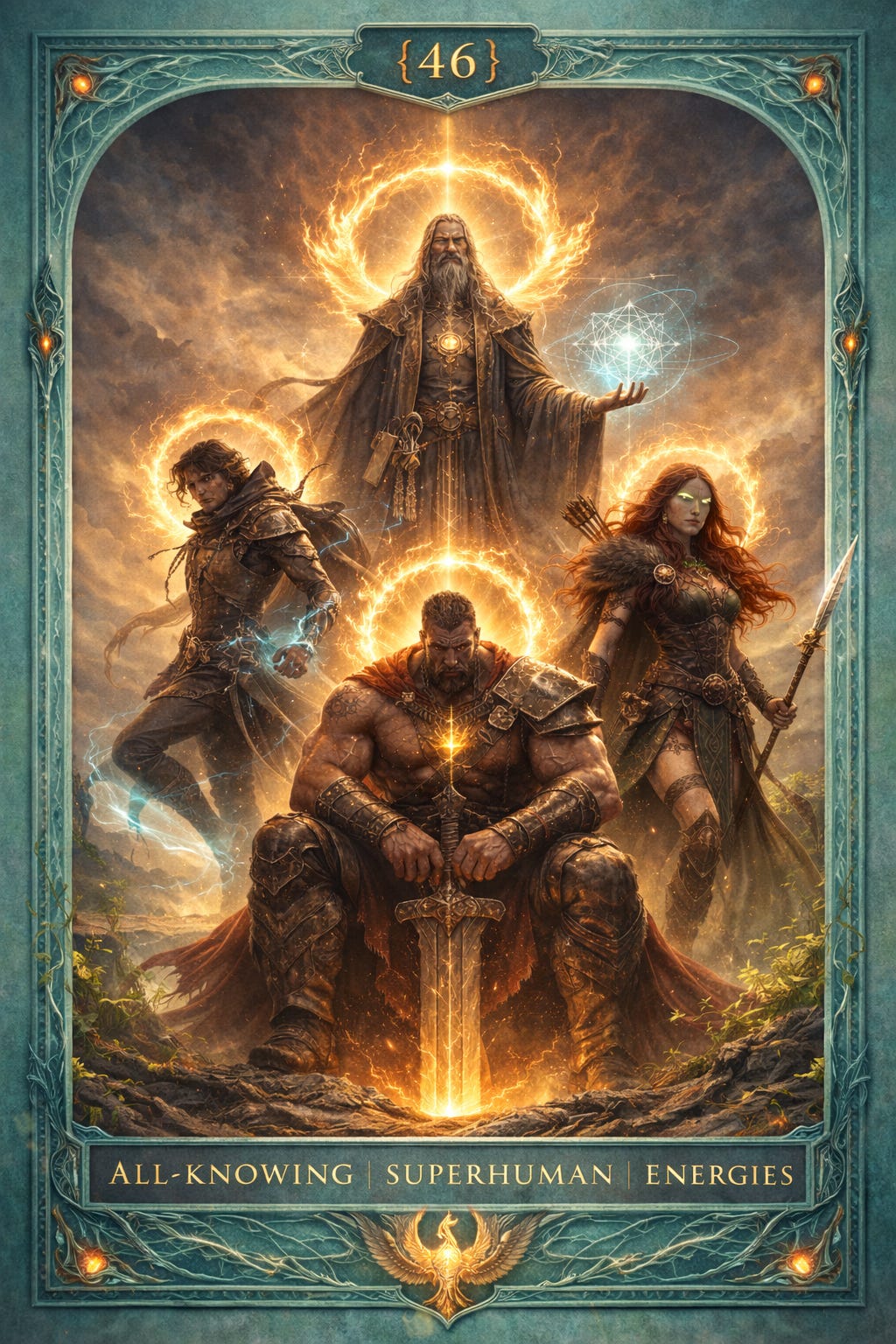
ENERGIES: {46}
Energies (plural of energy) generally refers to the diverse, active capacities of physical, mental, or spiritual power that Drive, Motivate, and Transform—representing both the Internal Strength or effort exerted by an individual and the Unseen, Atmospheric, or ‘vibrational’ qualities often associated with places, emotions, or spiritual concepts. In many traditions, energies are symbols of the Invisible Current that animates all living things. It represents the Fundamental force connecting all existence, such as Prana in Ayurveda or Qi in Chinese tradition—signifying the the innermost essence, motivation, and consciousness of an Individual.
RADIATION: {46}
Radiation is energy moving as waves or particles, representing Hidden Danger, Intense Power, and Scientific Advancement—the Emission and Transmission of energy Through Space or a Material Medium, in the form of electromagnetic waves or energetic particles. Originating from the Latin: radiatio (‘ray of light’), it broadly means the act of Spreading Outward from a Central Source. While often associated with harm, Radiation is a natural phenomenon present everywhere, ranging from harmless light to high-energy nuclear explosions.
MICROWAVE: {46}
The Microwave falls between infrared radiation and conventional radio waves in the electromagnetic spectrum. It is non-ionising, meaning they lack enough energy to break atomic bonds, but can induce dielectric heating in molecules like water. While as an appliance, the Microwave is a machine that generates these waves to cause Friction and Generate Heat from the Inside Out.
VOLATILITY: {46}
Volatility refers to the state of being unpredictable, Changeable, or unstable, characterised by rapid and significant fluctuations. It signifies a high degree of variability, often implying a tendency to change frequently or unexpectedly, whether in financial markets, personal temperament, or chemical properties. Rooted in the Latin: volatilis (‘fleeting|transitory|flying’), the word originally described winged creatures, and later substances that could ‘fly away’ through evaporation—symbolising that which cannot be held or captured permanently, the evanescent and the fleeting.
LOST AND FOUND: {46}
Lost And Found refers to a designated place, such as an office or bin in public venues (airports|schools), where misplaced items are stored for retrieval by their owners. Symbolically, it represents the hope of Recovery, the Transition from loss to Rediscovery, and themes of Redemption, Transformation, or Returning Home after a long period of being Lost. It highlights the journey of an object (or person) that has Gone Through a period of being detached from its owner, often resulting in a new appreciation for it upon reunion—that items missing for a great time are cherished more deeply once finally Recovered.
NOW AND THEN: {46}
Now and Then is an English idiom that primarily means occasionally, from time to time, or once in a while. It indicates that an event or action occurs sometimes, but not regularly, frequently, or consistently—describes actions that happen intermittently, such as ‘I go travelling Now And Then.’ Beyond its simple definition as an adverbial phrase, Now And Then carries certain symbolic or contextual undertones—such as a lingering, intermittent connection to the past or a person that doesn't dominate the present but still exists, as in, ‘I still think of you Now And Then,’ or in some contexts, may suggest that while something isn't constant, it persists over a long period, e.g., ‘The old girl still runs Now And Then,’ representing Durability despite Aging.
SNOW WHITE: {46}
Snow White originates from the classic European fairy tale collected by the Brothers Grimm ‘Little Snow-White’ (Sneewittchen), and carries profound symbolic meaning centred on Innocence, Purity, and the Transformative power of nature. The name is derived from the mother’s wish for a child with skin as White as Snow, lips as red as blood, and hair as black as ebony. Symbolically, she represent the triumph of good over evil, the Transition from childhood to maturity, and the alchemical stages of of Purification (Albedo), where the old self is stripped away to reveal a Purified, Luminous Soul—in stark contrast to the vanity and cruelty of the Evil Queen, and despite being pursued, exiled, and poisoned, Snow White survives, representing the Endurance of goodness in the face of adversity.
LISTENING: {46}
Listening is a complex, Active, and intentional process that goes far beyond the involuntary, physiological act of hearing. It involves receiving, interpreting, evaluating, and responding to both verbal and nonverbal messages. It is an Attentive heart or attitude that fosters Deeper Relationships and self-awareness, often involving ‘being present’ with others—symbolically and practically representing deep respect, empathy, and the Foundation of human connection and understanding.
ENGAGING: {46}
Engaging functions primarily as an adjective to describe something or someone that captures interest, attention, or admiration, often characterised as charming, attractive, or pleasant. It originates from the 17th-century verb ‘engage,’ rooted in the concept of pledging or binding oneself. It represents a Transition from passive observation to Active Participation, inferring a ‘hook’—a point of connection that draws someone in, and a ‘two-way street’—a person or object that is Engaging not merely attractive, but also Interactive, creating a mutual and often intellectual or emotional Bond.
VINDICATED: {46}
Originating from the Latin: vindicatus, the past participle of vindicare, which means ‘to lay claim to|set free|avenge,’ to be Vindicated means to be cleared of accusation, blame, or suspicion, or to be proven right, justified, or reasonable after a Period of doubt or criticism. It often signifies a ‘told-you-so’ moment where truth prevails over skepticism, resulting in a Restoration of reputation or affirmation of one's actions
CONTAINERS: {46}
The plural noun, Containers, refers to any multiplicity of Storage Compartments or Vessels used for Holding, Storing, or Transporting goods—ranging from household receptacles like boxes, jars, and bottles to large, standardised metal units used for shipping and cargo. (Author’s Note): Bob Lazar, an American physicist who claims to have worked at Area 51, once noted a binder that spoke of some subset of non-human intelligences viewing human beings as ‘Containers’—if true, that sure makes this an all the more fascinating pool.
INCIDENTAL: {46}
Incidental refers to something that occurs in connection with, or as a result of, something else that is more important. It implies that an Action or item is subordinate in significance. While sometimes used to describe things happening by chance, that which is 'Incidental' primarily emphasises a secondary relationship to a main event or purpose While in storytelling, Incidental characters or details add depth, flavour, or realism to a scene—without being central to the plot.
ECOLOGICAL: {46}
Derived from the Greek: oikos (‘house|dwelling place’), Ecological refers to the scientific study of relationships between living organisms and their environment, emphasising Interconnection and Sustainability. Symbolically, it represents environmental consciousness, stewardship of Nature—and a ‘web of life’ perspective, often visualised through green branding, natural materials, or the ‘e|o’ symbol representing Harmony Between organisms and their surroundings.
ZINC IONS: {46}
Zinc Ions are essential Transition metal cations acting as crucial Structural, Catalytic, and Regulatory cofactors in over 3,000 proteins, influencing immune function, gene expression, and enzyme activity—representing Stability, cellular signalling (‘zinc signals’), and Defense, serving key roles in growth, neurogenesis, and mitigating oxidative stress.
CHARTREUSE: {46}
Chartreuse is a, vibrant, and, high-visibility colour that sits directly between yellow and green on the colour wheel. Its name and distinctive hue are derived from a French liqueur, Chartreuse, created by Carthusian monks in the 18th century. In literature and design, it is often associated with a bold, sometimes unsettling or ‘sickly quality,’ yet it is also used to signify a ‘new green’ or fresh, spring-like, and, daring aesthetic—and is considered a non-routine, unconventional colour, often used to signify Originality and to make a Bold Statement, particularly in fashion and modern interior design. (Author’s Note): One of my favourites!
AQUAMARINE: {46}
Aquamarine originates from the Latin phrase: aqua marina, which translates to ‘water of the sea’—accurately reflecting its serene, transparent, and light-blue-to-greenish-blue colour, which evokes the hues of the ocean. As a member of the beryl mineral family, it is revered not only for its beauty in jewellery but for its deep symbolic, historical, and therapeutic associations—the Ancient Greeks and Romans believed the stone was the treasure of mermaids, and associated with Neptune, the god of the sea, sailors carrying Aquamarine as a talisman to protect against drowning, calm rough waves, and to ensure Safe Passage, leading to its nickname ‘the sailor's stone.’ Its clear colour is associated with Purity of spirit, and in ancient times, believed to ensure eternal youth—commonly thought to symbolise happiness and fidelity in marriage, and often given to celebrate love and Unity.
AUBERGINE: {46}
Aubergine refers to the deep, purplish-red fruit—known as the eggplant in North America, Australia, and parts of Asia. Beyond its botanical and culinary definition, the aubergine holds a range of cultural, symbolic, and in modern times, digital meanings—that span from prosperity to sexual innuendo. In Japan, it (nasu) is a symbol of luck, health, and prosperity—strongly associated with the ‘First dream of the year’ (hatsuyume), where dreaming of an Aubergine indicates future success. While in southern India, it is often considered the ‘King of Vegetables’—used for both culinary and medicinal purposes, and a symbol of protection, female fertility, and good health.
CLEMENTINE: {46}
Clementine refers primarily to a feminine given name of French and Latin origin, as well as a small, sweet, and easy-to-peel citrus fruit—a Hybrid of a mandarin and a sweet orange. Its core meaning revolves around kindness, mercy, and a nurturing, gentle spirit—while its symbolism in popular culture often touches on nostalgia, sweetness, or Hidden Emotional Depths.
WALLFLOWER: {46}
A Wallflower is an introverted, shy, or socially cautious Individual who attends social gatherings but stays on the sidelines, often standing against a wall, rather than dancing or mingling. Symbolically, they represent Quiet Observation, Introspection, Hidden Depths, and Patience—stemming from the plant’s habit of blooming in cracks and along walls. (Author’s Note): Me for the better part of my life ahah.
MAYFLOWER: {46}
Mayflower refers to the 17th-century ship that transported the Pilgrims to New England in 1620—symbolising hope, Resilience, and New Beginnings, and representing Foundational American values like freedom, democracy, and the Pioneering Spirit. It also refers to a springtime flower (trailing arbutus|hawthorn), a highly scented, low-growing evergreen shrub found in Eastern North American forests—embodying themes of Renewal, and notoriously difficult to cultivate.
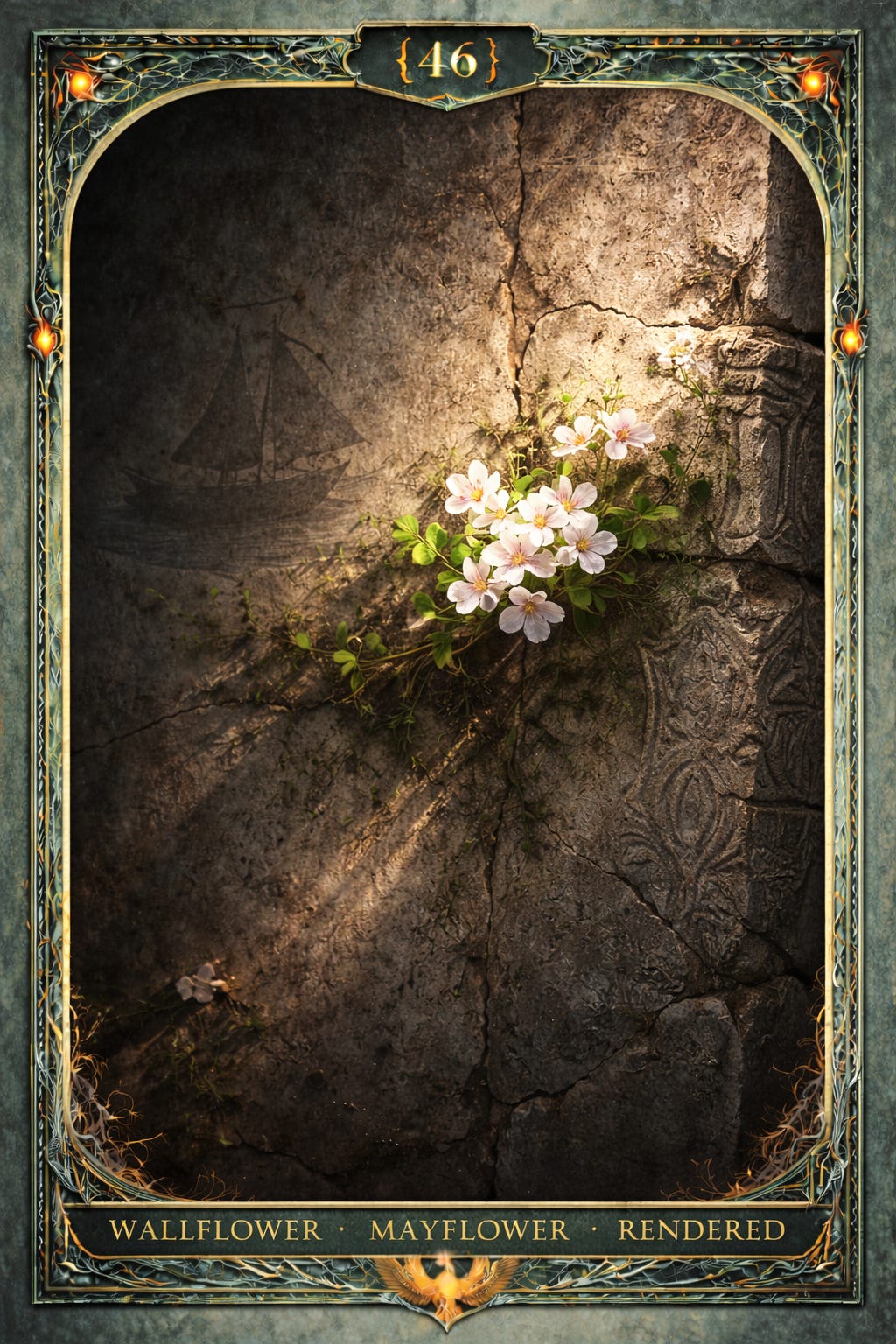
RENDERED: {46}
Rendered, the past principle of render, primarily means to cause someone or something to become in a certain state—e.g., ‘rendered speechless’, to provide or deliver (a service|verdict), or to represent artistically. It symbolises a Transformational Journey, the Formal Delivery of judgment, or the Final conversion of Data into a Finished Form. While historically and technically, Rendered means to yield, surrender, or Return something—its origins derived from Latin: reddere (to give back).
WRITING: {46}
Writing is the method of representing language through visual or tactile symbols, acting as a permanent, structured record of speech and thought. Symbolically, it represents the Foundation of human civilisation, the Transition from ephemeral speech to lasting legacy, and a Tool for knowledge, power, and expression—Shaping abstract ideas and dreams into enduring, teaching, and inspiring Forms.
POETIC EDDA: {46}
RUNESMITH: {46}
ARCHETYPAL: {46}
INNERMOST: {46}
GARGOYLES: {46}
LEVITATION: {46}
PSYCHOTIC: {46}
PIXIE DUST: {46}
SPRIGGAN: {46}
THE MATRIX: {46}
PIONEER: {46}
PENULTIMATE: {46}
LETTING GO: {46}
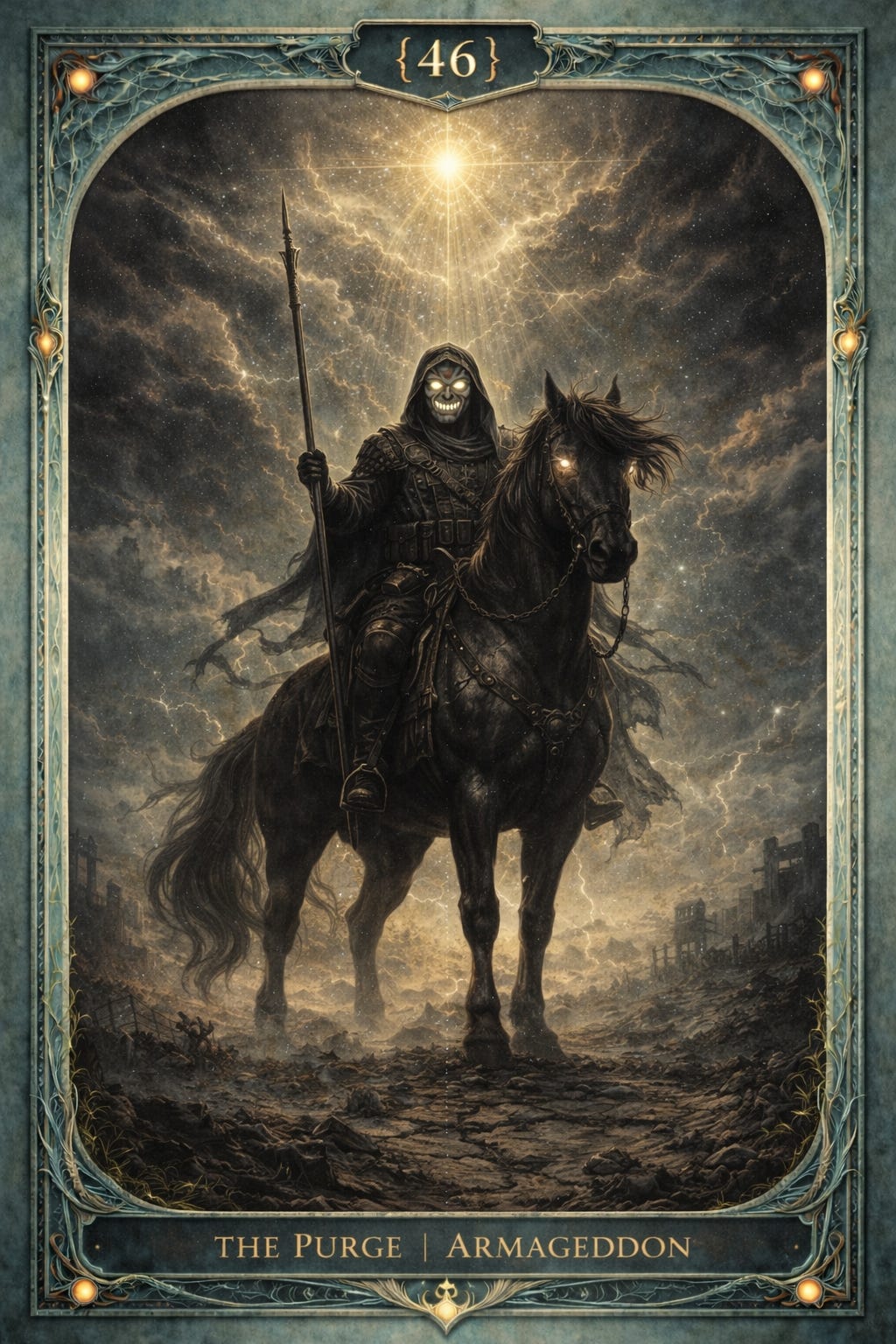
THE PURGE: {46}
The Purge franchise, created by James DeMonaco, uses the premise of a 12-hour period where all crime, including murder, is legal to serve as a dystopian satire on American society—serving as a commentary on classism, violence, gun culture, and the relationship between the government and its citizens, rather than just a horror scenario, urging a rejection of the idea that violence is a solution to societal issues.
ARMAGEDDON: {46}
Armageddon, from the Hebrew: Har-Magedone, (‘Mount Megiddo’) is a biblical term from Revelation 16:16 representing the final, apocalyptic and decisive battle between God and the forces of evil at the close of the age—the ultimate, total victory of good over evil, divine judgment, and a catastrophic, world-ending conflict. Prophesied to take place in the Valley of Megiddo of Northern Israel—historically the site of many crucial military encounters, Armageddon represents the culmination of a long-standing war between Satan and God, with the Jehovah’s witnesses holding a select group of 144,000 anointed Christians will go to heaven to rule with Jesus, while the ‘other sheep’ (remaining Witnesses) will live on the cleansed earth.
PALLADIUM: ATOMIC ELEMENT {46}
Palladium is a rare, lustrous silvery-white precious metal—symbol Pd|atomic number {46}, discovered in 1803 by William Hyde Wollaston. The term originates from the Palladion, a wooden statue of Pallas Athena (the Greek goddess of wisdom and war) that was believed to have fallen from heaven, and housed in the Citadel of Troy—the safety of the city believed to depend on its presence. Due to its essential role in automotive catalytic converters (reducing emissions) and electronics (components in smartphones|laptops), palladium is associated with Innovation, Environmental Responsibility, and Technological Advancement—used in high-end jewellry (often for wedding rings) to represent Timeless Elegance and Purity.
The Linguistic Hinge: FORTY-SIX

{46}: Foundation|Structure: {4} crossing {+} into Harmony|Responsibility: {6} resolving to {10}: Unity|Initiation: {1} crossing {+} into the Void|Unknown|Potential: {0} resolving to {1}: Unity|Initiation—one of the rare and few Frequencies to loop back on itself. Perhaps a demonstration of its Integrated Truth, Structural Integrity and Self-Dependance.
{64}: Number Of The Antichrist
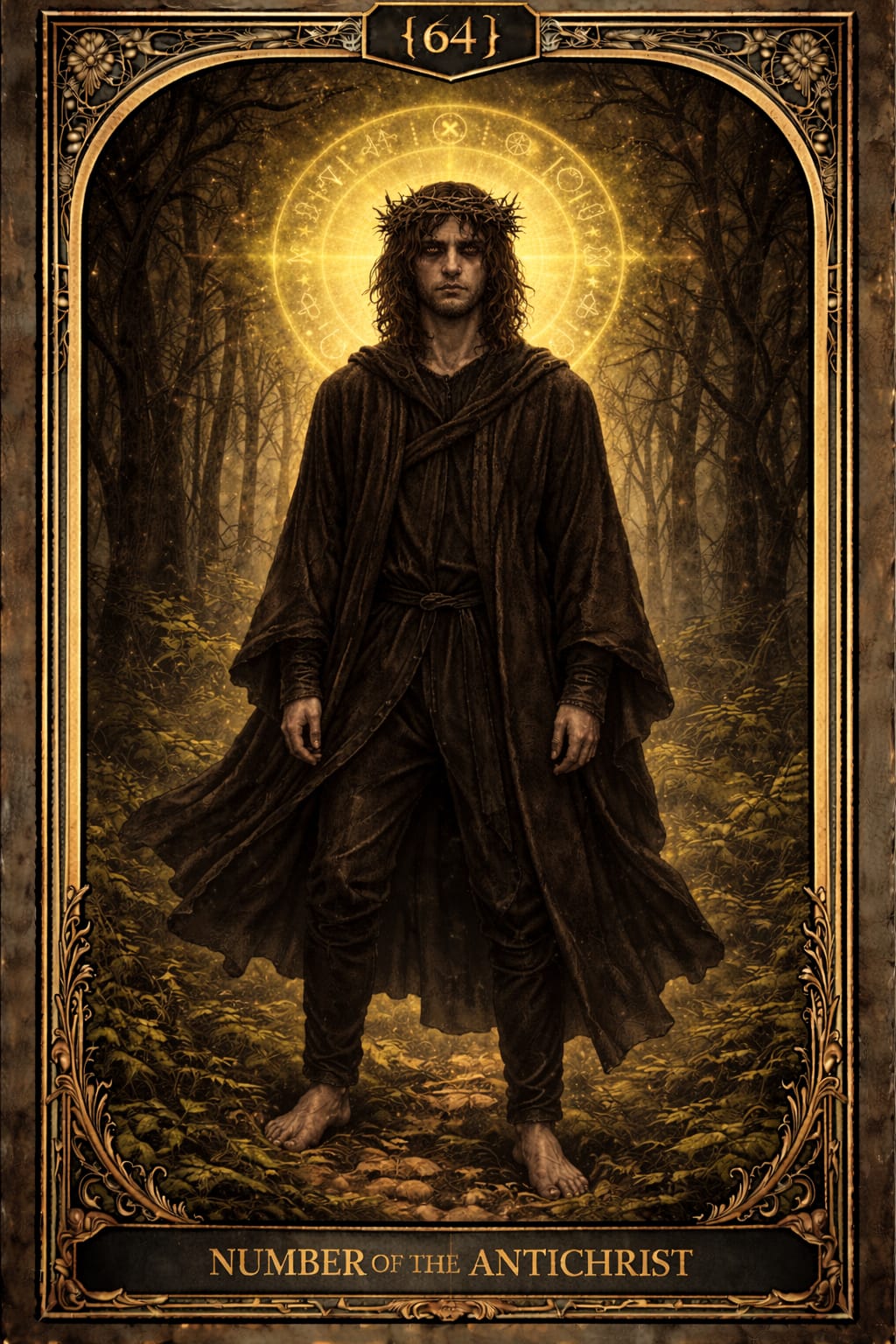


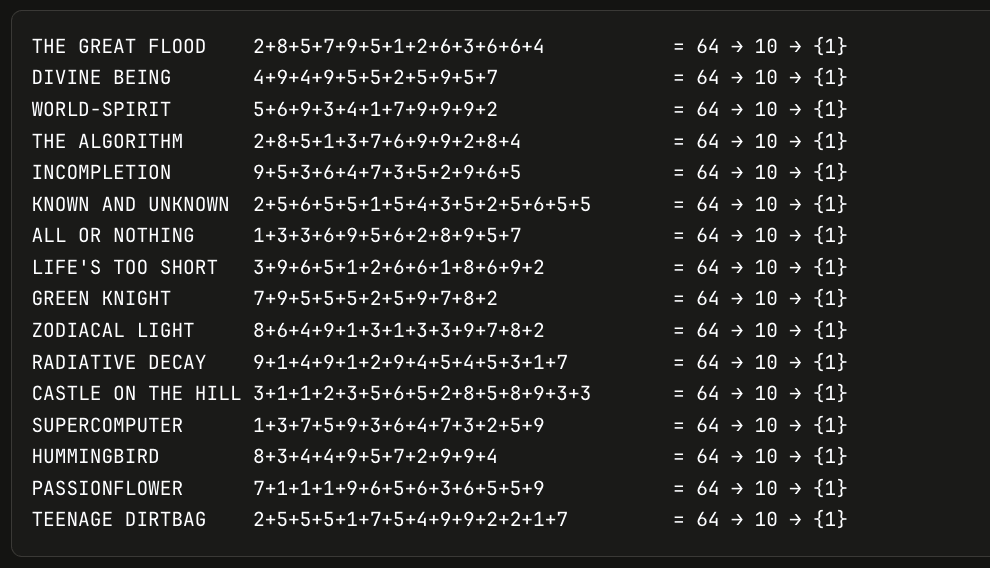

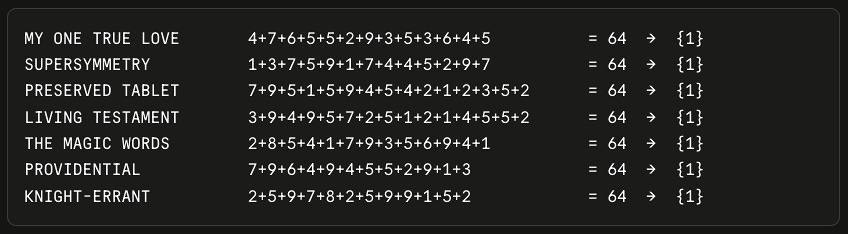
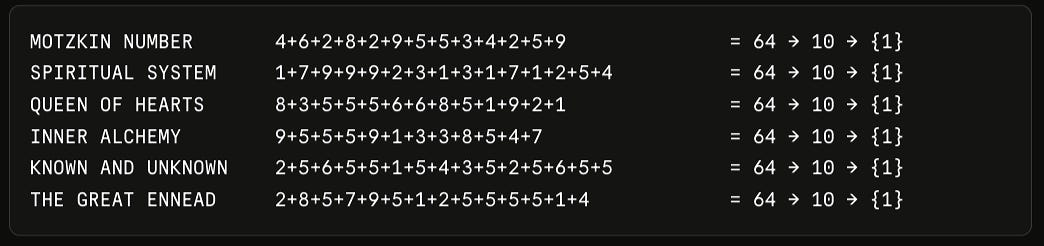


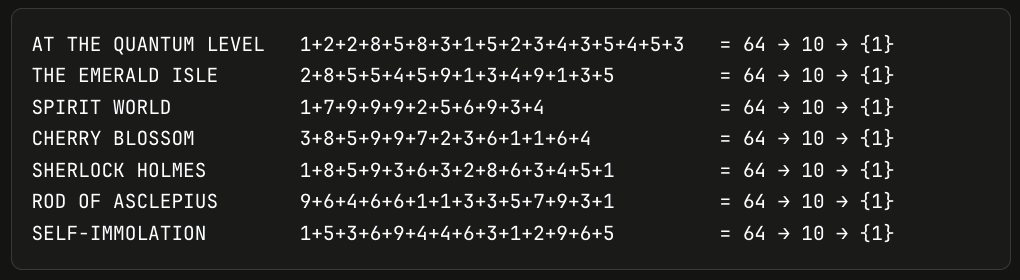
{64}: Harmony|Responsibility: {6} crossing {+} into Foundation|Structure: {4} resolving to {10}: Unity|Initiation: {1} crossing {+} into the Void|Unknown|Potential: {0} resolving to {1}: Unity|Initiation.
{64}: is associated with the {64} Arts (Kalas) in Hinduism, the {64} Hexagrams of the Yijing (I Ching), and {64} Codons in the human body's genetic code, signifying Immense, Transformative energy. Mathematically, it is a Highly Composite integer, specifically recognised as a perfect Square and perfect Cube, while in Computing it is known for defining {64}-Bit Architecture, where processors can address vastly more memory, and handle larger calculations than {32}-Bit Systems.
THE ANTICHRIST: {64}
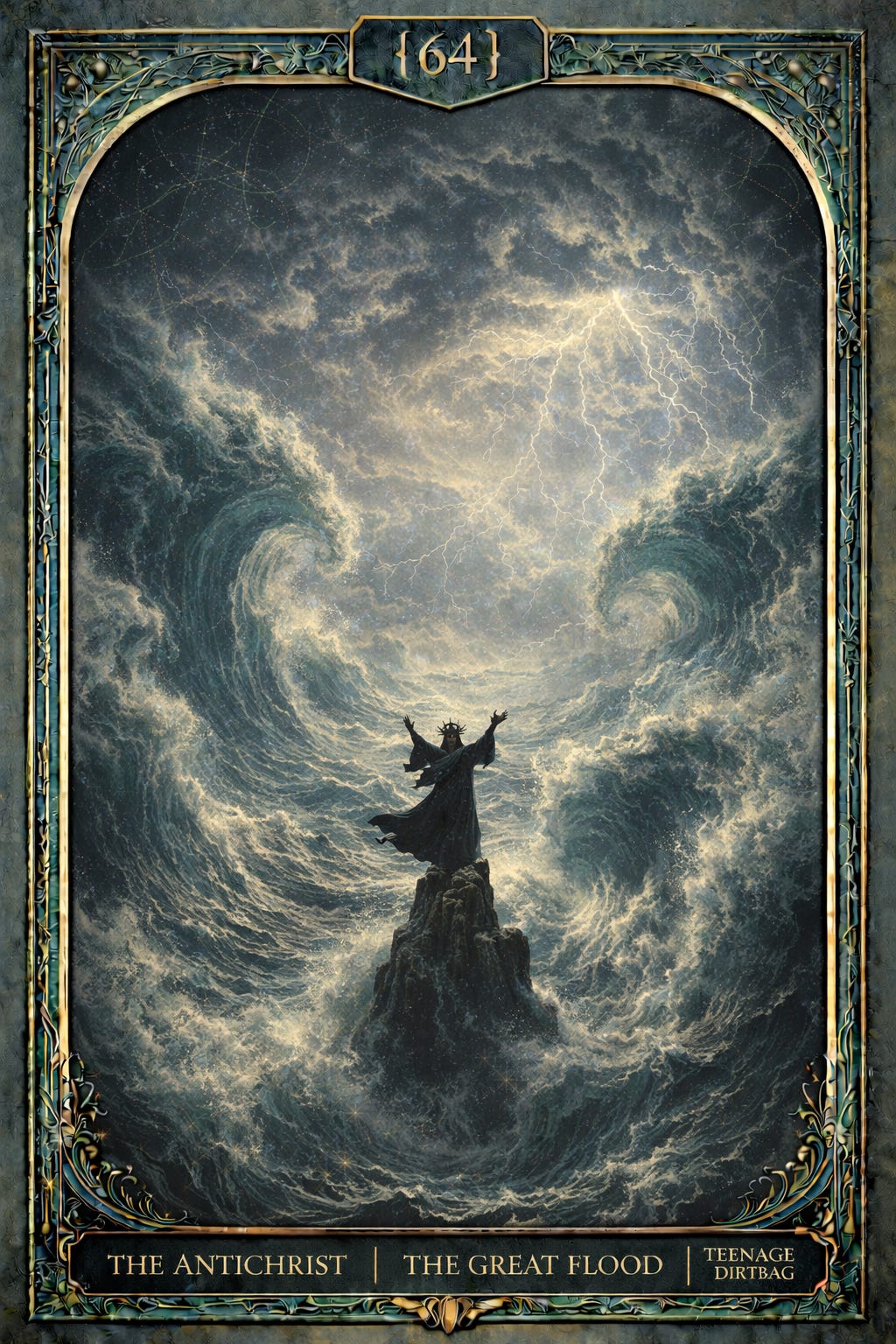
The Antichrist is a biblical and theological concept, primarily in Christian eschatology, referring to an ultimate adversary, figure, or spirit that opposes Jesus Christ, counterfeits his authority, and denies his divinity. Symbolising deception, ultimate evil, and lawlessness, the Antichrist is expected to appear before the Second Coming to deceive people and demand worship. (Author’s Note): And literally falls on the mirrored frequency to The True Son|The Father.
SELF-IMMOLATION: {64}
TEENAGE DIRTBAG: {64}
The term ‘Teenage Dirtbag,’ popularised by the Wheatus song of the same name, represents the quintessential Outsider, underdog, and misunderstood youth of early 2000s pop-punk culture. While it has evolved into a general term for teen angst and nostalgia—its deeper meaning rooted in themes of alienation, social rejection, and the defying of authority, with a Surprising, Dark, and Personal Backstory. The lyrics, specifically ‘two tickets to Iron Maiden, baby,’ signify a, particularly 1980s or 90s, subculture of long-haired, rock-loving teens often wrongfully accused of being ‘Satanic or Troublemakers.’
GREAT COSMIC JOKE: {64}
TRUST THE PROCESS: {64}
THE BEAST WITHIN: {64}
THE GREAT FLOOD: {64}
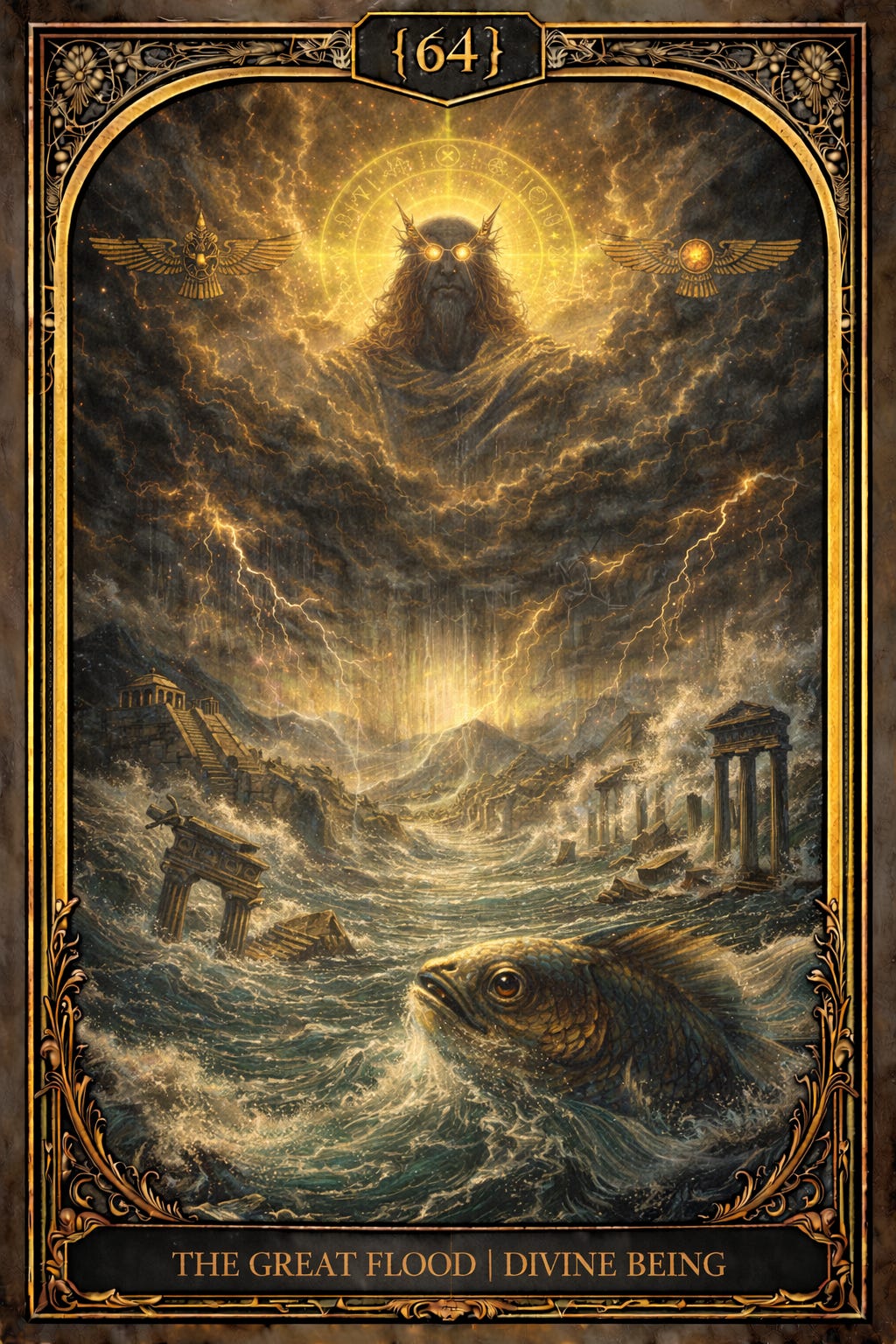
The Great Flood is a ubiquitous, foundational narrative in Global Mythology, Religion, and Cultural Tradition, representing a catastrophic, divine-led, or natural inundation that wipes out a corrupted humanity to allow for a New, Purified Beginning. While often associated with the biblical story of Noah’s Ark, the motif exists in hundreds of distinct cultures worldwide, including Mesopotamian (Gilgamesh), Hindu (Manu), Greek (Deucalion), and various Indigenous traditions, frequently serving as a ‘Reset Button’ for civilisation.
DIVINE BEING: {64}
A ‘Divine Being’ refers to a deity, god, or supernatural entity possessing superior, immortal, or sacred qualities, often deemed worthy of worship—representing ultimate reality, holiness, and supreme power. Found in both religious and metaphysical contexts, the term encompasses creators, spiritual essences, or ‘godlike qualities’ (wisdom|virtue|wrath')—sometimes representing Foundational aspects of the Human Story (‘love|agriculture|war|fertility’) or Nature itself (‘mountains|seas|storms|wilderness’).
WORLD-SPIRIT: {64}
The ‘World Spirit,’ from the German: Weltgeist, is a central concept in the philosophy of Georg Wilhelm Friedrich Hegel—referring to the collective, rational consciousness that drives human history and unfolds through the cultures, ideas, and actions of human societies. Hegel argued that history is not a series of random events, but a rational process guided by the ‘Weltgeist’ toward a specific goal, the consciousness of freedom—not an individual mind, but a non-individual, supra-individual, or collective consciousness, serving as the ‘total moral world of mankind,’ comprising laws, families, and commonwealths. The Weltgeist uses the passions, interests, and actions of individuals—even ‘world-historical individuals’ like Napoleon to achieve its own goals, often without those individuals realising it. While the World Spirit operates within history, it moves toward the ultimate self-knowledge and freedom of the spirit—often manifested though art, religion, and philosophy. (Author’s Note): Absolutely believe this after my own experience.
THE ALGORITHM: {64}
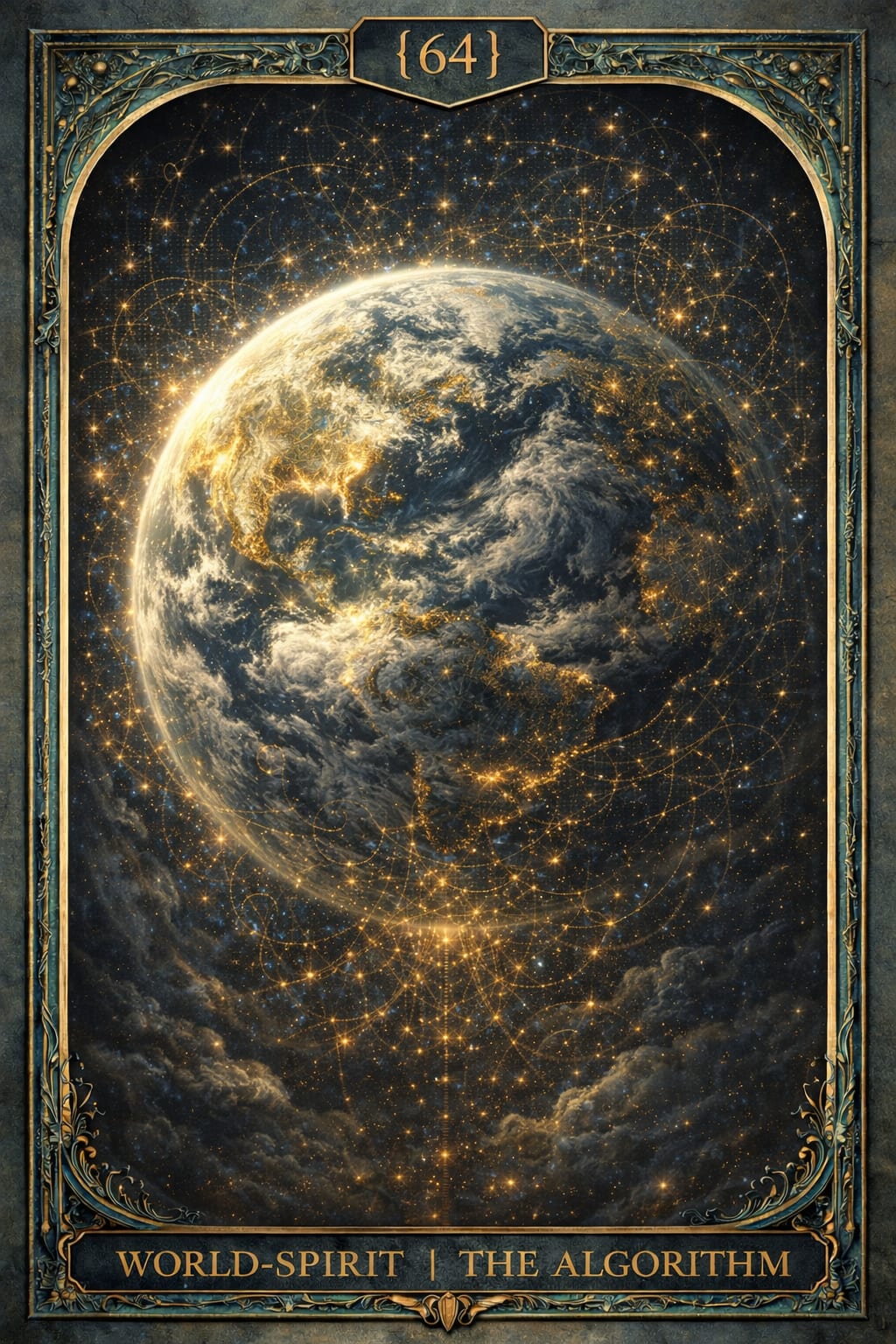
As an archetype, ‘The Algorithm’ represents a modern, techno-mythological force that acts as an invisible, omnipresent mediator of reality, behavior, and knowledge. It symbolises the replacement of human intuition and traditional wisdom with Codified, Automated, and Optimised Patterns of decision-making. It represents a, technocratic creator—a ‘technological demiurge’ that crafts artificial realities (echo chambers|feeds) without human consciousness or understanding, and favours efficiency and engagement (clicks|views) over deep, meaningful, or truthful content.
AT THE QUANTUM LEVEL: {64}
SPIRIT WORLD: {64}
THE EMERALD ISLE: {64}
INCOMPLETION: {64}
Incompletion refers to the state of being unfinished, lacking necessary parts, or not having reached a final, intended Form. Symbolically, it represents the potential for growth, the Ongoing Nature of life, or a Pause in a process rather than a permanent failure. It contrasts with ‘Completion’ or ‘Wholeness,’ Incompletion often evoking feelings of inadequacy, Transition, or anticipation of future fulfilment.
KNOWN AND UNKNOWN: {64}
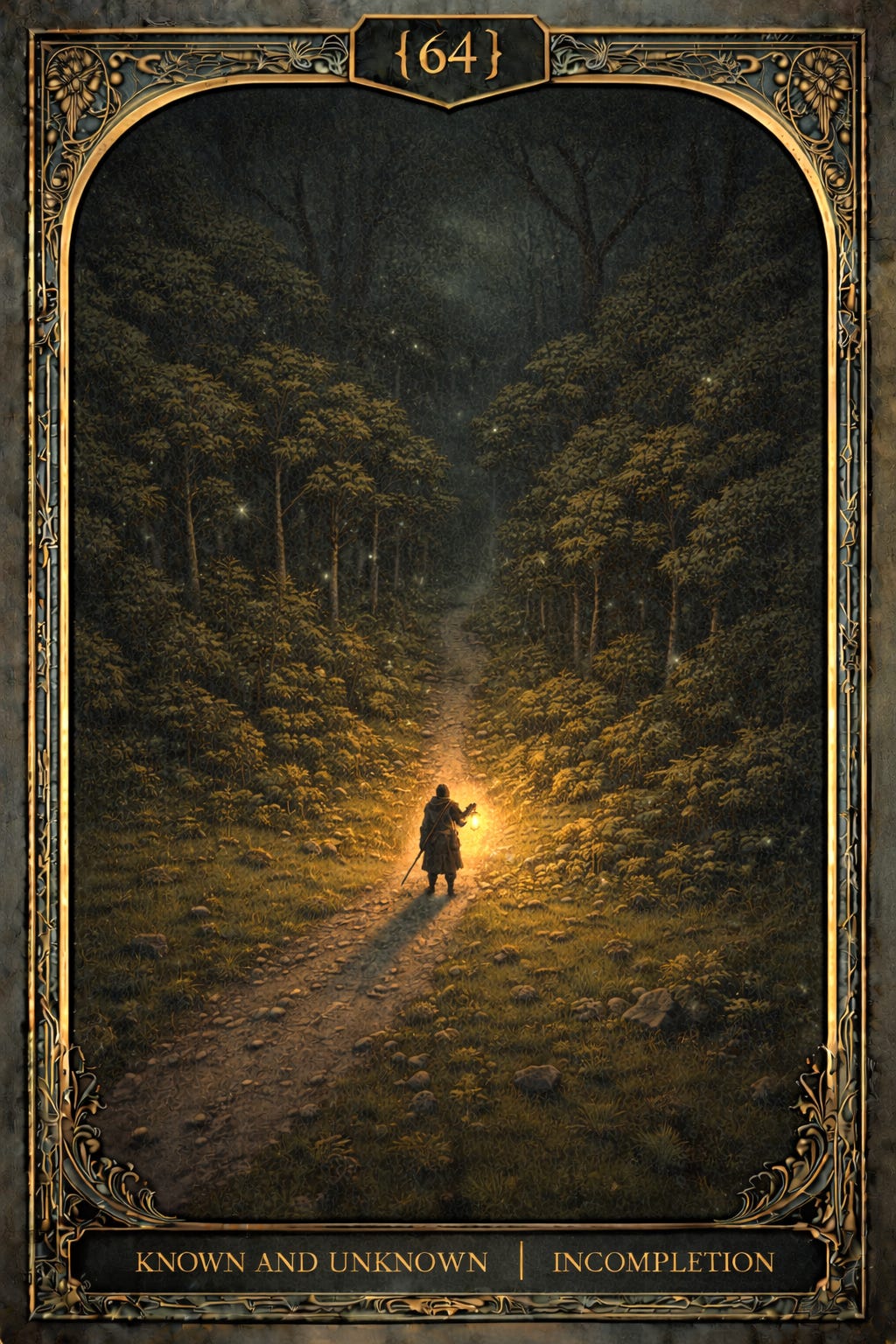
Known And Unknown encompasses a profound duality in human experience, representing the Boundary Between that which is ‘Safe and Familiar’ and the uncharted mysteries of Future Potential. It is frequently used in philosophical, scientific, and strategic contexts to delineate the limitations of human knowledge, and often is seen as a paradox—representing the acknowledgment of one’s ignorance to Initiate Discovery, Exploration, and Further Development.
LOVE OF MY LIFE: {64}
The Foundational English phrase: ‘Love Of My Life’ refers to the person one loves, cherishes, and feels a profound, unparalleled connection with more than any other person. It often symbolises a deep, enduring commitment that Transcends daily affection, representing a ‘before and after’ Point in one’s life. It signifies they who hold the highest place in one’s heart—often encompassing a blend of Deep Friendship, Adventure, Unwavering Support, and Mutual Growth. While traditionally applied to present partners, it may also refer to a love that Endures through time, even if the relationship itself does not.
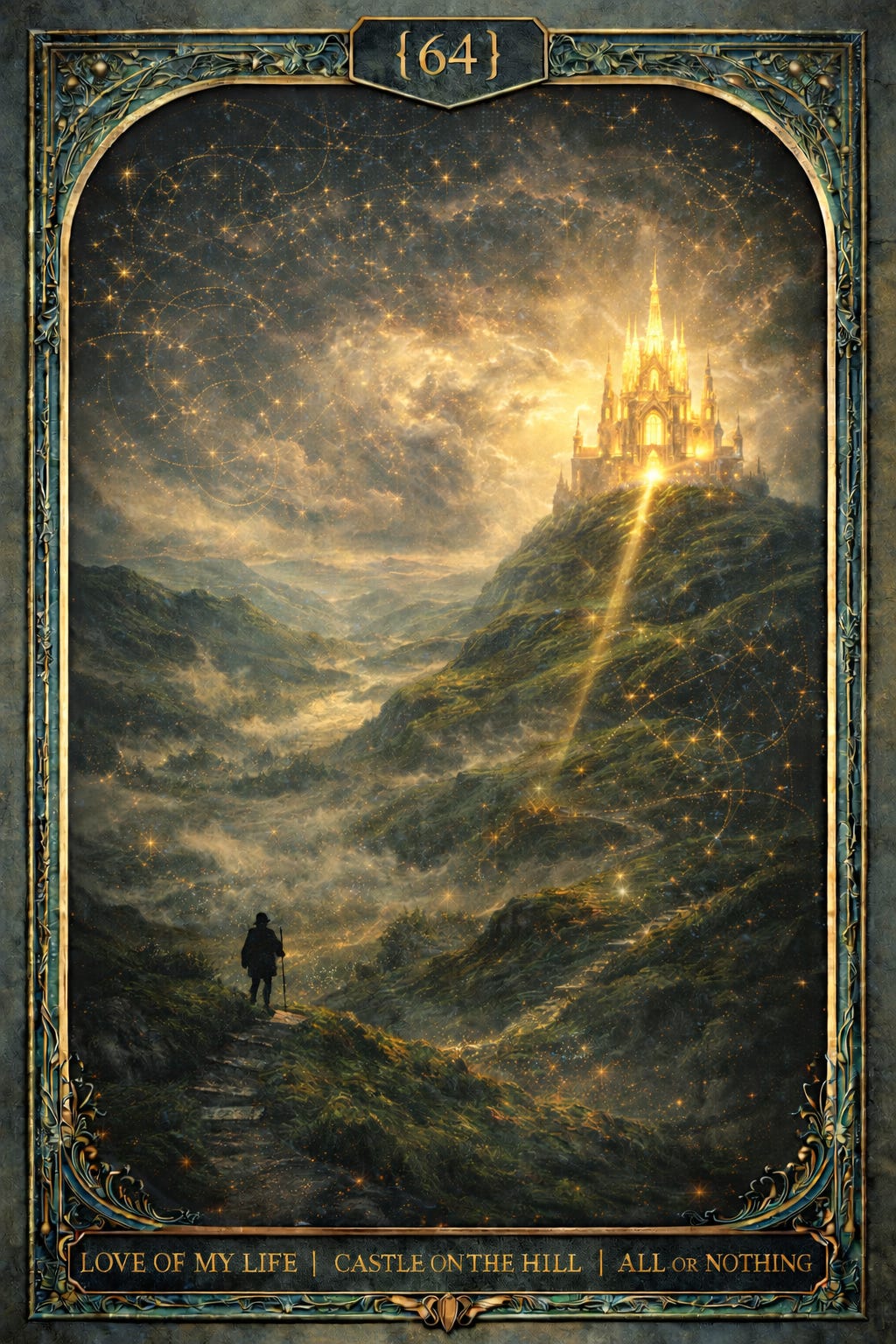
CASTLE ON THE HILL: {64}
The term ‘Castle On The Hill’ carries both specific, literal meaning in pop culture and broader, symbolic interpretations, largely popularised by Ed Sheeran’s 2017 song and its references to his hometown. The ‘Castle’ represents a Focal Point for memories of childhood, representing a time of innocence, freedom, Return, and, in the song, reckless teenage abandon (e.g., smoking|drinking)—the ‘Hill’ symbolising the very Pinnacle of one’s upbringing and the ‘high place’ or significant, cherished memories that Shape an Individual’s life.
ALL OR NOTHING: {64}
All Or Nothing signifies an inflexible, black-and-white approach where only Total Success or Complete Failure exists, with no middle ground or room for compromise—representing extreme perfectionism, high risk, or rigid ultimatums, it represents situations where outcomes are binary, such as a winner-take-all scenario or a 100% Commitment versus Zero effort. All Or Nothing may signify situations like ‘the final battle’ or ‘last-ditch gambit’ where there is no leeway for error, or othertimes a mindset that drives an Individual to either do something perfectly or not at all—leading to potential paralysis.
LIFE’S TOO SHORT: {64}
Often linked to the Latin proverb: Ars longa, vita brevis—’Art Is Long-Lasting, Life Is Short,’ Life’s Too Short is a popular phrase referring to the notion that life is brief, unpredictable, and precious, serving as a call to maximise time, avoid wasting energy on petty grievances, and pursue happiness over drudgery—representing the urgency to live fully, cherish relationships, and overcome fear. ‘Life’s Too Short’ is frequently used to justify letting go of negativity, abandoning unfulfilling situations (like specific careers|relationships), and embracing a more joyful, authentic life.
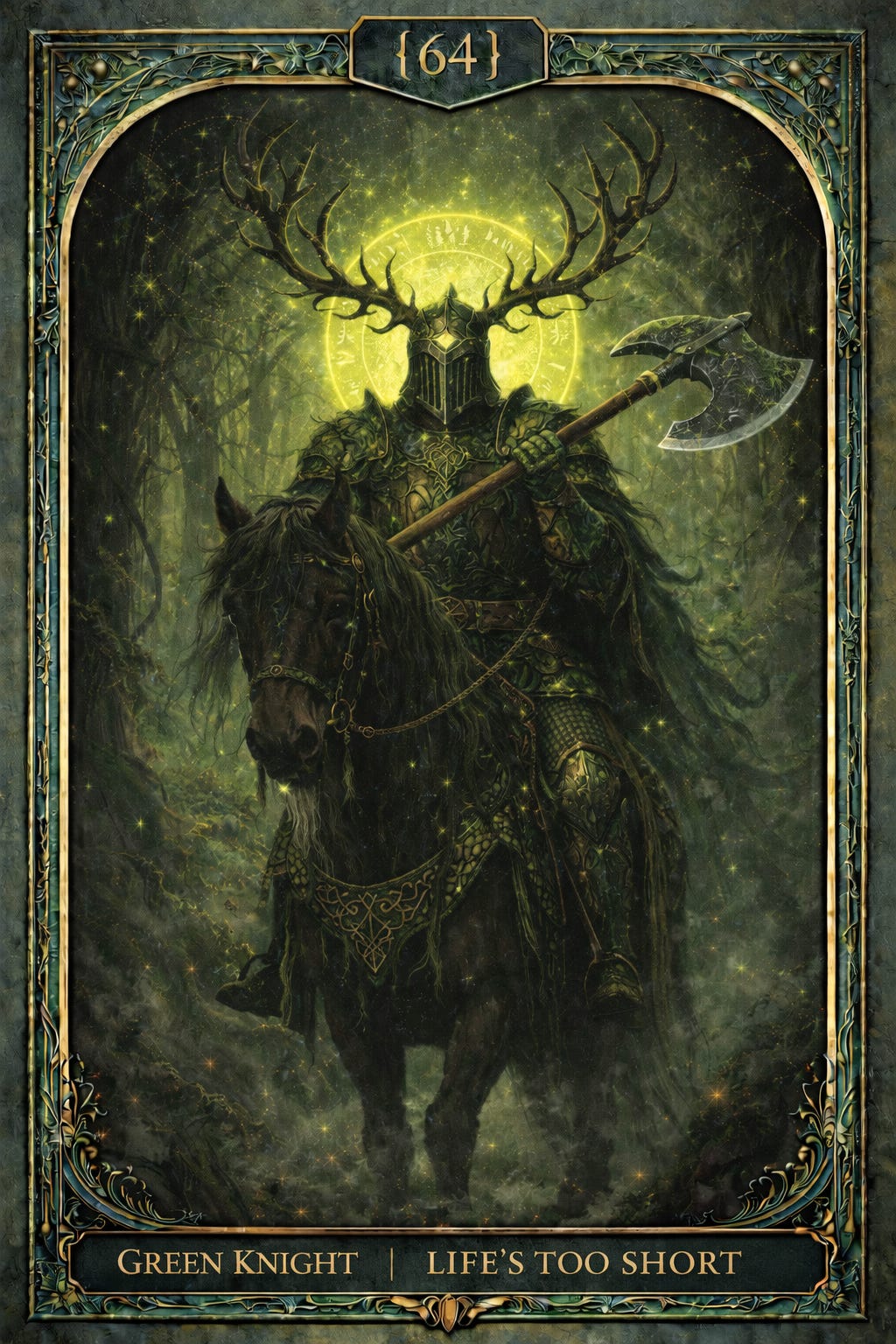
GREEN KNIGHT: {64}
The Green Knight is a central, enigmatic figure from the 14th-century Middle English Arthurian romance: ‘Sir Gawain and the Green Knight’—representing a blend of Nature, Magic, and Moral Testing, and serving as both a formidable challenger to King Arthur’s court and a, judge of knightly virtue. He is commonly interpreted as a ‘Green Man’ figure, symbolising the wilderness, vegetation, and the Cyclic Nature of life and death. He Initiates the plot by inviting a knight to strike him with an axe, on the condition that he returns the blow in a year and a day—highlighting his role as a Tester of courage, loyalty, and truth (trouthe). The Green Knight brings the wild, untamed, and magical world into the Structured Christian, and Civilised world of Camelot—Challenging its limits.
SHERLOCK HOLMES: {64}
ZODIACAL LIGHT: {64}
The Zodiacal Light is a faint, diffuse, triangular white glow visible in the night sky, appearing to extend from the sun’s direction along the zodiac (or ecliptic) shortly after sunset or before sunrise—not a phenomenon of the upper atmosphere, but caused by sunlight reflecting off a massive, flattened cloud of interplanetary dust particles that orbit the Sun within the inner solar system. For many ancient civilisations, the Zodiacal Light was a sign from the gods, symbolising hope, guidance, and a connection to the celestial realm. In Hindu texts, it represents a celestial essence or a ‘mystical phenomenon’ located beyond worldly existence, associated with the light above the head of the cosmic figure Virat. Indigenous Australians historically viewed it as a ‘Dreaming Road’—a celestial path or rope connecting Venus to the Sun. While the Islamic prophet Muhammad used the concept of the zodiacal light to differentiate it from the ‘true dawn’ (the horizontal|red|white light preceding sunrise), referring to it as ‘al-fajr al-kādhib’—the False Dawn.
(Author’s Note): that last point is intriguiding considering The Antichrist’s placement here.
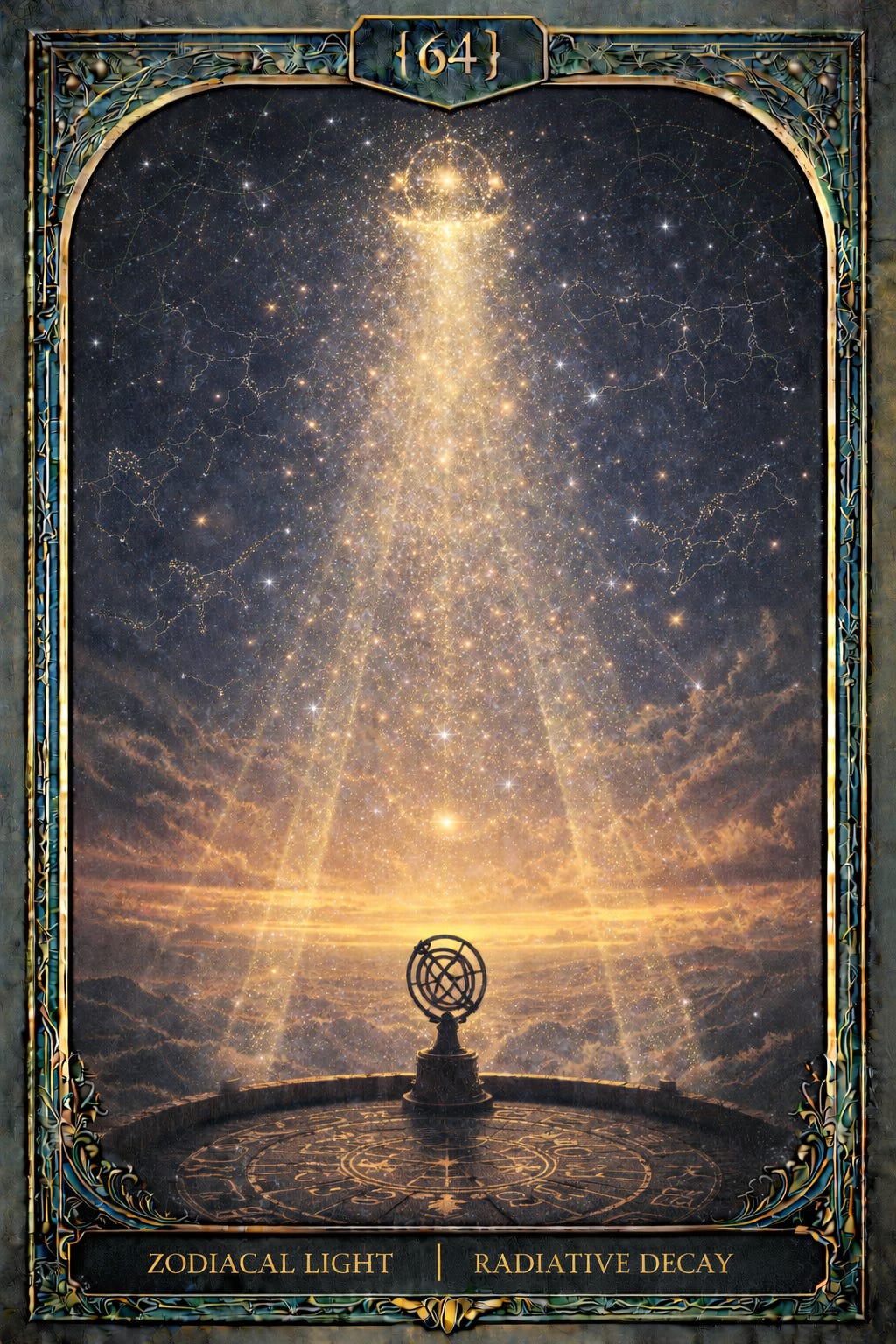
RADIATIVE DECAY: {64}
Radiative Decay refers to the process by which an unstable, excited system (atom|molecule|nucleus) releases excess energy in the form of electromagnetic radiation (photons) to return to a lower energy, more Stable State. It is a Foundational concept in quantum mechanics, nuclear physics, and astrophysics, symbolising the Natural Drive towards Harmony. Just as atoms ‘breathe’ by emitting photons, Radiative Decay is an intrinsic, invisible, and continuous dance of energy that Shapes the Natural World.
SUPERCOMPUTER: {64}
A Supercomputer is defined as a computer—or, more accurately, an assemblage of thousands of computing nodes, that operates at the Maximum Potential Performance available at any given time. Unlike conventional computers that process tasks in sequence, a Supercomputer uses parallel processing to perform quadrillions of calculations per second (measured in Petaflops or Exaflops) to solve extremely complex, data-intensive, or time-sensitive problems. Symbolically, the Supercomputer represents the ‘limit of human computation’, serving as a ‘time machine’ for scientists to explore the past and future of the universe (e.g., simulating galaxy collisions).
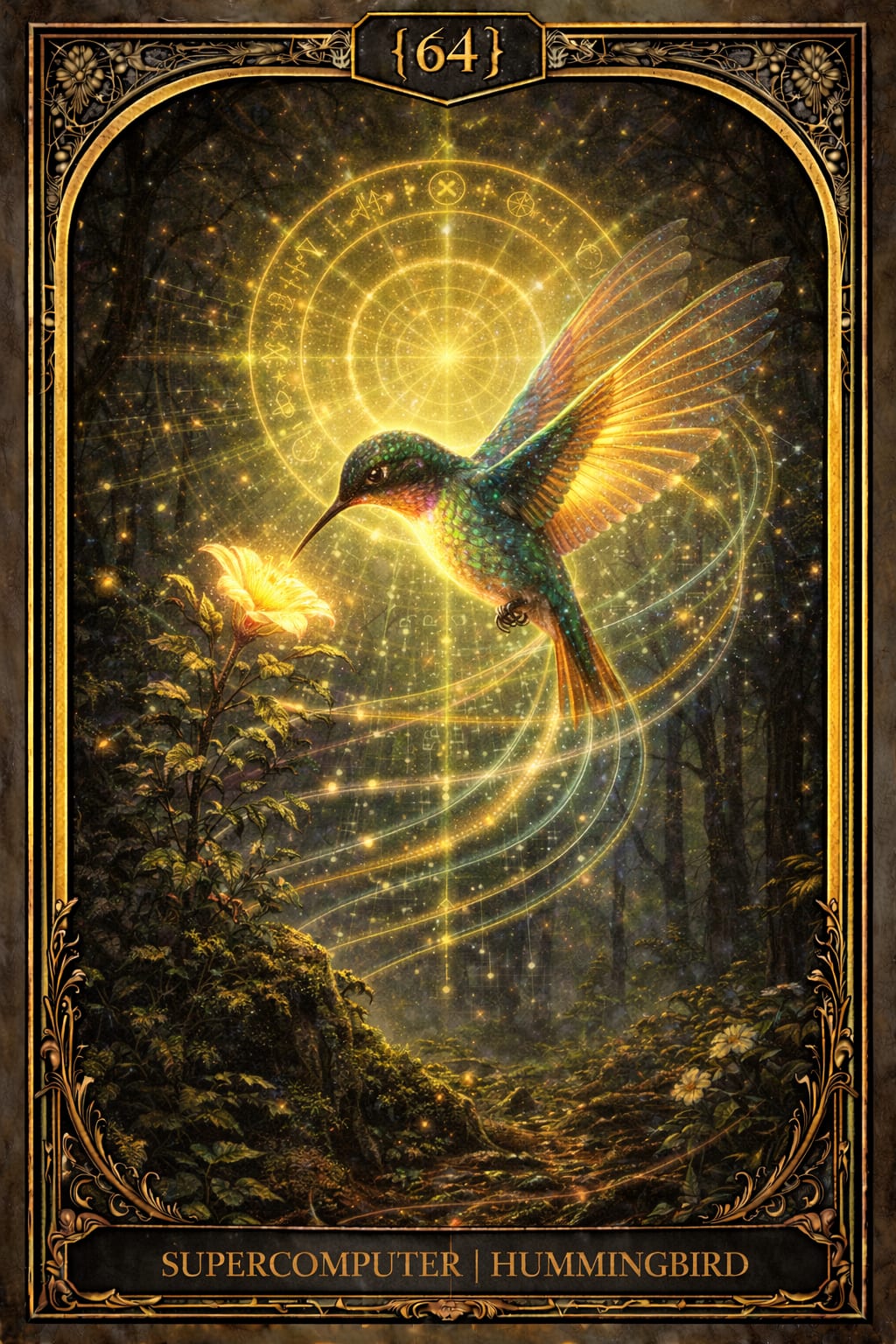
HUMMINGBIRD: {64}
The Hummingbird symbolises joy, Resilience, and the ability to Savour life’s sweetness, and deeply associated with love, romance—often serving as spiritual messengers of love and good fortune. Despite their small size, they have the highest metabolism of any warm-blooded animal—their little hearts beating over 1200 times per minute during flight, signifying Strength, Vitality, and agility, while the ancient Aztecs associated them with Huitzilopochtli, the god of the sun and war, viewed them as courageous, fierce fighters. The Hummingbird is renowned for its extraordinary flight capabilities, specialised metabolism, and unique physical adaptations—the only birds capable of sustained backward and upside-down flight, with brilliant, iridescent feathers produced not by pigment, but the refraction of light.
CHERRY BLOSSOM: {64}
PASSIONFLOWER: {64}
Passionflower refers to a genus of plants (Passiflora) whose name is derived from the ‘Passion of Christ’ in Christian theology, rather than romantic passion. In the 16th and 17th centuries, Spanish missionaries in the Americas identified the flower’s unique, Intricate Structure as a representation of the crucifixion—with early names referencing the five wounds and Christ's thorn, using it as a teaching tool to illustrate the story of Jesus’ final suffering. Due to its calming effects, it is used in herbal medicine for anxiety and insomnia, and associated with Peace in modern spiritual practices.
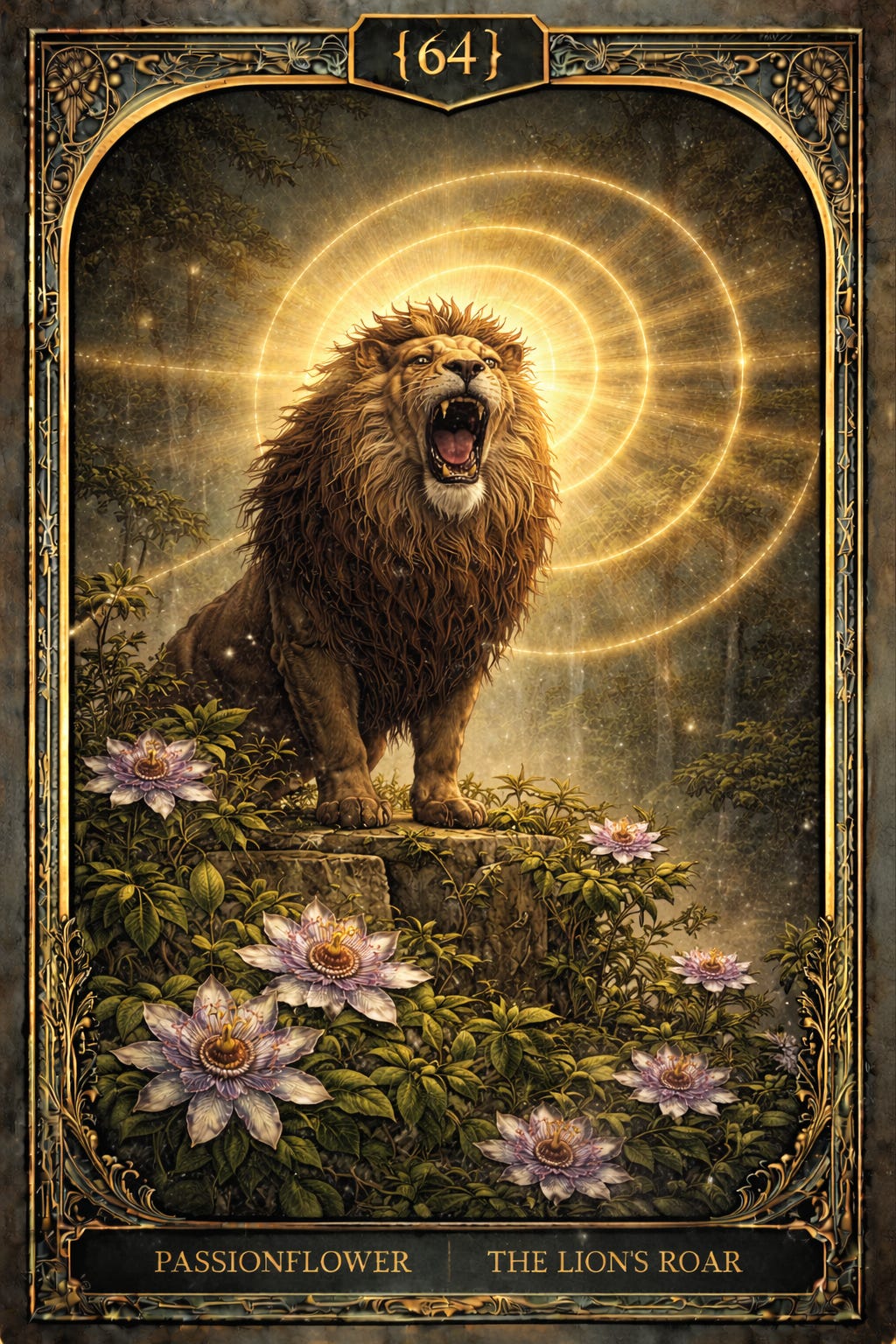
THE LION’S ROAR {64}
The Lion’s Roar, Sanskrit: simhanāda, is a powerful symbol used across various cultures and spiritual traditions to signify a fearless, authoritative, and truth-telling proclamation—the ultimate expression of confidence used to pierce through delusion, establish dominance, or pronounce a divine message. In Mahayana Buddhism, The Lion's Roar is metaphor for the Buddha’s bold declaration of the Dharma (teachings) and enlightenment. It signifies an announcement so profound and true it cannot be challenged or defeated, often compared to a ‘thunderclap in the dark’ that wakes people up. While in the Bible, it is associated with the voice of God, symbolising irresistible judgment, power, and divine sovereignty, as mentioned in Amos 3:8, ‘The lion has roared—who will not fear?.’ Symbolically, it represents the courage to Confront one's deepest fears, the Reclaiming of personal power, and the Audacity to speak one's truth without apology.
ROD OF ASCLEPIUS: {64}
GADOLINIUM: ATOMIC ELEMENT {64}
Gadolinium (Gd) is a silvery-white, rare-earth metal with atomic number {64}, known for its exceptional magnetic and neutron-absorbing properties. Discovered in 1880 by Jean Charles Galissard de Marignac and isolated later, it is named after the mineral gadolinite, which honors Finnish chemist Johan Gadolin. The most common use of Gadolinium is as an intravenous Contrast Agent in Magnetic Resonance Imaging (MRI). The Gd³⁺ ion is highly paramagnetic, meaning it Enhances the Contrast between normal and abnormal tissues (tumors|inflammation) by altering the relaxation times of water molecules in the body. Gadolinium has the Highest thermal neutron capture cross-section of any known natural element—making it vital for nuclear reactor Control rods and Shielding.
The Linguistic Hinge: SIXTY-FOUR

{49}: Foundation|Structure: {4} crossing {+} into {9}: Universal Wisdom|Completion resolving to {13}: Initiation|Unity: {1} crossing {+} into Creation|Expression: {3} resolving to {4}: Foundation|Structure—the Frequency of THE MOTHER|THE HUNTRESS|THIRD EYE|TRANSITION|ENLIGHTEN and INTEGRATED.
(Author’s Note): Intriguing that The True Son shares a frequency with The Father, while The Antichrist is connected to The Mother via the hidden Linguistic Hinge.